Bangladesh's FY27 Budget Bets on Gas
A strategic pivot towards energy security amid budget cuts
Model Diplomat8 min readSouth Asia
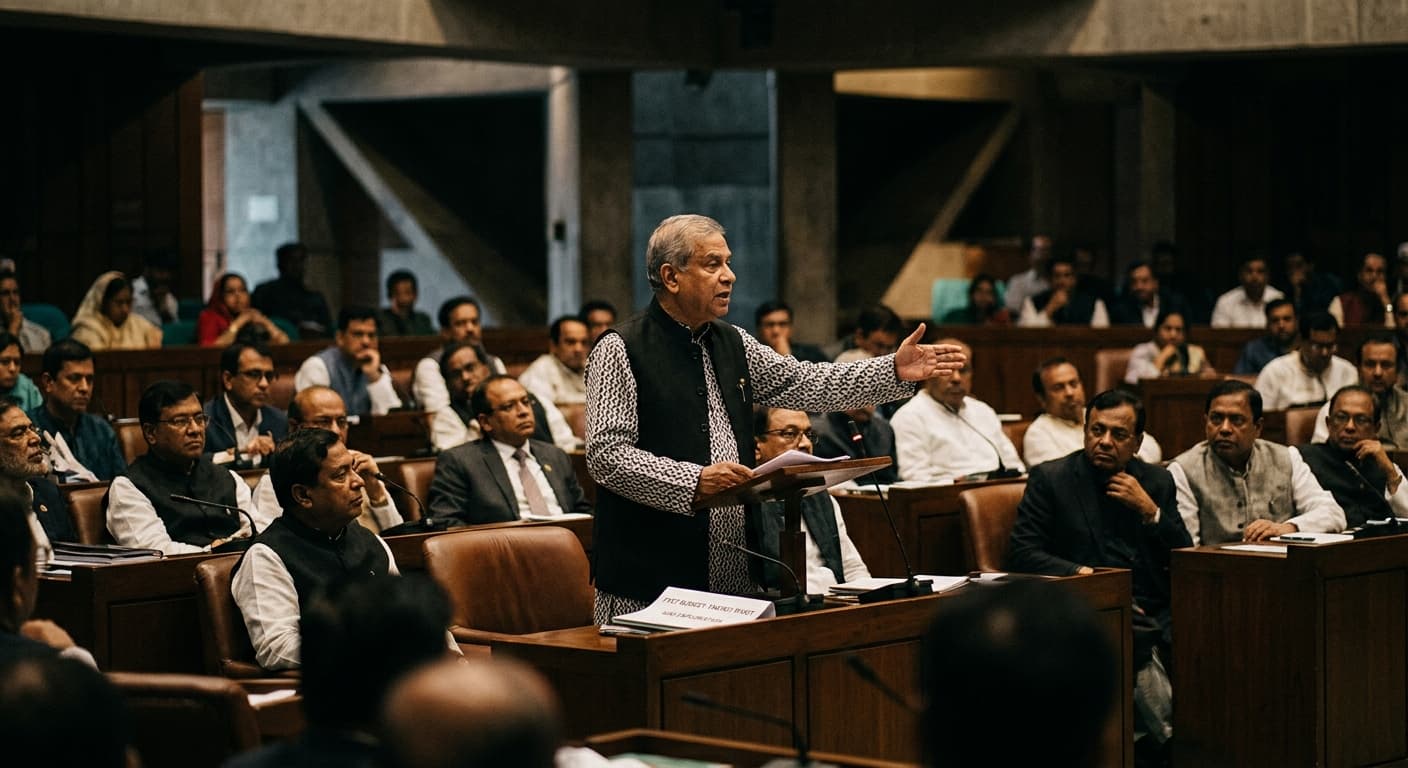
Bangladesh's FY27 budget quietly bets its energy future on gas
Dhaka cut the energy budget 23% but rebranded it "energy security" — a Hormuz-shocked pivot that sidelines renewables and its own NDC 3.0 climate pledge.
Bangladesh's FY27 budget, tabled on June 11, 2026 by Finance Minister Amir Khosru Mahmud Chowdhury, allocates Tk 17,345 crore to power and energy — a 23% cut from the previous year — yet is being sold in Dhaka as a "strategic shift towards energy security." The paradox is the story: the cut is not austerity but a forced rebalancing after the Strait of Hormuz shock blew a Tk 36,418-crore hole in the LNG import bill and made the old subsidise-and-import model unaffordable. Dhaka's answer is to double down on domestic gas exploration, nuclear commissioning at Rooppur and offshore bidding — a fossil-heavy pivot that quietly walks back the renewable ambitions Bangladesh filed with the UNFCCC only nine months earlier under NDC 3.0.
The Hormuz shock rewrote the budget before it was written
The FY27 budget is the first from the BNP government that took office on February 12, 2026 after the post-uprising elections. Two weeks later, on February 28, US and Israeli strikes on Iran triggered what the Atlantic Council calls "the largest energy market disruption in history," with traffic through the Strait of Hormuz dropping 86% and roughly 700 ships idled on either side, according to Al Jazeera's coverage of the QatarEnergy production halt.
For a country that imports 95% of its petroleum and roughly a third of its gas as LNG, the exposure was terminal. The Centre for Policy Dialogue's Q1 2026 sector brief documents that 14 LNG cargoes and eight scheduled oil vessels carrying 385,000 tonnes failed to arrive in the first month. Petrobangla's LNG bill, originally budgeted at Tk 60,582 crore for FY26, ballooned to a projected Tk 97,000 crore — a Tk 36,418-crore overrun that alone exceeds the entire FY27 sectoral allocation.
That is the fiscal fact that reshaped everything. On May 27, 2026, Al Jazeera reported that Dhaka was seeking $2 billion in emergency loans, with the World Bank approving a $350 million IDA-backed payment guarantee to keep Petrobangla's LNG procurement solvent. The
World Bank project document is unusually blunt: gas demand runs 20–25% above supply, 19% of national generation capacity is unavailable at peak, and the ready-made garment sector — 80% of exports — is being throttled by gas curtailment.
The BNP finance ministry did not choose energy security as a slogan. It chose it because the alternative was insolvency.
What the "shift" actually funds
Read past the framing and the FY27 allocation is a barely-disguised triage. According to The Daily Star's line-item analysis, the Tk 17,345 crore is split between a sharply reduced power subsidy — reflecting BPDB's cleared arrears with Adani and lower capacity payments — and a markedly higher gas-sector envelope aimed at exploration, LNG terminal expansion and strategic reserves.
The Centre for Policy Dialogue's FY27 budget analysis shows the internal composition more clearly. The Rooppur Nuclear Power Plant alone accounts for 47.4% of the entire power and energy Annual Development Programme allocation. Fossil-fuel-based projects continue to absorb roughly 79% of sectoral spending; renewable energy projects remain stuck at about 5%, unchanged from the revised FY26 figures. The government's own
FY27 budget document, titled Journey Towards a Democratic, Humane and Inclusive Economy, lists domestic gas exploration, offshore bidding, refinery expansion and strategic reserves as top-line priorities.
Three concrete moves anchor the pivot:
- Offshore acceleration. The 2024 offshore bidding round, offering 24 Bay of Bengal blocks under improved production-sharing contract terms, is being kept alive despite the Chevron dispute at ICSID (Case No. ARB/24/39), where the tribunal issued Procedural Order No. 3 on June 12, 2026. The BNP government has signalled it will re-tender un-awarded deepwater blocks in late 2026.
- Domestic drilling. The FY26 budget had already earmarked Tk 1,098 crore for gas-well drilling, with 17 wells planned. FY27 builds on that with additional exploration surveys and prepaid metering, per the
CPD FY2025-26 sectoral presentation.
- Nuclear stretch. Rosatom continues to target first power at Rooppur Unit 1 in 2026, per the
CSIS analysis of Russian nuclear exports, with loan repayments now routed through a Bangladeshi taka account after sanctions on Russian banks broke the original SWIFT-based mechanism.
None of these moves is renewable. All of them are gas or fission. That is not accidental.
The renewable losers, and the NDC that was quietly downgraded
The angle most Dhaka commentary misses: Bangladesh filed NDC 3.0 with the UNFCCC on September 29, 2025, extending its climate horizon to 2035 with a headline 20.3% emissions cut from business-as-usual. The energy sector target — 26.46% by 2035 — is the linchpin. And 80% of it is conditional on international finance that has not materialised, an implementation gap the CPD estimates at $90.23 billion over a decade.
The FY27 budget makes the gap wider. CPD Research Director Khondaker Golam Moazzem's June 7, 2026 briefing on fiscal discrimination documents the mechanics. LNG imports carry a total tax incidence of just 9.5%, thanks to zero VAT and 2% advance income tax. Lithium-ion batteries face 61.8%. Storage batteries, grid components and EVs face over 93%. The National Board of Revenue is forgoing an estimated Tk 1,059–1,293 crore in revenue by favouring LNG-based businesses over solar and wind equivalents.
In other words, the fiscal architecture is now actively cheaper for fossil imports than for the renewable build-out the NDC promises. Moazzem and Helen Mashiyat Preoty have already flagged that NDC 3.0 quietly weakened the power sector target — the combined 2035 mitigation target for energy is lower in absolute terms than the 2030 target in NDC 2.0. The FY27 budget is now consistent with that weaker ambition, not with the country's Paris commitments.
Bangladesh's renewable share of generation is currently around 5%, per CPD's road-to-COP30 consultation. Hitting the 25% NDC target by 2035 would require roughly 35,700 MW of installed renewable capacity and USD 18–24 billion in fresh investment. On current fiscal trajectory, it is not going to happen.
The regional geometry: who benefits from Dhaka's gas pivot
This is where the story moves from budget line to geopolitics. A gas-led energy-security strategy in the Bay of Bengal has four external beneficiaries, and one clear loser.
India is the quiet winner. Its ONGC Videsh–Oil India consortium already holds shallow-water Blocks SS-04 and SS-09 off Maheshkhali under a 2014 PSC, per the Indian government's Press Information Bureau. A Bangladesh that needs offshore capital and drilling capacity has few politically palatable options besides Indian majors, US supermajors and QatarEnergy. The
Observer Research Foundation argues that the fuel crisis is already forcing the Tarique Rahman administration to rekindle diesel-pipeline and grid-connectivity ties with New Delhi that had frayed under the interim government.
Russia locks in a two-decade nuclear-services relationship if Rooppur commissions on schedule. The OSW Centre for Eastern Studies notes that Rooppur's yuan-denominated loan mechanism, routed through China's CIPS system, is now a template Rosatom is exporting elsewhere — meaning Dhaka's energy pivot also cements a workaround to Western sanctions architecture.
Qatar and the UAE retain their LNG grip through long-term contracts that Petrobangla cannot walk away from without collapsing baseload generation.
The United States and the IOCs are the wild card. The Chevron ICSID case remains unresolved, and how Dhaka handles it will signal to majors whether the 2024 offshore round is investible.
The loser is Bangladesh's climate credibility, and by extension its access to concessional climate finance — a point EU Delegation representative Tanzina Dilshad made bluntly at the CPD dialogue in August 2025: if industries fail to adopt clean energy, buyers will shift orders to India and Vietnam. The RMG sector — the country's economic lifeline — is now caught between a gas-dependent grid and European buyers with tightening scope-3 emissions requirements under CBAM-adjacent frameworks.
For context on the neighbourhood — a Bangladesh that stakes its energy future on Bay of Bengal hydrocarbons is a Bangladesh whose foreign policy tilts more visibly towards India, the Gulf and Russia than towards Western climate donors.
What to watch next
Three catalysts will determine whether the FY27 pivot delivers or unravels:
- Rooppur Unit 1 grid synchronisation, expected in the second half of 2026. A slip pushes the 47.4% ADP allocation into another fiscal year without generation, blowing a hole in load projections.
- Deepwater block awards from the 2024 offshore round, with the BNP government signalling re-tender by end-2026. Watch for ExxonMobil, ONGC and QatarEnergy interest.
- COP30 outcomes and the January 2027 IMF Article IV review. If concessional climate finance does not flow and the IMF conditions its next tranche on subsidy reform, the gas-heavy fiscal architecture will face pressure from both directions.
Diplomat View
Bangladesh's FY27 budget is being read in Dhaka as a strategic pivot. It is more accurately a fiscal capitulation dressed as strategy. The 23% headline cut is not a shift towards efficiency; it is the government admitting it can no longer subsidise the volumes of LNG the grid actually needs, and betting instead that domestic gas, offshore drilling and Rooppur will close the gap before the next Hormuz-scale shock. The forecast: on current fiscal architecture, Bangladesh will miss the NDC 3.0 renewable target by a wide margin, and its climate-vulnerability leverage at COP30 will collide with the fossil bias visible in every line of the FY27 tax code. The call would change if two things happen — a commercial-scale offshore gas discovery in one of the 24 Bay of Bengal blocks before end-2027, and a hard fiscal wedge (through NBR reform) between LNG and renewables. Neither is likely without external pressure. Watch the IMF, not the finance ministry.
The Bottom Line
Bangladesh's FY27 budget marks a shift towards energy security only in the narrow sense that it prioritises supply continuity over subsidy sustainability — the deeper pivot is towards domestic gas, nuclear and offshore hydrocarbons at the direct expense of the renewable trajectory the country promised the UNFCCC nine months ago. The winners are Indian, Russian and Gulf energy incumbents; the loser is Bangladesh's own NDC 3.0 and its claim on concessional climate finance. If Rooppur commissions and the offshore round attracts a supermajor, the gamble pays off. If either falters, Dhaka will find itself locked into fossil dependence with a weakened climate case for the finance that could have funded the alternative.
Discover more
International Relations
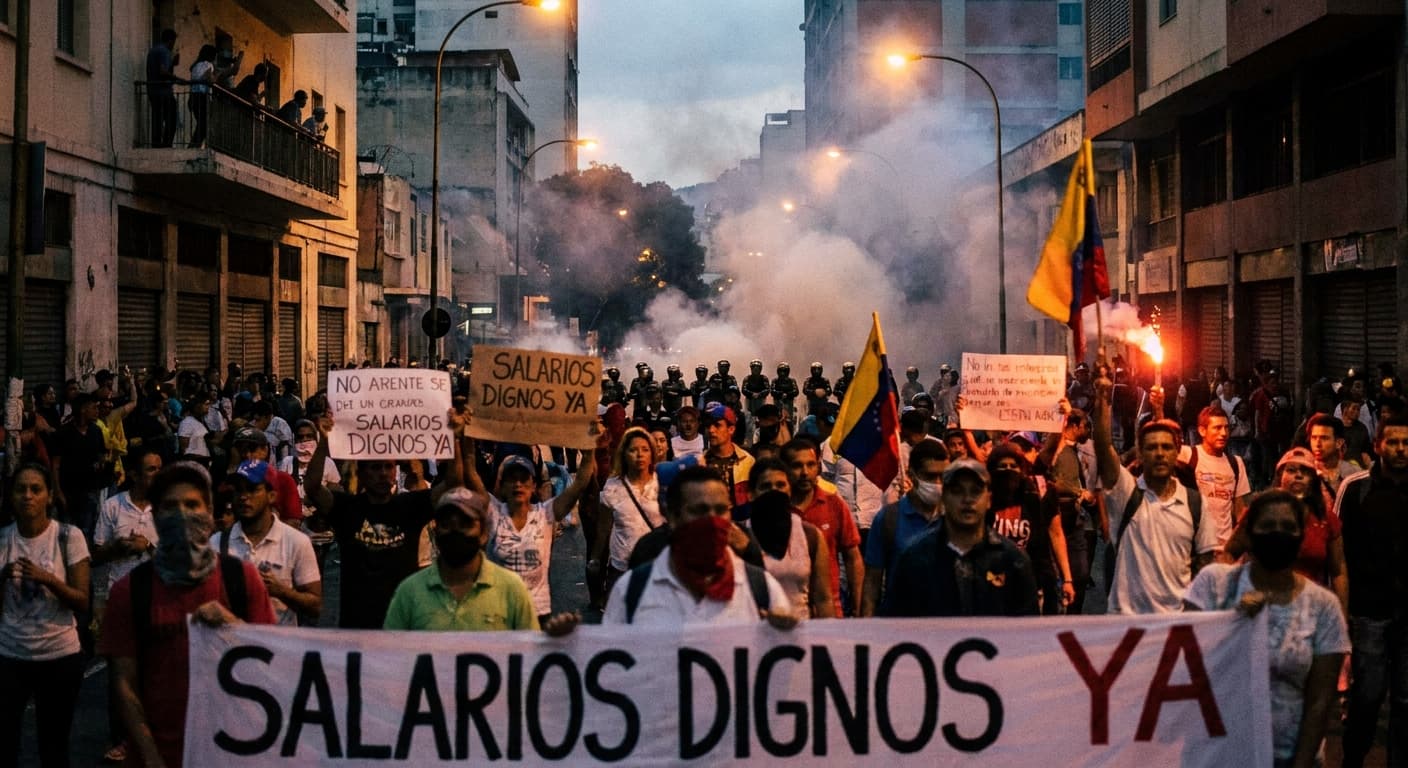
Venezuela Protests Demand Economic Reforms
Protests across Venezuela spotlighted deepening economic hardship under Maduro as workers demanded higher wages and pensions amid growing public discontent.
US Politics
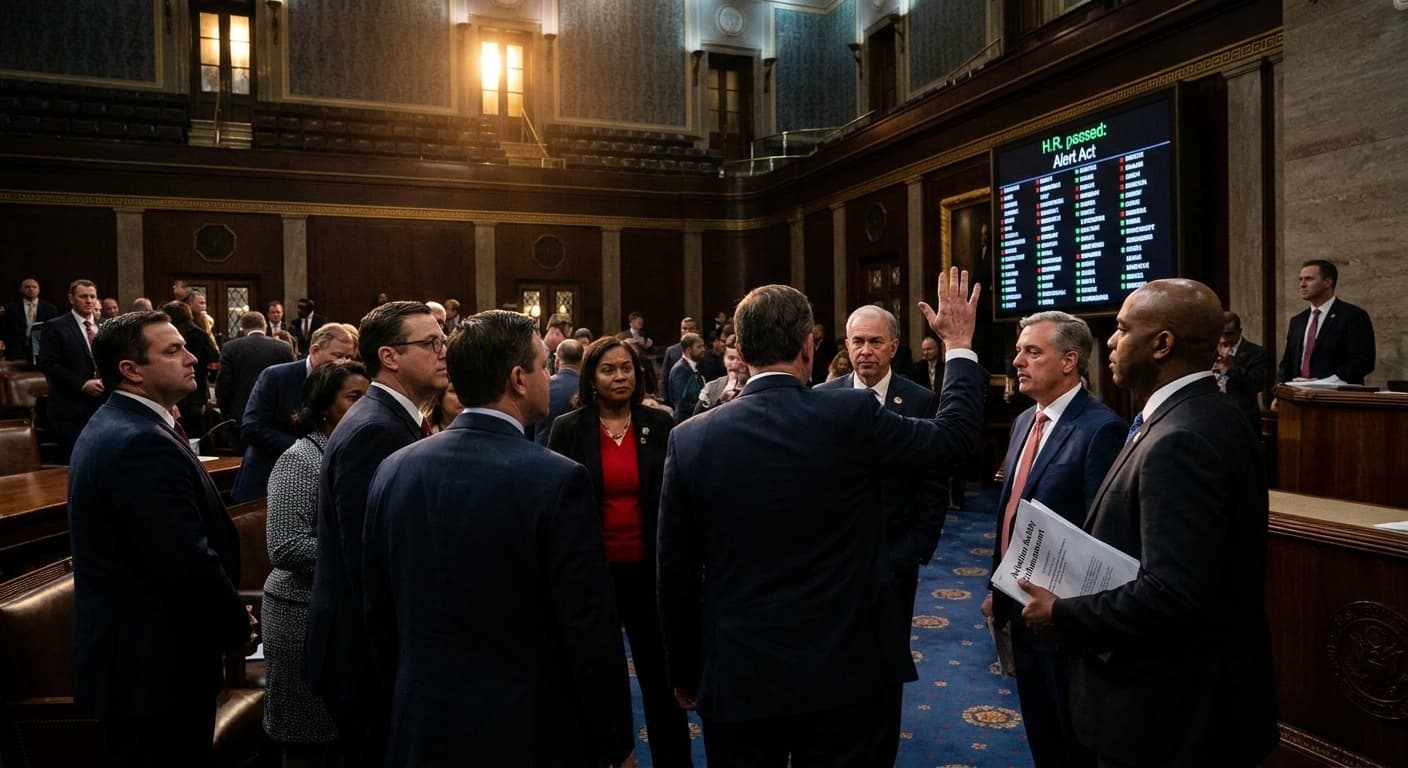
U.S. House Passes Alert Act for Aviation
The House passed the ALERT Act 396–10, replacing the ROTOR Act after Pentagon intervention, impacting aviation safety regulations.

International Relations
U.S.–Iran Peace Deal
A narrow US-Iran deal on nuclear and regional issues could reshape Middle East diplomacy, offering a pragmatic path forward despite grand bargain obstacles.

Conflict & Security
Drone Warfare Killing Aid Workers at Unprec
Over 1,000 humanitarian workers killed in three years as cheap armed drones collapse legal protections. Gaza, Sudan, Ukraine, and DRC see deliberate targeting of aid convoys and hospitals with zero prosecutions.