ASML's €200 Billion Warning on Exports
Export controls threaten ASML's AI chip business.
Model Diplomat7 min readEurope
ASML's €200 Billion Warning: Export Controls Meet the AI Trade
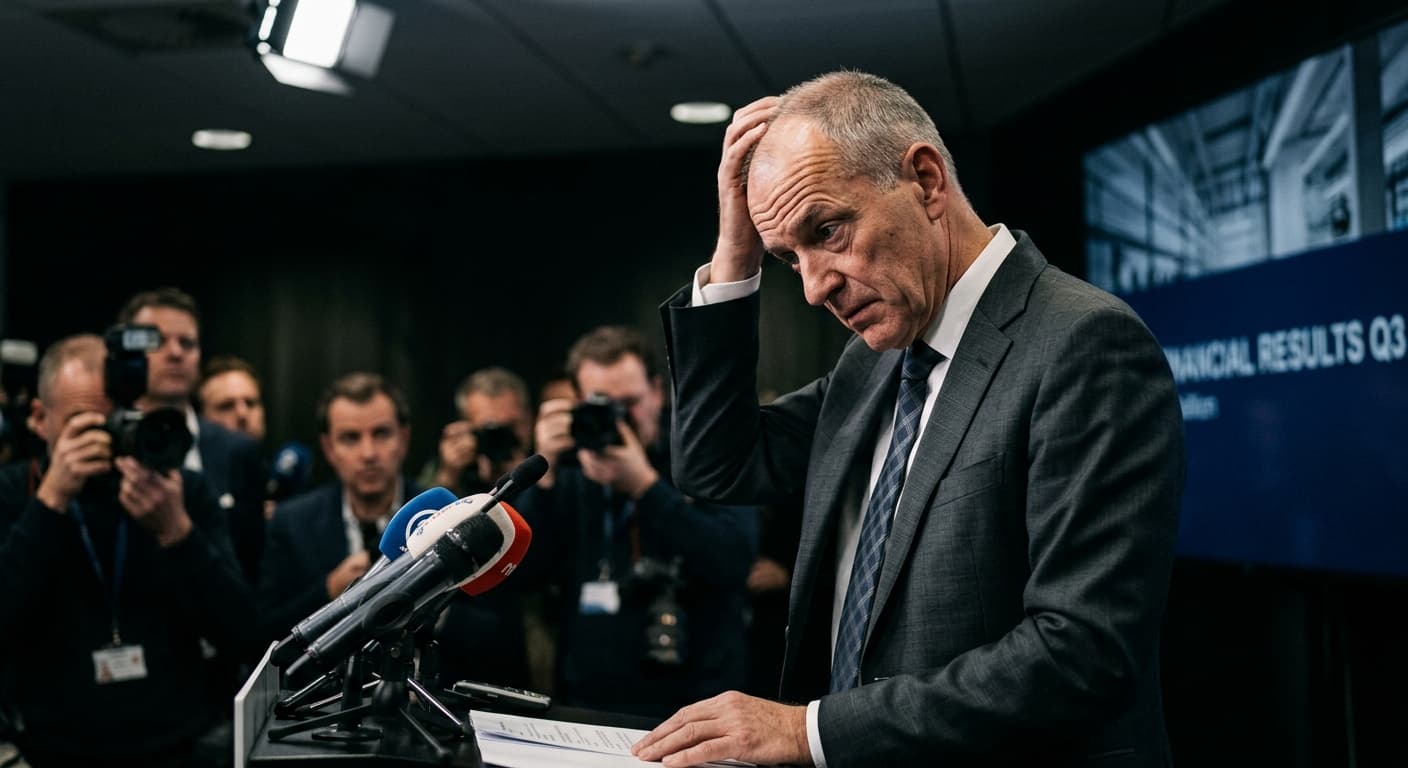
ASML shares fell 12% in a week as export controls, an AI-sentiment rotation and a widening DUV loophole reset the market's view of Europe's most valuable tech company.
The Dutch monopolist whose machines print every advanced AI chip on Earth lost more than an eighth of its market value between June 30 and July 7, 2026 — not because demand collapsed, but because investors finally priced in what Washington and The Hague have been quietly imposing since 2022: ASML's China business is a wasting asset, and the AI revenue meant to replace it is now hostage to the same policy machinery. That is the story behind the slide, and it matters more than the ticker: a company Brussels has bet on as its industrial champion is being squeezed between a US–Dutch export regime that keeps tightening, a Chinese customer base that keeps buying older tools to circumvent it, and an AI capex cycle whose bulls are, for the first time in eighteen months, blinking.
The slide, in specifics
ASML closed at €1,535.60 on Tuesday, July 7, down 3.78% on the session and off 12.2% from the all-time high of €1,748 reached on June 30, according to trading data compiled by NewsCase. The July 7 print alone was a 5.08% intraday drop, per
TradingKey, and it dragged the broader European technology-equipment sector down 3.82%.
The proximate trigger was Samsung Electronics. Its preliminary second-quarter guidance projected an operating profit of ₩89.4 trillion (roughly $58.4 billion) — an 1,800% year-on-year jump driven by AI memory demand, as the BBC reported. Yet Samsung's own Seoul-listed shares fell almost 7% on the print because bulls had priced in more, and the disappointment rippled through every semiconductor name whose valuation now depends on the AI trade accelerating rather than merely continuing. ASML, by virtue of its concentrated exposure to the same customers, took the beating.
That is the surface. The deeper reason the stock is trading like a policy asset — not an industrial one — is on record in the Financial Times, which has catalogued in recent months a company navigating tariff uncertainty, retrofitted Chinese lithography tools, and a CEO warning Brussels not to "direct" European chip supplies.
The policy vise: Washington tightens, The Hague follows
The regulatory pressure on ASML is not new, but its trajectory is. Since October 2022, the US Bureau of Industry and Security has layered rules — foreign direct product rule extensions, entity list expansions, country-wide controls for high-bandwidth memory — on top of the original chip-and-SME package documented in a Congressional Research Service report by Karen M. Sutter. In 2024, the FDPR was extended to semiconductor manufacturing equipment itself, restrictions were added on 16 Chinese entities, and the
US Government Accountability Office confirmed that BIS had moved to formal, enforceable rules covering EUV and DUV tools.
The Netherlands has moved in parallel. The original national licensing regime for advanced semiconductor manufacturing equipment took effect September 1, 2023, published in the Staatscourant. It was expanded on September 7, 2024, and again on April 1, 2025, when Trade Minister Reinette Klever brought metrology and inspection tools under license. The Dutch government stated on
Rijksoverheid.nl that "security interests take precedence over economic interests."
The most consequential step is the quietest. On November 15, 2025, the Dutch national regime was partially folded into the EU dual-use regulation through a European Commission delegated act — meaning ASML's export perimeter is now enforceable at EU level, not merely by The Hague. That is a structural change: it makes the controls harder to unwind and removes any lingering hope in Veldhoven that a Dutch government under commercial pressure could quietly narrow the annex.
What actually breaks the bull case: the DUV loophole is closing
Bulls have long argued that even under controls, ASML's Chinese revenue was durable because deep-ultraviolet immersion (DUVi) tools — one generation behind EUV — remained largely licensable. That premise is now under sustained attack from the think tanks that write US policy.
An April 2026 American Enterprise Institute report by Ryan Fedasiuk and Julia Torres documents that Chinese entities accounted for 70% of ASML's DUVi shipments in 2024, worth roughly $5–7 billion, with total ASML sales to China that year near $12 billion — more than a third of company revenue. SMIC and Huawei, the report argues, are already using those machines with multi-patterning to fabricate 7-nanometer AI chips, and are testing 5nm. The policy recommendation is explicit: capability-based controls, a country-wide presumption of denial for lithography exports to China, and — critically for ASML's installed-base revenue — restrictions on the company's servicing of DUVi machines already in Chinese fabs.
CNAS has published a similar prescription.
If enacted, this would sever not just future sales but the recurring services revenue that management has been marketing to investors as its most defensible line. ASML has guided €44–60 billion in annual sales by decade's end with gross margins of 56–60%, per its own investor materials cited by Ranzware. Those margins assume an installed base that keeps generating fees. Cut the China service book and the model does not merely miss — it re-rates.
The competition question: overstated, but no longer irrelevant
The AktienSensor summary flags rising competitive pressure from Applied Materials and Lam Research. That framing needs calibration. Neither firm competes with ASML in EUV; both compete in adjacent process steps — deposition, etch, metrology — where ASML has always shared the fab. What has changed is that Chinese domestic suppliers are gaining share below the leading edge.
A September 2025 CSIS strategic technologies blog is blunt about the actual gap: Shanghai Micro Electronics Equipment, China's leading domestic lithography firm, holds only about 4% of the global i-line market and has no meaningful DUV product at ASML's leading nodes; Huawei-linked Shenzhen SiCarrier Technologies is developing 28nm-class systems. That is not a rival to EUV. It is, however, a rival for the older-node capacity that has quietly become ASML's political-risk buffer. If SMEE and SiCarrier absorb Chinese demand for legacy tools while Dutch and EU controls block sales of newer ones, ASML loses the geographic diversification that made its China exposure look manageable.
The RAND Corporation's forecasting exercise on China's lithography indigenisation gives the base case: EUV parity remains improbable by 2030; DUV parity is plausible.
The AI-sentiment overlay
The macro backdrop is doing ASML no favours. On June 8, 2026, Asian markets sold off hard on Iran–Israel escalation and Federal Reserve rate fears, with KOSPI triggering circuit breakers and the Nasdaq posting its worst day since April 2025, Al Jazeera reported. The AI cohort has since traded on a hair trigger. When Samsung's blowout earnings still weren't enough this week, the market signal was unambiguous: the AI trade needs more than confirmation to keep going up. Expectations have run ahead of even record fundamentals.
For ASML specifically, the January 2026 story — €13.2 billion in Q4 bookings, full-year guidance raised to €34–39 billion, as Al Jazeera reported — is already discounted. What matters now is Q2, due later this month, and whether CEO Christophe Fouquet can defend the medium-term China assumption without a fresh policy shock.
Where ASML is playing offense
Two moves deserve attention. First, the May 17, 2026 Tata Electronics agreement to supply the $11 billion Dholera fab, signed during Prime Minister Narendra Modi's Netherlands visit, opens an India channel that is politically insulated from US–China dynamics. Second, the €1.3 billion Mistral deal flagged by the FT positions ASML inside the European AI stack, which matters for Brussels' industrial-policy calculus and for any future EU carve-outs. Fouquet told
The Economist in March 2025, and repeated in June, that "European champions could move elsewhere if they are not better protected."
That is a warning shot. It is also, functionally, a lobbying position ahead of the next round of Dutch and EU controls.
Diplomat View
The market is not mispricing ASML — it is finally pricing it correctly. For three years, investors treated the company as a monopolist whose China exposure was a legal question with a commercial answer. It is now a commercial question with a legal answer, and the legal answer is trending in one direction. Expect the July Q2 report to confirm resilient EUV bookings while management downplays China servicing risk. That downplay becomes untenable if BIS follows the AEI blueprint on capability-based controls — which we assess as more likely than not within twelve months, given bipartisan pressure documented in the CRS report. The forecast that would need revision: any move by the incoming Dutch coalition to soften the November 15, 2025 EU harmonisation, or a formal US–China chip diplomatic settlement that ring-fences ASML servicing. Absent those, the correct read on this week's slide is not "buy the dip" — it is "the terminal multiple was too high."
What to watch next
- ASML Q2 2026 earnings (mid-July 2026): management commentary on China servicing revenue and 2026 guidance range is the single most market-moving disclosure of the quarter.
- US BIS rulemaking cycle: any move to adopt capability-based lithography controls or restrict ASML servicing of installed Chinese DUVi tools would validate the AEI/CNAS policy track.
- Dutch coalition politics: the trade portfolio's stance on further annex expansions under the 2025 Klever framework will signal whether The Hague continues to align with Washington or seeks European room to manoeuvre.
The Bottom Line
ASML's 12% slide is not a demand story — it is the market catching up to a policy story that has been building since 2022. Europe's most valuable technology company is now a hostage of the export-control system its own government helped design, and the AI capex boom is no longer big enough to hide the China revenue that regime is engineered to erode. The next re-rating will be triggered not by earnings but by a BIS rule or a Staatscourant notice — and The Hague can no longer credibly promise its champion otherwise.
Discover more

US Politics
SNAP Food Assistance Faces Legal Challenges
In 2026, SNAP faces stricter eligibility rules and mounting legal challenges, threatening food assistance for the millions of Americans who rely on the program.
US Politics
House Ethics Committee Pushes Sexual Miscond.
The House Ethics Committee has shifted responsibility for sexual harassment settlement records to the Office of Congressional Workplace Rights, complicating disclosure efforts.
India
Congress Accuses Modi of Stalling Women's Law
Congress accuses Modi of stalling women's reservation law by linking it to delimitation, revealing a deeper electoral strategy.

Economics
Fed's Amex AML order puts correspondent banking on notice
Federal Reserve's Amex AML order requires board-level controls and a 90-day plan; OCC fined the bank $350 million over enterprise-wide deficiencies.