Argentina's $44.1B Debt Plan: No Market
Caputo's roadmap avoids global bond markets until 2027
Model Diplomat8 min readLatin America

Caputo's 2027 Debt Roadmap: Argentina Refuses to Beg the Market
Argentina's Economy Minister Luis Caputo unveiled a US$44.1 billion financing plan through end-2027 on July 6, 2026, ruling out any obligation to tap global bond markets. Here's who wins and loses.
Argentina's Economy Minister Luis Caputo on July 6, 2026 published a US$44.1 billion financing roadmap through the end of President Javier Milei's term — and its most consequential sentence was a negative: "Salir al mercado externo es una opción, no un objetivo." That framing, delivered three days before a US$4.3 billion coupon-and-principal payment to private bondholders, is the thesis of the story. By stacking multilateral guarantees, central bank repos, local-law dollar bonds and privatization proceeds, Buenos Aires is deliberately downgrading foreign-law issuance from a lifeline to a lever — betting that country risk, currently at eight-year lows, will keep falling if Argentina refuses to issue at a bad price. The immediate loser is any Wall Street desk pricing a 2026 return premium; the immediate winner is the IMF, whose exposure gets amortized on Argentina's schedule, not the market's.
According to TN, Caputo appeared alongside Vice Minister José Luis Daza and Finance Secretary Federico Furiase to publish a full-menu financing plan covering US$19.2 billion in maturities for the remainder of 2026 and US$24.9 billion in 2027. In both years the sources column overshoots the uses column — an unusual posture for a sovereign that defaulted as recently as 2020 and that
the IMF's own sustainability note once said had "practically no room" for FX debt service in the short and medium term. The gap between that 2020 diagnosis and today's over-financed program is the news.
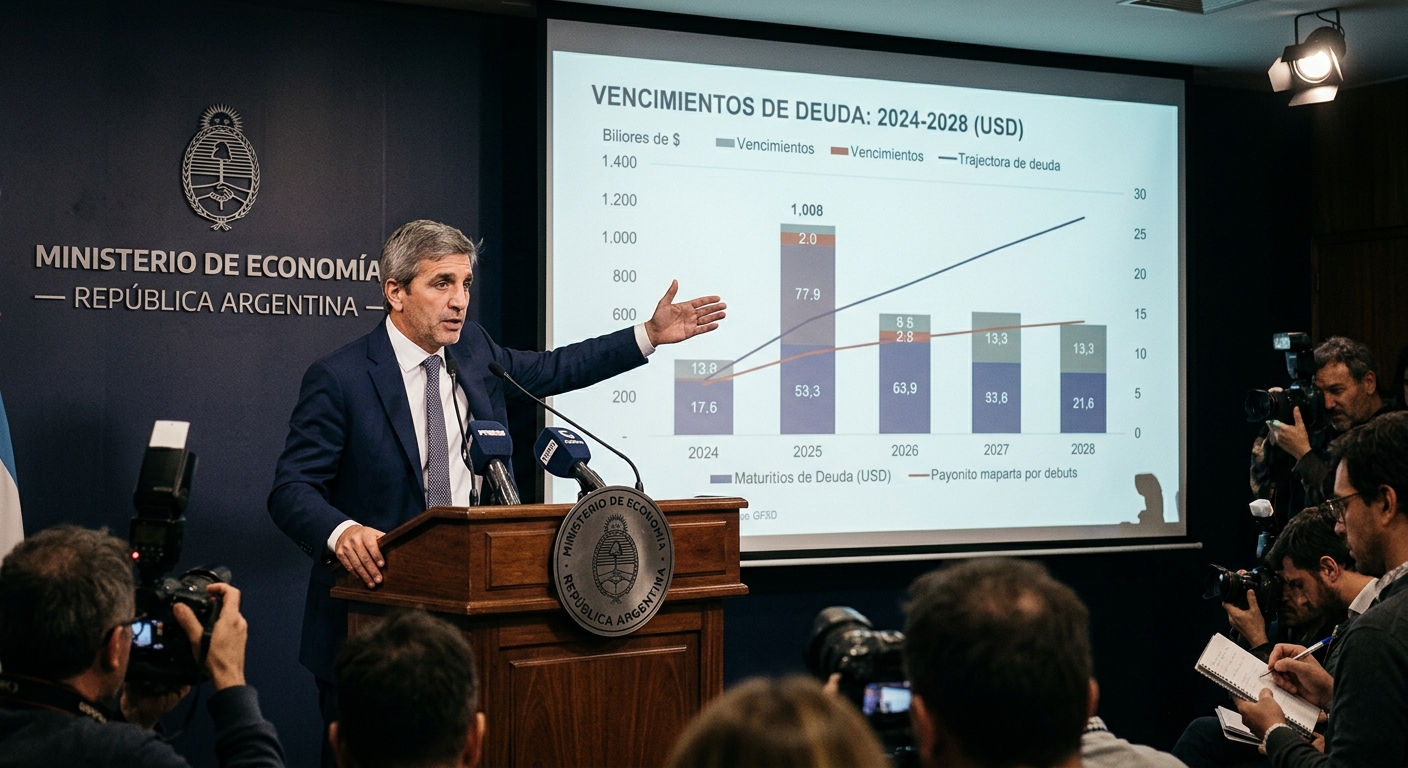
What Caputo actually put on the table
The plan is a departure from the government's earlier rhetoric that Argentina would "return to markets" by early 2026 — the trigger the IMF used to justify its April 2025 program. In its second Extended Fund Facility review completed May 21, 2026, the Fund's Executive Board explicitly urged Buenos Aires to secure "timely and durable access to international capital markets to refinance large public sector FX obligations and gradually reduce Fund exposure." Caputo's answer, seven weeks later, is that he will not pay 10-year money at anything close to today's secondary yield.
He put a number on it. Argentina, he said, had been offered US$5 billion at 12.5% for 10 years earlier in the cycle; today it can borrow at roughly 6% for the same tenor via other channels — an implied savings of US$3.3 billion. Foreign-law issuance, he argued, would be executed only if pricing collapses toward that level. The strategic logic is legible: every basis point compression before the 2027 general election is political capital, and every dollar not paid to New York bondholders is a dollar available for the promised income-tax cut Milei has trailed since his October victory.
The 2026 financing stack, as detailed by GN Noticias and confirmed by
El Tribuno, leans heavily on non-market sources.
That US$3.7 billion projected surplus rolls into 2027, where the government forecasts US$24.9 billion in needs against matching sources — including US$5 billion in new local-law bonds, US$4.9 billion in fresh BCRA FX purchases, US$4.2 billion from non-IMF multilaterals, US$1.7 billion from the Fund, US$1.5 billion in privatization proceeds and a US$2 billion residual bucket labelled "other". As reported by Perfil, Caputo told the press that 2027 is "less demanding" — local-law refinancing alone would cover it. The plan explicitly leaves the January 2028 payment of roughly US$5 billion as "an inheritance for the second Milei mandate," a rhetorical device that presumes re-election but also, more usefully, punts the toughest maturity beyond the political horizon that matters to today's price-taker.
Why he can say no to the market — for now
The plan is credible for one reason: a stack of official-sector money that did not exist a year ago. The IMF's US$21 billion Extended Fund Facility, approved April 11, 2025, has already disbursed US$15.8 billion of the total envelope after the second review, per the IMF Executive Board release of May 21, 2026. The
IMF's First Review staff report from July 2025 had already flagged the strategic pivot Caputo is now formalizing: peso-denominated sovereign bonds subscribed in dollars, "not adding to FX denominated debt," while explicitly warning against "the bunching of maturities resulting from excessive reliance on 2027 put options."
Layered on top: the World Bank Group approved on June 16, 2026 an innovative guarantee package — a first-loss IBRD Policy-Based Guarantee stacked with a MIGA second-loss instrument — that covers 95% of debt service on up to US$2 billion in six-year commercial loans with a three-year grace period. That is the mechanism behind the "US$4 billion in private loans backed by multilateral guarantees" line item Furiase read out on Monday: the WBG package is a template that Buenos Aires plans to replicate.
Layered above that: the US$20 billion U.S. Treasury currency swap arranged by Secretary Scott Bessent in September 2025, described by the Council on Foreign Relations as "the first large-scale rescue financed directly by the United States since the Bill Clinton administration provided Mexico with a $20 billion loan in 1995." That backstop, together with Milei's October 26, 2025 midterm win — La Libertad Avanza took over 40% nationally, according to
Al Jazeera — is what took country risk from four-digit territory in September 2025 to the eight-year lows Caputo referenced on Monday. Argentine dollar bonds rallied between 9 and 13 cents on election night alone.
The political-financial architecture is best understood as concentric rings: an IMF anchor, a World Bank/IDB guarantee sleeve, a bilateral U.S. swap, and — sitting furthest from Caputo's desk — the private bond market he no longer needs to touch this year. As Foreign Affairs put it, Milei now holds "a veto-proof minority" in Congress, 109 lower-chamber seats plus a third of the Senate, which removes the fiscal-rollback risk that spooked private creditors in September 2025.
The IMF is the real beneficiary — and the real hostage
Argentina owes the Fund roughly one-third of its outstanding portfolio, making it the IMF's largest single debtor. The Fund's own payment schedule shows Argentina must repay
about US$5.55 billion in principal and charges to the IMF alone in 2027, including four EFF repurchases totaling more than US$4.1 billion. Caputo's plan slots US$1.7 billion in new IMF disbursements into 2027 — meaning the net cash flow to Washington is around US$3.8 billion outbound. Every dollar of Bessent swap, WBG guarantee, and local-law dollar bond that Buenos Aires raises this year is, functionally, IMF exposure amortization.
That is the second-order story wire copy is missing. Caputo is not primarily managing bondholder anxiety; he is managing Kristalina Georgieva's exposure timetable. The IMF's Executive Board explicitly called on May 21 for a "gradual reduction of Fund exposure" — and the July 6 plan is Buenos Aires' compliance letter, written in the form of a financing table.
The corollary is uncomfortable: the strategy holds only as long as the U.S. Treasury swap and the WBG guarantee stack remain politically live. Both are unusually personalist. As the BBC noted, the U.S. peso intervention is "unprecedented" and carries genuine mark-to-market risk for the ESF; a change in U.S. political weather — or in the peso's trading band — could pull the anchor out. Analysts cited by BBC expect Buenos Aires will eventually have to let the peso weaken further to preserve reserves, exactly the dollars Caputo needs to keep BCRA purchases flowing at the US$6.7 billion pace his plan requires.
The historical parallel that reframes it
Argentina's last three sovereign debt cycles ended with the same choreography: the government swears it has "market access," rolls a maturity wall into an election year, and then either restructures (2005, 2010, 2020) or is bailed out (2018). The BBC's account of the 2010 canje shows the pattern: Amado Boudou opened a US$20 billion exchange offer to buy time; the 2018 Macri-Caputo cycle repeated it with a US$50 billion IMF program, of which
Argentina drew US$44 billion before returning to default in 2020.
What is different in July 2026 is the sequencing. Caputo is publishing the roadmap 18 months before the maturity wall — not, as in prior cycles, six weeks before. He is over-funding rather than reprofiling. And crucially, he is doing so with country risk at multi-year lows rather than in the middle of a run. If he is bluffing, it is a bluff with US$22.9 billion of covered maturities behind it.
The counter-case is that these plans have failed before precisely when the political anchor gave way — and Milei's re-election is not certain. Christian Buteler, cited by BBC Mundo, calculated IMF maturities alone climb to US$15.2 billion by 2029. Push the wall past Caputo's roadmap and every subsequent government inherits a debt profile that assumed continued reformist governance. That is the wager Argentina is asking creditors — official and private — to accept.
What to watch next
- July 9, 2026: the US$4.3 billion Bonar/Global payment to private bondholders. Execution without touching markets validates the roadmap.
- Third EFF review (H2 2026): the IMF's next disbursement decision will test whether the Fund accepts Caputo's slower-than-promised market re-entry.
- BCRA reserve accumulation target: the IMF program requires
at least US$8 billion in NIR accumulation in 2026; miss it and the entire "purchases from BCRA" line collapses.
- October 2027 general election: the maturity wall Caputo has explicitly deferred sits on the desk of whoever wins.
Diplomat View
Caputo's plan is a coherent bet, but it is a bet on continuity, not on markets. The decisive claim — that Argentina can finance US$44.1 billion through end-2027 without foreign-law issuance — holds if and only if three conditions survive intact: the IMF stays disbursing, the World Bank guarantee model scales, and the U.S. Treasury swap remains politically defensible in Washington. Remove any one and the "opcionalidad" collapses into obligation, at the exact yields Caputo is trying to avoid. The forecast to revise: if Argentine 10-year dollar yields fail to compress below 8% by Q1 2027, or if the BCRA misses its NIR target by more than US$2 billion, the July 6 plan will have to be reopened before the maturity wall — not after. The most likely trigger for revision is not a market event but a Washington one: a Bessent departure, or a Georgieva Board that decides Argentina's Fund exposure is not falling fast enough.
The Bottom Line
Argentina is not returning to global bond markets in 2026 because it does not need to — and refusing to issue at today's spreads is now the government's principal tool for compressing them further. The plan works as long as the IMF, the World Bank, and the U.S. Treasury remain the co-underwriters of Milei's second-half term. If any leg of that tripod wobbles, Caputo's "option, not objective" language will read very differently in six months.
Discover more

US Politics
SNAP Food Assistance Faces Legal Challenges
In 2026, SNAP faces stricter eligibility rules and mounting legal challenges, threatening food assistance for the millions of Americans who rely on the program.
Global Politics
Trump's Conflicting Messages on Iran War
Trump's mixed messages on Iran reflect a strategy of audience management, benefiting Tehran amid a complex geopolitical landscape.

US Politics
House Ethics Committee Pushes Sexual Miscond.
The House Ethics Committee has shifted responsibility for sexual harassment settlement records to the Office of Congressional Workplace Rights, complicating disclosure efforts.

Economics
Fed's Amex AML order puts correspondent banking on notice
Federal Reserve's Amex AML order requires board-level controls and a 90-day plan; OCC fined the bank $350 million over enterprise-wide deficiencies.