America's Nuclear Sprint Hits the Tape
Two companies achieve nuclear criticality amid safety rule changes.
Model Diplomat4 min readNorth America
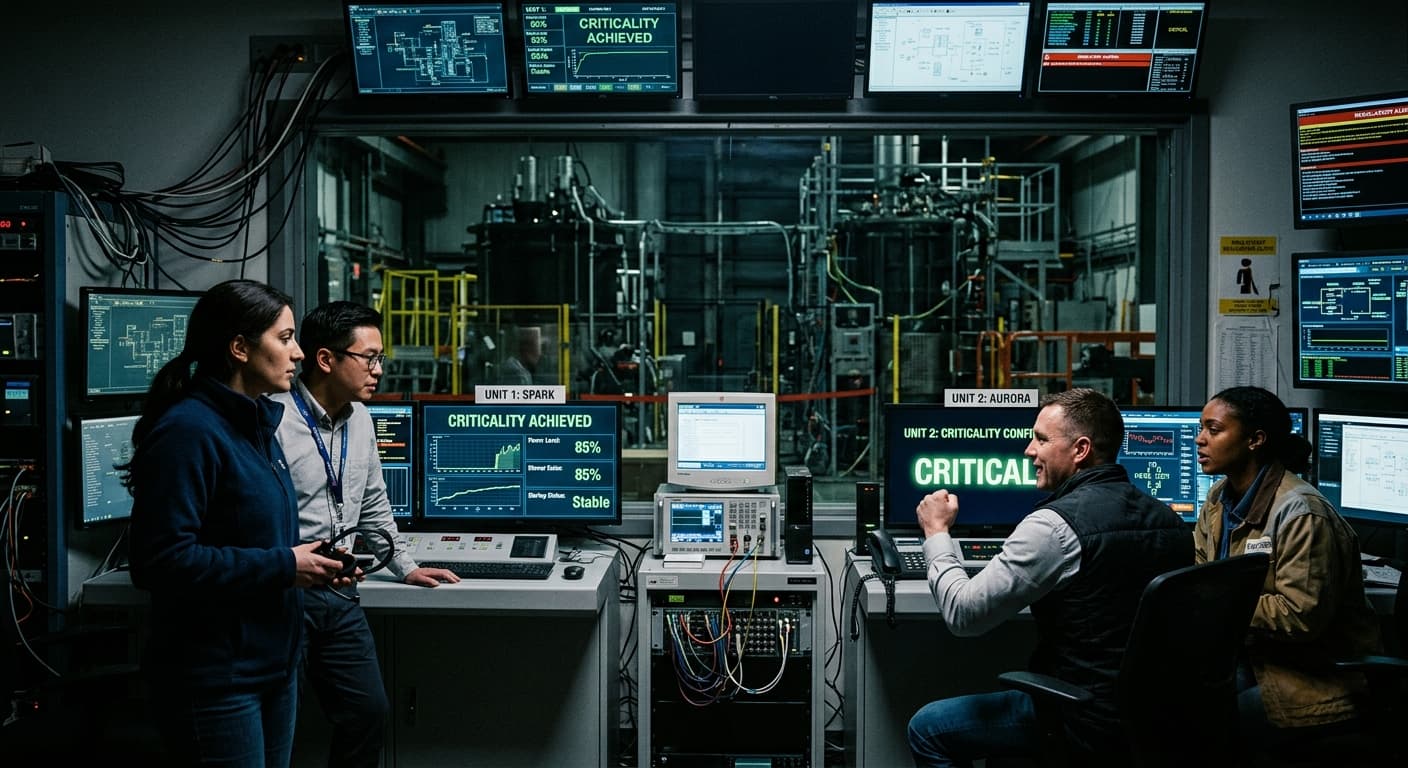
America's Nuclear Sprint Hits the Tape — Two Reactors Critical, Safety Rules Left in the Dust
Two companies beat Trump's July 4 deadline for experimental nuclear reactors — but only after the DOE gutted its own safety rulebook and sidestepped the NRC entirely.
With less than a week until President Trump's self-imposed July 4, 2026 deadline, two startups have achieved nuclear criticality under the Department of Energy's Reactor Pilot Program — the fastest reactor build-out in American history, and one executed almost entirely outside the public regulatory framework that governed the industry for half a century.
Antares Nuclear announced it went critical on June 4, and Valar Atomics followed on June 18, operating its experimental core from a tent-like structure in the Utah desert and now producing tens of kilowatts of heat, according to NPR. A third company, Radiant Industries, is tracking to begin testing at Idaho National Laboratory by the deadline but will not achieve criticality in time. Each of these reactors uses radically different fuel architectures — Valar's design employs high-temperature gas cooling, Radiant uses uranium-fueled "gobstopper" pellets — and none were reviewed by the Nuclear Regulatory Commission.
The power dynamics here are unambiguous. The White House holds all the leverage, and it has used it to remove every procedural barrier between startups and fission. Trump's May 2025 executive order explicitly placed oversight with the DOE, not the NRC, and demanded that Energy Secretary Chris Wright "approve at least three reactors... with the goal of achieving criticality... by July 4, 2026." Wright has delivered. "Before July fourth of this year, we will have multiple nuclear reactors critical," he said at Hill Air Force Base in February. "That's speed. That's innovation. That's the start of a nuclear renaissance." (NPR)
The deregulatory blitz, month by month
The deadline left just over a year for review, approval, and construction — a timeline that Kathryn Huff, former head of the DOE's Office of Nuclear Energy under Biden, called "a pretty big understatement" to describe as aggressive. Research reactors typically need at least two years from construction start, she told NPR. So the administration moved methodically to strip the clock of its teeth.
By late 2025, DOE officials at Idaho National Laboratory had secretly rewritten the department's internal safety orders — slashing hundreds of pages of security requirements, eliminating the ALARA radiation-exposure principle, removing the requirement for a cognizant system engineer on each critical safety system, and softening environmental protections. NPR obtained the documents and forced their public release in February 2026. Days later, the DOE announced it would exclude the experimental reactors from environmental impact statements under the National Environmental Policy Act. (NPR) The NRC, sidelined to a consulting role, detailed just a dozen staff to assist.
DOE lawyer Seth Cohen captured the program's ethos in a recorded industry meeting: "Our job is to make sure that the government is no longer a barrier... whatever we need to ensure that the government is not stopping you from reaching criticality on or before July 4, 2026." (NPR)
Winners and losers
The winners are clear: Valar Atomics, Antares Nuclear, and the Silicon Valley-backed startup ecosystem that raised billions in private capital betting on microreactors for AI data centers and military applications. Valar's reactor was airlifted to Utah aboard a C-17 military transport in February — the Pentagon wants these for Project Janus, deploying small reactors to bases off-grid. Radiant has broken ground on a factory targeting 50 reactors per year, and its backers include firms like Giant Ventures, per the Financial Times. Oklo, a publicly traded advanced nuclear company, is using the pilot program to develop its Pluto reactor with AI-assisted design tools.
The losers are transparency and the institutional safety apparatus. Edwin Lyman, director of nuclear power safety at the Union of Concerned Scientists, called the race "essentially an exercise in public relations" and warned it "is taking us back to the 1950s — and that is not progress." (NPR) Even a small radiation release from an experimental core — operating in a tent, on a compressed timeline, without independent NRC oversight — could contaminate the surrounding area. The DOE insists safety "remains paramount," but the rulebook tells a different story.
Supporters counter that smaller reactors carry inherently lower worst-case risk than gigawatt-scale plants. Nick Touran, an independent nuclear consultant, told NPR that "a Chernobyl or Fukushima-type accident" is impossible at this scale. Real operational data, the argument goes, will ultimately make the whole enterprise safer.
What to watch next
The immediate next marker is July 4 itself — whether Radiant or a fourth company, Aalo Atomics, can join the criticality club in time for the Semiquincentennial. More consequential is what happens afterward. A memorandum of understanding between the NRC and DOE already commits the commission to "an expedited pathway to approve advanced reactor designs that have been authorized and tested by DOE." If the pilot program's safety record holds, these companies will move straight to commercial licensing — and the NRC's five-decade monopoly on nuclear safety will be functionally over.
Discover more
India
Congress Accuses Modi of Stalling Women's Law
Congress accuses Modi of stalling women's reservation law by linking it to delimitation, revealing a deeper electoral strategy.
US Politics
SNAP Food Assistance Faces Legal Challenges
In 2026, SNAP faces stricter eligibility rules and mounting legal challenges, threatening food assistance for the millions of Americans who rely on the program.

India
Delhi CM Rekha Gupta Blasts Opposition's Delm
Delhi CM Rekha Gupta's remarks on women's quota defeat reveal BJP's strategy for the 2029 Lok Sabha elections, focusing on delimitation.

Economics
Fed's Amex AML order puts correspondent banking on notice
Federal Reserve's Amex AML order requires board-level controls and a 90-day plan; OCC fined the bank $350 million over enterprise-wide deficiencies.