AI Chip Supercycle Reshapes Export Controls
How the AI chip boom is altering global trade laws
Model Diplomat8 min readGlobal

The AI Chip Supercycle Is Rewriting Export Control Law
DRAM prices are up roughly 340% since October 2025. The regulators arriving to police that surge — from BIS to Beijing's SAMR — will decide who actually owns the AI stack.
Samsung Electronics told customers on July 3, 2026 that it would raise Q3 DRAM contract prices by up to 20% — its third consecutive double-digit quarterly hike, taking the cumulative year-to-date rise to roughly 340%, according to BigGo Finance. That is not merely a supercycle; it is a legal event. The AI-driven price surge across CPUs, DRAM, HBM and CoWoS packaging is now colliding with four regulatory perimeters simultaneously — US export controls, Chinese antitrust retaliation, a new US "right of first refusal" statute, and state-sponsored cyber intrusions targeting the same supply chain. The thesis: the supercycle is no longer a market story — it is the mechanism through which Washington and Beijing are converting semiconductor scarcity into industrial policy, and the price of a memory chip is now the price of a licence.
The scarcity that broke the export-control model
The physical facts are unambiguous. SK Hynix has sold out its entire 2026 HBM production slate and is no longer accepting new orders for major memory products, according to the Center for Strategic and International Studies. Samsung, SK Hynix and Micron — together over 90% of global DRAM — have pivoted so aggressively toward HBM that data centres are projected to consume roughly 70% of worldwide memory output in 2026. OpenAI alone has reportedly locked in agreements for up to 900,000 DRAM wafers a month for its Stargate build-out, equivalent to about 40% of global DRAM supply.
The pass-through is now visible in consumer prices. Apple raised MacBook and iPad prices by nearly 20% in late June 2026, blaming an "extraordinary surge" in AI chip demand, BBC News reported. Microsoft's Xbox followed within hours, lifting basic console prices by $100 and higher-memory SKUs by $150. Outgoing Apple chief executive Tim Cook told the Wall Street Journal that further increases were "unavoidable" and the situation "unsustainable," in an interview relayed by
Al Jazeera. Tech Insights told the BBC that memory's share of a typical PC bill of materials had swung from 15–20% to 30–40%.
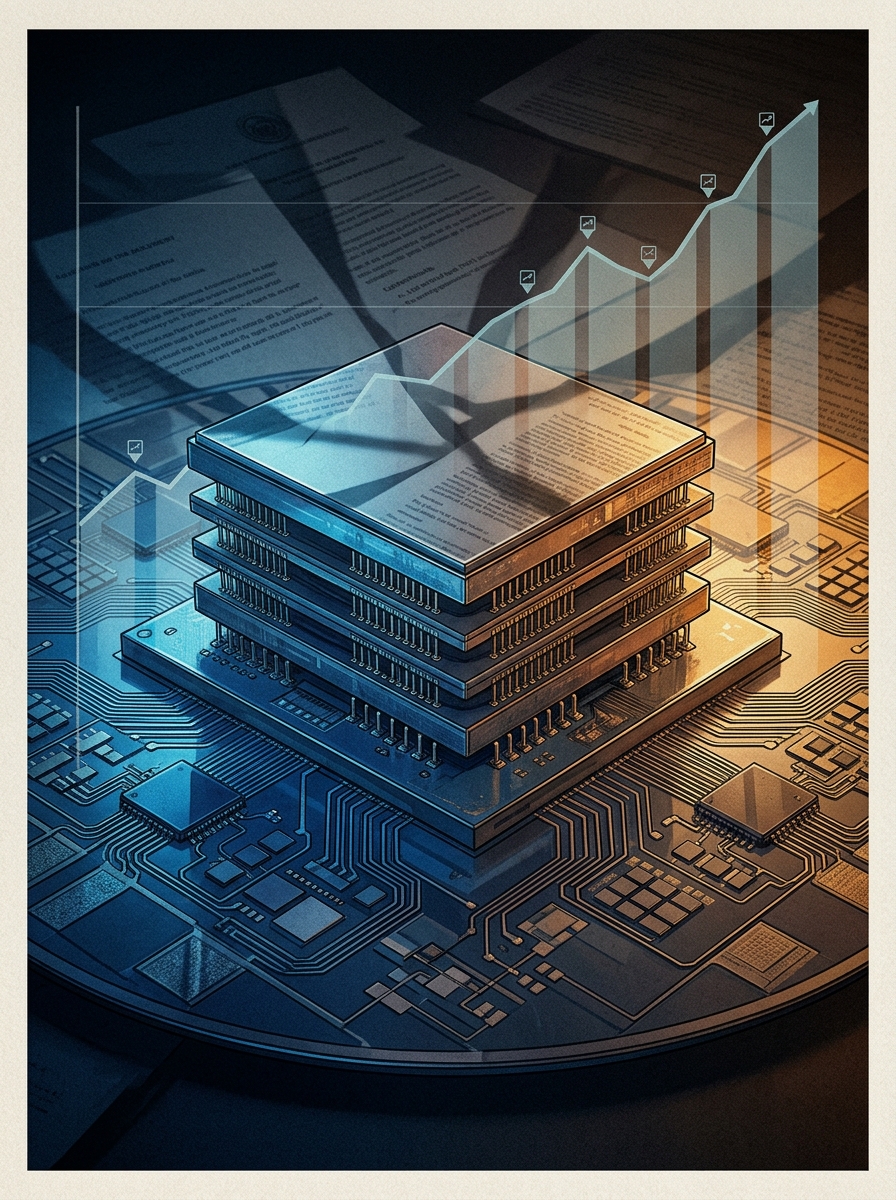
This is the physical substrate that regulators must now police. And the export-control apparatus was designed for a world of surplus — a world that no longer exists.
The BIS rulebook, rewritten around HBM
The Bureau of Industry and Security's December 2, 2024 Interim Final Rule is the primary document to anchor this story on. Its language is explicit that HBM is now a national-security-controlled commodity, not merely a commercial input. The rule states, in the Federal Register, that high-bandwidth memory "provide[s] necessary memory capacity and bandwidth needed for advanced artificial intelligence (AI) models and supercomputing applications" that "can enable advanced military and intelligence applications, lower the barriers to entry for non-experts to develop WMD, [and] support powerful offensive cyber operations." BIS created a new ECCN 3A090.c specifically for HBM and layered on new foreign-direct-product rules to catch chips packaged offshore.
That regulation had a paradoxical effect. By locking down HBM outbound to China, it accelerated the reallocation of every remaining wafer toward AI hyperscalers — pushing consumer memory prices to what Micron's Sanjay Mehrotra called a demand-supply imbalance likely to persist "for the foreseeable future," according to NPR. The BIS rule did not create the shortage. But it removed the safety valve — a Chinese HBM buyer of last resort — and hard-wired scarcity into the AI stack.
Beijing's antitrust counterpunch
The retaliation was pointed. On December 9, 2024, China's State Administration for Market Regulation opened an anti-monopoly investigation into Nvidia over alleged breaches of the conditions imposed when it acquired Mellanox in 2020, as Al Jazeera documented. On September 15, 2025, SAMR issued a preliminary ruling finding Nvidia had violated Chinese antitrust law — timed, transparently, to coincide with US–China trade talks in Madrid, per
BBC News. Omdia analyst Lian Jye Su told reporters the probable remedy is that Nvidia be forced to sell chips in China unaccompanied by Mellanox networking technology — a targeted amputation of the AI-cluster stack.
The Trump administration answered by monetising, rather than tightening, the flow. On December 8, 2025, the White House authorised H200 exports to "approved" Chinese customers, subject to a 25% import fee, a 50% volume cap versus US shipments, and case-by-case BIS licensing, as detailed by the Council on Foreign Relations. CFR's fellows called the regime "strategically incoherent." Brookings' John Villasenor, in a June 2026 analysis, argued the
US has already lost the China AI chip market — Beijing has instructed domestic firms not to purchase the H200s Washington now allows to be sold. The June 1, 2026 BIS clarification that export licences apply to any China-headquartered firm's overseas subsidiaries, reported by
Al Jazeera, acknowledges the loophole was already being exploited at scale.
The GAIN AI Act and the domestic queue
Congress has quietly changed the domestic side of the equation. The Guaranteeing Access and Innovation for National Artificial Intelligence Act — S. 3150, introduced by Senators Jim Banks and Elizabeth Warren and passed in October 2025 as an NDAA amendment — requires any exporter of advanced AI chips to certify that US persons had a "right of first refusal" and that the export creates no "backlog" or "reduction in critical production capacity" for domestic customers. The
Senate Banking Committee framed this as ensuring US startups and universities do not "wait in line behind China's tech giants."
The statutory language is the sharpest instrument in the current toolkit. CFR notes that certifying no impact on US supply is functionally impossible while HBM remains in structural shortage — meaning the GAIN AI Act, if enforced strictly, would block most Chinese exports on paper while the White House permits them in practice. The contradiction is the point. Washington is now regulating scarcity itself.
Cyber, IP theft, and the shadow tier
Every scarcity regime invites illicit alternatives. On April 27, 2026, a Taiwanese court sentenced five defendants — including former TSMC employees — to up to 10 years in prison for stealing sensitive process technology, fining the local Tokyo Electron unit $5 million under the National Security Act, per Al Jazeera. The prosecutions, brought against employees of the world's dominant AI foundry, are the criminal-law face of the same supercycle.
Meanwhile the cyber layer has thickened. South Korea's National Intelligence Service has previously blamed North Korean state-sponsored actors for breaching two chip equipment makers, BBC News reported, using "living off the land" techniques to steal facility designs. CSIS assesses that Chinese state-sponsored hackers have targeted South Korean semiconductor firms specifically for
intellectual-property theft and trade secrets. BIS's own justification for the HBM rule cited the risk of "powerful offensive cyber operations" — the loop closes: the chips that enable AI-scale cyber operations are the same chips being pursued through cyber operations.
Who benefits, who loses
The winners are legible. SK Hynix and Samsung crossed a trillion-dollar valuation on the back of the supercycle, according to BBC News; Samsung's second-quarter operating profit was projected at roughly 86 trillion won, an eighteenfold year-over-year jump. South Korea's government announced a $1 trillion AI-and-chip investment plan on June 29, 2026, per
Al Jazeera, effectively state-backing the two firms whose HBM output the world's hyperscalers cannot do without.
The losers are the industries the CSIS memory paper flagged in June 2026: telecommunications, automotive, medical device, and retail trade associations, which collectively urged the Trump administration to intervene in memory allocation. Consumer electronics is bleeding margin — TechInsights told the WSJ Apple would need to raise iPhone Pro prices by $270 to preserve current margins. And US antitrust regulators are watching a 90%-plus-share oligopoly move prices in lockstep for the third consecutive quarter — the exact pattern that produced the 2005 Samsung guilty plea and $300 million DOJ fine in the last DRAM cartel case, as documented at the time by the Financial Times. No enforcement action has been announced. The precedent is nevertheless on the books.
Diplomat View
The consensus reading — that the supercycle is a cyclical shortage that new fabs will resolve by 2027 — is directionally wrong. The correct reading is that AI has fused the memory market to the export-control system, and neither regulator now has a clean exit. Washington cannot enforce the GAIN AI Act's certification requirements against a physically inelastic HBM supply without effectively banning China sales its own White House has just authorised. Beijing cannot force Nvidia divestitures under SAMR remedies without conceding that Chinese buyers still need the products in question. The two sides have built a mutually hostage regime around chips they cannot make fast enough for their own users.
The falsifiable call: within the next twelve months, one of three things breaks the equilibrium — a formal BIS quota linking HBM export licences to domestic-supply certification under the GAIN AI Act's language; a SAMR structural remedy that forces Nvidia to unbundle Mellanox from its China offering; or a DOJ/EU Commission antitrust probe into the memory three. Any of the three would revalue every AI stock in the S&P 500. Absent all three by mid-2027, the price surge is durable and the second Trump administration will have chosen revenue extraction (the 25% import fee) over strategic denial. The forecast revises if China's domestic HBM output — currently negligible — clears 10% of global supply, or if a Micron-scale new fab comes online ahead of its 2027 schedule.
What to watch:
- BIS licence data (Q3 2026) — how many H200 shipments to China Commerce actually clears under the GAIN AI Act certification, and whether Nvidia can credibly attest "no US backlog" while Xbox and Apple raise prices citing chip shortages.
- SAMR final ruling on Nvidia (expected H2 2026) — the remedy language will telegraph whether Beijing wants a bargaining chip or a market-restructuring precedent.
- December 31, 2026 — the extended deadline under the
BIS April 2026 final rule for OSATs and foundries to apply for "approved IC designer" status, which will determine which non-US customers can still legally receive advanced logic.
The Bottom Line
The AI chip supercycle is not a shortage in search of new fabs — it is the moment memory and advanced logic became instruments of statecraft, priced by BIS licences and SAMR rulings as much as by demand. The firms that win the next decade will be those, like SK Hynix and Samsung, whose home governments can credibly guarantee both output and market access; the firms that lose will be the downstream buyers — Apple, Microsoft, Dell — who have no seat at the regulatory table where their input costs are now set.
Discover more

India
Congress Accuses Modi of Stalling Women's Law
Congress accuses Modi of stalling women's reservation law by linking it to delimitation, revealing a deeper electoral strategy.

US Politics
House Ethics Committee Pushes Sexual Miscond.
The House Ethics Committee has shifted responsibility for sexual harassment settlement records to the Office of Congressional Workplace Rights, complicating disclosure efforts.
US Politics
SNAP Food Assistance Faces Legal Challenges
In 2026, SNAP faces stricter eligibility rules and mounting legal challenges, threatening food assistance for the millions of Americans who rely on the program.

Economics
Fed's Amex AML order puts correspondent banking on notice
Federal Reserve's Amex AML order requires board-level controls and a 90-day plan; OCC fined the bank $350 million over enterprise-wide deficiencies.