Agricultural Commodity Markets 2026
Grains abundant, but hunger crisis worsens
Model Diplomat7 min readGlobal
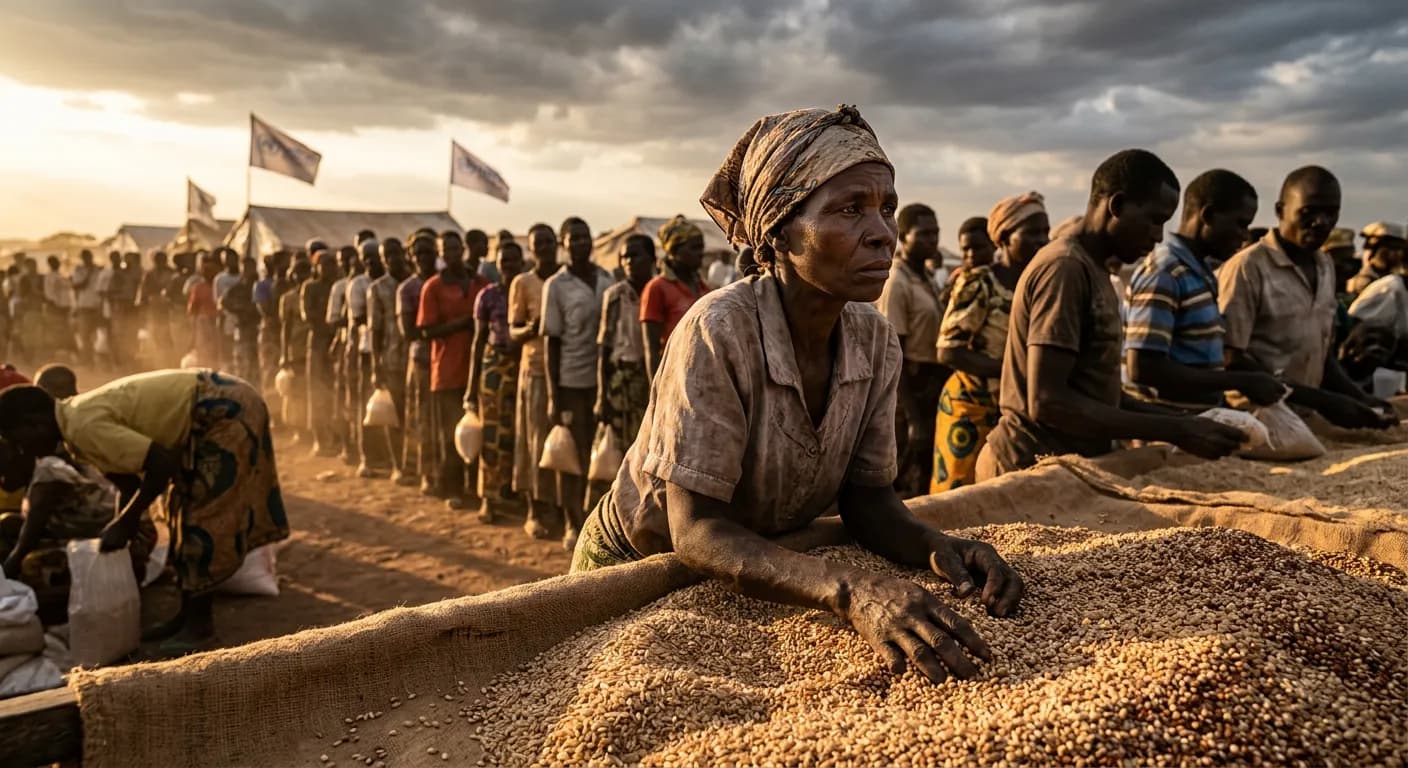
Agricultural Commodity Markets 2026: Cheap Grain, Costly Hunger
The 2026 global food outlook: grains stay abundant, fertilizer prices jump 38%, and the world's hunger crisis keeps growing despite stable markets — driven by conflict, not price.
Global agricultural commodity markets entered 2026 well-supplied and cheap by recent standards — and yet the number of people in acute hunger is still rising. That gap is this year's real story: the 2026 food shock is being transmitted not through grain prices but through fertilizer, energy and conflict, and it is punishing exactly the populations that market indices no longer capture. The World Bank's April 2026 Commodity Markets Outlook projects food commodity prices up just 2 to 3 percent this year despite the Middle East war closing the Strait of Hormuz — but fertilizer prices rising 31 to 38 percent, and 266 million people already in IPC Phase 3 or worse before that shock even landed.
A grain glut colliding with an energy war
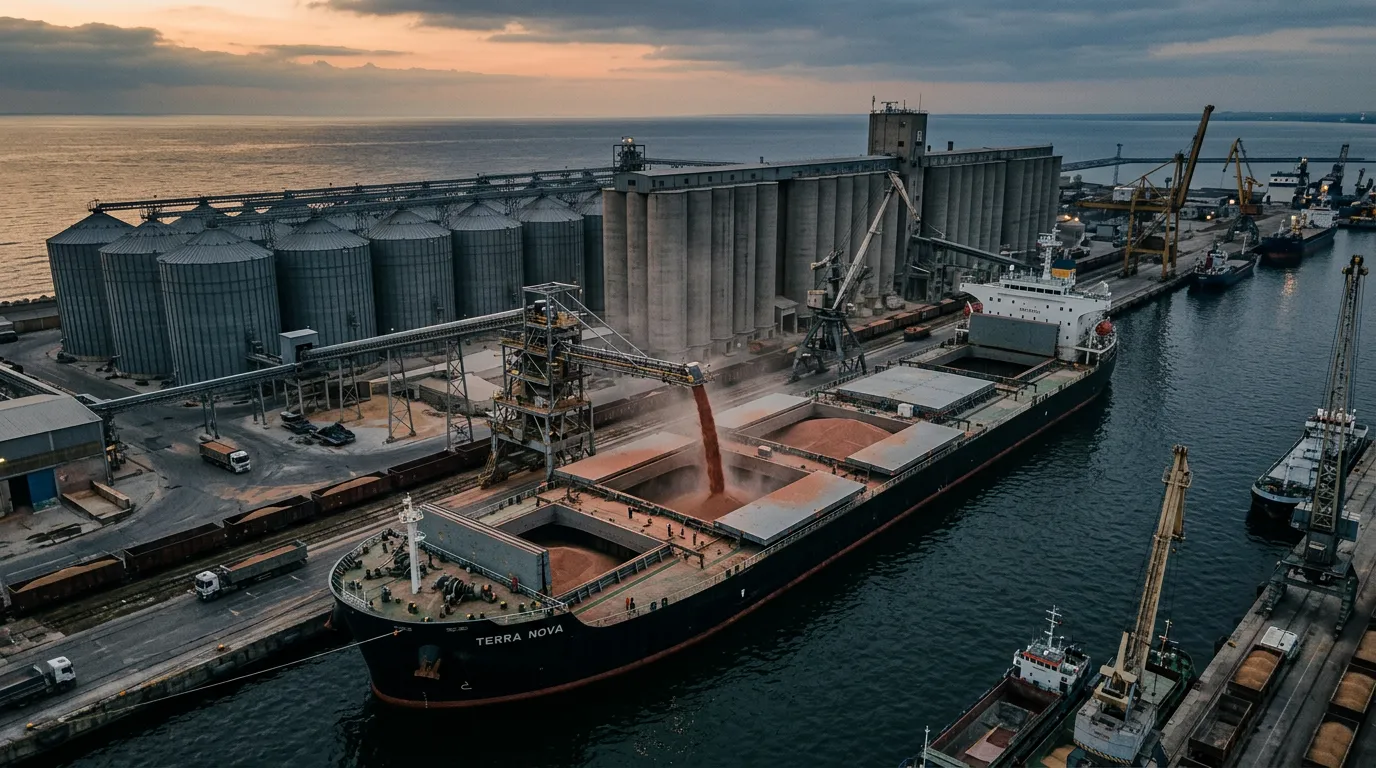
The 2025/26 harvest is, on paper, the best in history. According to a June 2025 WTO Committee on Agriculture submission, global grain production reached a record 2,375 million tonnes, wheat output tied its all-time high at 806 million tonnes, and soybeans hit a peak 428 million tonnes. Rice production also broke records. That is the buffer keeping international food markets calm even as Brent crude averages near $94 a barrel and the FAO Food Price Index rose in April 2026 for a third straight month, to 130.7 points,
according to FAO.
FAO Chief Economist Máximo Torero framed the transmission mechanism precisely in that release:
"It means that prices of the inputs costs are starting to be transmitted to the commodity prices, but at a very low pace. The major increase is happening on vegetable oils, which is linked to biofuels."
That single sentence explains the 2026 market. The Strait of Hormuz closure, triggered by the February 2026 escalation between Israel, the United States and Iran, took out a region that plays only a limited role in food trade — but a dominant role in fertilizer and energy trade. Pre-conflict, Gulf economies supplied about 20 percent of global urea and diammonium phosphate exports, per the World Bank's June 2026 Global Economic Prospects. Urea prices have surged roughly 60 percent. Fertilizer affordability is now at its worst level since 2022.
The second-order shock: farmers ration inputs
This is where the arithmetic gets uncomfortable. Fertilizer prices climbing 38 percent while food commodity prices rise only 3 percent means one thing at the farm gate: growers cut nitrogen. The May 2026 FAO Food Price Monitoring bulletin already flagged the behavioural pivot — wheat plantings for 2026/27 are being reduced "with farmers shifting to less fertilizer intensive crops." The European Commission's
short-term agricultural outlook forecasts EU cereal output contracting in 2026, and Brussels adopted a Fertiliser Action Plan in May 2026 alongside a temporary State Aid Framework specifically to protect producer margins.
The June 2026 World Bank Food and Nutrition Security Update is blunt about the implication: "Production of wheat, maize, and rice is expected to decline from the 2025 record levels, reflecting high input costs, adverse weather, and weaker planting incentives." Layer on an El Niño with an 82 percent probability of developing and persisting into early 2027, threatening Southern Africa, the Sahel and parts of South and Southeast Asia, and the 2026/27 balance sheet looks materially tighter than 2025/26. The buffer is being spent this year to keep prices calm; there is less of it next year.
Biofuel policy is now food policy
The clearest sign that governments have not internalised food-fuel competition is Indonesia's B50 biodiesel mandate, effective July 1, 2026. The Indonesian palm oil growers' association (GAPKI) estimates domestic biodiesel demand will pull 17.5 million tonnes of crude palm oil off export markets under B50, up from 11.66 million under B35, according to BBC Indonesia. A Bank Indonesia working paper concludes bluntly that "for B50–B70, foregone CPO export revenues systematically exceed diesel import savings," and warns that land-use change "could undermine the net emission benefits" —
Bank Indonesia WP/05/2025.
The United States has moved in parallel. The World Bank's June 2026 developmenttalk analysis documents that Washington raised the required volume of biomass-based diesel to 5.4 billion gallons in 2026, up from 3.4 billion in 2025, and 5.7 billion in 2027. Thailand lifted its blend from 5 to 7 percent. Palm oil and soybean oil prices are both projected to rise 8 percent this year — the fastest-moving food sub-index. FAO explicitly attributed April's 5.9 percent month-on-month vegetable oil surge to biofuel demand.
The winners are transparent. Brazilian sugar mills can flip production between sugar and ethanol as crude prices move. Indonesian palm-oil conglomerates receive subsidies channelled through the BPDPKS levy fund; a 2022 Indonesia Corruption Watch audit found roughly 80 percent of those subsidies flowed to about ten large corporations, per ISEAS analysis. The losers are edible-oil-importing countries in South Asia and Africa, where cooking oil is a staple price signal households feel first.
The soybean map, redrawn
The other quiet structural shift of 2026 is that China has finished decoupling its soybean supply from the United States. American Enterprise Institute analysis by former USDA chief economist Joseph Glauber documents that US soybean exports to China totalled just 7.4 million tonnes in 2025 — a 72 percent collapse — while Brazil shipped a record 85 million tonnes and Argentina nearly tripled its shipments to 11.5 million tonnes. The November 2025 Busan agreement committed China to buy 25 million tonnes annually of US soybeans through 2028, but Beijing left its 10 percent retaliatory tariff on US beans in place, ensuring purchases stay in the hands of state buyers meeting a political quota rather than commercial demand,
as CSIS noted in May.
The strategic read: China now treats agricultural imports the way it treats semiconductors — as a dependency to be diversified away from a rival. Brazil is the structural winner. The North Dakota State University Agricultural Trade Monitor estimates Brazilian premiums over US soybeans are running at $40 per tonne in 2025/26, less than half the $90 spread during the 2018 trade war — meaning bypassing US supply is economically feasible, not merely political.
The hunger index is decoupling from the price index
Here is the number that reframes everything above. Global commodity prices are contained, but the Global Report on Food Crises 2026, released by the EU Joint Research Centre and partners in April 2026, found 266 million people in 47 countries at IPC Phase 3 or worse in 2025 — with no improvement projected in 2026. 1.4 million are in IPC Phase 5 (Catastrophe) across six territories, a nine-fold increase since 2016.
The drivers named are consistent: conflict, displacement, blocked humanitarian access. In Sudan, the May 2026 IPC analysis placed 19.5 million people — 41 percent of the population — in Phase 3 or above, with 135,000 already in Catastrophe and 14 areas across Darfur and Kordofan at risk of famine in the June–September lean season. Famine has been formally confirmed in El Fasher and Kadugli, according to
UN Sudan. Only 20 percent of Sudan's 2026 humanitarian appeal was funded as of April,
UN News reported. In Gaza,
the IPC December 2025 special brief placed 1.6 million people (77 percent) in Phase 3 or worse through April 2026, with 571,000 in Emergency.
The World Bank Global Economic Prospects estimates that under adverse scenarios, "up to an additional 70 million people could face acute hunger and food insecurity over the forecast period." That figure is not a function of the FAO price index — it is a function of whether the Strait of Hormuz reopens on schedule and whether donors fund appeals.
The Russian wheat variable
One geopolitical variable to watch as El Niño develops: Russia's leverage in the wheat market. Russia's share of the global wheat trade hit 22 percent in 2024, per CSIS, before adverse weather cut 2025/26 exports to about 44 million tonnes — a 20 percent decline from the record. Ukraine's grain-and-oilseed exports remain 35 percent below 2020, and roughly 90 percent still moves through the Black Sea corridor,
per European Commission data. Any renewed Russian action against that corridor, or a Kremlin decision to enforce its export price floor more aggressively, would hit North African and Middle Eastern importers first — the same region already absorbing the fertilizer and fuel shock.
What to watch
- August–September 2026: IPC lean-season projections for Sudan, South Sudan and the Sahel. World Bank/AMIS updates on 2026/27 grain plantings and El Niño confirmation.
- October 2026 World Bank Commodity Markets Outlook: the first hard read on whether the Middle East supply disruption eased on the Q3 timeline the April baseline assumed.
- October 20–24, 2026: 53rd plenary of the UN Committee on World Food Security in Rome; funding gaps for 2026 humanitarian appeals will be central.
- Indonesian B50 rollout data (Q4 2026): whether palm oil export volumes drop as GAPKI projects — the leading indicator for global vegetable oil prices in 2027.
- US Section 301 investigations conclusion: if the Supreme Court's Learning Resources decision unravels the IEEPA basis for the Busan soybean commitment, China's 25-million-tonne pledge is at risk.
The Bottom Line
The 2026 agricultural commodity story is not a food price crisis — it is a fertilizer, energy and conflict crisis dressed in food prices' clothes. Cheap grain is masking a slower, structural squeeze: producers are cutting inputs, biofuel mandates are pulling calories into fuel tanks, and hunger is now driven overwhelmingly by war and blocked access rather than by market signals. Watch fertilizer affordability and humanitarian funding, not the FAO index — that is where the next 70 million food-insecure people will be decided.
Discover more

US Politics
Virginia's Redistricting Referendum
Virginia's redistricting referendum is drawing a flood of dark money, shaping future elections and the fight for congressional control amid party stakes.
India
UN Expert Albanese: India Violates Law
UN Rapporteur Francesca Albanese accuses India of breaching international law, spotlighting human rights concerns in Kashmir and prompting diplomatic pushback.

India
Delhi CM Rekha Gupta Blasts Opposition's Delm
Delhi CM Rekha Gupta's remarks on women's quota defeat reveal BJP's strategy for the 2029 Lok Sabha elections, focusing on delimitation.

Economics
Fed's Amex AML order puts correspondent banking on notice
Federal Reserve's Amex AML order requires board-level controls and a 90-day plan; OCC fined the bank $350 million over enterprise-wide deficiencies.