Africa's Green Century Runs on Borrowed Time
Why Africa's green century is failing on financing and grids
Model Diplomat8 min readAfrica
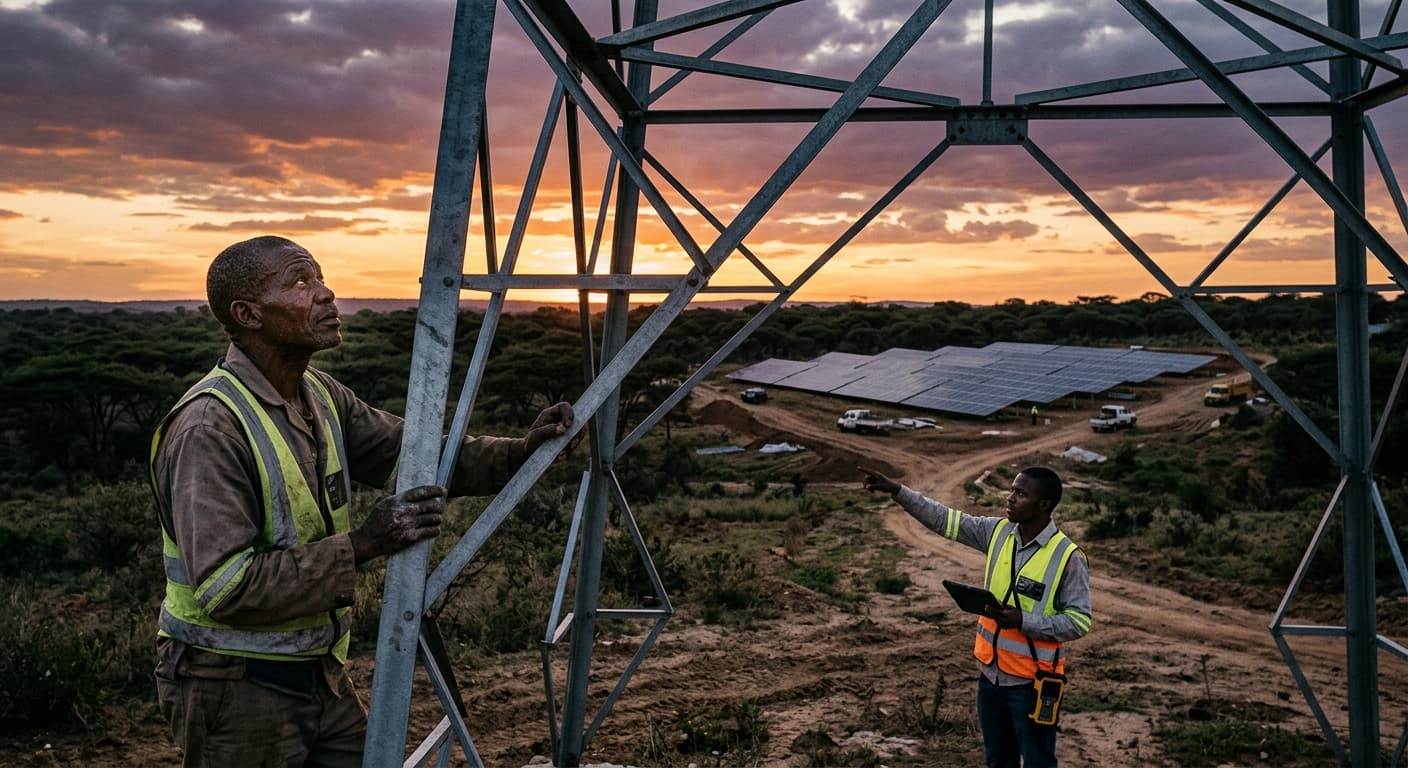
Africa's Green Century Runs on Borrowed Time and Missing Grids
Africa holds 30% of the world's critical minerals and 60% of its best solar resources, yet draws just 2% of global clean-energy investment — the binding constraint is not generation capacity but financial plumbing, transmission grids, and a labor market absorbing 12 million young Africans a year into informal work.

The contradiction is stark, and it is priced in. Rich countries borrow at 1 to 4 percent interest; African governments, deemed riskier, borrow at roughly 14 percent. Prime Minister Mia Mottley of Barbados flagged that gap at COP27. Now Sellah Bogonko of KBC Digital places it at the center of the missing infrastructure behind Africa's green century. Published July 16, 2026, the essay argues that Africa's green transition is not failing on endowment or ambition — it is failing on financing structure, transmission capacity, and the absence of industrial pathways that turn clean megawatts into formal jobs. This is not a technology gap. It is a pricing and plumbing gap. The plumbing determines who captures the value of the next commodity supercycle.
The pricing trap: why endowment doesn't equal investment
The numbers are punishing. Africa holds approximately 30 percent of the world's critical mineral reserves, according to the United Nations Conference on Trade and Development, and 60 percent of the world's best solar resources, according to the International Energy Agency. Yet the continent receives just 2 percent of global clean-energy investment. The gap is not a market failure but a pricing one, rooted in currency volatility, sovereign-risk perception, and weak regulatory certainty.
The IMF's 2025 working paper on external financing in Sub-Saharan Africa finds the "African risk premium" is relatively modest in normal times, about 50 basis points on Eurobond issuances, but "increases substantially during periods of stress, potentially reflecting non-linearities and liquidity constraints." A separate
IMF study covering 2004–2021 found that Sub-Saharan African countries paid around 2.1 percentage points higher coupon rates than countries from other regions, with the SSA coupon rate roughly 66 percent higher than the average — even after controlling for credit rating and bond characteristics.
Debt servicing compounds the trap. Kenya's debt-service-to-revenue ratio stood at 67.1 percent in mid-2025, more than double the IMF's recommended 30 percent ceiling, according to KBC Digital. The World Bank's Africa Pulse warns that several governments now spend more servicing debt than investing in the sectors that would let them grow out of it. A green transition financed this way, Bogonko writes, "isn't a transition. It's a deferral."
The cost-of-capital differential is not abstract. The World Bank's infrastructure finance assessment for South Africa notes that the weighted average cost of capital for infrastructure in emerging markets rose from 9 percent in 2019 to 12 percent in 2024, while in developed markets it moved from 4 percent to 8 percent. Risk premia for infrastructure equities have remained above 7 percent since 2020. The gap means a solar project in Lagos or Nairobi costs roughly 50 percent more to finance than an equivalent project in Lisbon, before a single panel is installed.
Currency risk seals the trap. The Center for Strategic and International Studies notes that only 14 percent of direct investments in renewable energy globally are publicly funded, but in Africa public financing assumes a larger role because private capital is deterred by political, legal, and economic risks. The core problem is a currency mismatch: projects are funded in dollars or euros, but revenues are in local currencies that have depreciated significantly against the dollar over the past decade. A
World Bank analysis of exchange-rate risk in infrastructure found that only 2 percent of private infrastructure investment in emerging markets is made in local currency. Domestic-currency yields have been higher than Eurobond yields about 80 percent of the time since 2012, according to the
IMF's 2025 working paper, reflecting the premium foreign investors demand for accepting exchange-rate risk.
Mottley has argued that the IMF's lending framework itself is flawed. The Extended Fund Facility disburses over three to four years and must be repaid in seven, locking middle-income countries into "perpetual programs, borrowing from the IMF just to repay the IMF," as she wrote in Finance & Development. The Resilience and Sustainability Facility, with its 20-year maturity and no surcharges, is a step, but its scale is insufficient against the magnitude of need.
Generation without transmission is stranded power
The KBC argument is most precise on the missing physical infrastructure: transmission. Kenya generates roughly 90 percent of its electricity from renewables and is Africa's largest geothermal producer. But clean generation without transmission, logistics, maintenance, and enterprise pathways produces a transition that stays "narrow and economically fragile," however clean the grid becomes.
This is a continental pattern. The World Bank's June 2026 approval of a $1.6 billion package for the Regional Energy Transmission, Trade & Decarbonization program for Eastern Africa is a direct response. The first phase includes a 260-kilometer, 400-kilovolt transmission line between Uganda and Tanzania, creating 1,000 megawatts of transfer capacity. Uganda generates more electricity than it consumes; the surplus hydropower goes underutilized because there is no physical link to regional demand. By 2031, the project is expected to enable 452 gigawatt-hours of annual trade between Uganda and Tanzania and avoid 25.8 million metric tons of CO₂ across the Eastern Africa Power Pool.
South Africa faces the same chokepoint at a larger scale. The country needs roughly 14,000 kilometers of new transmission infrastructure, backed by an estimated R2.2 trillion ($126.8 billion) in cumulative investment over 15 years, according to the Financial Times. The World Bank estimates transmission investment needs in South Africa alone exceed $15 billion over the next decade. The Southern African Development Community has launched a Regional Transmission Infrastructure Financing Facility targeting $1.3 billion in blended finance — a fraction of the continental need, which one estimate puts at $1.29 trillion by 2040 for full grid integration.
The deeper problem is that transmission projects carry a fundamentally different risk profile from generation. They require multi-country coordination, 30- to 50-year debt horizons, and cross-border regulatory harmonization. According to Energy News Network, Africa50's Moshood Abolade and partners argue that 15 to 25 cents of each dollar in Africa's energy sector should go to transmission. Privately financed transmission, backed by 30-year concessions and regulated availability-based tariffs, is becoming a bankable asset class, with precedents in Chile, Brazil, India, and Peru.
The historical parallel is Asia's electrification. In the 1990s and 2000s, rapid generation buildout in countries like India and Vietnam outpaced transmission, creating bottlenecks that delayed benefits for years. The strategic pivot came when regional grid integration — not country-by-country generation — became the organizing principle. Africa's power pools (SAPP, EAPP, WAPP) are attempting the same pivot, but with weaker institutions, shallower capital markets, and higher borrowing costs than any Asian country faced at a comparable stage.
The labor-market transition nobody is financing
Bogonko's sharpest claim is that Africa's green transition is a labor-market transition before it is an energy one. Roughly 10 to 12 million young Africans enter the labor market every year, according to the Mastercard Foundation's Africa Youth Employment Outlook 2026, most into informal work. "Green jobs" cannot remain a niche climate-circle conversation and must become an economic development strategy.
Kenya illustrates the disconnection. The country generates 90 percent of its electricity from renewables, yet youth unemployment and underemployment remain acute, and informal work still absorbs the large majority of new jobs created each year, according to KBC Digital, citing the KNBS Economic Survey 2025. Clean power generation, on its own, does not create manufacturing, logistics, maintenance, or enterprise pathways. Without those, a green transition stays narrow and economically fragile.
The African Continental Free Trade Area provides a framework for regional value chains in electric mobility, battery technologies, climate-smart agriculture, sustainable construction materials, and circular economy industries. But the framework is only as strong as the infrastructure that connects its participants — and that infrastructure is what is missing.
Who wins, who loses
The winners are the actors who can de-risk cross-border transmission and local-currency financing. The World Bank's $200 million Regional DARES program, approved June 22, 2026, for Benin, the Central African Republic, Liberia, and Sierra Leone, represents one model: aggregating demand across countries and leveraging private sector participation through results-based financing. The EU's Global Gateway has pledged €150 billion to Africa by 2027, with a €545 million green energy package announced recently, according to the
Financial Times. A pilot programme by the International Development Finance Club to use risk instruments enabling national development banks to lend more in local currencies could be, in the words of South African climate envoy Brian Olver, "the thing that changes everything."
The losers are the countries that cannot stabilize their regulatory environment or reduce their debt-service burden. Nigeria's National Energy Compact, filed at the January 2025 Africa Energy Summit, acknowledges that universal access by 2030 requires over $23 billion in last-mile investment alone and $15.5 billion in private capital — but its transmission system cannot evacuate available generation capacity due to "aging and poorly maintained infrastructure," as the compact document states. Ethiopia's
energy compact concedes that 56 percent of the population lacks basic electricity access, 92 percent of households rely on traditional biomass for cooking, and "transmission investments have not kept pace with generation capacity."
The geopolitical stakes are visible in the mineral corridors. The Lobito corridor — linking the DRC and Zambia to Angola's Atlantic coast, Western-funded — competes with the TAZARA rail upgrade to Tanzania, backed by China. According to Reuters, the Western model emphasizes risk-sharing and governance reforms, while China's model emphasizes end-to-end capacity building with fewer governance strings but higher exposure to debt and currency risks. If Africa cannot build the grids to power processing, both corridors become export routes for raw minerals — not industrial ecosystems.
The World Bank's electrification paper estimates that Sub-Saharan Africa requires $22 billion per year in electricity connection investments between 2022 and 2030, rising to $40 billion per year when transmission grid expansion is included. The total energy-sector investment need for 2026–2030 is $190 billion. The IEA estimates 60 percent must come from the private sector. At current flows, that gap is not closing — it is widening.
Diplomat View
The defining question is not whether Africa has the resources to power a green century — it does, decisively — but whether the financial architecture can be re-engineered to price those resources correctly. The evidence points to a narrow window: if local-currency lending instruments scale before debt-service burdens force another round of austerity, Africa's green transition could follow the Asian trajectory of generation-plus-transmission-plus-industrial-policy. If they do not, the continent will export critical minerals and solar potential while importing the finished batteries, vehicles, and grid equipment that its own resources made possible — a green extractivism dressed in climate vocabulary.
The forecast turns on three conditions. First, whether the IDFC's local-currency lending pilot moves from pilot to scale by 2027. Second, whether the GreenWorks for Africa Forum in August 2026 produces binding investment frameworks, not another communiqué. Third, whether South Africa's G20 chairmanship delivers concrete climate-finance reform commitments before it ends in December 2026.
What to watch:
- August 12–13, 2026: Inaugural GreenWorks for Africa Forum in Nairobi — test of whether governance and investment frameworks move from concept to commitment.
- November 2026: COP30 in Brazil — South Africa's credibility rests on demonstrating that decarbonization and development can advance together; local-currency lending instruments expected to draw attention.
- December 2026: End of South Africa's G20 chairmanship — deadline for concrete climate-finance reform commitments on surcharges, tenor, and currency risk.
- By 2031: Uganda–Tanzania interconnector target completion — 452 GWh annual cross-border trade, 25.8 million tons CO₂ avoided. First real test of whether regional power pools can monetize surplus clean generation.
Discover more

India
Delhi CM Rekha Gupta Blasts Opposition's Delm
Delhi CM Rekha Gupta's remarks on women's quota defeat reveal BJP's strategy for the 2029 Lok Sabha elections, focusing on delimitation.

US Politics
House Ethics Committee Pushes Sexual Miscond.
The House Ethics Committee has shifted responsibility for sexual harassment settlement records to the Office of Congressional Workplace Rights, complicating disclosure efforts.
India
Congress Accuses Modi of Stalling Women's Law
Congress accuses Modi of stalling women's reservation law by linking it to delimitation, revealing a deeper electoral strategy.

Economics
Fed's Amex AML order puts correspondent banking on notice
Federal Reserve's Amex AML order requires board-level controls and a 90-day plan; OCC fined the bank $350 million over enterprise-wide deficiencies.