79 States Support ICC Amid Trump Sanctions
A coalition backs the ICC, but operational challenges loom.
Model Diplomat8 min readGlobal
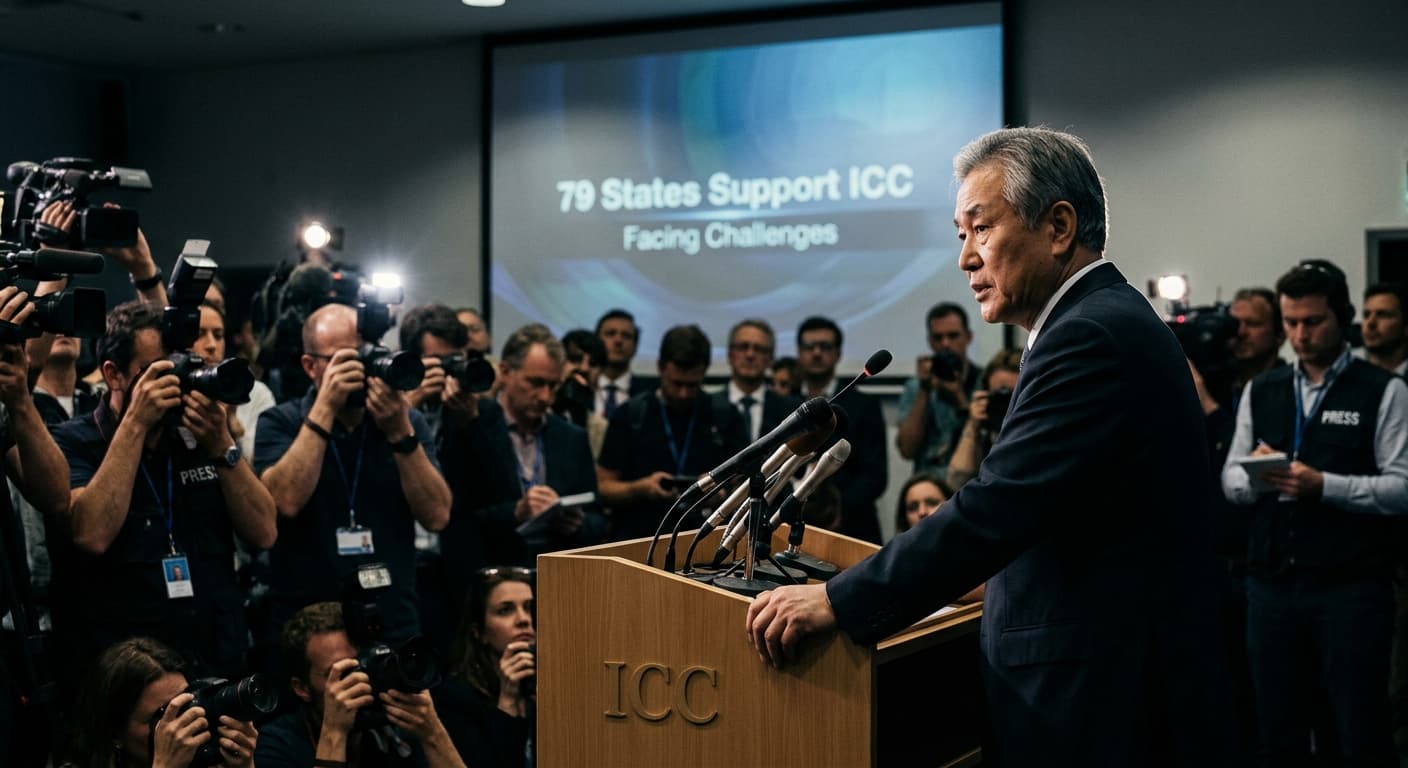
ICC sanctions: 79 states back the court, but the ledger is shifting
Seventy-nine of 125 ICC member states rallied behind the court after Trump's February 2025 sanctions. Eighteen months on, the coalition is holding — barely.
On February 7, 2025, exactly one day after President Donald Trump signed Executive Order 14203, seventy-nine of the International Criminal Court's 125 member states — led by Slovenia, Luxembourg, Mexico, Sierra Leone and Vanuatu — issued a joint statement declaring the Hague tribunal a "vital pillar" of international justice. Eighteen months, three sanctions rounds and one Sahelian defection later, the true story is not the rhetorical solidarity but the widening gap between what states said and what they did — and the fact that the sanctions have already reshaped who the ICC can prosecute, and how.
The BBC reported that the UK, France, Germany, Canada, Brazil and Bangladesh signed; Australia, Italy, Hungary and the Czech Republic did not. That silent list of abstainers — three of them EU members, one a G7 economy — is the first evidence that the Trump order achieved something short of legal victory but far more than diplomatic isolation.

What the sanctions actually did
Executive Order 14203, published at 90 Fed. Reg. 9369 on February 6, 2025, invoked the International Emergency Economic Powers Act (IEEPA) to freeze the U.S. assets of designated ICC personnel and threaten "any foreign person" who "materially" aids probes of "protected persons" — defined as U.S. nationals and citizens of non-ICC allies. The full text and legal architecture are laid out in a July 2025 federal ruling in the Southern District of New York, Smith v. Trump, which enjoined enforcement against two U.S. human-rights advocates on First Amendment and ultra vires grounds.
Prosecutor Karim Khan was designated within days. By June 5, 2025, U.S. Secretary of State Marco Rubio added four judges — Solomy Balungi Bossa (Uganda), Luz del Carmen Ibáñez Carranza (Peru), Reine Alapini-Gansou (Benin) and Beti Hohler (Slovenia). Al Jazeera reported that Slovenia immediately demanded activation of the EU's blocking statute. Two more judges and two prosecutors followed in August; three Palestinian NGOs — Al Haq, Al Mezan and the Palestinian Centre for Human Rights — were added in September for supplying evidence to the court. A December 2025 tranche targeted Judges Gocha Lordkipanidze of Georgia and Erdenebalsuren Damdin of Mongolia after they voted to reject Israel's motion to pause the Gaza investigation,
Al Jazeera reported.
The Associated Press documented the operational effect in December 2025: sanctioned judges lost access to credit cards, banking, Amazon, and in one case health insurance. Deputy prosecutor Nazhat Shameem Khan told AP she was "never quite sure when your card is not working somewhere, whether this is just a glitch or whether this is the sanction," according to Al Jazeera's summary.
The rhetoric held. The legal shield did not.
The joint statement of February 2025 remains, in the words of the ICC Bureau of the Assembly of States Parties, a "firm commitment to uphold and defend the principles and values enshrined in the Rome Statute" — official ICC release of January 23, 2025. ICC President Judge Tomoko Akane, in a
February 7, 2025 statement, called on "our 125 States Parties, civil society and all nations of the world" to stand united.
They stood. They did not shield.
The single most important commitment demanded by the ICC, its President, the European Parliament, and Human Rights Watch was activation of Council Regulation (EC) No 2271/96 — the EU Blocking Statute — which would prohibit European companies from complying with U.S. sanctions against ICC personnel. On March 17, 2025, the European Parliament's human rights subcommittee formally called on the Commission to enact it, according to the Parliament's press service. One year later — in a
March 11, 2026 plenary debate — the Commission representative told MEPs the statute "remains one of these potential tools" whose activation was still being "assessed."
Sixteen months after the sanctions, Brussels has not pulled the trigger. The reason, stated on the record in that same debate: activation "would not protect the EU operators from US action outside the European Union, especially when they have economic and financial exposure to the US." Translated: European banks and cloud providers will not defy OFAC because their New York correspondent accounts matter more than their Hague clients.
Who benefits from the gap between statement and action
The Trump administration's strategic bet was that the sanctions did not need to force ICC members to renounce the court — only to make cooperating with it operationally expensive. That bet is paying off. Microsoft, Amazon and major European banks have quietly severed relationships with sanctioned personnel rather than test IEEPA's 20-year prison exposure. The Hague court's practical work — banking, insurance, IT infrastructure — is degraded in every situation on its docket, from Ukraine to the Philippines, as ICC President Akane told MEPs in March 2025.
The second beneficiary is Israel. The ICC's November 2024 arrest warrants against Benjamin Netanyahu and former defence minister Yoav Gallant remain outstanding, but the political cost of executing them has climbed. Middle East Eye reported, and Al Jazeera confirmed in December 2025, that then–UK Foreign Secretary David Cameron privately warned Khan in April 2024 that Britain would "defund and withdraw from the ICC" if the warrants issued.
The third — and least anticipated — beneficiary is a small cluster of governments that have chosen this moment to exit. On July 1, 2026, the ICC Presidency confirmed that Burkina Faso, Mali and Niger have taken steps to withdraw from the Rome Statute, in an official statement noting the Presidency "regrets these developments." The three Sahel juntas timed their exits to a moment when the court's most powerful non-member is publicly attacking it — a diplomatic subsidy Washington did not intend but has paid.
The Brookings thesis, tested
The prevailing expert view in early 2025, articulated by Kelebogile Zvobgo at Brookings, was that sanctions "haven't stopped the court's work in the past and could backfire this time too." Zvobgo cited Fatou Bensouda's refusal to abandon the Afghanistan probe after her 2019 visa revocation as proof that ICC prosecutors do not flinch.
Eighteen months of data complicate that view. The Gaza probe has advanced — the December 15, 2025 pre-trial chamber ruling rejecting Israel's admissibility challenge is the strongest evidence. But the Afghanistan investigation, which Khan quietly narrowed in 2021 to focus on the Taliban and Islamic State rather than U.S. personnel, is functionally dead. And the court is now operating without its chief prosecutor: on June 8, 2026, the ICC Bureau suspended Khan pending an Assembly of States Parties vote after finding "serious misconduct," per an official decision. Britain's Bar Standards Board followed suit on June 19,
Al Jazeera reported.
The misconduct case is legally distinct from the U.S. sanctions. Politically, it is not. A prosecutor sanctioned by Washington, suspended by his own court and disbarred at home is a prosecutor whose successor will inherit a chilled institution. That is the second-order effect the February 2025 signatories did not price in.
The judges push back
On June 25, 2026, three sanctioned judges — Kimberly Prost (Canada), Solomy Balungi Bossa (Uganda) and Reine Alapini-Gansou (Benin) — filed suit in the U.S. District Court for the Southern District of New York. Their complaint, reported by Al Jazeera, argues the sanctions "exceeded the scope of the International Emergency Economic Powers Act" and were "not based on a genuine national emergency or extraordinary threat." The filing describes IEEPA designation as "tantamount to the financial death penalty."
They have a template. In the July 18, 2025 Smith v. Trump ruling, Judge Nancy Torresen granted a preliminary injunction barring enforcement of EO 14203 against two U.S. advocates, holding that the order's speech restrictions likely violate the First Amendment and that IEEPA's own §1702(b)(3) exempts the export of "information or informational materials." That ruling protects Americans; the judges' new suit tests whether Article III courts will extend comparable protection to foreign officials of a treaty-based institution.
The Trump administration is not waiting. On June 29, 2026, acting Attorney General Todd Blanche sent ICC President Akane a letter — reported by Al Jazeera on July 2 — declaring: "The ICC has no jurisdiction over U.S. persons — anywhere in the world — and any attempt to assert such authority is illegitimate, unlawful and a direct affront to the sovereignty of the United States."
The Hague Group and the emerging counter-coalition
The most durable institutional response has come not from the EU but from nine Global South states. In January 2025, South Africa, Malaysia, Colombia, Bolivia, Cuba, Honduras, Namibia, Senegal and Belize launched the Hague Group, a coalition explicitly committed to enforcing ICC arrest warrants and defending the court against political pressure. Human Rights Watch's April 2025 advocacy note framed the Group as filling a gap left by European hesitation on the blocking statute.
The Group's leverage is limited — none of its members hosts a major reserve currency or global bank — but its formation signals that the defense of the ICC is drifting from the transatlantic core to the Global South, mirroring the pattern already seen in the ICJ's genocide case against Israel.
What to watch
- The Khan vote. The Wall Street Journal reported that the Assembly of States Parties has provisionally scheduled a July 24, 2026 special session on Khan's removal. Sixty-three of 125 states must vote to remove him. The outcome will determine whether the Office of the Prosecutor operates under an interim or a new appointee through the Netanyahu warrant enforcement phase.
- The Manhattan lawsuit. The Prost/Bossa/Alapini-Gansou complaint (S.D.N.Y., filed June 24, 2026) tests whether IEEPA sanctions on foreign judicial officers survive judicial review. A preliminary-injunction hearing is expected in the coming months.
- EU Commission decision on the blocking statute. The Commission told the European Parliament in March 2026 that activation was under "serious" assessment. Slovenia, whose national is sanctioned, continues to push. A decision would materially affect European banks' willingness to serve ICC personnel.
- The next designation. Rubio has retained authority under EO 14203 to add names on a rolling basis. Judges who ruled against Israel in the December 15, 2025 admissibility decision remain exposed.
The Bottom Line
The 79-state joint statement of February 2025 preserved the ICC's political legitimacy but did not protect its operations — and the eighteen months since prove that rhetorical solidarity is not the same as legal shielding. The Trump sanctions have degraded the court's ability to function without a single member state renouncing it, which is the outcome Washington actually wanted. Whether the ICC survives as an effective institution now depends less on The Hague or Brussels than on a Manhattan federal courtroom and a July 24 vote in New York.
Discover more

Global Politics
U.S. Naval Blockade Heightens Iran Tensions
The U.S. naval blockade of Iran collapsed oil exports, creating a new maritime regime in Hormuz that favors Tehran.

US Politics
SNAP Food Assistance Faces Legal Challenges
In 2026, SNAP faces stricter eligibility rules and mounting legal challenges, threatening food assistance for the millions of Americans who rely on the program.
Global Politics
Xi Jinping Calls China-Russia Ties 'Precious'
Xi Jinping's description of China-Russia ties as 'precious' reflects a strategic imbalance, with Beijing dictating terms in the partnership.

Economics
Fed's Amex AML order puts correspondent banking on notice
Federal Reserve's Amex AML order requires board-level controls and a 90-day plan; OCC fined the bank $350 million over enterprise-wide deficiencies.