Zimbabwe's 2030 Agenda: Mnangagwa's Coup
A constitutional amendment extends Mnangagwa's rule to 2030.
Model Diplomat9 min readSouthern Africa
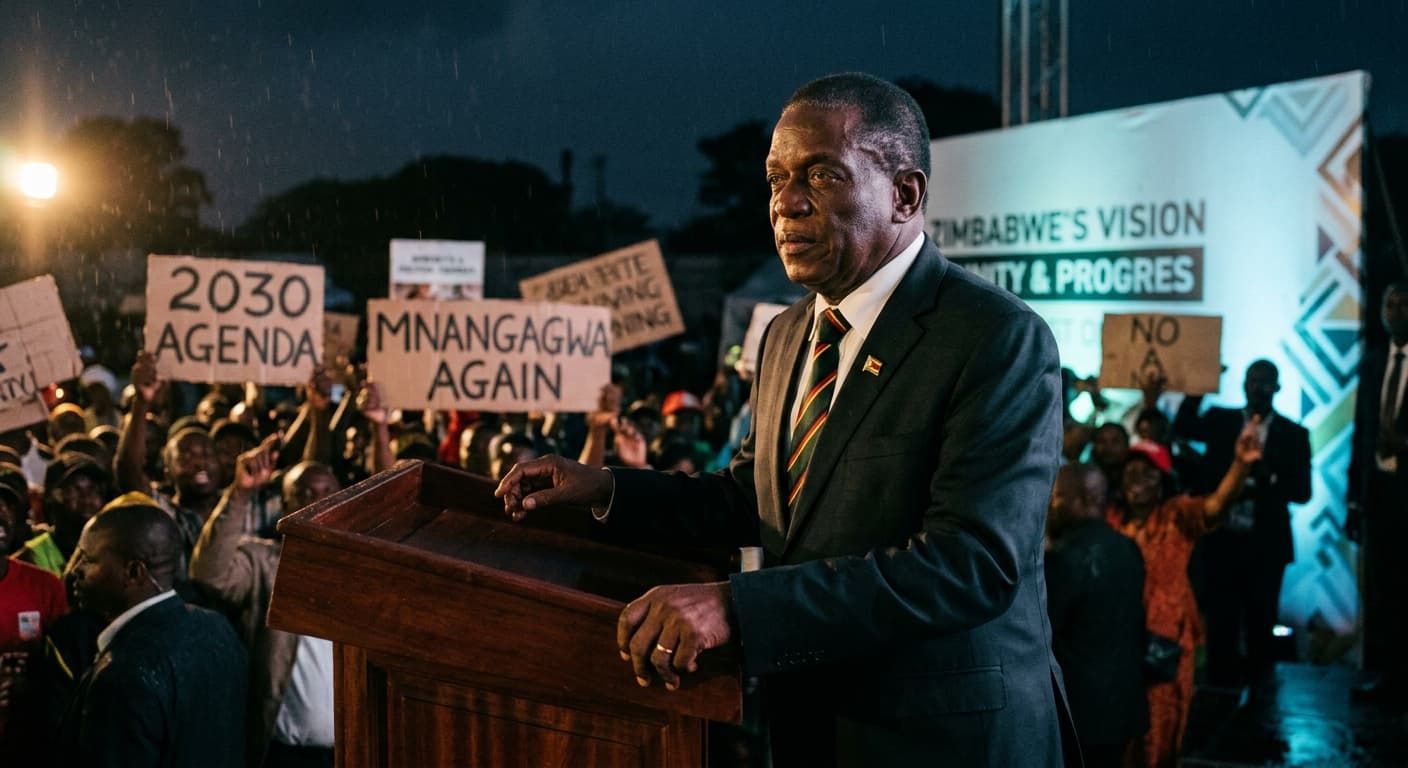
Zimbabwe's 2030 Agenda: Mnangagwa's Constitutional Coup
Mnangagwa signed a law on July 7, 2026 extending his rule to 2030 and letting parliament pick the next president — a Southern African template for term-limit evasion.
Emmerson Mnangagwa, 83, signed the Constitution of Zimbabwe Amendment (No. 3) Act into law on July 7, 2026. The amendment stretches his second and final term two years past its 2028 expiry, abolishes direct presidential elections, and lengthens every future presidential and parliamentary term from five to seven years. The change was pushed through parliament — 216–42 in the National Assembly on June 18 and 75–4 in the Senate on June 24, according to Al Jazeera — without the referendum the 2013 constitution appears to require. That method matters more than the two years. Zimbabwe has imported the Togo playbook into Southern Africa — rather than delete term limits, redesign the electoral system so the ruling party's parliamentary majority becomes the sole gatekeeper to the presidency. The precedent, not the president, is the story.
For the Southern African Development Community (SADC), where all but two of 16 members hold direct presidential elections and where Mnangagwa was chair as recently as 2024, that redesign is the first successful attempt to move a functioning direct-election democracy to a parliamentary-selection model since Togo did it via a new constitution in May 2024. Zimbabwe did it with a single amendment — and no referendum.
The mechanics of the workaround
The 2013 constitution was drafted to be coup-proof against exactly this move. Section 328(7) states that any amendment whose "effect" is to extend the length of time an incumbent may hold office cannot apply to that incumbent, and any such change must be endorsed twice in a national referendum. David Coltart, the Bulawayo mayor and CCC leader who helped draft the 2013 text, argued in an Institute for Security Studies analysis that "it doesn't matter how one couches what this amendment is described as, whether it is a cycle or term — the simple enquiry is whether the provision one seeks to change involves the length of time a person holds public office."
ZANU-PF's answer, delivered on X by Treasurer General Patrick Chinamasa and quoted in the same ISS piece, was that the bill "elongates the electoral cycle" rather than the term itself, and that "there will be no referendum. Full stop." The Constitutional Court reserved judgment in May 2026 and then, according to
Brookings, dismissed the challenges on technical grounds. The BBC
reported that a further constitutional challenge was dismissed the day before the Assembly vote.
The reworked constitution now says presidents can serve two seven-year terms, are elected by parliament — abolishing direct presidential polls that Zimbabwe has held since 1990, per the BBC — and that the parliamentary elections scheduled for 2028 are postponed to 2030. Mnangagwa's current term simply expires later. That is what ZANU-PF calls "elongation."
How the two-thirds majority was assembled
ZANU-PF alone did not have the numbers. The party controls 33 of 80 Senate seats and lacked a two-thirds majority in either chamber outright. The bill cleared because Senator Sengezo Tshabangu — who since 2023 has used a Supreme Court ruling to recall opposition MPs and senators aligned with Nelson Chamisa — delivered the CCC bloc. More than 30 opposition legislators voted in favour in the National Assembly, according to Al Jazeera's Farai Matiashe, some of them recipients of vehicles from the ZANU-PF-linked businessman Wicknell Chivayo. The Portuguese-language wire
ANG noted the amendment "would not have been approved without the support of CCC senators aligned with Sengezo Tshabangu."
That is the second precedent worth extracting: a ruling party facing a hard constitutional entrenchment does not need to defeat the opposition, only to capture its leadership through the courts and recall the dissenters. It is the "lawfare" model documented across Zambia, Tanzania, the DRC and Togo. The BBC noted that public consultation "hearings" were marked by allegations of intimidation and the death, days before the process concluded, of Blessed "Bombshell" Geza, the war-veteran-turned-YouTuber who had been the most audible internal opponent of the 2030 agenda.
The succession war ZANU-PF didn't want to have
The extension is best understood as the outcome of a two-year succession fight inside ZANU-PF that Mnangagwa was losing on the merits and won by rewriting the rules. Vice President Constantino Chiwenga — the former general who led the November 2017 coup against Robert Mugabe — was widely expected to succeed Mnangagwa in 2028 as reward for that coup. Al Jazeera reported in April 2025 that Mnangagwa had already begun purging Chiwenga allies, moving General Anselem Sanyatwe from army chief to a sports ministry portfolio.
By moving presidential selection to parliament, where ZANU-PF's Politburo controls candidate lists, Mnangagwa has done more than buy two years. He has removed Chiwenga's most plausible route to power, which ran through a direct popular vote in which the vice president's military constituency and rural support could have overwhelmed a Mnangagwa loyalist. The Al Jazeera analyst Justice Mavedzenge has argued the deeper play is dynastic: "His intention is to leave power when one of his family members is ready to take over." Mnangagwa's son Emmerson Jr. and nephew Tongai Mnangagwa now sit in senior party structures.
Chiwenga has stayed publicly silent through the entire process. That silence is the single most important variable in Zimbabwean politics for the next 24 months.
The regional pattern — and why SADC is the outlier that just fell
Southern Africa had, until this week, been the last African subregion where presidential term limits were broadly respected. Presidents in South Africa, Botswana, Namibia, Zambia, Malawi and Angola have stepped down at term's end within the past decade. The exceptions — Eswatini's absolute monarchy, Mozambique's FRELIMO and Zimbabwe under Mugabe — were the outliers, not the norm.
The Journal of Democracy documented in October 2024 that 30 of 54 African states now operate without meaningful term limits, and that 14 have either eliminated or extended presidential terms since 2002. Zimbabwe's amendment adds a specifically Southern African data point to a trend previously concentrated in Central and Francophone West Africa. Brookings scholar
John Mukum Mbaku calls the tactic a "constitutional coup" — the manipulation of legal texts to achieve what tanks used to.
Regional response has been muted. SADC's protocol on democratic governance contains no enforceable term-limit norm — unlike ECOWAS, which is drafting one. The African Union Peace and Security Council has historically treated constitutional term extensions as "sovereign prerogative" and reserved its unconstitutional-changes-of-government framework for military coups. Ghanaian President John Mahama, whose country holds the AU chair in 2027, hosted Mnangagwa for a bilateral in April 2026 that ended with Ghana
endorsing Zimbabwe as venue for the 2027 AU mid-year summit and backing Harare's UN Security Council bid for 2027–2028. There will be no continental sanction.
The EU ambassador in Harare, Katrin Hagemann, was quoted by ZANU-PF's Herald newspaper in February as calling the amendment a "sovereign prerogative," a formulation the EU delegation later hedged but did not retract, per ISS. Zimbabwe is under US sanctions via ZDERA but has been effectively excluded from IMF financing for two decades, blunting Western leverage.
The economy Mnangagwa wants two more years to manage
Mnangagwa's ministers frame the extension as necessary for "policy continuity" to complete "Vision 2030" — the target of upper-middle-income status. The macro picture is better than at any point since 2019 but structurally fragile. The IMF's 2025 Article IV consultation, concluded in October 2025, projected GDP growth of 6% in 2025 after 1.7% in 2024, with monthly ZiG inflation down to 0.3% in June 2025. The
World Bank put 2025 growth at 6.6%.
But the IMF's staff report notes reserve buffers "remain low," that Zimbabwe accumulated nearly US$600 million in domestic expenditure arrears in 2024, and that a Staff Monitored Program remains contingent on 2026 budget discipline. There is no debt normalisation agreement with the Paris Club and China, and Zimbabwe remains locked out of concessional finance by the accumulated arrears the IMF documents. The stability that Chinamasa cites as justification for extension is precisely the stability that a contested transition in 2028 could have unwound — the argument runs both ways.
The Australian Institute of International Affairs reported that over 80% of Zimbabwean national income now flows through the informal sector, with corruption estimated by the government itself at more than US$2 billion annually. Roughly four million Zimbabweans — a quarter of the population — live abroad. The 2030 date is aspirational; the political economy that produced it is a rent extraction machine that requires whoever holds State House to keep the door closed to a reckoning.
Opposition, courts, and the "constitutional coup" contagion
The opposition is broken by design. Chamisa quit the CCC in January 2024 after Tshabangu's recalls; the party that remains bearing that name is largely a ZANU-PF adjunct. Jameson Timba's Defend the Constitution Platform, the National Constitutional Assembly, and a coalition of Catholic bishops and war veterans opposed the bill but could not force a referendum. The Constitutional Court dismissed the referendum challenge on the eve of the National Assembly vote — a ruling constitutional lawyers including Alex Magaisa's former colleagues have said cannot survive scrutiny outside the court's own jurisprudence.
The contagion risk is concrete. Mozambique's Daniel Chapo governs a FRELIMO with the same parliamentary two-thirds arithmetic ZANU-PF exploited. Namibia's SWAPO has the numbers. Angola's MPLA has floated similar language around "electoral cycle harmonisation." What Zimbabwe just demonstrated — that a party can extend an incumbent by two years, scrap direct elections, capture the judiciary's ratification, and face no regional sanction — is a template with a demonstrated success rate.

What could still derail the 2030 agenda
Three things could still break the plan. First, Chiwenga. He commands enough residual loyalty in the Zimbabwe National Army to make a 2017-style intervention theoretically possible; Mnangagwa's purges suggest he takes the risk seriously. Second, the ZiG. Another currency collapse of the kind that occurred in September 2024, when the ZiG lost 43% overnight, would shred the "policy continuity" argument. Third, the courts. The Constitutional Court's technical dismissals leave the substantive question of section 328(7) unadjudicated; a determined legal challenge post-signature, particularly one that reaches the African Court on Human and Peoples' Rights, could still put the amendment in play.
None is likely. All are possible. Chiwenga's silence is the only variable that matters before December 2027.
Diplomat View
The 2030 agenda is not primarily about Mnangagwa staying in office. It is about ZANU-PF permanently insulating executive succession from the electorate — and, in doing so, exporting a legal template into Southern Africa that ECOWAS has spent five years trying to prevent in West Africa. Expect Mozambique's FRELIMO to test similar language within 18 months; expect the AU's silence on Zimbabwe to be cited as precedent when it does. The forecast breaks if Chiwenga moves militarily before December 2027, if the ZiG collapses a second time and forces a snap political concession, or if a SADC troika chaired by a genuine reformer (Botswana's Duma Boko is the closest thing) puts term-limit language back on the regional agenda. Absent those, the most consequential Southern African political story of the decade is not a coup in Maputo or a debt crisis in Lusaka — it is that Harare has just made the ballot itself optional. The next constitutional coup in the region will cite this one.
What to watch next
- September 2026: Zimbabwe's 2026 fiscal review and the IMF's decision on a Staff Monitored Program — the leverage test for external actors who did not object to the amendment.
- December 2026: ZANU-PF's annual conference, where any Chiwenga move (or purge of Chiwenga) will surface.
- August 2027: Zimbabwe hosts the AU mid-year summit; whether Mahama's chairmanship raises constitutional coups on the agenda will define AU norm-setting for the balance of the decade.
- 2028 (originally scheduled election date): watch for referendum petitions and SADC observer statements; the absence of an election is itself the datapoint.
Discover more

US Politics
SNAP Food Assistance Faces Legal Challenges
In 2026, SNAP faces stricter eligibility rules and mounting legal challenges, threatening food assistance for the millions of Americans who rely on the program.
Global Politics
Trump's Conflicting Messages on Iran War
Trump's mixed messages on Iran reflect a strategy of audience management, benefiting Tehran amid a complex geopolitical landscape.

US Politics
Next Generation Republicans
A leaked survey shows 39% of Republicans under 30 do not identify as MAGA, revealing a split in the GOP's future leadership.

Conflict & Security
Drone Warfare Killing Aid Workers at Unprec
Over 1,000 humanitarian workers killed in three years as cheap armed drones collapse legal protections. Gaza, Sudan, Ukraine, and DRC see deliberate targeting of aid convoys and hospitals with zero prosecutions.