Yemen's Hostage Crisis: UN Staff Detained
Houthi detentions disrupt humanitarian efforts in Yemen.
Model Diplomat8 min readMiddle East
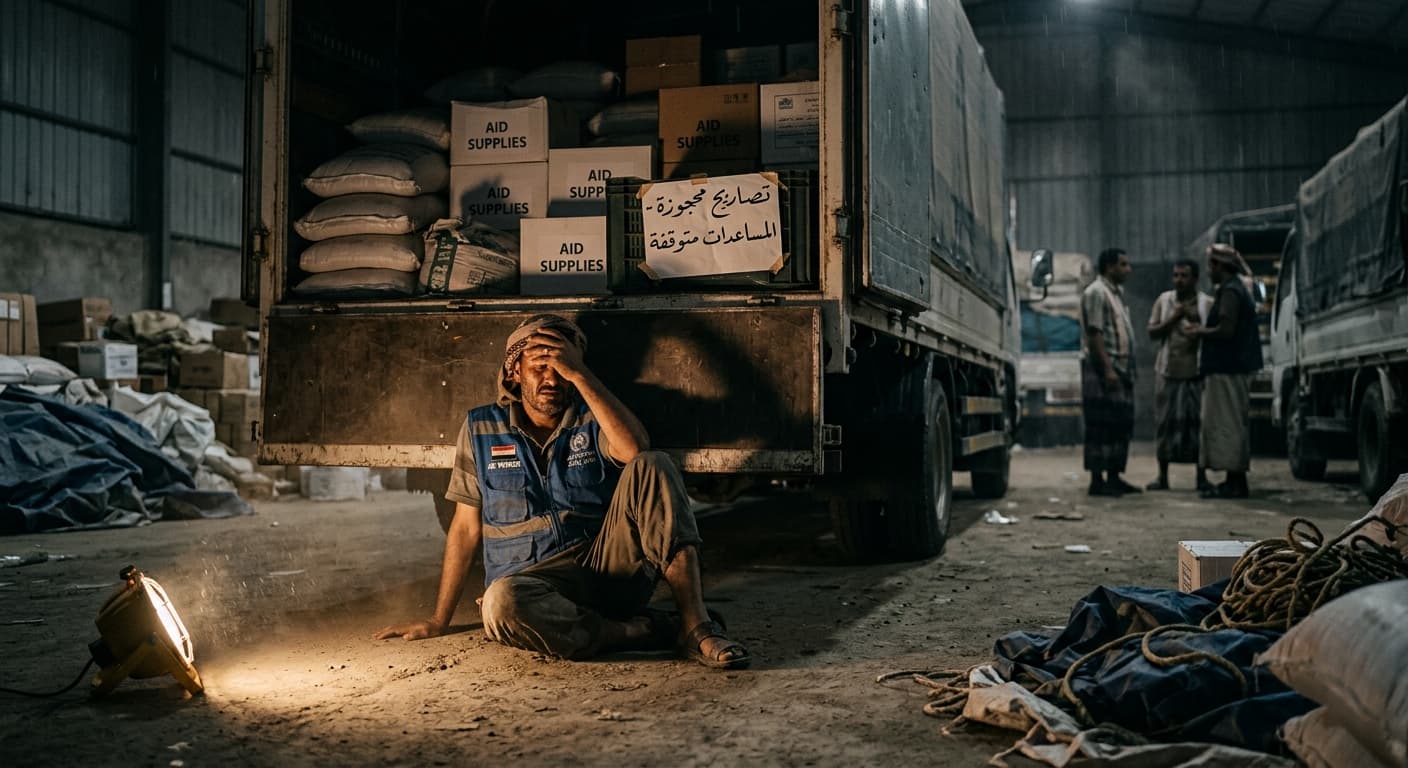
Yemen: Why 73 hostages in UN offices are killing more Yemenis than airstrikes
Houthi detentions of 73 UN staff have collapsed humanitarian access in northern Yemen — the operational lesson from civil-military coordination is that hostage-taking now works better than combat.
The Houthi movement is holding 73 United Nations personnel in arbitrary detention as of June 10, 2026 — more than have been killed in any Saudi-led airstrike since the war's peak, and enough to have forced the UN to relocate its Humanitarian Coordinator out of Sanaa, freeze WFP operations across the north, and suspend official movement into Houthi-held Yemen for months at a time. The kidnappings, not the bombings, are what finally broke the aid architecture. That is the operational lesson from a decade of civil-military coordination in Yemen: a belligerent that captures the humanitarian system's own staff can shut down assistance to 22.3 million people more efficiently than any air campaign, and at essentially no diplomatic cost.
According to the Secretary-General's June 10, 2026 statement, 73 UN personnel remain held, one has died in custody, and "some colleagues are being held incommunicado." The number was 24 in January 2025 and 52 worldwide at the same point in 2025, per an
Al Jazeera Human Rights review citing UN data of 118 UN staff detained globally by March 2026. Yemen is now the single largest concentration of detained UN personnel in the world.
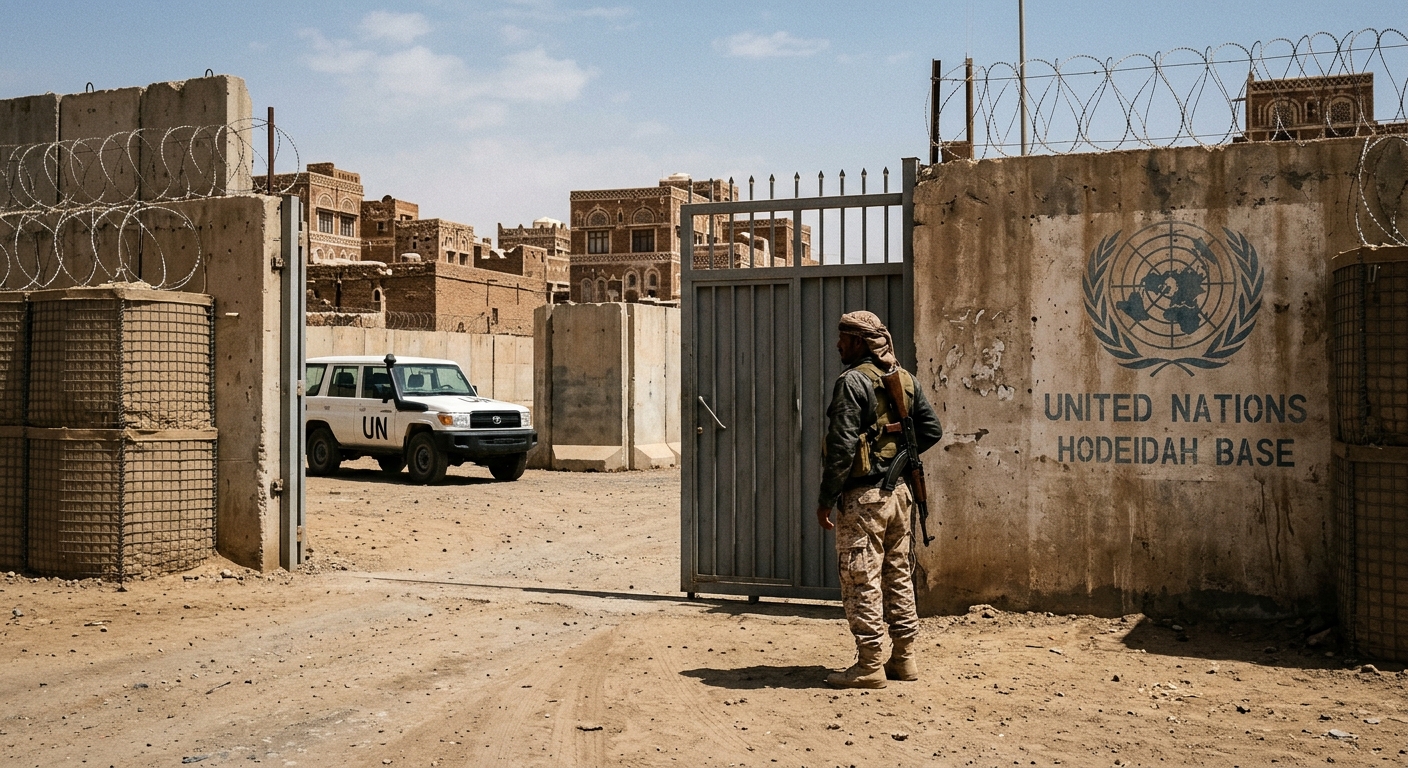
The escalation the deconfliction system was not designed to stop
Yemen's humanitarian civil-military coordination architecture was built for a different war. When OCHA's Humanitarian Country Team in Sanaa established the Deconfliction Mechanism in April 2015, its purpose was to notify the Saudi-led Coalition's Evacuation and Humanitarian Operations Committee of static locations and convoy movements so airstrikes would not hit clinics, warehouses and Land Cruisers. The mechanism is voluntary and, as OCHA notes in the document, "does not constitute a legally binding agreement" and "does not guarantee the safety of personnel." It was, in the UN-CMCoord vocabulary, deconfliction against kinetic risk from an external air force.
That model worked, imperfectly. What it never anticipated was that the de facto authority hosting the humanitarian operation would itself become the primary security threat — not by bombing UN premises, but by walking into them. On October 19, 2025, Houthi forces entered a UN compound in Sanaa's Hada district and detained roughly 20 staff, including 15 international personnel, seizing computers, phones and servers, according to Al Jazeera. The deconfliction list did not help; the address was known — that was the point.
From tribal ransom to state coercion
Yemen has a long taxonomy of abduction. As the Safer Yemen dataset covering 2010–2014 catalogued, kidnappings of foreigners were once mostly tribal instruments — leverage to extract prisoner releases or state payments, usually ending, as DefenceWeb reported in one 2014 case, with the release of seven UN workers within 48 hours once a jailed relative was freed. Costs were low, casualties rare, the transactional logic legible. Al-Qaeda in the Arabian Peninsula introduced a more lethal ransom-and-execution variant after 2013.
What the Houthi de facto authorities have done since May 31, 2024 is different in kind. As Amnesty International, Human Rights Watch and the Cairo Institute documented in June 2026, the arrests are state-scale, criminalised through the Specialized Criminal Court, and framed as counter-espionage. In late October 2025, acting foreign minister Abdulwahid Abu Ras told Reuters that a "cell" inside the World Food Programme had been linked to the Israeli strike that killed Prime Minister Ahmed al-Rahawi; Houthi official Nasruddin Amer told DPA the detainees would be tried for spying for Israel — a charge that carries the death penalty,
Al Jazeera reported. On November 23, 2025, the same court in Sanaa sentenced 17 people to death by firing squad in a related espionage case, per
Al Jazeera.
The tribal ransom paid off in hours. The state-coercion model pays off in months of humanitarian shutdown — and in the leverage that comes with holding staff as chips against Israeli operations, US Foreign Terrorist Organisation redesignation, and Saudi-Houthi roadmap talks.
What the aid architecture has already conceded
The concessions are visible on the ground. In February 2025, after a wave of raids and the death in custody of a WFP worker named only as Ahmed, the UN suspended all operations in Saada — a Houthi stronghold where seven UN agencies were active — citing a lack of "necessary security conditions," per Al Jazeera. WFP announced it would terminate its decades-long operations in northern Yemen by the end of March 2026, according to the
BBC's February 27, 2026 investigation. Save the Children and the International Rescue Committee suspended work in Houthi areas in 2025. In September 2025, the UN Humanitarian Coordinator was physically relocated from Sanaa to Aden — the first structural retreat of the UN's political-humanitarian centre of gravity from the Houthi capital since 2015.
The operational cost is measurable. Briefing the Security Council in early 2026, Ramesh Rajasingham, on behalf of Under-Secretary-General Tom Fletcher, told members that more than 450 health facilities have closed, that Yemen recorded the world's highest measles caseload in 2025, and that 5.5 million people are in IPC Phase 4 emergency food insecurity or worse. His first ask of the Council was not a ceasefire; it was the release of the detained staff:
First, all Council Members must exert their influence and pressure to bring about the release of the 73 UN workers who remain held by the Houthi de facto authorities... End this arbitrary detention, return these staff to their families and loved ones, and allow humanitarians to do their job safely and unimpeded.
The immunity claim, and why it is not working
The UN's legal position is straightforward. In his June 10 statement, the Secretary-General reiterated that "United Nations personnel, including those who are nationals of Yemen, are immune from legal process in respect of all acts performed by them in their official capacity." That immunity, codified in the 1946 Convention on Privileges and Immunities, is the load-bearing beam of the entire civil-military coordination system: it is what lets a Yemeni WFP driver cross a Houthi checkpoint at all.
The Houthis have functionally punctured it. By transferring three detainees to a criminal court in December 2025 — for what Guterres explicitly called charges tied to "their performance of United Nations official duties," per Al Jazeera — the de facto authorities are testing whether the international community will accept a national-security exception to functional immunity. So far, the answer has been letters, not consequences. And the market signal to other belligerents — in the Sahel, in Myanmar, in Sudan — is that hostaging UN staff carries a lower political price than shelling a compound.
Oman, the ICRC, and the deal that was not offered
The story's second-order lesson is who is not being traded. On May 14, 2026, in Amman, the internationally recognised Yemeni government and the Houthis signed the largest prisoner exchange since the war began: more than 1,600 fighters, seven Saudis, 20 Sudanese, brokered under Omani mediation and implemented by the ICRC, per Al Jazeera. The detained UN and NGO staff were not on the list.
That is not an oversight. Oman — the only GCC state that stayed out of the 2015 coalition and has become, as Chatham House put it in January 2026, "indispensable to nearly every actor in the conflict" — has kept the humanitarian file separate from the military prisoner file. Sultan Haitham bin Tariq raised the UN detentions with Guterres in mid-December 2025, but Muscat has not put UN staff into the "all for all" prisoner-swap framework. The reason is diplomatic hygiene: linking them would concede that they are prisoners of war rather than protected humanitarians, and would set a permanent market price for future UN hostages. The cost of that hygiene is that the 73 stay in cells while the fighters go home.
What civil–military coordination has to relearn
The operational implications, laid out in the UN-CMCoord Handbook Version 2.1 issued by OCHA in 2025, run in three directions.
First, deconfliction was built to keep humanitarians away from the battlespace. In Yemen, the battlespace is the office. The handbook's static-location notification framework assumes the notifying party benefits from disclosure; when the de facto authority uses those addresses to plan raids, the calculus inverts. Expect country teams elsewhere — from Tigray to Rakhine — to quietly stop sharing office coordinates with authorities that have detained staff.
Second, "stay and deliver" has a hostage-taking exception nobody wrote down. WFP's decision to wind down northern operations, and the UN's suspension of movement into Houthi areas, are the first cases in which a UN humanitarian actor has withdrawn from a Level-3 emergency primarily because of civil detention risk rather than kinetic risk. That precedent will be cited.
Third, the humanitarian community's protective instrument of last resort — functional immunity — is only as strong as the willingness of Council members to enforce it. The Security Council has issued statements. It has not sanctioned individual Houthi officials responsible for the detentions, and Russia and China have blocked stronger language, as diplomats present at recent Yemen briefings have noted. Until that changes, the price of taking a UN badge hostage remains close to zero.
What to watch
- Referral of the three named UN detainees to the Specialized Criminal Court in Sanaa. Guterres flagged their transfer in mid-December 2025; a hearing schedule and any death-penalty request will be the next major escalation point.
- The Muscat channel. Whether Oman and the ICRC widen the May 2026 Amman framework to include the 73 UN staff in a follow-on release round — Grundberg's office signalled "further releases" were under discussion.
- WFP's northern shutdown deadline. WFP's stated end-of-March 2026 exit from Houthi areas is the operational deadline that will determine whether the World Food Programme returns at scale or ends its 30-year presence in northern Yemen.
- US FTO designation review. The Trump administration's January 2025 re-designation of the Houthis as a Foreign Terrorist Organisation created ambiguity around humanitarian exemptions; any tightening or loosening in 2026 will directly affect what NGOs can operate in Houthi areas at all.
The Bottom Line
The Houthi authorities have discovered that detaining humanitarians is a cheaper, quieter and more effective way to shape a war economy than fighting it — and the international humanitarian system, built to be shielded from bombs, has no equivalent defence against being hostaged from within. Until the Security Council attaches a real cost to arbitrary detention of UN staff, and until Oman is prepared to put humanitarian workers on the same table as fighters, the 73 in Sanaa will remain the most productive weapons system in Yemen's war.
Discover more
US Politics
Virginia's Redistricting Referendum
Virginia's redistricting referendum is drawing a flood of dark money, shaping future elections and the fight for congressional control amid party stakes.
US Politics
House Ethics Committee Pushes Sexual Miscond.
The House Ethics Committee has shifted responsibility for sexual harassment settlement records to the Office of Congressional Workplace Rights, complicating disclosure efforts.

US Politics
US Launches $166B Tariff Refund Portal
The US is launching a $166 billion tariff refund portal to aid importers hit by Trump-era tariffs, with major implications for trade and supply costs.

Economics
Fed's Amex AML order puts correspondent banking on notice
Federal Reserve's Amex AML order requires board-level controls and a 90-day plan; OCC fined the bank $350 million over enterprise-wide deficiencies.