Women’s Political Representation in India
Women's quota law in India faces hurdles post-implementation.
Model Diplomat8 min readIndia
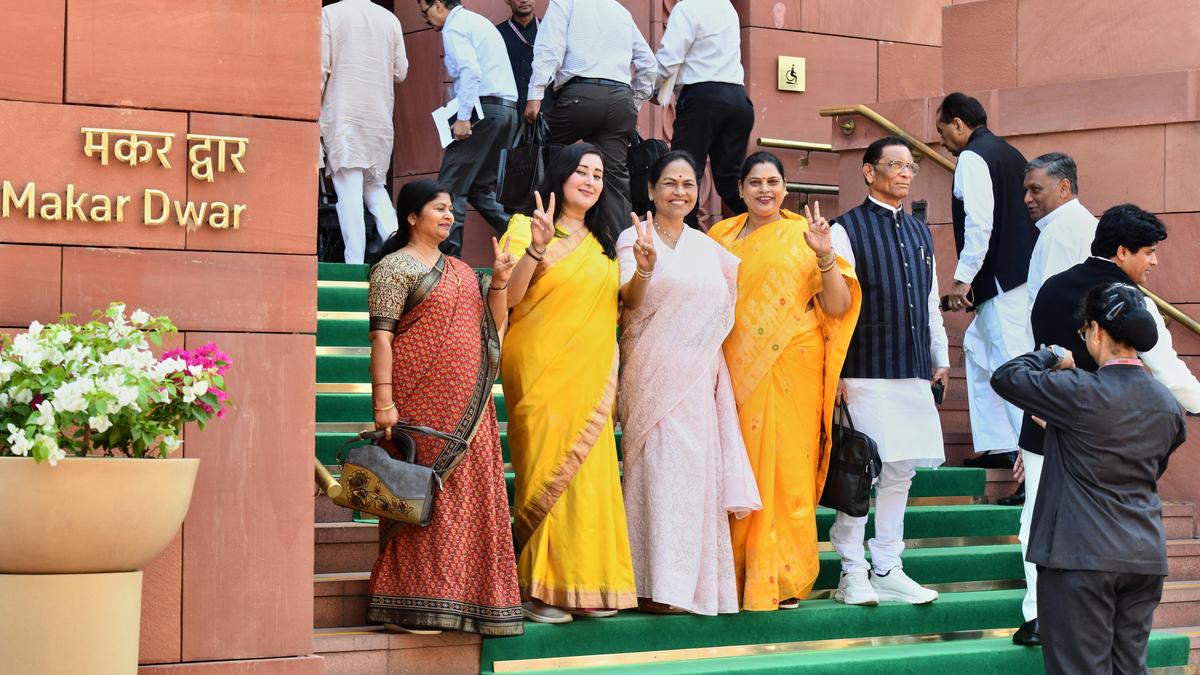
India's Women's Reservation: In Force, Out of Reach
India's 2023 women's quota law took effect on April 16, 2026, yet a defeated constitutional amendment leaves 33% reservation frozen behind delimitation that may miss 2029.
The Lok Sabha killed the Narendra Modi government's attempt to bundle women's reservation with a parliamentary expansion on April 17, 2026 — 298 votes to 230, 54 short of the two-thirds needed to pass the 131st Constitutional Amendment Bill, BBC Hindi reported. The vote matters less for what it blocked than for what it exposed. The Nari Shakti Vandan Adhiniyam, notified into force one day earlier, is now law without a delivery mechanism. India has locked in a 33% women's quota that no woman can yet claim — leaving Lok Sabha representation at 13.6% and state assemblies at 9.5% into at least the 2029 general election, and quite possibly the 2034 one. The real winners of the failed vote are the incumbent MPs of both benches, whose seats will not be rotated, redrawn, or reserved on any near horizon.
A law in force, a right in suspense
The Nari Shakti Vandan Adhiniyam — technically the Constitution (106th Amendment) Act, 2023 — was notified by the Ministry of Law and Justice on April 16, 2026, more than two and a half years after Parliament passed it. Prime Minister Modi called it "one of the biggest decisions of the 21st century" at a Nari Shakti Vandan Sammelan on April 13, urging women "to openly dream that in the coming days, from the states to the Parliament of the country, they can mark their presence," according to the Prime Minister's Office. The statute reserves one-third of seats in the Lok Sabha, state legislative assemblies and the Delhi assembly for women, including within existing SC/ST quotas, for 15 years.
The catch sits in the enabling clause. The 2023 Act says the quota "shall come into effect after an exercise of delimitation is undertaken … after the relevant figures for the first census taken after the commencement" of the Act have been published. In plain terms: no census, no map redraw, no quota. Article 82 of the Constitution, amended in 2001, freezes parliamentary constituency boundaries until "the first census taken after 2026." The 2021 census was postponed through the pandemic and only re-launched this April; officials told Al Jazeera it will take a year to enumerate 1.4 billion people, and longer to publish. A Vidhi Centre for Legal Policy analyst
told the BBC that the last delimitation panel took five years to file a final report — meaning, on a strict census-first reading, women's reservation cannot realistically apply before the 2034 general election.
That is the trap. To hit the 2029 election, the government had to break the sequence and legislate that delimitation proceed on the 2011 figures already in hand. Two-thirds of the Lok Sabha said no.
What the 131st Amendment actually was
The bill that fell on April 17 was not simply a women's reservation instrument. It was a package. As Al Jazeera laid out, three linked measures went to the Lok Sabha: the Constitution (131st Amendment) Bill, which would have raised the Lok Sabha ceiling to 850 seats (815 from states, 35 from Union Territories); a Delimitation Bill, 2026 authorising a fresh redraw of constituencies based on the 2011 census; and a Union Territories Law (Amendment) Bill extending the women's quota to UTs.
That bundling is the whole story. The NDA holds 293 seats in the lower house; a two-thirds majority requires 360. On any single women's reservation vote, opposition parties would have found it politically ruinous to say no. The government instead attached the quota to a delimitation formula that opposition-ruled southern states view as an existential threat. As the BBC noted, India has not redrawn parliamentary seats since the 1971 census; a redistribution keyed to 2011 population would shift decisive weight to the faster-growing Hindi belt and away from Tamil Nadu, Kerala, Karnataka, Andhra Pradesh and Telangana — states that met their fertility targets and now stand to lose relative representation for having done so. The Communist Party of India (Marxist)'s John Brittas told the BBC his party supports 33% reservation "based on the current strength of parliament" but wants a "further freeze on expanding overall seats … until population trends stabilise."
Rahul Gandhi called the package "an attempt to seize power through delimitation and gerrymandering." Congress MP Gaurav Gogoi accused the government of introducing delimitation "through the backdoor" of the women's quota, per Al Jazeera. The BJP's rebuttal — a uniform 50% seat increase across all states — appeared nowhere in the draft bill itself, Al Jazeera noted.
The result: an opposition that wants women's reservation now can vote against the vehicle that would deliver it, because the vehicle also carries a payload that empties out southern political power. The government, in turn, gets what Home Minister Amit Shah signalled in his post-vote statement — a narrative that opposition parties blocked women's representation on the eve of key elections. As one senior journalist told BBC Hindi of the West Bengal poll cycle: "The BJP will now repeatedly say in elections that the opposition did not let us work in favour of women."
The numbers behind the fight
The floor is where the argument lives. The 18th Lok Sabha, elected in June 2024, seats 74 women out of 543 — 13.6%, a slight dip from 78 in 2019, per Al Jazeera. The US Congressional Research Service, in its June 2024 briefing on India's election, put the figure at
14% and flagged the decline — one of the few areas where the 18th Lok Sabha ran backwards on diversity.
The Association for Democratic Reforms, in its March 8, 2026 report, found that of 51,708 candidates who contested the current Lok Sabha and state/UT assembly elections, only 5,095 — 10% — were women; among 4,666 sitting MPs and MLAs, just 464, again 10%, are women. In 2024, 152 of 543 Lok Sabha constituencies — 28% — fielded no women candidates at all, according to
The Hindu, citing ADR. Across 20 assembly elections held since the 2023 Act's passage, women were 10.2% of candidates — statistically indistinguishable from the pre-reform baseline.
Party behaviour is the second-order story. The BJP fielded women for 16% of its Lok Sabha tickets in 2024 and elected 31 — 12.9% of its 240-strong bench. Congress elected 13 women (13.1% of its seats). Mamata Banerjee's Trinamool Congress sends 11 women, 37.9% of its Lok Sabha delegation, per Al Jazeera. ADR's
March 2026 report notes a paradox that punctures the "women don't win" argument: 9% of the 800 women candidates in 2024 won their seats, versus 6% of the 7,554 male candidates. Where women are nominated, they win at a higher rate than men. What holds down representation is the selectorate, not the electorate.
That distinction matters because women now outvote men in India. According to The Economist, women's turnout has overtaken men's, driving cash-transfer schemes targeted at female beneficiaries across state after state. Ahead of Bihar's 2025 poll, the
BBC reported record turnout of 64.66%, with analysts saying women were the decisive bloc; both alliances competed on direct-transfer promises to female voters. Politicians want women's votes. They still do not want women in their seats.
What the panchayat evidence says the quota would change
The strongest empirical case for reservation comes from India's own three-decade experiment at the village level. Under the 73rd and 74th Amendments (1992), one-third of panchayat and municipal seats have been reserved for women. Randomised assignment of women-only pradhan positions in West Bengal and Rajasthan generated one of development economics' most cited natural experiments. Raghabendra Chattopadhyay and Esther Duflo, in Econometrica (2004), found that village councils led by women invested measurably more in drinking-water infrastructure, roads and biogas — goods women identified as priorities — with drinking-water investment roughly doubling in reserved councils, per the
NBER working paper.
The panchayat evidence is what makes the Lok Sabha delay costly, not merely symbolic. It is not disputed that reservation changes policy outputs; it is disputed only how those outputs shift when the reserved body is a national legislature rather than a village council. Every year the quota is deferred is a year in which that shift does not begin.
Who wins the delay
The Australian Institute of International Affairs describes the situation as "compound taxation": women who made it onto BJP tickets in 2024 declared average assets of ₹515 million (about $5.45 million), 2.8 times the equivalent average for INC women candidates, per ADR data cited in that analysis. Where formal barriers to entry rise, informal barriers — dynastic ties, extreme wealth, elite education — take over as the filter. Reservation is designed to break that filter. Its indefinite deferral preserves it.
The direct beneficiary of the April 17 defeat is the sitting MP class. No delimitation means no rotation of reserved seats, no new constituencies drawn against incumbents, no fresh contests forced on entrenched fiefs. Southern regional parties — the DMK, CPI(M), YSRCP — protect their bloc weight in Delhi. Northern-belt incumbents, mostly BJP and its allies, avoid the internal churn of a 307-seat expansion that would have forced difficult local realignments even where the party dominates. And the government retains a live grievance to campaign on. As a senior journalist told BBC Hindi, the government "knew it did not have two-thirds, but politics is the art of possibilities" — the bill was tabled as much for the West Bengal 2026 assembly election as for its own passage.
The direct loser is the median woman politician outside the top three dynastic parties. She has no quota to run on, no party structure inclined to nominate her, and no ₹500-million war chest to open BJP doors. ADR's ledger — 1,664 women among 20,250 independent candidates in the last cycle, not one of whom won — is her arithmetic.
What to watch
The census timetable is now the whole game. House-listing operations began in April 2026; the government's own filings to Parliament suggest enumeration through 2027 and publication in 2028, with delimitation to follow. If the Election Commission and the delimitation commission compress their work — as the 2001 amendment technically permits once the first post-2026 census is published — a 2029 quota is legally conceivable but administratively heroic. Absent that, the operative election is 2034.
Three catalysts to track:
- West Bengal assembly poll, spring 2026: The BJP has already made "opposition blocked women's reservation" a campaign line; Trinamool, the country's most feminised major party by delegation share, is the counter-test.
- Bihar government, post-November 2025: The state with the country's third-highest number of women MLAs (29) is now the test case for whether cash-transfer politics translates into candidate-selection politics.
- Any move to reintroduce a stripped-down 131st Amendment: A women's reservation bill decoupled from delimitation would put the opposition on the spot within months. Its non-appearance is itself a signal.
The bottom line
India passed a women's reservation law in 2023, notified it in 2026, and immediately failed to unlock it. The 33% quota is a right written into the Constitution and a seat that does not exist — deferred not by principle but by a fight over which regions will control the redrawn Lok Sabha. Until Parliament separates the two questions, women's political representation in India will remain what it has been for a generation: near 14% at the top, 10% at the middle, and one-third only at the village council. The panchayat experiment tells us what a real quota would change. The April 17 vote tells us who benefits from making sure that change waits.
Discover more

India
Women Surge in Unreserved Panchayat Seats
India's government reports women occupy 49.75% of panchayat seats, but lacks data on unreserved wins, raising questions about representation.
India
Women Rise in Indian Civil Services, Need Par
Vice President Radhakrishnan urges Parliament to match the rising share of women in civil services, pressing for stronger gender equality in governance.
Global Politics
Modi's 33% Women Reservation Bill Impact
India's Women's Reservation Bill would reserve 33% of parliamentary seats for women, a reform poised to reshape political dynamics and gender representation.
India
Former Leaders Endorse Women's Reservation
Pratibha Patil, Meira Kumar, and Mayawati backed the 33% Women's Reservation Bill, uniting behind a push to expand women's political representation in India.