WFP's 2025 Report: Funding Cuts and Famine
UN World Food Programme faces severe funding crisis in 2025
Model Diplomat10 min readGlobal
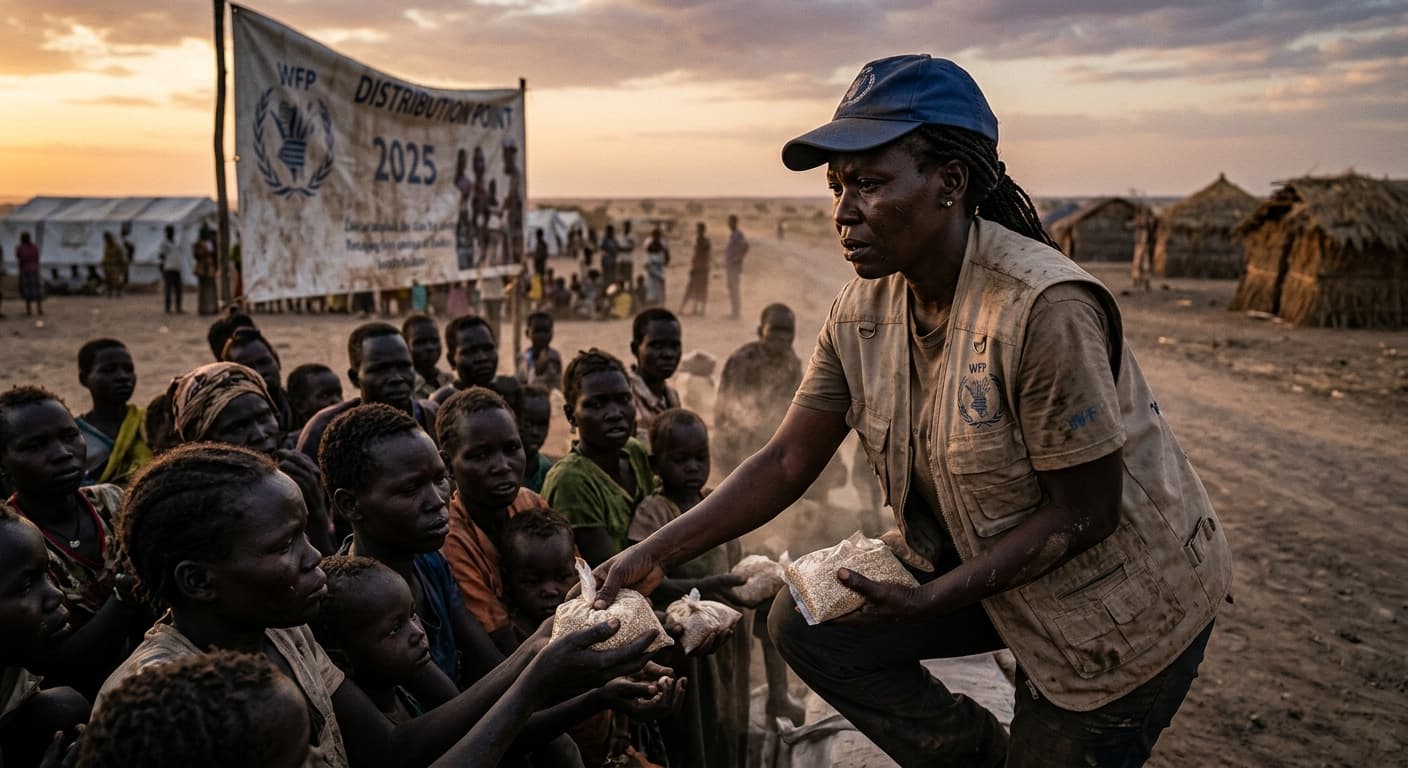
WFP's 2025 Annual Report: Triage Dressed as Innovation
The UN World Food Programme reached 121 million people in 2025 as funding fell 33% — a $12.6 billion gap that forced rationed famines and a new triage doctrine.
The World Food Programme's Annual Performance Report for 2025, released to its Executive Board on June 24, 2026, records the sharpest one-year contraction in the agency's modern history: confirmed contributions fell 33 percent to USD 6.5 billion, covering just 41 percent of a USD 19.1 billion operational requirement, while an estimated 318 million people faced acute hunger and two famines were declared inside the same calendar year — a first this century. The report's own tagline — "Delivering Faster and Smarter Despite Compounding Crises" — is best read not as a communications triumph but as the doctrinal name for a triage system: WFP reached 121 million people, 3.5 million fewer than in 2024, and distributed only 47 percent of planned food and cash. The story of 2025 is not that WFP innovated its way through the crash. It is that anticipatory action and AI kept the machinery running while ration cuts, beneficiary de-listing, and famine declarations were quietly normalised in the field.
The numbers behind "faster and smarter"
The headline figures come from WFP's own Executive Board presentation delivered on June 4, 2026. Confirmed contributions fell from USD 9.8 billion in 2024 to USD 6.5 billion in 2025. Operational requirements simultaneously rose from USD 16.9 billion to USD 19.1 billion, driven principally by escalating budgets for Sudan and the State of Palestine, per the
Update to the WFP management plan (2025–2027). Direct expenditures came in at USD 7.8 billion, down from USD 8.4 billion, with 76 percent absorbed by crisis response. Resilience-building fell to 19 percent and root-causes work to just 5 percent — the classic pattern of a humanitarian system consuming its own long-term investments to feed today's emergency.
Flexible funding — the discretionary money that lets WFP move resources across borders without donor earmarks — dropped 23 percent to USD 850 million, or 13 percent of total contributions. That is a significant retreat from the USD 1.1 billion in flexible funding that WFP itself credits as the operational core of "faster, smarter, life-saving action." UN pooled funding contracted just as sharply: the Central Emergency Response Fund allocation to WFP fell from USD 133 million to USD 77 million. These are the two funding streams that make "faster and smarter" possible in the first place; both shrank faster than the topline.
The single most consequential number is not in the report's marketing summary. According to the Executive Board briefing, WFP distributed only 47 percent of planned food and cash-based transfers — a delivery ratio that reflects not efficiency but the compound effect of funding cuts, access denials in Gaza and Sudan, and outright suspension of operations. Ration reductions of over 40 percent were imposed in "many country offices," per the same document, and operational reach declined globally by 3.5 million people compared with 2024. The Programme Support and Administrative budget was cut a further 10 percent, on top of a 15 percent cut in 2024 — meaning the overhead that funds anticipatory action, evaluation and country-office capacity has now been compressed by roughly a quarter over two years.
Where the money went — and where it didn't
The largest single trigger was the second Trump administration's decision, in the opening months of 2025, to freeze and then cancel most US humanitarian contracts. The United States had contributed roughly USD 4.5 billion to WFP in 2024, nearly half its budget; the Council on Foreign Relations calculated US contributions to WFP collapsed by more than half in 2025, a USD 2.6 billion swing following the shuttering of USAID. NPR reported in May 2025 that WFP leadership had told staff to expect
6,000 job cuts, or 25–30 percent of the workforce. The cuts fell hardest in country offices that had scaled up during the 2022 peak funding year of USD 14.2 billion.
The withdrawal happened in visible spasms. NPR documented that USAID contracts worth more than USD 1.3 billion were cancelled in a single weekend in April 2025 — including USD 464 million in WFP contracts across Ecuador, Iraq, Jordan, Lebanon, Somalia and Syria, some of which were subsequently reinstated after State Department review. The reversals themselves — described by a former USAID official as "total whiplash" — imposed a planning cost that no efficiency gain could recoup. USD 280 million in USAID grants to WFP Afghanistan and USD 67 million for Yemen were zeroed out and never restored, on the stated grounds that funds risked benefiting the Taliban and Houthis. In Sudan, the BBC found that roughly
80 percent of emergency communal kitchens had closed following the US aid freeze — the flexible cash pipeline that had underwritten them simply evaporated.
Europe compounded the shock. The UK cut aid from 0.5 to 0.3 percent of gross national income to fund defence, saving roughly £6 billion annually, Al Jazeera reported after UN humanitarian chief Tom Fletcher warned that "many will die because that aid is drying up." The Netherlands cut roughly €1 billion. WFP's contribution table for 2025 shows a donor base "diversified but concentrated" — the polite phrasing for structural dependence on a Washington that has decided humanitarian architecture is negotiable.
Two second-order effects deserve attention. First, the US Congressional appropriation for FY2026 channels nearly all remaining humanitarian dollars through UN OCHA rather than bilaterally to WFP, UNICEF and UNHCR. Per CFR, the USD 2 billion pledged to OCHA is less than what WFP alone received in 2025, and the USD 200 million earmarked for Sudan is now shared across the entire humanitarian community rather than dedicated to WFP's operation. Second, private-sector fundraising did not fill the hole: WFP mobilised USD 310 million from private sources in 2025 — welcome, but a rounding error against the shortfall. CFR's
wider dataset shows that of 62 donor governments that contributed to CERF in 2025, only five private-sector contributions were made, the largest a single USD 2 million pledge.
The innovation ledger: real, but oversold
WFP's Rome headquarters is not wrong to call 2025 a year of operational innovation. The Innovation Accelerator's 2025 Year in Review, published May 26, 2026, records that innovation-linked programmes reached 132.5 million people in 75 countries — double 2024 — and generated USD 23 million in direct savings for WFP plus USD 301.8 million for the wider humanitarian ecosystem. The
2024 Annual Performance Report had already logged 99.7 percent uptime on critical IT systems, the launch of WFP's first global data and AI strategies, and USD 169.9 million in efficiency gains from innovation. In 2025, WFP signed 125 South–South and financial-institution agreements worth USD 843 million, an important pivot toward IFI-linked co-financing as bilateral aid retreats.
The most substantively "smarter" instrument is anticipatory action — pre-positioning cash and food before a forecast disaster, rather than after. The evidence base hardened significantly in 2025. A World Bank randomised controlled trial published as Fast Action for Floods found that households receiving forecast-based cash transfers in Bangladesh and Nepal experienced measurable gains in food security and psychosocial well-being versus post-flood recipients. A parallel
Niger drought RCT found that large, early cash transfers before the lean season produced an 8 percent higher food consumption score than the traditional lean-season response. A joint FAO–WFP–OCHA synthesis,
Saving lives, time and money, argues that anticipatory action is now a cost-effective default in predictable-hazard contexts.
But the numbers on scale are humbling. In Bangladesh, WFP and the disaster ministry mobilised USD 10.4 million for anticipatory action in 2024, reaching 430,000 people ahead of four hazards — while more than half of households needing coverage went unsupported and the 2025 funding requirement of USD 42 million remained more than half unfunded. In Ethiopia, a CERF-funded WFP drought anticipatory action grant
reached 49,470 people with USD 1.5 million between October 2024 and June 2025. Saint Lucia ran the first end-to-end government-led anticipatory-action simulation in the English- and Dutch-speaking Caribbean in May 2025, tied to its social protection registry — a genuine institutional advance but at pilot scale. Anticipatory action is a demonstrably better instrument. It is not yet an instrument of scale.
Two famines, one calendar year
The best measure of whether "faster and smarter" was enough is the IPC ledger. It is not.
On August 22, 2025, FAO, WFP, WHO and UNICEF issued a joint press release confirming famine in Gaza Governorate — the first formal famine declaration in the Middle East since the IPC scale was created. The
IPC Famine Review Committee report projected famine to expand to Deir al-Balah and Khan Younis, with more than 640,000 people in IPC Phase 5 by end-September. The FRC noted it had "never before had to return so many times to the same crisis." In August 2025, WFP Executive Director Cindy McCain told NPR the agency was getting
about 100 trucks a day into Gaza, compared with 600 during the previous ceasefire — a delivery collapse that no logistics innovation could reverse.
"As this Famine is entirely man-made, it can be halted and reversed. The time for debate and hesitation has passed, starvation is present and is rapidly spreading." — IPC Famine Review Committee, August 2025
On November 4, 2025, UN News reported that the IPC had confirmed famine conditions in El Fasher and Kadugli, Sudan, with 21.2 million Sudanese — 45 percent of the population — in acute food insecurity. Global Acute Malnutrition in El Fasher reached 38 to 75 percent. That two IPC Phase 5 declarations occurred in a single calendar year is, per the CFR analysis, the defining superlative of 2025: "the worst humanitarian year on record."
Who benefits, who loses
The winners from the 2025 architecture are not obvious but they are identifiable. UN OCHA, under Tom Fletcher, gains coordinating power as the US channels its residual funding through a single point. National governments that host WFP operations gain leverage: the new WFP Strategic Plan 2026–2029 explicitly commits the agency to strengthening or "shifting to national systems" where feasible, meaning host states now sit on the receiving end of a more explicitly consultative relationship. Private-sector fundraising units at WFP, UNICEF and UNHCR — the three UN agencies with mature individual-giving models — retain relative autonomy that OCHA and smaller entities lack.
The losers are the populations WFP has been forced to de-list. The agency's own Annual Evaluation Report 2025 states plainly that from 2023 onward, and intensifying in 2025, "WFP did not always manage to reach all intended beneficiaries," with evaluations in the DRC, Ethiopia and Yemen finding "beneficiaries' nutritional thresholds were not maintained during crisis responses." The evaluation office itself cut 24 posts, 29 percent of its PSA-funded structure, and reduced travel by 40 percent — a signal that even the accountability function has been triaged. In Cox's Bazar, monthly rations for Rohingya refugees were halved to USD 6 per person in March 2025, according to CFR; the IPC subsequently classified 20 percent of the Rohingya population in IPC Phase 4.
Humanitarian workers themselves are on the ledger: over 1,000 aid workers were killed in the past three years, including 334 in 2025 alone, per the WFP board briefing — a figure that reframes "operating in complex environments" as something closer to combat casualty accounting.
The historical parallel worth naming is the 1980s, when the Reagan administration reoriented PL-480 food aid toward Cold War political priorities and forced WFP to diversify away from a single-donor model. WFP survived that pivot. The 2025 pivot is harder to route around because European austerity is running parallel to American withdrawal, not against it, and because the US is not merely reallocating aid — it is reconfiguring the plumbing so that OCHA, not WFP, holds the tap.
What to watch
- The next Executive Director. Cindy McCain announced her resignation on February 26, 2026, following an October 2025 stroke. UN Secretary-General António Guterres will likely appoint an American, per 33-year precedent — the question is whether that pick will be a Trump loyalist willing to further restructure WFP's mandate, or a technocrat committed to preserving core functions such as UNHAS aviation and the logistics cluster. Watch the announcement window in Q3 2026.
- The FY2027 US appropriation. CFR has flagged an emerging debate over earmarking 20 percent of the US humanitarian appropriation as a bilateral grant back to WFP, rather than routing everything through OCHA. This is the single largest fiscal lever affecting WFP's 2026–27 delivery.
- IPC updates on Sudan and Gaza. The next Sudan IPC analysis is expected in Q1 2026 and will show whether the fragile improvements in Khartoum, Al Jazirah and Sennar hold, or whether the fighting in Darfur and Kordofan expands the famine map.
- The 2026 mid-year outlook. WFP's Global Outlook, last published in November 2025, will be updated mid-2026. That is when the agency will have to reveal whether the 47 percent delivery ratio was a one-year floor — or a new baseline.
The Bottom Line
WFP's 2025 report is the most detailed public accounting yet of what a 33 percent funding cut looks like when it collides with two simultaneous famines: 121 million people reached, but only 47 percent of planned assistance delivered, and ration cuts absorbed by the hungriest populations rather than the donor base. The "faster and smarter" framing is real at the margins — anticipatory action and AI targeting are producing measurable efficiency — but it is being asked to carry political weight it cannot bear. The 2026 test is not whether WFP innovates. It is whether Washington's next WFP appointee treats the agency as infrastructure worth preserving, or as leverage worth spending.
Discover more

India
Delhi CM Rekha Gupta Blasts Opposition's Delm
Delhi CM Rekha Gupta's remarks on women's quota defeat reveal BJP's strategy for the 2029 Lok Sabha elections, focusing on delimitation.

International Relations
U.S.–Iran Peace Deal
A narrow US-Iran deal on nuclear and regional issues could reshape Middle East diplomacy, offering a pragmatic path forward despite grand bargain obstacles.
Global Politics
US Proposes Pakistan for Iran Talks Amid Ties
The US-Iran negotiations are now mediated by Pakistan, highlighting Islamabad's strategic role and the implications for regional diplomacy.

Economics
Fed's Amex AML order puts correspondent banking on notice
Federal Reserve's Amex AML order requires board-level controls and a 90-day plan; OCC fined the bank $350 million over enterprise-wide deficiencies.