WFP's 2025 Hunger Crisis: Funding Cuts
UN food agency faces severe funding challenges in 2025
Model Diplomat8 min readGlobal
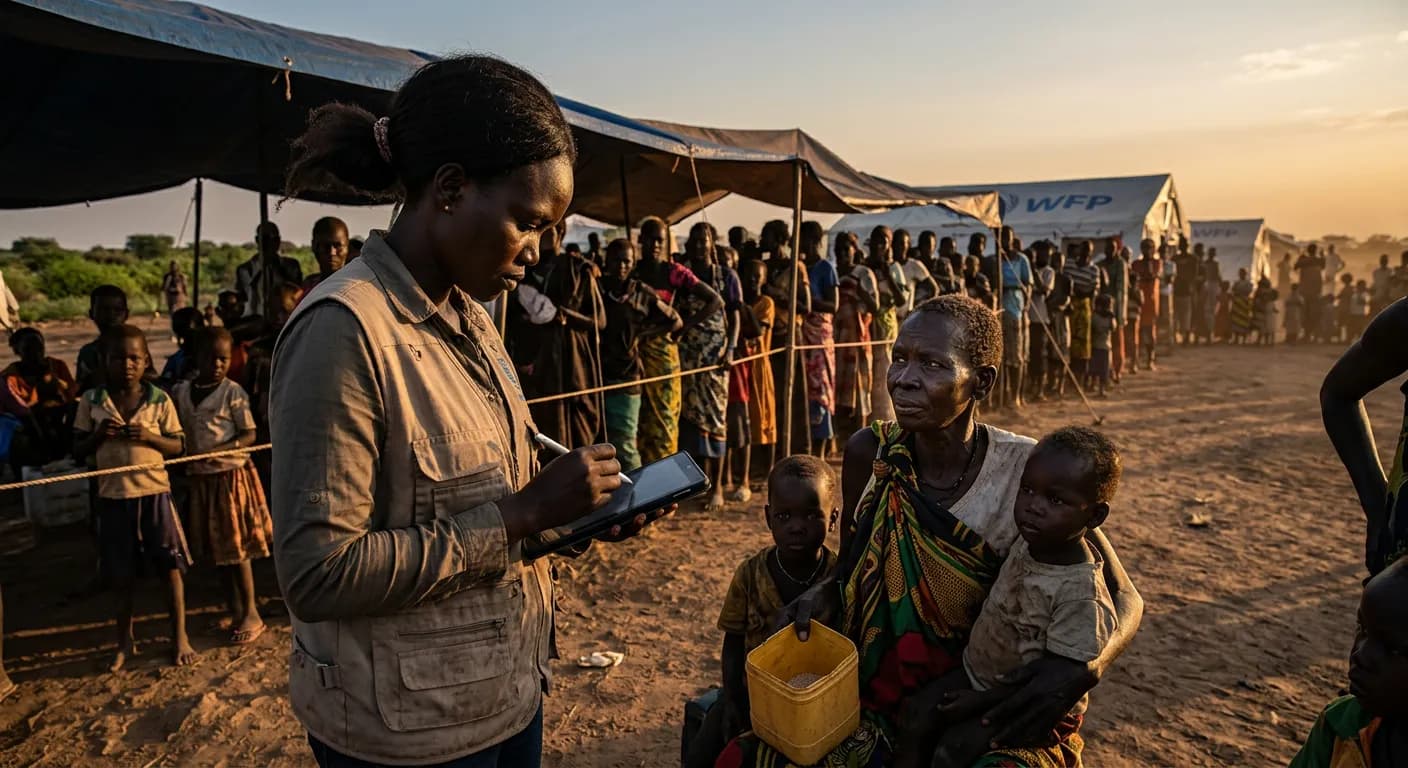
WFP's 2025 Reckoning: More Hunger, Less Money, Harder Choices
The UN's food agency reached 121 million people in 2025 despite a 40% funding collapse — the numbers reveal a permanent downsizing, not a temporary squeeze.
The World Food Programme's 2025 annual review, published under the banner "Delivering Faster and Smarter Despite Compounding Crises," documents a decisive shift: the world's largest hunger agency assisted 121 million people against a caseload of 318 million facing acute hunger, the widest gap between need and reach in a decade, while absorbing a roughly one-third contraction in resources and preparing to cut up to 6,000 jobs. The report's optimistic framing obscures the strategic reality it describes. WFP is not weathering a bad year. It is being restructured in real time by donor politics, and the "faster and smarter" language is an institutional adaptation to a smaller, more selective mandate that will outlast the Trump administration's aid freeze.
The numbers that define 2025
WFP's own Annual Review 2025 states plainly that "an estimated 318 million people faced acute hunger, while funding declined sharply — forcing difficult choices about who to reach and how." The agency supported 121 million people — a drop of roughly one-fifth from the 152 million assisted in 2023, according to its most recent
Annual Performance Report transmitted to ECOSOC. Against a needs-based plan of USD 16.9 billion articulated in the
WFP 2025 Global Outlook, the agency projects it will close the year on approximately USD 6.4 billion — down from USD 9.8 billion in 2024, according to
UN News.
That is not a shortfall in the usual humanitarian sense. It is a structural donor retrenchment. The European Commission's Knowledge Centre confirms a 34 percent projected drop in WFP resources versus 2024, forcing emergency food assistance down for up to 16.7 million people — a 21 percent reduction from the 79.9 million assisted with emergency aid the previous year.
Who did it: Washington's decisive turn
The single explanatory variable is the United States. The US contributed roughly USD 4.4 billion to WFP in 2024, close to half its budget. In April 2025, the Trump administration canceled USD 808 million in WFP grants across 14 countries — including Afghanistan, Yemen, Syria, Gaza, and Haiti — a decision the European Commission's JRC review documents in detail. Some cuts to Lebanon, Syria, Iraq, Jordan, Ecuador, and Somalia were reversed a week later; the cuts to Afghanistan and Yemen were not, on the stated rationale of preventing funds from reaching the Taliban and the Houthis.
The domestic knock-on came fast. On April 24, WFP leadership told staff to expect job cuts of 25–30 percent (about 6,000 positions) in an internal memo obtained by NPR. Europe compounded the shock. Germany's contribution alone is expected to fall from €58 million to €28 million, a 51.7 percent reduction, per the same JRC review. The FY2026 White House budget request would cut Food for Peace by USD 1.62 billion and contributions to international organizations by USD 1.7 billion. That signals 2025 is a floor, not a trough.
The FAO/WFP Hunger Hotspots June–October 2025 report puts the concentration risk in one sentence: "75 percent of humanitarian funding for food security and nutrition in food crisis contexts is provided by just four donors — half of it from the United States of America." That is the leverage that has now been exercised.
What "faster and smarter" actually means
Read carefully, the Annual Review is a document about triage. The organization says it "stayed and delivered, supporting 121 million people with life-saving assistance while prioritizing those facing the most severe hunger." That prioritization is the operational innovation. It is codified in an internal doctrine reviewed by ReliefWeb's Summary of Evidence on Prioritization, which draws on the same techniques WFP was already deploying in 2023, when it reported that ration cuts, "a reduced duration of assistance provision and more narrow targeting of beneficiaries" were the principal instruments for managing shortfalls.
The technology story is real but oversold. WFP's supply-chain analytics unit (Optimus, the Supply Chain Management Dashboard, and the DOTS data platform) had already generated more than USD 150 million in efficiency savings before 2022, according to a peer-reviewed account in INFORMS Interfaces. The 2023 Annual Performance Report claimed
USD 256 million in efficiency gains that year. Even doubled, these gains are dwarfed by a USD 3.4 billion year-on-year funding drop. Efficiency is not a bridge across this gap. It is a rhetorical frame that allows donors to see progress while cutting.
Anticipatory action tells a similar story. A 2025 evidence review co-authored by WFP, FAO, and OCHA — Saving lives, time and money — argues that pre-positioned assistance is more cost-effective than post-disaster response, and WFP is embedding forecast triggers into social protection systems in Bangladesh, Saint Lucia, and elsewhere. Bangladesh mobilized USD 10.4 million for anticipatory action in 2024, activating 15 pre-agreed responses that reached 430,000 people, per
UN Bangladesh — but the same report warns that over half of the USD 42 million needed for 2025 remained unfunded. Anticipation costs less than response; it does not cost nothing.

The country ledger: where the cuts land
The reduction is not evenly distributed. Country-level data confirm that the biggest cuts follow US political priorities, not humanitarian need.
- Afghanistan. WFP planned to feed 2.3 million people in October 2025; it reached 600,000, with a "complete pipeline break" possible by February 2026, according to
UN News. USAID's roughly USD 280 million contribution in 2024 was zeroed out.
- Yemen. The European Commission's
funding impact review identifies Yemen as the single hardest-hit operation, with 4.8 million people potentially losing life-saving support.
- Sudan. WFP is supporting 4 million people a month in an environment where 25 million — half the population — face acute food insecurity and famine has been confirmed in multiple locations.
- Somalia. Support has been "downsized repeatedly, from 2.2 million people last year to just 350,000 in November," per WFP.
- Haiti. Hot meals have stopped; families receive half rations.
- Libya. In a rare countertrend, WFP scaled up in 2025 to reach
256,000 beneficiaries, driven by 514,000 Sudanese refugee arrivals — a reminder that new emergencies still command resources when they align with donor priorities.
The Democratic Republic of the Congo captures the strategic dilemma. In May 2025, WFP Executive Director Cindy McCain told NPR from Bunia that 1.3 million people risked losing food assistance that summer and that the UN Humanitarian Air Service — the only realistic logistics backbone in eastern Congo — needed USD 12.5 million to keep flying. WFP is prioritizing, but the prioritization runs against the geography of need.
Gaza: the exception that reveals the rule
Gaza is where WFP's "faster and smarter" narrative meets its sharpest test. During the January 2025 ceasefire window, WFP and UNRWA delivered over 65,000 metric tonnes of food into Gaza in four weeks, enabling near-full rations for a million people. When the ceasefire collapsed, monthly throughput fell to a small fraction of the estimated
62,000 metric tonnes required each month for basic humanitarian food needs, with 470,000 people enduring famine-like IPC Phase 5 conditions by mid-2025. By the second ceasefire in October, WFP had food parcels reaching a million people again within three weeks —
against a target of 1.6 million and only two crossings open.
The lesson is not that WFP is inefficient. The lesson is that access, not analytics, sets the ceiling. In Gaza WFP had 170,000 metric tonnes prepositioned in the region — enough to feed the entire population for three months. Delivery was constrained by political decisions taken in Jerusalem and Washington, not by supply-chain algorithms in Rome.
The historical parallel donors are not discussing
The closest analogue is the 2005–2008 restructuring of the UN's humanitarian architecture that followed the Iraq war donor fatigue, when Emergency Relief Coordinator Jan Egeland warned that funding was falling behind needs. What is different in 2025 is that this is the first time since WFP's founding in 1961 that its principal donor has cut contributions as an act of foreign policy rather than budgetary constraint. Executive Director Cindy McCain, herself a Republican former US ambassador to the Rome-based agencies, told Al Jazeera in November that "the world is grappling with simultaneous famines, in Gaza and parts of Sudan. This is completely unacceptable in the 21st century." Her institutional position is that hunger is a stability question — "swift and effective food assistance is a vital bulwark against chaos," she said in
October — a framing chosen precisely because it might resonate in a security-first Washington.
That framing has not yet moved the numbers. WFP itself now expects a further 40 percent funding drop in 2026, per Al Jazeera's summary of its November statement.
Who benefits, who loses
The immediate losers are visible: 13.7 million people WFP estimates could slide from IPC Phase 3 (Crisis) into Phase 4 (Emergency), plus up to 3 million people already in Phase 4 who may lose assistance altogether.
The less visible losers are the resilience and development portfolios that make emergencies smaller in the first place. Caitlin Welsh of the Center for Strategic and International Studies told NPR that Washington is "cutting the emergency assistance for those in most need, and the other types of assistance that are intended to make sure that people wouldn't need that assistance in the first place." Sahel resilience gains — where WFP says 500,000 people have been lifted out of aid dependence — are the kind of program that dies first when budgets are triaged toward pure emergency response.
Two actors quietly benefit. The first is China and the Gulf states, whose relative weight in humanitarian financing rises without their contributions rising in absolute terms: a soft-power windfall. The second is any donor that prefers a smaller WFP with a narrower mandate; the localization policy approved by the Executive Board in June 2025, which shifts more delivery to national and local actors, is genuinely progressive on paper and also, conveniently, a mechanism to shrink the international footprint.
What to watch
- June 2026 WFP Executive Board annual session, where the full Annual Performance Report for 2025 will be formally approved and transmitted to ECOSOC, following the pattern documented in
E/2025/14. Watch for the final funding figure and the country-by-country reach tables.
- US FY2026 appropriations, where a proposed 47 percent cut to international programs would cement the 2025 baseline as permanent.
- Afghanistan pipeline break, projected by WFP for February 2026 absent new funding.
- Sudan famine trajectory, where WFP currently reaches 4 million of 25 million in need.
The Bottom Line
WFP's 2025 Annual Review is a bureaucratic success story wrapped around a strategic defeat: the agency delivered to 121 million people while its budget fell by a third, but no amount of anticipatory action or supply-chain optimisation offsets a USD 3.4 billion donor withdrawal driven by US foreign policy. The "faster and smarter" narrative is real, and it is also the language of a permanent downsizing that the humanitarian system refuses to name.
Discover more

India
Delhi CM Rekha Gupta Blasts Opposition's Delm
Delhi CM Rekha Gupta's remarks on women's quota defeat reveal BJP's strategy for the 2029 Lok Sabha elections, focusing on delimitation.

International Relations
U.S.–Iran Peace Deal
A narrow US-Iran deal on nuclear and regional issues could reshape Middle East diplomacy, offering a pragmatic path forward despite grand bargain obstacles.
US Politics
Congress Targets AI Chatbot Access for Terror
The House passed the Generative AI Terrorism Risk Assessment Act, focusing on AI's role in terrorism and potential surveillance implications.

Economics
Fed's Amex AML order puts correspondent banking on notice
Federal Reserve's Amex AML order requires board-level controls and a 90-day plan; OCC fined the bank $350 million over enterprise-wide deficiencies.