West Bengal, Tamil Nadu
Election welfare impacts state finances significantly.
Model Diplomat3 min readAsia
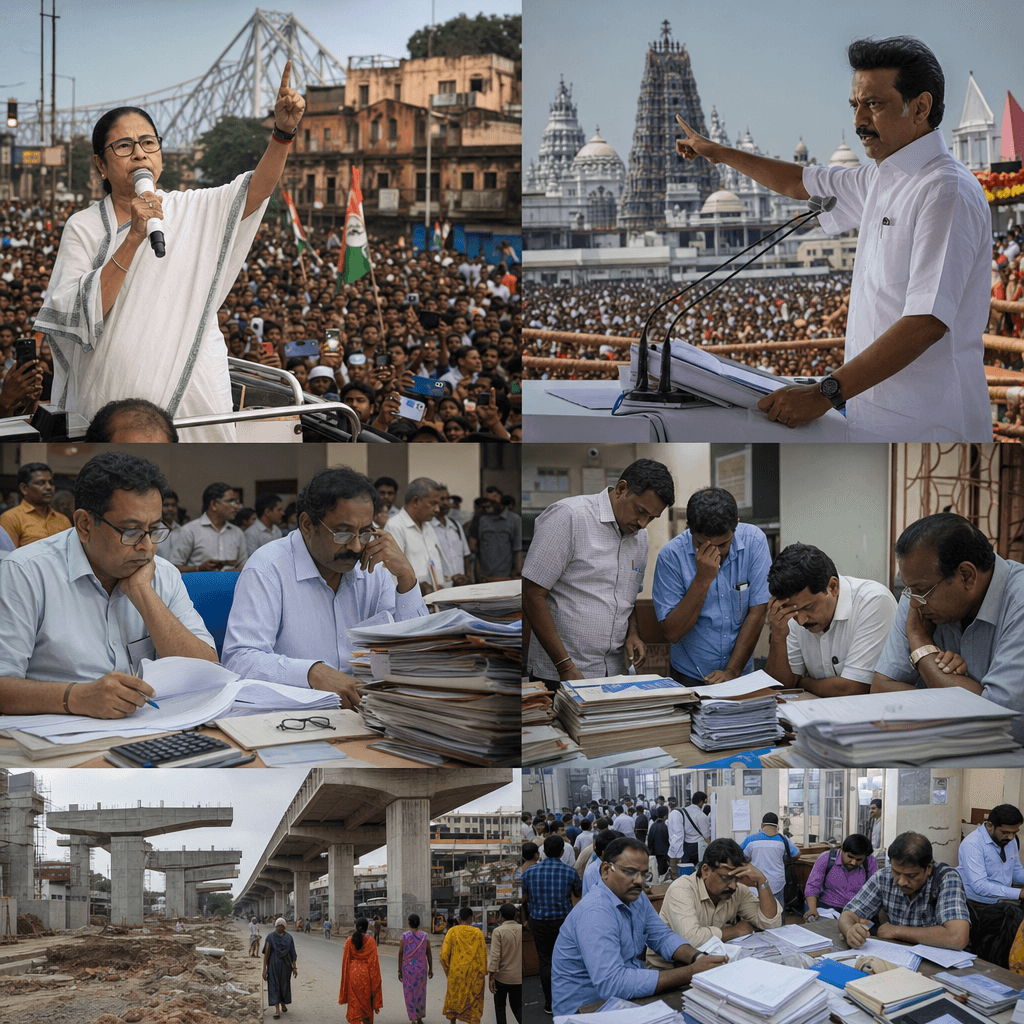
West Bengal, Tamil Nadu: Poll Promises Meet Fiscal Limits
Election welfare is now a balance-sheet issue: parties win votes with cash transfers, but the bill is landing on already stretched state finances.
The power dynamic is straightforward: campaign promises are being used as electoral leverage, while the post-poll burden falls on state treasuries. NDTV, citing Emkay Research, says the West Bengal package would cost about Rs 72,600 crore, or 3.4% of GSDP, while Tamil Nadu’s would add Rs 87,900 crore, or 2.2% of GSDP (NDTV). That is not a marginal squeeze. It lands on top of a broader pattern in which election-year spending tends to persist after the votes are counted: Emkay’s state-election dataset shows average fiscal deficits rising from 2.5% pre-election to 3.4% post-election in nine of 11 states (
NDTV;
CNBC-TV18).
Welfare promises are turning into durable spending
This matters because the new commitments are not one-off giveaways; they are recurring transfers that harden into permanent expenditure. In Tamil Nadu, TVK’s manifesto includes Rs 2,500 a month for women heads of households, unemployment assistance, six free LPG cylinders, and education-linked cash support (Business Standard;
The New Indian Express). NDTV says West Bengal’s BJP campaign likewise centered on cash transfers, including Rs 3,000 a month for eligible women and youth unemployment aid (
NDTV).
The political payoff is immediate: parties get a clean, simple message that converts badly into fiscal space. The losers are the finance departments that must reconcile recurring welfare commitments with salary bills, pensions, interest payments, and the borrowing ceiling. That is why CNBC-TV18 says the more structural effect is not just a wider deficit, but crowding out of capital expenditure and higher borrowing stress across states (CNBC-TV18).
The 3% line is becoming a negotiating point
The 16th Finance Commission wants state fiscal deficits capped at 3% of GSDP, and NDTV notes both West Bengal and Tamil Nadu have been above 3% for six years (NDTV). That is the key constraint: these promises are being made in states that already have little room to absorb them without either raising revenue, cutting elsewhere, or borrowing more.
Emkay’s view, as relayed by NDTV, is revealing: a BJP-led government in West Bengal could improve Centre-state alignment and speed approvals for central projects, which would help medium-term industrial growth, but the immediate test is fiscal discipline (NDTV). In other words, the market benefit of political change is not the issue; the budget arithmetic is.
For readers tracking the broader federal picture, this is part of a wider shift in India: states are learning that welfare-heavy campaigns can win office, but they also lock in higher baseline spending.
What to watch next
The next decision point is implementation: whether the new governments phase in benefits, narrow eligibility, or finance them through higher borrowing. Watch the first post-election budget and any revision to deficit targets. If the promised schemes are rolled out quickly and broadly, the fiscal squeeze will show up first in capital spending, then in debt service, and finally in the borrowing room available for the next cycle.
Discover more
India
UK Trade Deal Dismisses Investment Concerns
UK trade expert Anton Muscatelli argues investment chapter is unnecessary for FDI growth.
India
India Takes Vice-Presidency at FATF
India's Vivek Aggarwal becomes FATF vice president, paving the way for future leadership.
India
India Expands Education with 15 New Campuses
India's plan to host 15 foreign university campuses aims to retain students and reduce costs.
Global Politics
Iran Demands US Enforce Ceasefire
Iran insists the US must enforce a ceasefire in Lebanon to uphold the MoU.