Washington's Venezuela Track Bypasses Machado
Washington bypasses Machado for Figuera in Venezuela talks
Model Diplomat9 min readLatin America
Machado Convenes Opposition as Washington's Venezuela Track Bypasses Her
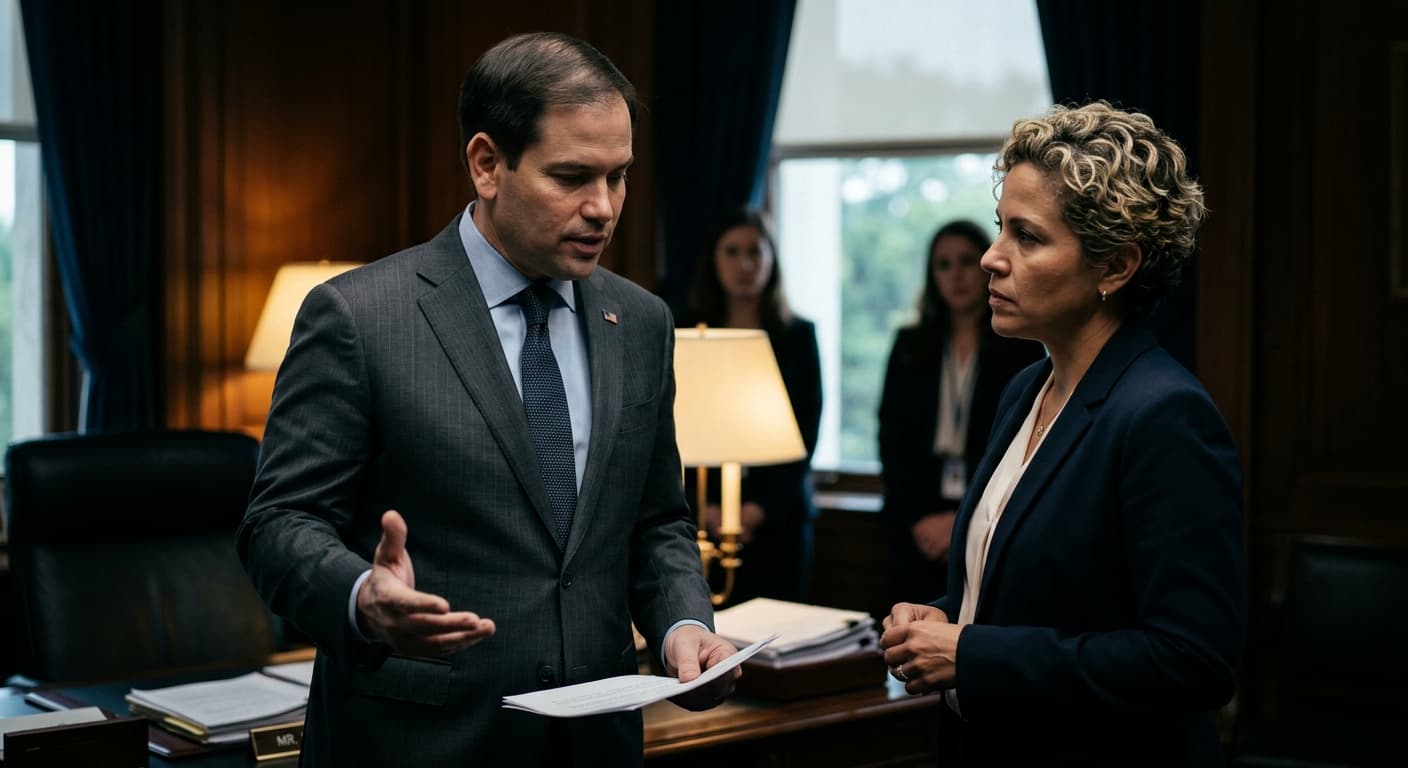
María Corina Machado met Venezuela's opposition coalition on July 16, 2026, to evaluate a chavismo-dialogue track she did not design, cannot join, and may not survive politically — because the United States chose Dinorah Figuera instead.
On July 16, 2026, María Corina Machado and Edmundo González Urrutia convened the Plataforma Unitaria Democrática (PUD) — Venezuela's largest opposition coalition — to assess a dialogue process with chavismo that begins formally on August 1. The meeting, first reported by Noticias SIN, was called to "gather information" on the joint work agenda announced two days earlier and to "define a public position." The phrase is telling. Machado is reacting to a process she was supposedly designated to lead — one that is now being run by someone else, under Washington's direction, without her at the table.
How Washington Built a Track Machado Cannot Join
The architecture of this dialogue was not assembled in Caracas or Panama. It was built in Washington, across a series of meetings that bypassed Machado's coalition entirely.
On April 22, 2026, Dinorah Figuera — who claims the presidency of the opposition-controlled 2015 National Assembly — met with US Undersecretary of State for the Western Hemisphere Michael Kozak to discuss "pathways toward a stable, orderly, and consolidated democratic transition," according to BBC News Mundo. Figuera returned to Venezuela in June 2026 after nearly eight years in exile, telling reporters she had traveled "on invitation from the [US] State Department" with the aim of pushing for renewal of the National Electoral Council. On June 18, she held her first meeting with Jorge Rodríguez, the chavista president of the National Assembly and brother of interim President Delcy Rodríguez, as
BBC News reported.
Less than a month later, on July 10, the PUD met in Panama and signed the Manifiesto de Panamá, designating Machado — the 2025 Nobel Peace Prize laureate — to lead negotiations with the chavista interim government, per BBC News Mundo. The manifesto demanded the release of all political prisoners, guarantees for exiles' return, and the dismantling of the repressive apparatus. It was an ambitious maximalist platform.
Four days after Panama, on July 14, Jorge Rodríguez and Figuera separately announced a "joint work agenda" beginning August 1, focused on "strengthening democracy" and "facing together the consequences of the seismic doublet." Secretary of State Marco Rubio shared Figuera's statement on X, according to Noticias SIN. Rubio's endorsement of the Figuera track — silent on the Panama manifesto — was the signal.
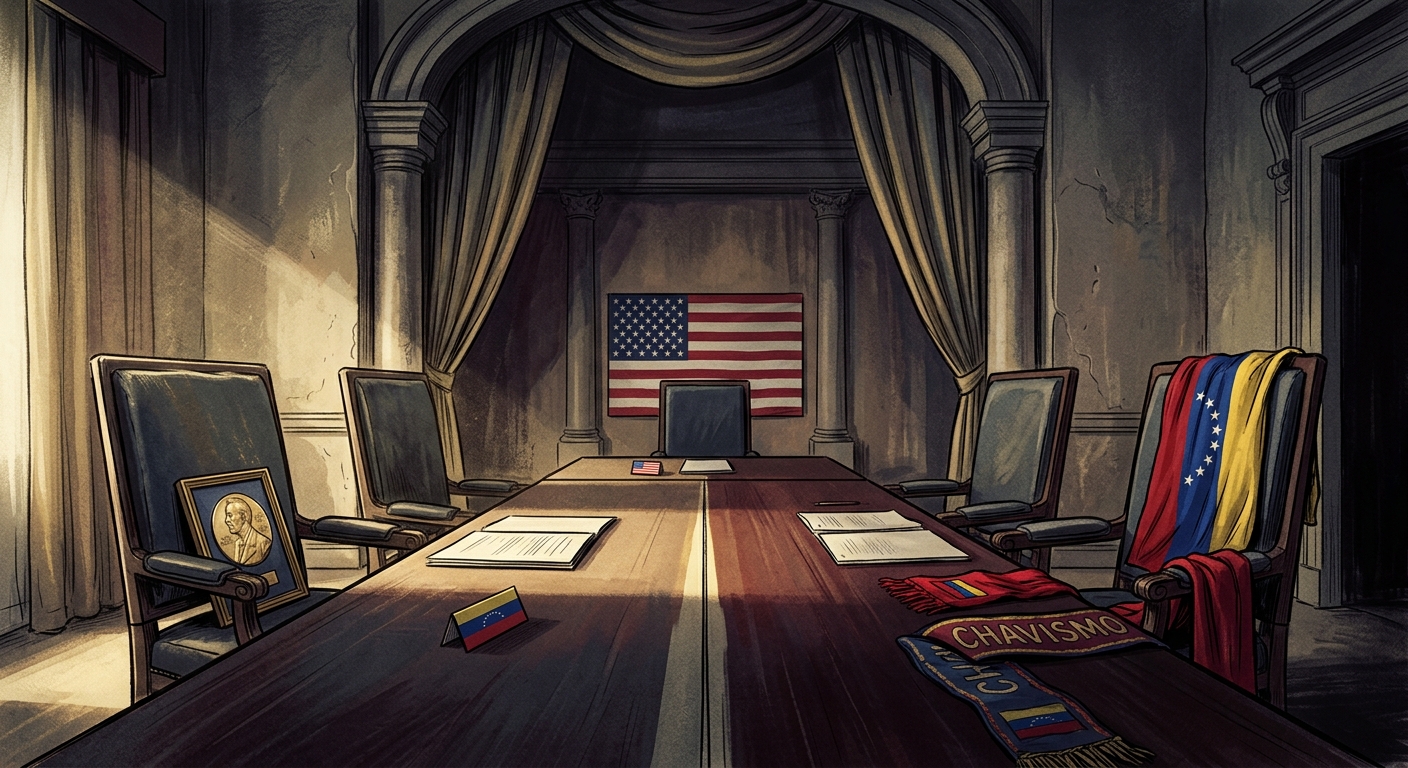
The US preference is not subtle. Asked on CBS why he was not working with Machado, Rubio said: "María Corina Machado is fantastic and is someone I have known for a long time. But we are dealing with immediate realities," as quoted by BBC News Mundo. The "immediate reality" is that Machado is in exile, blocked from re-entering Venezuela, and carries decades of personal enmity with the chavismo leadership. Figuera, by contrast, is physically in Caracas, has institutional standing through the 2015 Assembly, and lacks the radioactive personal history that makes Machado unacceptable to the regime's inner circle.
Rubio's Three-Phase Plan and the Earthquake That Rewrote the Calendar
The strategic framework was laid out on January 28, 2026, when Rubio testified before the Senate Foreign Relations Committee. The US would oversee a stage-based plan: stabilization, recovery, and political transition. "Delcy Rodríguez has assumed leadership of the interim authorities and has stated her intention to cooperate with the United States," Rubio said in his prepared testimony. "She has committed to opening Venezuela's energy sector to American companies, providing preferential access to production, and using revenues to purchase American goods."
Rodríguez pledged to end the oil lifeline to Cuba and pursue national reconciliation. Rubio was blunt about the leverage: "Make no mistake, as the President has stated, we are prepared to use force to ensure maximum cooperation if other methods fail." The implicit message to Delcy Rodríguez was the same one delivered to Maduro — comply or share his fate.
Then the earthquakes struck. On June 24, twin quakes measuring 7.2 and 7.5 on the Richter scale devastated Venezuela's coast. Government figures put the death toll above 4,800, with over 16,000 injured, according to NPR. The US Geological Survey estimated as many as 10,000 could be dead, with economic losses projected at 1 to 7 percent of GDP, per
CSIS. The country was already seeking to restructure $240 billion in sovereign debt.
The state of emergency declared by Delcy Rodríguez gave the interim government a rationale to delay any electoral timetable. Critics contend the post-earthquake emergency has allowed Rodríguez to "ignore demands that she set a timetable for holding presidential elections," as NPR reported. Rodríguez accused her critics of exploiting the chaos to "conspire" against her government. The CSIS analysis warned that "what starts as even a temporary pause can rapidly become self-reinforcing and suppress discussion around democratization."
The earthquake reframed the August 1 talks. The joint agenda now explicitly pairs "strengthening democracy" with "facing together the consequences of the seismic doublet" — a formulation that gives chavismo a humanitarian shield against pressure for early elections.
The Chavismo Calculation: Survival First, Elections Later
The chavista inner circle's strategy is documented with unusual candor in a Crisis Group analysis. Officials told Crisis Group that the movement's "maximum priority" is survival. Their short-term strategy: "avoid calling new elections and, if unavoidable, do everything possible to secure victory at the polls, even if that means again prohibiting Machado's participation."
The reasoning is Machado-specific. One chavista source told Crisis Group: "The real problem is María Corina, because she is Washington's candidate [who would continue Trump's policies beyond his mandate]. With her, the colonial subordination [of Venezuela] would be consummated." The same source speculated that Trump might lose interest or lose the midterms, making the US pressure temporary. Machado, by contrast, is permanent.
This is the non-obvious dynamic: chavismo prefers the Figuera track not because it is weaker, but because it is less existentially threatening. Figuera's agenda — institutional reconstruction, electoral council reform, a "shared vision of the future" — is technocratic. Machado's agenda — full transition, dismantling the repressive apparatus, her own candidacy — is existential. The Congressional Research Service notes that the PUD under Machado "has since split over whether to participate in future elections," with most PUD parties boycotting the 2025 legislative and municipal contests. The Figuera group, by contrast, represents the 2015 Assembly — the last opposition legislature recognized by the US as legitimate, and an institution with direct standing to negotiate institutional reform.
Named Winners and Losers
Dinorah Figuera is the immediate winner. She has US backing, physical presence in Caracas, a chavismo interlocutor in Jorge Rodríguez, and an institutional vehicle the US still recognizes. If the August 1 talks produce any tangible reform — a renewed electoral council, partial prisoner releases, party legalization — she will be the face of it.
Marco Rubio wins if the talks produce enough visible progress to validate the Trump administration's Venezuela policy as a cost-free success. His testimony framed the capture of Maduro as achieving "so much at so little cost." A negotiated transition, even a partial one, would be the proof of concept.
Delcy Rodríguez wins time. The earthquake gave her a state of emergency and a humanitarian justification for delay. The talks give her a process she can manage through her brother, Jorge Rodríguez, without conceding electoral timelines. The chavismo calculation, per Crisis Group, is to "conform with economic reforms favorable to investment, easy access to natural resources, and some signs that Caracas is limiting the use of its repressive apparatus" — enough to satisfy Washington without surrendering power.
María Corina Machado is the structural loser. She holds the popular mandate — polls show she remains Venezuela's most popular politician. She holds the international legitimacy — the Nobel Prize, the recognition by dozens of governments of González Urrutia as the rightful winner of the 2024 election. But she cannot enter the country. Her airspace was briefly closed to her plane in June 2026, per NPR. Her party, Vente Venezuela, is only now regrouping after its Caracas office was looted and hundreds of activists were jailed or fled, as
NPR reported. Her ally, Henry Alviarez, the party's deputy leader, was recently released but still faces terrorism and treason charges. The
BBC reported that Machado tried to return after the earthquakes but "failed to make it into the country."
Edmundo González Urrutia loses in a quieter way. The man the opposition recognizes as the rightful president of Venezuela, who told BBC News Mundo that "Maduro has no will to negotiate anything," now watches a negotiation proceed without him. His argument that pressure must continue is undercut by a process Washington has blessed.
The Historical Parallel: 1990 Chile
The closest analogy is Chile's 1988–1990 transition. There, the opposition won a plebiscite on Pinochet's rule, but the military regime negotiated the terms of its own exit — retaining institutional guarantees, amnesty provisions, and Senate seats. The opposition's moral leader — Patricio Aylwin — became president, but the transition was managed by a technocratic compact between the regime's moderate wing and the opposition's institutional wing.
Venezuela's August 1 talks follow a similar logic: chavismo's moderate wing (the Rodríguez siblings) negotiates with the opposition's institutional wing (Figuera's 2015 Assembly) under a foreign power's supervision (Washington). The maximalist opposition leader (Machado) is the moral authority but not the negotiator. The difference is that Chile's transition produced a constitution and elections within 14 months. Venezuela's has no guaranteed electoral endpoint — and chavismo's survival strategy explicitly aims to stretch the process to 2030, according to Crisis Group.
The Leverage Gap
The numbers that matter are not just the 4,800 dead or the $240 billion in sovereign debt. They are the ~900 political prisoners still held in Venezuelan jails — a figure González Urrutia cited in his BBC News Mundo interview — and the absence of any mechanism for Machado to enforce their release. The Manifiesto de Panamá demands their "full and conditional release." The Figuera track's stated priorities, per
BBC News Mundo, are "reconstruction of democratic institutions, strengthening of electoral bodies, restitution of political parties, and guarantees for all political actors." Prisoner releases are not a focal demand.
This is the leverage gap. Machado's strongest card is the moral urgency of political prisoners. Figuera's strongest card is Washington's endorsement. The August 1 talks will test whether these can be reconciled — or whether the technocratic track simply absorbs the maximalist track's demands and dilutes them.
What to Watch
- August 1, 2026: Formal talks open. The composition of the negotiating table — who sits, who is excluded, whether any PUD parties join alongside Figuera — will signal whether Machado's coalition is being integrated or bypassed.
- September 2026: The 180-day constitutional window for Delcy Rodríguez's interim presidency, calculated from January 6, expires. The constitution requires elections within 30 days of a president's "permanent" absence. Whether the chavismo-controlled Assembly extends the interim mandate or moves toward elections is the first hard test.
- Maduro's next court hearing: Originally scheduled for March 17, 2026, in New York. Any plea deal or cooperation agreement could shift Washington's leverage overnight — and with it, the entire negotiation.
- Machado's return attempt: She has pledged to return before the end of 2026 and to run for president. Whether the Figuera track produces conditions that allow her re-entry — or whether chavismo maintains its ban — will determine whether the two tracks converge or split the opposition irreparably.
The Bottom Line
The August 1 talks are Washington's track, not Machado's — and the July 16 PUD meeting was Machado's attempt to avoid being rendered irrelevant by a process she was nominally designated to lead. The decisive actor is not in Caracas or Panama; it is Marco Rubio, who chose Figuera over Machado because the US needs a negotiator who can sit in the room with chavismo, not one who can rally crowds against it. If the talks produce institutional reforms without elections, chavismo survives and Machado's leverage erodes further. If they produce a credible electoral timeline with Machado's reinstatement, the two tracks merge. The most likely outcome is the former — a managed transition that reforms Venezuela's institutions without dislodging its incumbents — because that is the outcome every actor with leverage currently prefers.
Discover more

US Politics
Virginia GOP Rallies Rural Voters Against Red
Virginia Republicans are mobilizing rural voters against a Democratic-led redistricting referendum, a fight seen as pivotal to control in the 2026 midterms.
US Politics
SNAP Food Assistance Faces Legal Challenges
In 2026, SNAP faces stricter eligibility rules and mounting legal challenges, threatening food assistance for the millions of Americans who rely on the program.
US Politics
Virginia's Redistricting Referendum
Virginia's redistricting referendum is drawing a flood of dark money, shaping future elections and the fight for congressional control amid party stakes.

Economics
Fed's Amex AML order puts correspondent banking on notice
Federal Reserve's Amex AML order requires board-level controls and a 90-day plan; OCC fined the bank $350 million over enterprise-wide deficiencies.