Warsh's Fed Minutes: A Hawkish Shift
FOMC minutes signal a hawkish stance under Warsh.
Model Diplomat8 min readNorth America
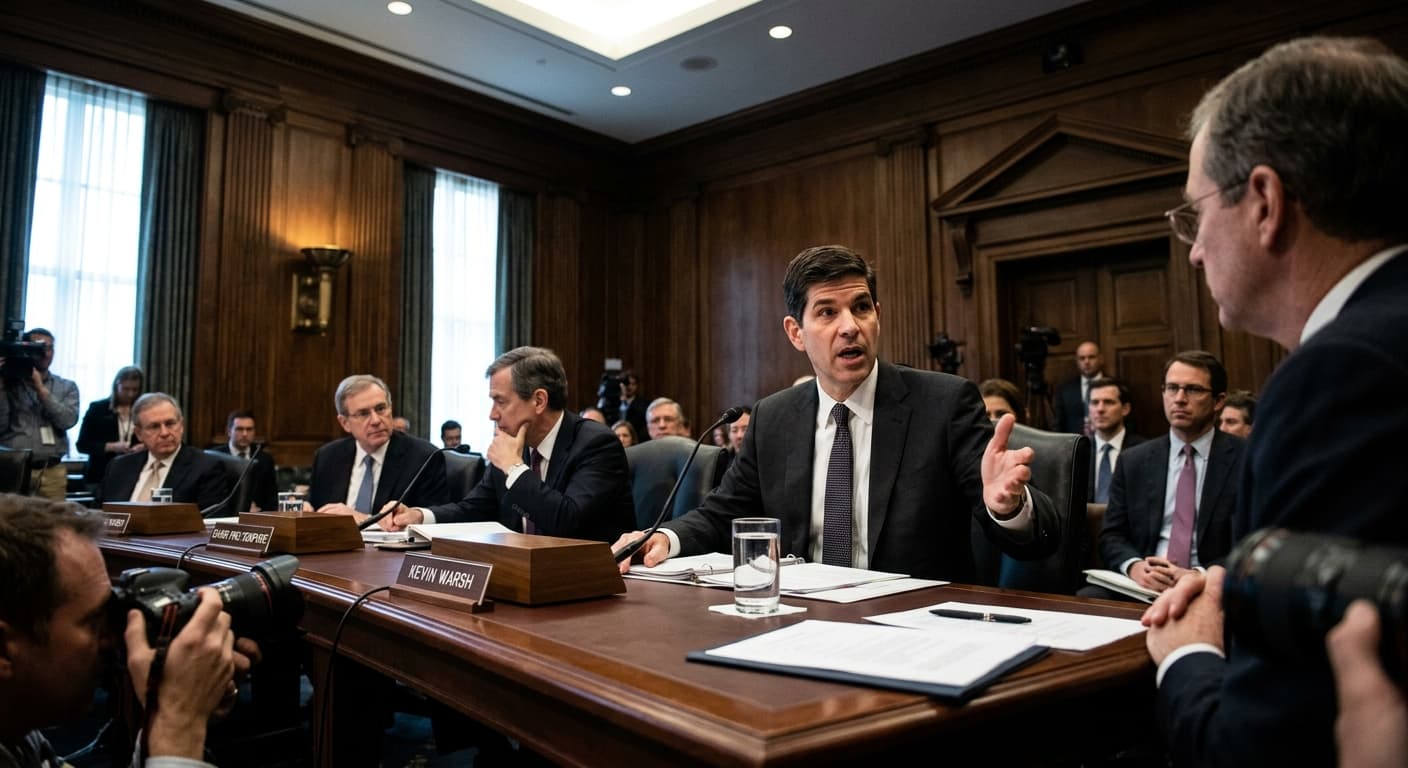
Warsh's First Fed Minutes: Disinflation Over Rate Cuts
The July 8, 2026 release of the June FOMC minutes reveals a Federal Reserve tilting hawkish under Kevin Warsh — with AI productivity as the only plausible off-ramp toward lower rates.
The June meeting minutes, released today, confirm the market's read of Kevin Warsh's first FOMC as a hawkish handover: nine of 18 participants now expect a rate hike by year-end, the "easing bias" language is gone, and the AI-productivity argument that once implied lower rates has been demoted to a research question — meaning the president who nominated Warsh to cut rates is more likely to get a hike before he gets a cut. That is the load-bearing takeaway from Warsh's debut. Everything else — the truncated statement, the missing chairman's dot, the five new task forces — is scaffolding around a single message: the Fed is not ready to declare victory on inflation, and it will not pre-commit to when it might.
The minutes ratify a hawkish pivot the market already priced
The June 16–17 decision itself was unanimous. The FOMC's official statement — approved 12–0 — held the federal funds rate at 3.50 to 3.75 percent and reduced Fed communication to 132 words, down from roughly 350 in April, according to the
BBC. Gone was any hint of an easing bias; in its place, a single-sentence pledge: "The Committee will deliver price stability."
The dot plot told the fuller story. Nine of 18 participants projected higher rates by December 2026; only one saw a cut, and Warsh himself declined to submit a dot, as the BBC and the
Financial Times both reported. Samuel Tombs of Pantheon Macroeconomics told the BBC the hike-leaning dots were the meeting's real news; the
Economist called Warsh's tone unambiguously hawkish, quoting his deflection — "we have a task force for that" — at the ECB's Sintra symposium a week later.
The minutes released today, according to the initial trade summary circulating in the Asia session, corroborate that reading: a broad set of policymakers see upside inflation risk, few see room to cut, and forward guidance has been deliberately withheld. That confirms what the FT's Claire Jones observed after the press conference — Warsh "set out his stall" that he would not lay out a rate path, and at least one other participant joined him in withholding a longer-term dot,
the FT reported.
The AI productivity argument, quietly demoted
The most consequential shift is intellectual, not procedural. During his confirmation hearing, Warsh argued that AI-driven productivity gains could create the conditions for lower rates than would otherwise be warranted — a view flagged by the Council on Foreign Relations as sitting "in some tension" with his hawkish reputation. The FT's own read of the hearing was more skeptical: Warsh "notably" did not draw an explicit link between AI-driven supply expansion and lower Fed rates, and instead said the central bank needed better "models" to gauge the effect,
the paper noted.
By June 17, the AI-permits-cuts argument had been effectively parked. It survives in the FOMC statement only as an observation — "productivity growth and capital investment are strong" — and in Warsh's new task force on productivity and jobs, which will report in the coming months. In the meantime, the Atlantic Council notes that US labor productivity growth has already accelerated to 2–3 percent per year since 2024, with AI investment on pace to reach nearly $3 trillion by 2028 and to account for over a third of US GDP growth, according to Morgan Stanley figures cited by the Council.
The problem is the numerator. Consumer prices rose 4.2 percent year-on-year in May 2026, with core CPI at 2.9 percent; the Iran war pushed gasoline from under $3 to roughly $4.25 a gallon, and University of Michigan household inflation expectations sit at 4.8 percent for the coming year, according to American Enterprise Institute analysis. Against that backdrop, an AI supply-side story is a bet, not a policy anchor — and Warsh has chosen not to make the bet in public.
The winners of this restraint are the bond-market vigilantes and Fed governors — Powell holdovers included — who wanted the easing-bias language gone. The losers are the White House and the equity narrative that priced multiple 2026 cuts after Warsh's nomination.

The Greenspan parallel — and its risks
Warsh is rebuilding the communications architecture of the Greenspan Fed. The Atlantic Council's Hung Tran argues Warsh's "less is more" posture — no chair dot, a stripped statement, skepticism toward dot plots — represents a deliberate break with the Bernanke-through-Powell transparency doctrine and a return to Greenspan-era opacity. The parallel goes deeper: Greenspan's late-1990s tolerance of low unemployment rested on a bet that technology-driven productivity gains would offset wage pressures. Warsh has floated the same bet with AI — but, unlike Greenspan, he has so far declined to act on it.
That restraint is disciplined. It is also risky. Academic work published in the B.E. Journal of Macroeconomics finds that unexpectedly hawkish minutes reduce daily stock returns by lifting the risk premium and, at larger sentiment deviations, can de-anchor long-term inflation expectations. Today's release lands directly in that zone. The New York Fed's own
high-frequency study of minutes-day price action shows that FOMC minutes still move Treasury yields, equities and the dollar meaningfully — the reaction is smaller than to the statement, but not trivial.
The reform agenda cuts against Fed-watcher consensus. A Brookings Hutchins Center survey conducted March 23–April 10, 2026 found that 83 percent of respondents want the chair to keep post-meeting press conferences, 60 percent want to keep the dot plot, and 75 percent rate the threat to Fed independence at 4 or 5 on a five-point scale. Warsh has signaled skepticism on all three fronts, and his first press conference did not commit to holding one after every meeting. He is picking a fight not just with markets but with his own profession.
The domestic power dynamic: Warsh is not Trump's instrument
The president wanted rate cuts. He got a chair who — six weeks in — is presiding over a committee where a majority of participants expect a hike. Trump's own on-camera reaction, per the BBC, was "it's alright… whatever," followed by "it just keeps the country down." The
American Enterprise Institute called Warsh's debut a repudiation of the "sock puppet" caricature Senator Elizabeth Warren pushed at his confirmation, when only Senator John Fetterman broke ranks to advance the nomination, according to
Al Jazeera.
The FOMC's institutional math constrains Warsh regardless of intent. He has one of 12 votes; a majority of participants have told him — via the dot plot he opposes — that they will not support cuts until inflation is visibly returning to 2 percent. With headline CPI running at 4.2 percent, gasoline near $4.25, and the CBO projecting deficits above 6 percent of GDP as far as the eye can see, AEI's Desmond Lachman argues the case for cuts is structurally weak — and a premature cut would spike 30-year Treasury yields, already above 5 percent, on independence and inflation-expectation concerns.
The counter-scenario matters. If the Middle East truce holds and oil prices continue to normalize — Brent fell roughly 20 percent after the Strait of Hormuz reopened, per AEI — headline inflation could ease by September. In that world, Warsh has room to pivot toward the AI-productivity narrative he has kept in reserve. Today's minutes are silent on the trigger. That silence is a feature, not a bug: Warsh has said forward guidance is "unhelpful," and his statement now confines itself to "the facts as best we can judge it."
What Chair Warsh is actually building
The five task forces — communications, balance sheet, data sources, productivity and jobs, and the inflation framework — are the real substance beneath the minutes. Together they amount to a wholesale audit of the post-2008 Fed. On inflation measurement, Brookings' Nasiha Salwati and David Wessel note Warsh's preference for the Dallas Fed's trimmed mean and the Cleveland Fed's median CPI over core PCE — measures the Fed already tracks but does not privilege. On the balance sheet, Warsh has said publicly it "took 18 years to create this problem, and we won't fix it in 18 minutes," per the
FT, and has floated a new Fed-Treasury accord as the vehicle for shrinking a $6.6 trillion portfolio.
The Council on Foreign Relations argues this reform program cannot happen fast: task force recommendations require board approval, and Warsh needs consensus he does not automatically command. That reality shapes today's minutes as much as the inflation debate does. The document is designed to look like a committee product, not a chairman's manifesto — because Warsh needs it to be one.
Diplomat View
Warsh's minutes, taken together with his June press conference and the June 25 Sintra remarks, define a defensible thesis: the Federal Reserve under Kevin Warsh will not cut rates in 2026 unless (a) core inflation prints below 3 percent on trimmed-mean and median measures for at least two consecutive months, or (b) unemployment breaks above 4.7 percent on a sustained trend. Absent either trigger, the next move is more likely a hike than a cut, and the AI-productivity argument — the one lever that could reconcile Trump's demand for cuts with an inflation-above-target regime — has been consciously withheld as a policy justification. The forecast revises if the Iran truce collapses and oil re-spikes (raises the hike probability further) or if AI-linked productivity growth breaks materially above 3 percent while headline CPI eases toward 3 percent (opens the door to a fourth-quarter cut). Watch labor productivity revisions and Cleveland Fed median CPI. The dot plot, ironically, is now the most reliable public signal — precisely because the chair has stopped signing his own.
What to watch next:
- July 28–29, 2026 — Next FOMC meeting. First test of whether the nine hike-leaning dots translate into a policy move or another hold.
- August 22, 2026 (est.) — Kansas City Fed's Jackson Hole symposium. Warsh's likely first major set-piece speech; markets will price his framework choices from the podium.
- September–October 2026 — Initial reports from at least two of the five Warsh task forces, most probably on communications and inflation framework, according to the
CFR 100-days analysis.
The Bottom Line
The bottom line: Kevin Warsh's first minutes are not a rate-path document — they are a credibility document. By stripping the statement, withholding his dot, and quietly demoting the AI-productivity argument that would have justified cuts, Warsh has bought himself the one asset his predecessor lost — the market's belief that the Fed will hit 2 percent before it accommodates the president. If that belief survives contact with the July FOMC and the Jackson Hole speech, Warsh will have executed the rarest maneuver in modern central banking: inheriting a chairmanship on political terms and redefining it on institutional ones.
Discover more

India
Delhi CM Rekha Gupta Blasts Opposition's Delm
Delhi CM Rekha Gupta's remarks on women's quota defeat reveal BJP's strategy for the 2029 Lok Sabha elections, focusing on delimitation.
India
Congress Accuses Modi of Stalling Women's Law
Congress accuses Modi of stalling women's reservation law by linking it to delimitation, revealing a deeper electoral strategy.
US Politics
SNAP Food Assistance Faces Legal Challenges
In 2026, SNAP faces stricter eligibility rules and mounting legal challenges, threatening food assistance for the millions of Americans who rely on the program.

Conflict & Security
Drone Warfare Killing Aid Workers at Unprec
Over 1,000 humanitarian workers killed in three years as cheap armed drones collapse legal protections. Gaza, Sudan, Ukraine, and DRC see deliberate targeting of aid convoys and hospitals with zero prosecutions.