Wang Huning's Pyongyang Visit Locks China's N
Wang Huning's Pyongyang visit locks China's only military ally as Taiwan calculus hardens.
Model Diplomat8 min readEast Asia
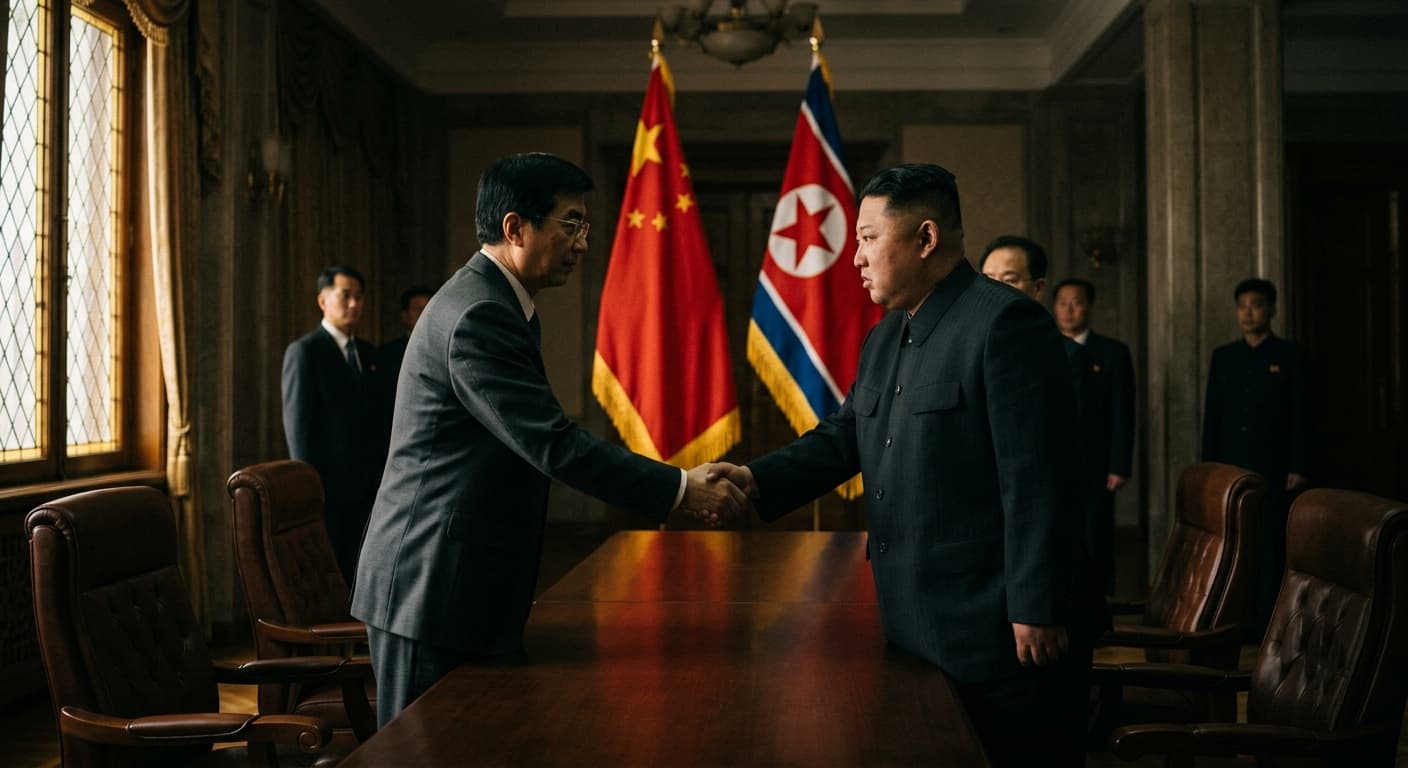
Wang Huning's Pyongyang Visit Locks China's Northern Flank Before Any Taiwan Move
China's top ideologue and united front chief met Kim Jong Un on July 17, 2026 — the third Beijing-Pyongyang summit in six weeks — signaling Beijing is securing its only formal military ally as the Taiwan contingency calculus hardens under a US president perceived as disengaged.
On July 17, 2026, North Korean leader Kim Jong Un held talks in Pyongyang with Wang Huning, China's fourth-ranked official and the architect of Xi Jinping's Taiwan reunification doctrine, capping a six-week cascade of three bilateral summits that has no precedent since the pandemic freeze. Wang is not a diplomat. He is the CCP's chief theorist, head of the national-level united front system, and the credited drafter of the Party's "overall strategy for resolving the Taiwan issue in the new era." His presence in Pyongyang — China's only formal military ally under the 1961 Treaty of Friendship, Cooperation and Mutual Assistance — signals Beijing is locking down its strategic rear before the Taiwan window narrows, and the choice of the Party's ideological enforcer rather than a foreign-policy hand says the trip is about political alignment for a contingency, not trade.
The Theorist, Not the Diplomat
Wang Huning's trip is the telling detail. Three prior high-level exchanges this year — Xi Jinping's June 8–9 state visit to Pyongyang, Premier Pak Thae Song's reciprocal trip to Beijing on June 10, and Pak's meetings with NPC Chairman Zhao Leji and Premier Li Qiang on July 10–11 — followed standard diplomatic choreography: a head of state, a premier, a legislative chief. Al Jazeera reported that Wang's delegation arrived July 15 and met Jo Yong Won, Kim's right-hand man, before the Kim-Wang summit on July 17. KCNA quoted Wang affirming "the will of the Chinese party and the government" to implement the agreement reached between Xi and Kim.
Wang is a different category of envoy. A former Fudan University political science professor, he has served as chief ideologue for three general secretaries — Jiang Zemin, Hu Jintao, and Xi Jinping — earning the nickname "China's Kissinger" and "chief advisor of Zhongnanhai," according to Brookings. He drafted Jiang's "Three Represents," Hu's "Scientific Outlook on Development," and the ideological core of Xi Jinping Thought. An academic study in the
Journal of Contemporary China calls him a "hidden ruler" who exercises "far-reaching influence on the nature of Chinese politics."
At the 20th Party Congress, Xi appointed Wang to lead the national-level united front system — the Party's instrument for political warfare, diaspora influence, and Taiwan absorption work. The US House Select Committee on the CCP describes the united front system as "one of the CCP's ways of building and wielding political power at home and abroad," explicitly linking it to the goal of "unifying with Taiwan and establishing a new global order that revolves around CCP values and interests." The memo notes Wang is "perhaps best known for his 1991 book America Against America, which critiqued the internal conflict he found at the heart of American society." Sending the man who wrote the book on America's vulnerabilities to lock in North Korea's alignment is not coincidental.
Securing the Northern Flank
The strategic logic runs through the 1961 Treaty of Friendship, Cooperation and Mutual Assistance — China's only formal military alliance, containing a mutual defense clause. The Council on Foreign Relations notes that Article II commits each signatory to "provide the other with military aid if they are attacked." The treaty has never been invoked, and Beijing has historically implied it would not apply if Pyongyang initiates conflict. But the treaty's existence means any Taiwan contingency that draws US forces to the western Pacific raises the question of what happens on the Korean Peninsula — the second front.
The historical parallel is exact and ironic. A Cambridge University study of the treaty's origins notes that Mao Zedong was reluctant to sign it because he was "preoccupied with Taiwan and Tibet" and feared being "entrapped into a war that Kim started." Mao wanted to focus on Taiwan; the Korean alliance was a constraint. Sixty-five years later, Xi is inverting that logic: the Korean alliance is being reactivated precisely to enable a Taiwan focus. What was Mao's entrapment risk has become Xi's flank-securing asset.
Beijing is tightening the screws now because North Korea's drift toward Russia eroded Chinese leverage. The June 2024 Putin-Kim comprehensive strategic partnership and the deployment of at least 10,000 North Korean troops to Ukraine gave Moscow a renewed foothold in northeast Asia. Merics observed that Xi's June visit was "intended to solidify and expand Beijing's influence in Pyongyang in the face of Moscow's rising standing," with Beijing alarmed that "Pyongyang appears to be very much geopolitically 'in play.'" An estimated 90 percent of North Korea's trade flows through China, including petroleum and food — leverage that no Russian partnership can replace.
The readouts matter. According to AEI-ISW's Korean Peninsula Update, when Premier Pak met Xi on June 10, the Chinese readout recorded Pak saying North Korea "would support the PRC's 'core interests on issues such as Taiwan.'" That phrasing — placing Taiwan explicitly within North Korea's pledged support for Chinese core interests — marks a hardening. Kim's public endorsement of the "one-China principle" in April 2026, reported by
Al Jazeera, was his first such explicit acknowledgement. The PRC has also stopped publicly mentioning denuclearization since May 2024, effectively accepting North Korea's nuclear status — a concession purchased to keep Pyongyang aligned.
The Taiwan Calculus Hardening
Wang's trip does not exist in isolation. It sits inside a matrix of Chinese actions that, taken together, suggest the Taiwan timeline is compressing. The CCP's official 2022 white paper frames reunification as "indispensable for the realization of China's rejuvenation" by 2049. But the rhetorical horizon and the operational timeline are not the same.
Foreign Affairs argues in a January 2026 essay that "the Chinese policy community is increasingly convinced that an effort to assert control of Taiwan will happen, and it could even be imminent," driven by the perception that "U.S. President Donald Trump has little interest in defending Taiwan militarily."
The numbers frame the disparity. The PLA fields more than two million active military personnel against Taiwan's 170,000. China's 2025 defense budget was $247 billion; Taiwan's 2026 defense budget, after a 16 percent increase, is $31 billion — supplemented by a $40 billion special defense budget spread across 2026–2033. China's December 2025 military exercise, the largest yet simulating a blockade, came 11 days after the US announced an $11.1 billion arms package. Trump's muted response was, in Foreign Affairs's assessment, "encouraging" to Beijing.
The coercion is not only military. The Observer Research Foundation documented 39 Chinese coast guard incursions involving 12 vessels around Taiwan's Pratas Islands between February 2025 and May 2026, plus at least 12 CNOOC drilling platforms in the surrounding EEZ.
AEI-ISW reports the China Coast Guard has established permanent patrols east of Taiwan, turning off AIS transponders after 24 hours to complicate tracking — a pattern that makes a future quarantine or blockade easier to launch on short notice.
US intelligence is not yet alarmist. The 2026 Annual Threat Assessment, as reported by Al Jazeera in March, states the IC "assesses that Chinese leaders do not currently plan to execute an invasion of Taiwan in 2027, nor do they have a fixed timeline for achieving unification." Bonnie Glaser of the German Marshall Fund agreed, noting Xi "prefers to achieve that goal without using force." But the
SWP Berlin analysis of the May 2026 Trump-Xi summit observed Trump calling pending arms packages "very good negotiating chips" and saying he was "not looking to have somebody go independent" or to "travel 9,500 miles to fight a war."
Foreign Affairs separately reported Trump held a $14 billion arms package "in abeyance" — the first time a US president has publicly consulted China on arms sales to Taiwan.
Who Benefits, Who Loses
The winners are identifiable. Beijing gains a secured northern flank and a diplomatic track record of alliance consolidation that it can point to in any future crisis. Wang Huning gains operational ownership of both the Taiwan strategy and the Korean alignment — an unprecedented consolidation of ideological and strategic authority in one figure. KMT Chairwoman Cheng Li-wun, who met Xi on April 10 in the first KMT-CCP leader summit since 2016, gains leverage: AEI-ISW reported the KMT requested delays to the Legislative Yuan's review of Taiwan's 1.25 trillion New Taiwan Dollar special defense budget during Cheng's visit, prompting the Mainland Affairs Council to warn she was acting as "a tool for United Front tactics."
The losers are equally concrete. Taiwan's DPP government loses deterrent credibility as US arms flow slows and the opposition obstructs defense spending at Beijing's apparent behest. The US loses strategic ambiguity — Trump's public ambivalence has shifted the policy from strategic ambiguity to what SWP Berlin calls "unpredictability and transactionalism." Japan loses: Prime Minister Sanae Takaichi's defense reforms, including loosening export restrictions and implying Japan may intervene in a Taiwan contingency, triggered an ongoing PRC coercion and propaganda campaign against Japanese "militarism," per AEI-ISW. The
ICDS offers one stabilizing variable: the PLA fired CMC vice-chairman Zhang Youxia for deeming an immediate attack infeasible and preferring a 2035 deadline, and the PLA has not yet adopted the joint training model required for a blockade or amphibious invasion. If KMT's Cheng wins the 2028 presidency, Beijing may lose urgency — "bombing Taipei after Xi has welcomed Cheng in front of the Great Hall of the People is not only bad optics but counterproductive."
Diplomat View
Wang Huning's Pyongyang visit is the political complement to a military signaling campaign that has been escalating since December 2025. The thesis: Beijing is locking down its only formal ally — and the Korean Peninsula as a potential second front — because the Taiwan window is perceived as open under Trump and may not remain so. Wang's identity as the ideologue who drafted the Taiwan strategy, not a diplomat, is the signal: this is about contingency alignment, not goodwill.
The forecast: no imminent invasion. The 2026 US intelligence assessment, the PLA's unfinished joint training model, and the KMT's potential 2028 electoral path all argue against military action in the near term. But the diplomatic and gray-zone pressure will intensify. Watch three catalysts: the fate of the $14 billion US arms package to Taiwan, now held "in abeyance"; the KMT's handling of Taiwan's special defense budget in the Legislative Yuan this fall; and any further Chinese Coast Guard escalation at the Pratas Islands or in Taiwan's eastern EEZ. If Trump releases the arms package and the KMT permits the defense budget to pass, the deterrence calculus shifts back. If both remain blocked, Beijing's perception of an opening will harden into conviction — and Wang's trip to Pyongyang will look less like diplomacy and more like preparation.
The bottom line: Wang Huning's visit to Pyongyang is not about North Korea. It is about Taiwan — and about ensuring that when Beijing moves, its northern flank holds.
Discover more
Global Politics
Trump's Conflicting Messages on Iran War
Trump's mixed messages on Iran reflect a strategy of audience management, benefiting Tehran amid a complex geopolitical landscape.

US Politics
Next Generation Republicans
A leaked survey shows 39% of Republicans under 30 do not identify as MAGA, revealing a split in the GOP's future leadership.
India
Women’s Reservation Bill 2026
The Constitution (131st Amendment) Bill, 2026 was defeated in Lok Sabha, revealing deeper political conflicts over women's reservation and delimitation.

Economics
Fed's Amex AML order puts correspondent banking on notice
Federal Reserve's Amex AML order requires board-level controls and a 90-day plan; OCC fined the bank $350 million over enterprise-wide deficiencies.