Venezuela's Transitional Camps: Migration Dét
Exploring the role of camps in Venezuelan migration dynamics
Model Diplomat7 min readLatin America
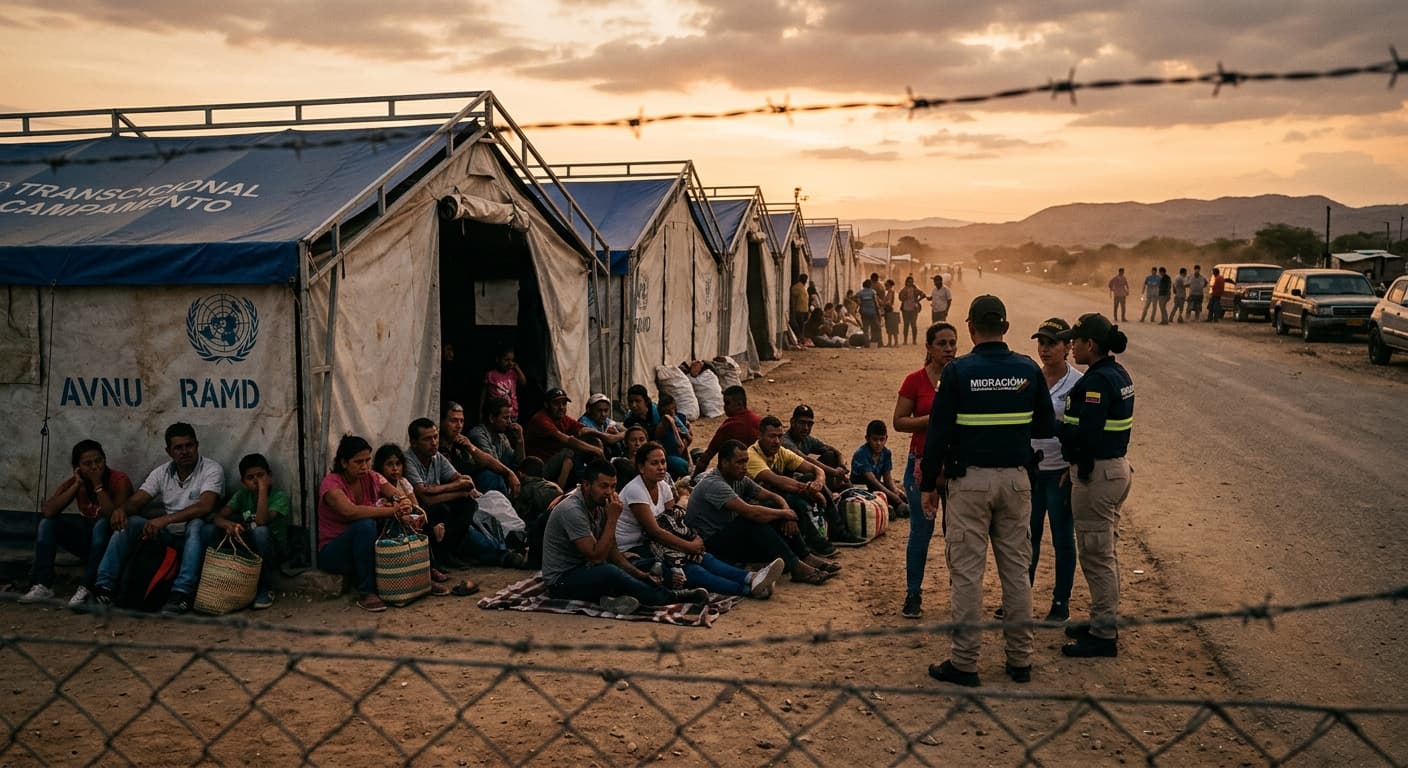
Venezuela's Transitional Camps: Migration Firebreak or Fuse?
As of 6 July 2026, Venezuela is running 79 transitional camps for 17,854 people left homeless by the June 24 earthquakes — a fragile firebreak against a fresh regional migration wave.
The 79 transitional camps that the interim government of Delcy Rodríguez and the United Nations have set up across seven Venezuelan states are being sold as a humanitarian response. They are also functioning as a migration firebreak — the only thing standing between the coastal survivors of Venezuela's worst earthquake in a century and a fresh southward exodus into a Colombia whose migrant protection regime has already lapsed. OCHA says the camps are designed to hold people for "up to a month" — a clock ticking on a country whose reconstruction bill was set Monday at US$37 billion by the UN Office for Disaster Risk Reduction, against a government with neither the money nor the credibility to rehouse them.
That is the second-order story behind the tents in the Estadio César Nieves and the Centro Polideportivo of La Guaira. What happens inside the camps over the next 30 days will shape whether the Andes see a repeat of the 2017–2019 Venezuelan diaspora surge, and whether Delcy Rodríguez — installed after US forces seized Nicolás Maduro on January 3, 2026 — survives her first political test.
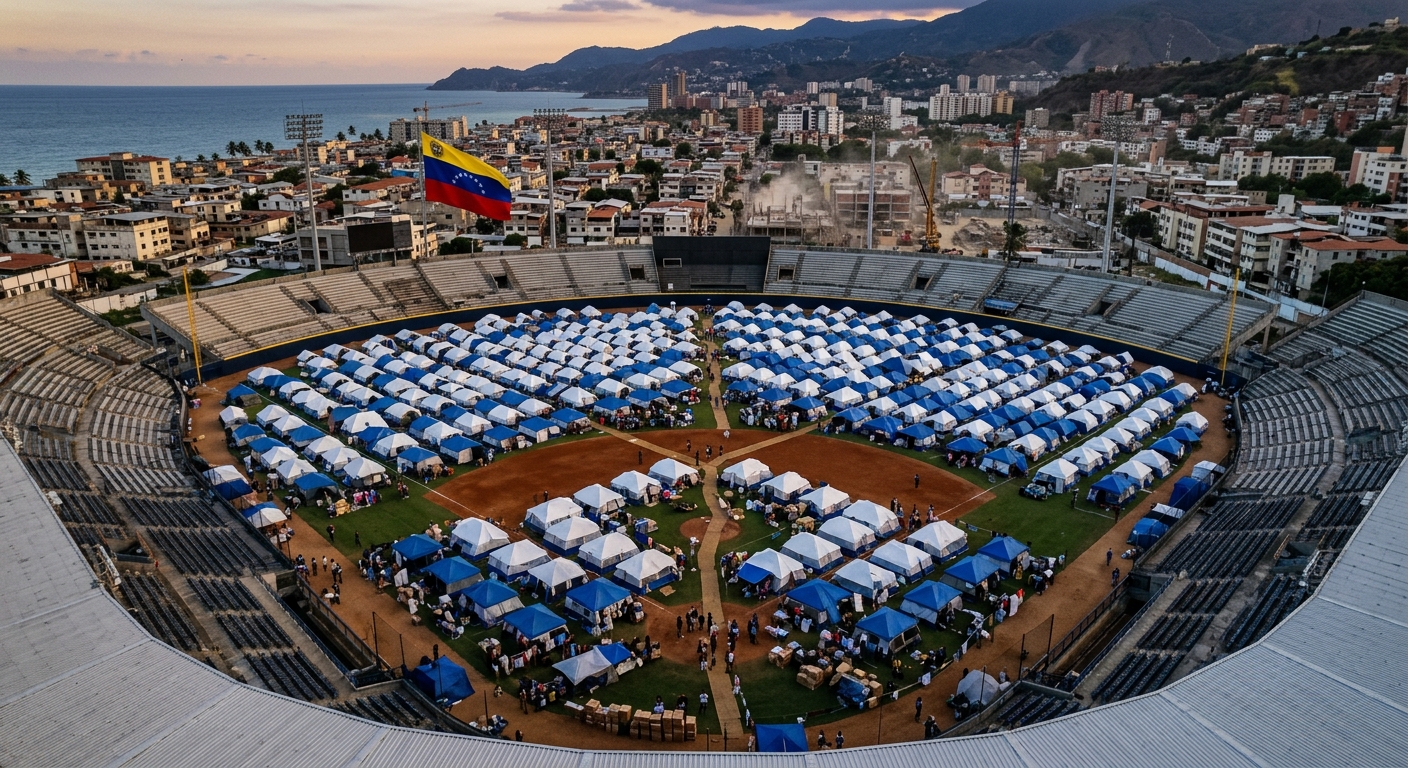
What the camps actually are
The label matters. Venezuelan state media has been running the phrase "campamentos transitorios" for a week — Radio Rebelde reported on 7 July that "the Venezuelan state has established 82 temporary camps" to assist survivors — but the operational architecture is not solely governmental. In an on-the-ground briefing filmed at the Centro Polideportivo La Guaira on 30 June, OCHA's Vanessa May defined the model in the government's own vocabulary:
"We are working with the authorities on centres equipped for people to stay in for the time being, we have defined them 'transitional camps.' The idea is that people here may get a comprehensive response in health, food security, nutrition — while making sure that it is a space where psycho-social support is offered and orientation classes for their next steps. We hope people can stay here up to a month, while at the same time, we discuss with the authorities about long-term solutions."
Lia Poggio, speaking for the International Organization for Migration (IOM) at the same site, told OCHA cameras that "last night, 1,700 people spent the night here, but an average of 2,500 to 3,000 showed up." That gap — between the people the camps can house and the people who need them — is the crisis in miniature.
OCHA's Situation Report #13, dated 8 p.m. on 6 July 2026, records 3,535 dead, 16,740 injured, and 17,854 people without housing. La Guaira state remains the epicentre of both the destruction and the displacement. UN News reported the same day that
at least 79 transitional camps have opened in stadiums and sports centres, with UN agencies delivering services in three of them and assessing more.
Why the camps are, quietly, a political instrument
The Rodríguez government is politically exposed. It inherited power from a captured predecessor, faces sustained popular anger over a slow rescue effort, and depends on Washington's continued willingness to keep sanctions partially lifted. The camps give it three things it badly needs: a visible state presence in devastated barrios where volunteers arrived first, a channel through which US and UN money can flow without directly funding regime coffers, and — most importantly — a way to keep displaced Venezuelans inside Venezuelan territory.
That last function is where the humanitarian and the geopolitical converge. CSIS warned on 25 June — in an analysis by Will Freeman — that "in a worst-case scenario, a botched recovery leading to further authoritarian consolidation could worsen ongoing irregular migration dynamics in the region." Al Jazeera correspondent Alessandro Rampietti, reporting from Bogotá, put it more bluntly: Venezuela's public services were already in "shambles" before the ground moved. The camps are what a "not-yet-botched" recovery looks like — barely.
Carolina Jiménez, president of the Washington Office on Latin America, captured the credibility problem in one line to Al Jazeera: "In a government in any other country, the first responder should be the state. In the case of Venezuela, the state has been the last responder." Every day that OCHA and IOM staff run the camps in the interim government's name buys Rodríguez political time she could not buy herself.
The Colombia problem sitting on the other side of the border
The reason 30 days matters is on the other side of the Táchira River. Colombia already hosts roughly three million of the 7.7 million Venezuelans who have left since 2013, according to the UN refugee agency (UNHCR). But President Gustavo Petro, as CFR's Will Freeman noted in a March 2024 analysis that has aged with grim relevance, let Colombia's flagship protection scheme — the Estatuto Temporal de Protección para Migrantes Venezolanos (ETPV) — lapse, with no new applications possible since November 2023. He also dismantled the interior-ministry agency that coordinated migration policy nationally.
The result: if the transitional camps empty into a new southward flow, they will hit a Colombia whose absorptive machinery is materially weaker than in 2019. Petro's own 3 January 2026 X post — after the US strike that removed Maduro — declared that "all the assistance resources at our disposal have been deployed in case of a mass influx of refugees." That was six months ago, before an earthquake destroyed roughly 60,000 buildings, according to Al Jazeera's tally citing Venezuelan authorities. The 2,219-kilometre eastern border Petro promised to fortify is the same border across which up to a third of some frontier cities like Cúcuta are
already Venezuelan-origin, per World Bank analysis.
Two second-order beneficiaries deserve naming. The first is the Trump administration, whose US$300 million commitment and 900 SOUTHCOM personnel — reported by Al Jazeera citing Steven McLoud of Southern Command — are, in effect, subsidising the camps that keep Venezuelans off the migration corridor to the US southern border. The second is the Rodríguez faction itself: every dollar that flows through OCHA to a camp is a dollar that does not need to be raised from an oil sector whose sanctions-relief architecture is still contingent on Washington's tolerance.
The 30-day clock and the medical time bomb
The transitional-camp model works only if two things happen inside a month. Long-term housing solutions need to be identified — OCHA's Sitrep #13 says these are still being "discussed" with authorities. And the camps need not to become disease vectors.
Neither is on track. The Pan American Health Organization reported on 2 July that all eight health facilities it reviewed in La Guaira, Caracas and Miranda need immediate outside help; three have structural damage. Teresa Bo, Al Jazeera's correspondent in La Guaira, described widespread diarrhoea reports, requests for portable toilets and fears of overcrowding-driven disease spread. UNICEF's Gabriel Vockel
told UN News on 1 July that some 680,000 children need humanitarian assistance across six states — a figure the agency has since revised to 234,000 children within a broader 650,000-person needs pool.
Venezuela's national assembly leader Jorge Rodríguez, brother of the interim president, claimed on 6 July that 12,800 people were staying in 80 shelters. Huniades Urbina of Venezuela's paediatrics association told Al Jazeera that a 2025 survey found shortages of over 30% of emergency hospital supplies and 70% of operating-room supplies — the medical baseline into which any camp-based disease outbreak would land.
The humanitarian response plan for Venezuela has received US$274 million in 2026, according to OCHA, plus roughly US$32 million from private-sector donors. Against a UNDRR damage estimate of US$37 billion, that is a rounding error.
What to watch
- Around 30 July 2026 — the operational end of OCHA's stated one-month window for camp stays. Whether residents are moved to identified long-term housing, allowed to remain, or told to disperse will determine whether the camps become de facto internally-displaced-person settlements.
- The next OCHA Situation Report — Sitrep #14, expected within the week, and UNHCR's follow-through on its
US$14.85 million shelter appeal to reach 30,000 people over six months.
- Colombian border monitoring data — Migración Colombia's daily arrival figures at Cúcuta and Paraguachón. A sustained uptick above pre-quake baselines would signal that the firebreak is failing and that Petro's dismantled protection architecture is about to be stress-tested.
- US disaster funding decisions — whether the Trump administration's
Disaster Assistance Response Team, described in a CFR analysis by Michael Igoe, is extended and scaled beyond the initial US$300 million commitment.
- Delcy Rodríguez's political standing — whether the opposition, backed by María Corina Machado in exile, converts public frustration over the response into a renewed transition demand before reconstruction contracts begin flowing to regime-aligned firms.
The Bottom Line
Venezuela's 79 transitional camps are the region's most consequential humanitarian intervention in a decade — not because of what they contain, but because of what they postpone. As long as OCHA, IOM and roughly US$300 million in US aid keep the Bolivarian Republic of Venezuela's displaced sheltered inside its borders, Colombia's lapsed protection regime, Brazil's Roraima corridor and the US southern border catch a break. If the one-month camp clock runs out without a housing plan, the same firebreak becomes the fuse — and the diaspora that has already pushed 7.7 million Venezuelans abroad since 2013 writes its next chapter in La Guaira's stadiums.
Discover more
US Politics
U.S. House Passes Alert Act for Aviation
The House passed the ALERT Act 396–10, replacing the ROTOR Act after Pentagon intervention, impacting aviation safety regulations.

US Politics
White House Pressures Congress for Crypto Leg
The Trump administration's push for the CLARITY Act aims to reshape crypto regulation, impacting trillions in market value and the Trump family's wealth.
US Politics
Virginia's Redistricting Referendum
Virginia's redistricting referendum is drawing a flood of dark money, shaping future elections and the fight for congressional control amid party stakes.

Economics
Fed's Amex AML order puts correspondent banking on notice
Federal Reserve's Amex AML order requires board-level controls and a 90-day plan; OCC fined the bank $350 million over enterprise-wide deficiencies.