Venezuela's $240bn Debt Sprint Risks Crisis
Urgent debt deal sought amid earthquake recovery efforts
Model Diplomat8 min readLatin America
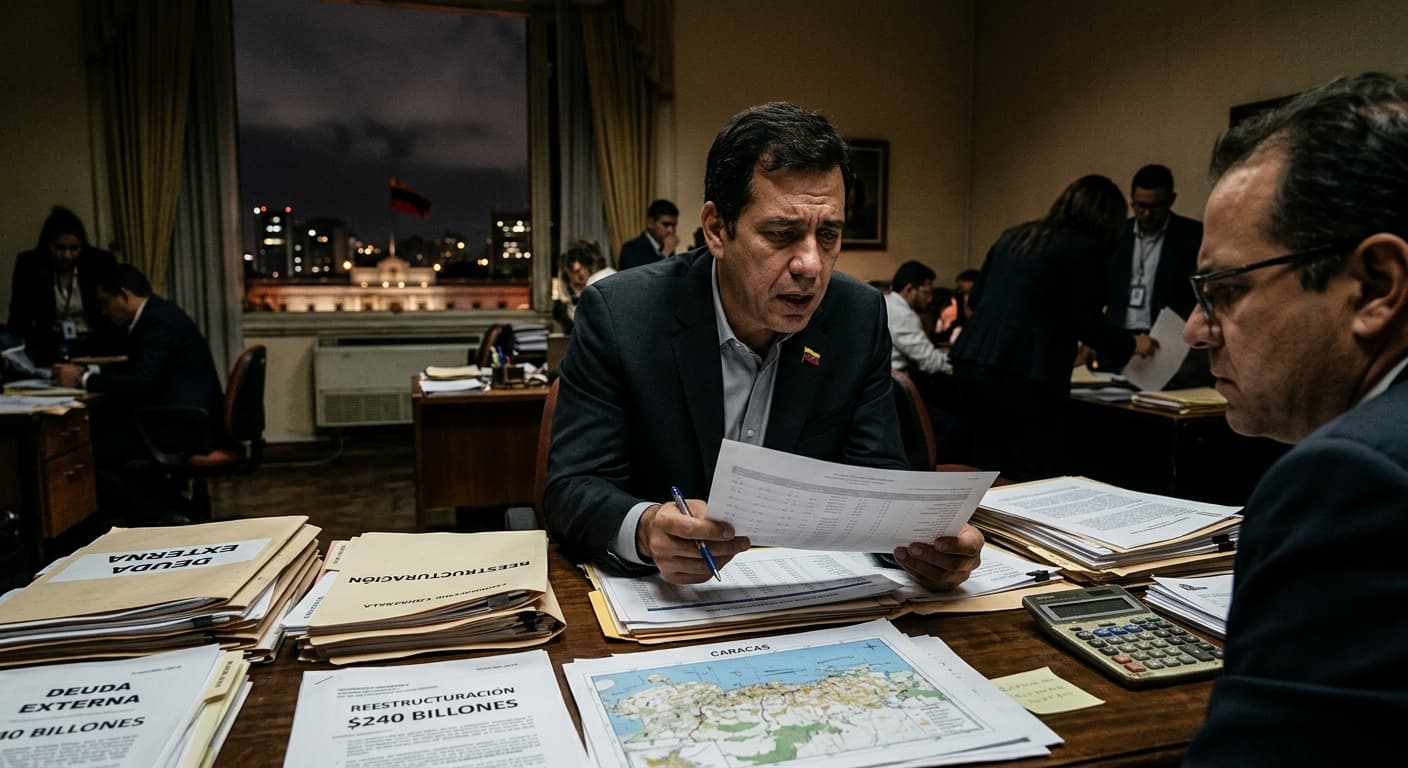
Venezuela's $240bn Debt Sprint After Quakes Risks New Crisis
Caracas wants a debt deal by November on $200–240bn in claims — without the IMF, without audited data, and with earthquake damage still unpriced.
Venezuela's interim government is trying to close the largest sovereign debt restructuring in history in under six months, on numbers no independent body has verified, while its capital is still digging bodies out of the rubble — and the deal now being pushed toward a November launch risks locking in a debt load the country cannot service through the next decade, according to the veteran lawyers and economists advising both sides. That is the argument buried inside a July 8 Reuters dispatch carried by SRN News: Caracas and its bondholders have a shared, private interest in speed — one that runs directly against the case for a sustainable deal.
The June 24 earthquakes changed the arithmetic. They did not change the calendar. According to Al Jazeera, the twin magnitude-7.2 and 7.5 quakes have killed at least 3,535 people, injured 16,740, damaged some 60,000 buildings and left nearly 18,000 homeless. The
Economist put direct damage at $10 billion, roughly a tenth of GDP, "and it could cost ten times that." Yet interim President Delcy Rodríguez's team, advised by New York boutique Centerview Partners, is still targeting an early-stage debt exchange as soon as November.
The number nobody agrees on
Every credible estimate of what Venezuela actually owes is a different number, and the range is a $100 billion wide.
The Financial Times reported in June that Caracas will disclose a debt pile of roughly $240 billion — "$40 billion above previous estimates," with no public explanation for the delta. That implies a debt-to-GDP ratio above 200%, against an economy the FT notes has "shrunk by about two-thirds since 2012." Chatham House's Christopher Sabatini and Nastassia Farsari
put defaulted external debt at $150–170 billion in a June briefing. A 2023 CSIS analysis pegged the external stock at
around $140 billion. Reuters says bondholders now see claims "approaching $200 billion."
Those are not rounding differences. They are the difference between a distressed sovereign and a fundamentally insolvent one. The gap exists because Venezuela's obligations are not just bonds. They include arbitration awards, oil-backed loans to China and Russia, past-due interest, promissory notes to service contractors, and disputed PDVSA paper. The International Centre for Settlement of Investment Disputes alone is still processing Venezuelan cases — Smurfit Holdings v. Venezuela held its annulment hearing in Paris on March 26–27, 2026. Each such claim is a live liability nobody has priced.
Nor has Caracas published full debt or macroeconomic statistics for years. The Debt Sustainability Analysis (DSA) that anchors any restructuring — the model that tells creditors how big a haircut is needed — is being built by Centerview on data no independent auditor has seen.
Why speed serves both sides — and neither of them
The unusual feature of this restructuring is that debtor and creditor incentives are aligned on the wrong axis: time, not sustainability.
Rodríguez needs a headline deal to unlock financing for oil-sector recovery and earthquake reconstruction, and to consolidate an interim government that the Council on Foreign Relations describes as still three-phase and reversible. Bondholders, meanwhile, want to lock in recoveries before the International Monetary Fund gets involved. As Lee Buchheit — the dean of sovereign restructuring lawyers, hired in 2019 by then-opposition leader Juan Guaidó — told Reuters, both sides have reason to close fast: authorities want to signal a market return; bondholders "want to avoid a more rigorous IMF-led assessment that could reduce recoveries."
Buchheit was blunter still on the DSA itself. "What may be presented as a DSA will in fact just be a manufactured set of numbers that appears to support some form of bond restructuring." That is a $200 billion warning from the person who has run more of these deals than anyone alive.
The IMF is being kept at arm's length. In a June 25 press briefing, Fund communications director Julie Kozack confirmed:
"So far, we, the Fund, are not and have not been involved in the debt restructuring process that has been announced by Venezuela… The IMF is never a party to the negotiations."
That is not neutrality. It is the absence of the one institution whose imprimatur normally makes a sovereign deal durable. The IMF's own April 2026 Restructuring Playbook is explicit: a credible restructuring envelope depends on an "IMF-World Bank DSA" and "financing assurances from official bilateral creditors" — neither of which exists here. Venezuela is running the playbook without the referee.

The earthquake changes the math
Even before June 24, the numbers were tight. Oxford Economics' chief Latin America economist Joan Domene told Reuters that $7 billion in quake damage is "a massive blow" that "will make the case for the government to plead for an even bigger haircut." The UN has launched a $296 million humanitarian appeal and Venezuela's foreign minister Yván Gil has
publicly asked nations holding frozen Venezuelan assets to release them. Rodríguez has separately appealed to King Charles III
to release 31 tonnes of Venezuelan gold held at the Bank of England — a dispute the UK Supreme Court ruled on in 2021 in favour of the Guaidó-appointed board, and which is now politically live again.
That is the wider context creditors are quietly betting on. If Caracas can pry loose frozen reserves — including the $5 billion in Special Drawing Rights that CFR notes Venezuela has been unable to access since 2019 — recoveries improve without the government having to make credible fiscal commitments. If it cannot, bondholders still get the exchange done before the earthquake damage assessment fully lands on the balance sheet.
Caracas-based Síntesis Financiera has told Reuters the government should pause: using pre-quake macro assumptions "would be a costly mistake" that risks underestimating the debt relief required. That is the polite version of Buchheit's warning.
The precedent nobody wants to cite
Greece's 2012 restructuring — the modern benchmark for a $200 billion deal — took roughly a year, ran through an IMF program, was anchored on audited European Commission data, and still required a follow-on Official Sector Involvement round in 2012–2013 because the first haircut was too small. Ukraine's 2015 restructuring, run by many of the same lawyers now circling Caracas, was widely judged to have under-cut debt relief and had to be revisited under wartime pressure in 2024.
Venezuela is attempting something structurally harder — a bigger stock, more creditor classes, no IMF program, an unresolved sanctions regime, active ICSID litigation, and disputed government legitimacy — in half the time. As Mitu Gulati of the University of Virginia told Reuters, "This will surely be the most complex sovereign debt restructuring of my lifetime… If you give away all of your goodies now… my worry is that we're just pushing the real restructuring problem down the road."
Who benefits from a bad deal
Follow the incentives.
Distressed-debt funds that bought Venezuelan and PDVSA paper at pennies on the dollar during the sanctions years win a fast exchange at almost any recovery above their entry price. The larger the headline debt figure, the larger the notional haircut looks — and the more room for a deal that still triples their cost basis.
Rodríguez's inner circle — a PSUV government that the BBC notes was installed by her brother Jorge, National Assembly president, days after Maduro's January capture — gets to point to a debt deal as validation before any electoral test. As Chatham House warns, "debt resolution may restore financing channels without restoring the institutional credibility needed for multi-sectoral investment and sustained recovery."
Centerview Partners collects a landmark mandate fee on the largest sovereign restructuring ever attempted.
The Trump administration gets a foreign-policy trophy: the country it took over in January is back on global markets by year-end. CFR notes the White House already controls the revenue from a 50-million-barrel Venezuelan oil tranche, disbursed through Executive Order 14373 and a Qatar account that Secretary of State Marco Rubio confirmed to Congress had moved $500 million to Caracas.
Ordinary Venezuelans — 18,000 of them still without housing, per Al Jazeera, and millions more depending on rebuilt hospitals, schools and power grids — bear the cost of any over-optimistic DSA. The Chatham House analysis is explicit: without central bank independence, fiscal transparency and anti-corruption controls attached to the deal, "debt resolution may restore financing channels" but not recovery.
What to watch
- This month (July 2026): Publication of the Centerview-led Debt Sustainability Analysis. Reuters reports investors now expect it in July, after the end-June target slipped. Watch for the total debt figure and whether the macro framework is dated pre- or post-June 24.
- August–September 2026: Formation of a bondholders' committee under Collective Action Clauses — the
IMF playbook step that will reveal which funds dominate the negotiation.
- November 2026 (target): Launch of the sovereign and PDVSA exchange offer. A slip past November signals the DSA credibility fight has been won by the sceptics.
- Bank of England: Any UK response to Rodríguez's request for the 31 tonnes of gold. Release would materially improve recoveries; refusal keeps sanctions leverage intact.
- ICSID docket: Rulings on pending Venezuelan arbitration claims — each converts contingent liability into hard claims that must sit inside the restructuring perimeter.
Diplomat View
The forecast: Venezuela closes an exchange offer in the November 2026–February 2027 window on a debt-relief envelope calibrated to the political calendar, not the reconstruction bill — and returns to a restructuring table within five years. The tell will be a DSA that assumes oil production recovery above 2 million barrels per day by 2029 without pricing the earthquake's hit to Puerto Cabello's export infrastructure, and a haircut of roughly 60–70% on face value with heavy back-loading via GDP-linked warrants. That is the shape of a deal that lets bondholders book a win, lets Rodríguez claim a market return, and lets the Trump administration declare victory before the 2028 US electoral cycle — while leaving the real solvency question for a future government.
The forecast changes if the IMF is pulled into a formal Article IV or program engagement before the November launch, if UK or US courts release meaningful frozen assets, or if a bondholders' committee credibly threatens to hold out. Absent one of those three, the market is pricing speed. Speed is what a fragile sovereign gets wrong.
The bottom line: Venezuela's rush to restructure $200–240 billion of debt while its dead are still being counted is not a recovery plan — it is a political deadline dressed in financial clothing, and the sovereign-debt profession's most experienced practitioners are on the record saying so. If the deal lands in November on numbers nobody has audited, expect Caracas back at the table before 2032.
Discover more

Global
Senegal Hires Lazard, Signaling Debt Restruct
Senegal hires Lazard as debt adviser, ending resistance to restructuring after audit revealed $13bn in concealed borrowing. Political deadlock between President Faye and PM Sonko threatens any IMF deal.
Global
Ethiopia's Tariff Shock and IMF Strategy
Ethiopia's electricity tariff increases are financing a $28 billion debt restructuring, as households bear the burden of IMF commitments.

Conflict & Security
Venezuela's Debt Overhaul: Pigasse's Role
Matthieu Pigasse's role in Venezuela's debt restructuring spotlights US influence over the deal, reshaping the geopolitics of the country's financial recovery.

Economics
Fed's Amex AML order puts correspondent banking on notice
Federal Reserve's Amex AML order requires board-level controls and a 90-day plan; OCC fined the bank $350 million over enterprise-wide deficiencies.