Ethiopia's Tariff Shock and IMF Strategy
How households are financing Ethiopia's debt restructuring
Model Diplomat9 min readAfrica
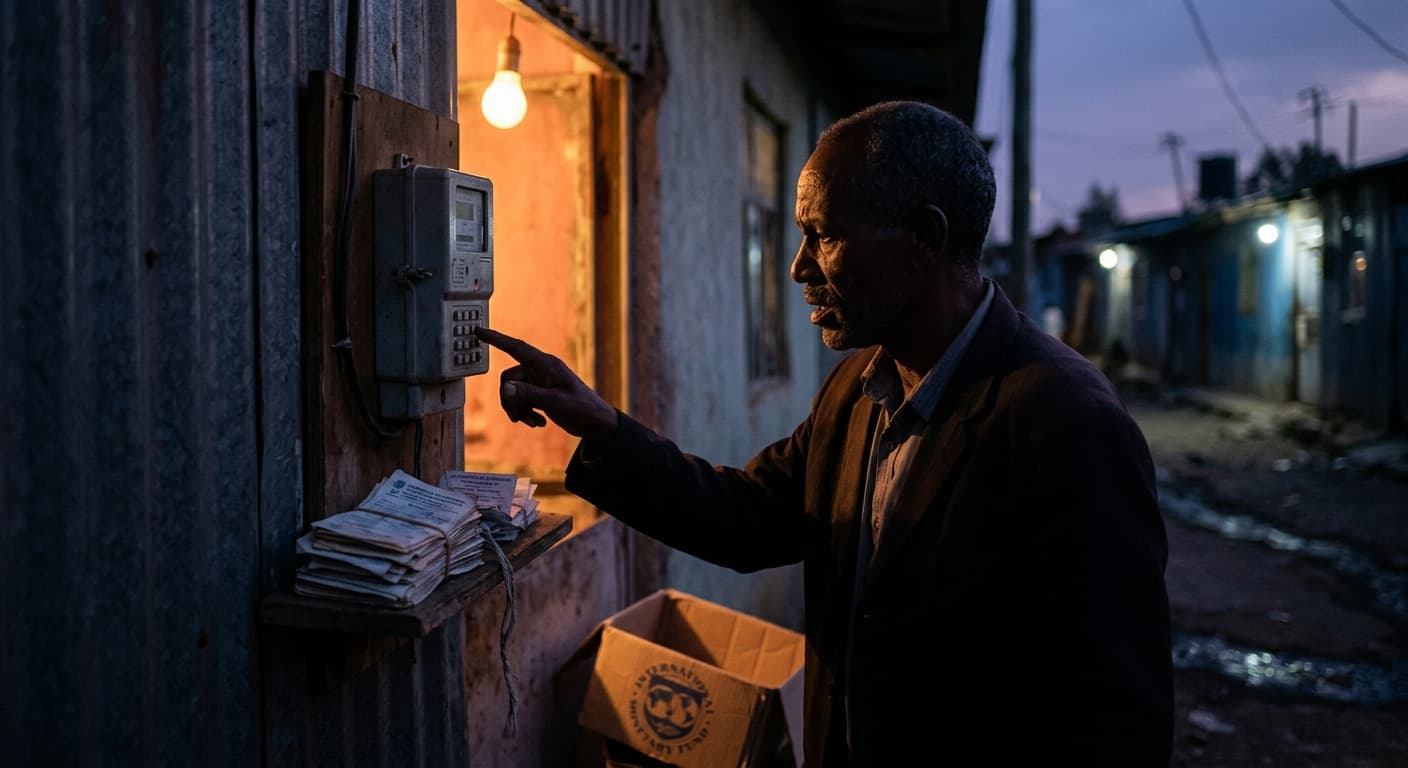
Ethiopia's Tariff Shock Is How the IMF Gets Paid
Ethiopia's quarterly electricity price hikes, a 30% birr crash and a $28bn default converge in one deal: households are financing the debt restructuring.
The IMF released $464 million to Ethiopia on July 1, 2026 and confirmed an agreement-in-principle with Eurobond holders — the last big obstacle to closing Africa's most-watched Common Framework restructuring. The same paragraph of the same press release notes that Addis Ababa "raised fuel and electricity prices in line with their commitments." That is not coincidence, and it is the story. Ethiopia's four-year electricity tariff shock — a quarterly ratchet that has pushed some residential rates up roughly six-fold since September 2024 — is the fiscal mechanism the IMF is using to convert a floated birr and a $28-billion default into a debt deal. Households in Addis are paying the bridge from GERD's cheap kilowatt-hour to bondholder recovery in London — and the IMF press release that announced the tranche said so, in the same paragraph.
The mechanics: a quarterly ratchet, not a price hike
The Council of Ministers approved a four-year tariff adjustment plan in June 2024. The first "front-loaded" increase of about 20% landed in September 2024, followed by quarterly adjustments running through 2028. According to the IMF's First Review, the schedule was engineered to cumulate to "about 80 percent over the next 12 months" — a structural benchmark under the Extended Credit Facility signed on July 29, 2024. That benchmark is not decorative. Missing it stops the next tranche.
The October 2025 schedule published by the Ethiopian Electric Utility gives the sharpest picture. According to Abren, residential customers now pay 0.7571 birr/kWh in the lowest lifeline tier and 5.0990 birr/kWh above 500 kWh — a 6.7x spread within a single household's bill. Low-voltage industrial users pay 3.0889 birr/kWh plus a 441.28 birr/kW demand charge; medium-voltage industry pays 2.4927 birr/kWh plus 324.34 birr/kW; general service commercial customers pay a flat 5.0141 birr/kWh. All bills carry a 15% VAT, a 0.5% regulatory fee and a 10-birr television levy. EEU CEO Getu Geremew told
The Reporter Ethiopia that households still pay roughly $0.005/kWh — "the second-lowest rate in the world" — a figure that is arithmetically accurate only because the birr has collapsed in dollar terms faster than tariffs have risen in birr.
That arithmetic is the trick embedded in the reform. The IMF's Fourth Review, published December 22, 2025, records that public and publicly guaranteed debt rose from 35.4% of GDP to 50.3% in the year to end-June 2025, "reflecting program disbursements and exchange rate depreciation." Every birr devaluation blows up the utility's dollar-denominated import bill and the sovereign's debt stock in the same motion. The tariff ratchet is the release valve — and the Fund is explicit that further hikes may be needed, noting that "additional tariff increases (scope for which is provided for under the regulatory tariff framework) could be needed to further strengthen viability and investment in the sector."
The weak birr is the point
Ethiopia floated the birr on July 29, 2024, dropping it roughly 30% overnight against the dollar, the BBC reported at the time. That was the entry ticket to the ECF and to Common Framework debt talks. Two years later, the currency has kept sliding: the UK's
Foreign, Commonwealth & Development Office used a consular rate of 194 birr per pound for July 2025, and
Al Jazeera reported the parallel-market rate hit 174 to the dollar in July 2025, an all-time low.
An IMF Selected Issues Paper by Bryan Gurhy and co-authors, published June 16, 2025, argues the parallel-market premium has persisted because of a 2.5% commission the National Bank charges on FX sales, a closed capital account, and the absence of hedging instruments — meaning importers still fear "sharp depreciation between the time letters of credit are opened and when payments are settled." Ethiopian Electric Power imports transformers, turbines and spare parts against exactly that risk, on deferred LCs, in a currency that keeps falling. The IMF's own comparison ranks Ethiopia lowest among Angola, Egypt and Nigeria on financial development, and finds its transition dynamics most closely resemble Angola's — where the parallel premium persisted for years after unification. That is the base case a policymaker should hold in mind.
The design implication is that the tariff plan cannot be denominated in a level. It has to track the birr down, quarter by quarter, or the utility's balance sheet collapses again and the whole ECF unwinds.
What the tariff actually finances
Read the IMF program documents carefully and the electricity bill is not a household expense — it is a fiscal instrument. The Fourth Review lists the tariff increases as "financial strengthening of SOEs (notably electricity tariff increases, equal to some 0.4 percent of GDP)" within a broader quasi-fiscal adjustment package that also includes removing implicit fuel and fertilizer subsidies worth 1.3% of GDP. Diesel prices were raised 11% in early December 2025 and gasoline 5%, bringing cumulative 2025 fuel increases to 43% and 42% respectively — with fuel subsidies to be "substantively eliminated" by end-February 2026. On top of that, public utilities have been brought into the VAT regime, adding another layer of revenue.
That fiscal room is what unlocked the debt deal. According to the Global Sovereign Debt Roundtable's April 15, 2026 co-chairs' report, all members of the Official Creditor Committee — which includes China, the swing player — signed the MOU in December 2025; the first bilateral agreement was signed on February 11, 2026. Bondholders held out longer. An earlier agreement-in-principle reached in early January 2026 was assessed by the OCC as failing the "comparability of treatment" test — meaning private creditors were being offered better terms than official ones, which would have triggered the claw-back clauses standard in Common Framework MOUs. Only after Ethiopia raised its offer did the
IMF's July 1, 2026 statement confirm a fresh AIP with Eurobond holders — alongside a $200 million top-up to the ECF envelope to cushion Middle East war-driven fuel costs.
The chain of causation is direct: household electricity bills → SOE recapitalisation → primary surplus → IMF disbursement → creditor confidence → bond exchange. The January 2026 AIP collapsed precisely because one link — comparability of treatment — snapped; the July 1 version holds only as long as none of the others do.
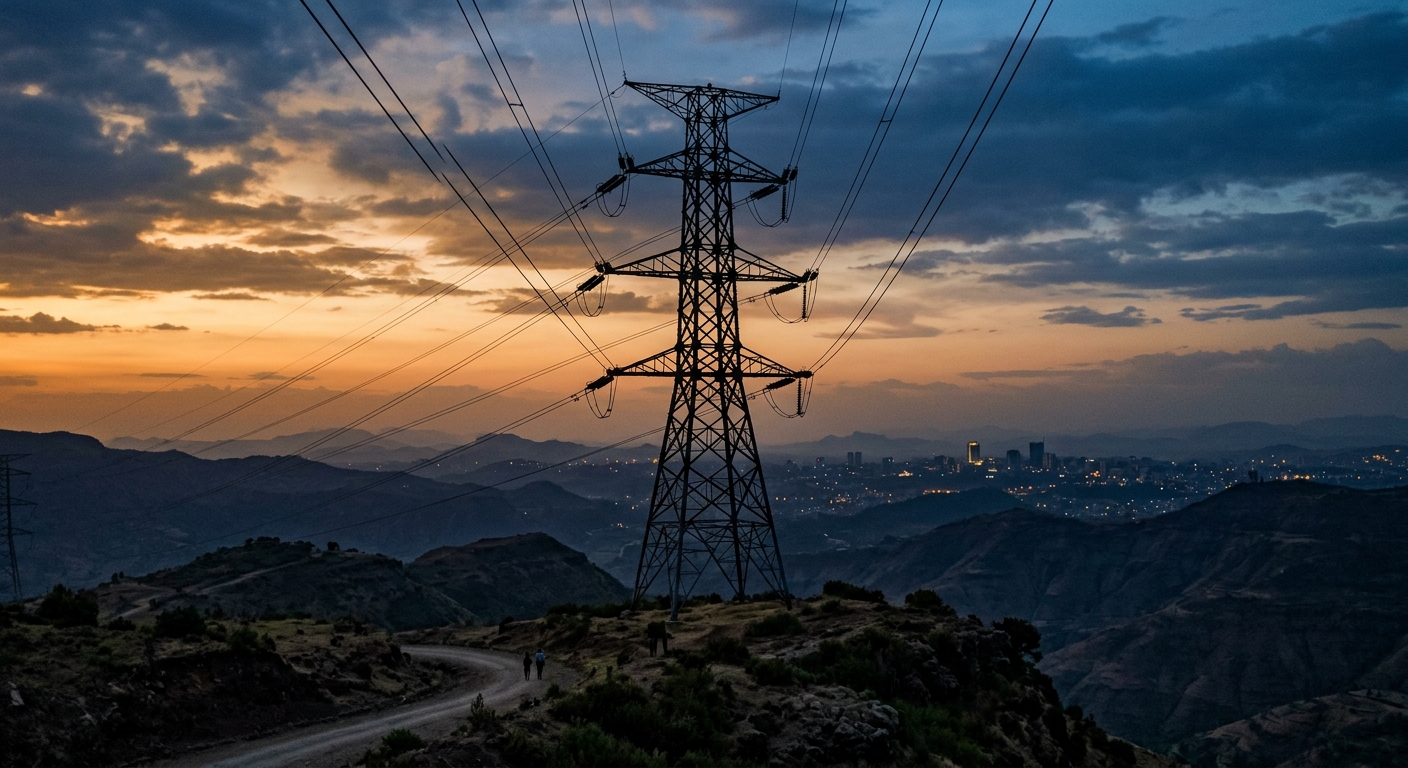
GERD, exports and the arbitrage nobody names
Prime Minister Abiy Ahmed inaugurated the Grand Ethiopian Renaissance Dam on September 9, 2025 alongside Kenya's William Ruto and Djibouti's Ismail Guelleh. According to Al Jazeera, the $5-billion project doubles installed capacity toward 5,000 MW. Egyptian Foreign Minister Badr Abdelatty called the dam an "existential threat" — but Egypt and Sudan boycotted the ceremony, and, as
the BBC observed, the colonial-era 1920s deal that guaranteed Egypt about 80% of the Nile's waters is now effectively dead. Ethiopia won the diplomatic battle by simply building.
The World Bank's National Energy Compact sets a target of 5,000 GWh in annual exports by 2030 — up from under 1,500 GWh — via the Eastern Africa Power Pool and new PPAs with South Sudan and Somalia, on top of existing interconnectors with Kenya, Sudan, Djibouti and Tanzania. Those exports are priced in dollars. Domestic consumption is priced in a birr that has fallen roughly 60% in two years. GERD's marginal kilowatt-hour therefore earns hard currency abroad while the domestic customer is walked up the tariff ladder to pay for the transmission and distribution build-out that carries the power in the first place. Half of Ethiopians still have no electricity access, according to Water and Energy Minister Habtamu Ifeta,
quoted by the BBC, and the compact concedes technical and commercial losses "over 20% across the system" and tariffs below cost recovery until 2028.
The named winners are visible. Ethiopian Electric Power gets a shot at operational solvency for the first time in a decade. Eurobond holders — a committee representing more than 40% of principal that met the authorities at the October 2024 Annual Meetings, per the IMF's Second Review — get a recovery. The Commercial Bank of Ethiopia, recapitalised by the sovereign to absorb SOE-linked non-performing loans, gets its balance sheet cleaned. Ethiopian Investment Holdings, which oversees the SOE reform track, gets policy leverage over EEP and EEU. And Abiy gets both a GERD inauguration and, eventually, a debt-restructuring headline before his political runway narrows.
The losers are equally identifiable: urban prepaid-meter households in the top consumption block, whose bills are indexed to a currency they do not control; low-voltage manufacturers, on whom the demand charge falls hardest and whose competitiveness was already eroding against a weaker birr; and rural off-grid households, on whom, per an Amsalu Woldie Yalew CGE study in Utilities Policy (2026), subsidy reform pushes a rising share of supply.
The affordability question, and the political one
The economics of the tariff shock are, on paper, benign. A 2022 study in Utilities Policy by Sied Hassen, Marc Jeuland, Alemu Mekonnen and co-authors — using two rounds of Ethiopian household survey data — found that prepaid customers cut consumption by only about 22 kWh per month after the 2018 tariff reform, an implied price elasticity that is "highly inelastic." Their conclusion, published on RePEc, was that governments "may be able to increase revenues and improve their balance sheets with relatively modest effects on households' electricity consumption, though effects from more substantial tariff hikes should be examined." That last clause is the caveat that matters now.
The 2018 reform was one hike. The 2024–2028 plan is sixteen. And it lands on top of a currency shock, an 8.3% health budget share that UNICEF says has lost real value to inflation, and a fuel-subsidy phase-out. A 2019 study by Cardenas and Whittington, also on RePEc, showed that Ethiopia's increasing block tariff was already regressive — the poorest quintile received only 7% of residential electricity subsidy, the wealthiest 37%, because 80% of the poor were "non-primary" customers sharing connections with landlords who pocketed the lifeline rate. Layering steeper blocks on top of that structure does not automatically protect the poor; it depends on the 200 kWh subsidy threshold holding as consumption creeps up.
Al Jazeera's reporting on the doctors' strike in May 2025 documented public-sector workers unable to pay rent, transport or food after the birr float. The Ethiopian Health Professionals Movement's twelve-point demand list is the leading indicator; a UK-funded FCDO working paper on the wellbeing effects of prior Addis tariff shocks is the trailing one. The
Ethiopian Business Review has flagged the reform as a "double-edged sword" — necessary for investment but capable of squeezing low-income households and small manufacturers, the very base of Abiy's industrialisation pitch. No government official has publicly named a threshold at which the ratchet would pause.
Diplomat View
The IMF-Ethiopia program is now the cleanest template for Common Framework restructurings to date — cleaner than Zambia, faster than Ghana — and it works because the utility tariff is doing the fiscal heavy lifting the tax base cannot. That is the transferable insight. Any Sub-Saharan sovereign the IMF steers through the Common Framework in the next 24 months will face pressure toward the same lever: a multi-year, indexed, quarterly electricity ratchet. The lever works because demand is inelastic and the political cost is diffuse; it fails only if the tariff schedule outruns wage growth long enough to trigger a general strike, as the May 2025 doctors' action began to hint. The forecast changes if (a) the bondholder AIP announced July 1 collapses under a renewed comparability-of-treatment challenge from the OCC, forcing Ethiopia to concede better terms and reopen fiscal maths; (b) inflation reaccelerates past the IMF's 12.0% end-2025/26 projection, invalidating the tariff pass-through model; or (c) Egypt escalates over GERD in a way that puts the export revenue stream in question. Absent one of those three, the tariff-for-debt swap holds — and other African finance ministers will be studying the playbook.
What to watch:
- July–September 2026: Formal Eurobond exchange offer following the July 1 AIP; watch for CoT sign-off from the Official Creditor Committee and for Chinese ExIm bank sign-offs on individual bilateral agreements.
- October 2026: Next quarterly EEU tariff adjustment under the multi-year plan; the first print after fuel subsidies are fully removed.
- Late 2026: IMF sixth review and initial GWh flows on the Ethiopia-Tanzania and Ethiopia-South Sudan interconnectors — the dollar-earning side of the ledger that has to grow if the domestic tariff pain is to plateau before 2028.
The Bottom Line
Ethiopia's electricity tariff shock is not an energy-sector reform; it is the collateral on a debt deal. Households in Addis are paying the bridge that carries Eurobond holders across a $28-billion default, and the model works because demand for power is inelastic while the birr keeps falling. If the July 1 bondholder agreement holds and the OCC signs off on comparability, the IMF has its template — and other African finance ministers already know it.
Discover more
US Politics
Congress Targets AI Chatbot Access for Terror
The House passed the Generative AI Terrorism Risk Assessment Act, focusing on AI's role in terrorism and potential surveillance implications.
US Politics
House Ethics Committee Pushes Sexual Miscond.
The House Ethics Committee has shifted responsibility for sexual harassment settlement records to the Office of Congressional Workplace Rights, complicating disclosure efforts.

International Relations
Pakistan's Key Role in US-Israel-Iran Meddle
Pakistan is seeking to mediate the US-Israel-Iran conflict, balancing high-stakes diplomacy against severe economic pressures and steep regional challenges.

Economics
Fed's Amex AML order puts correspondent banking on notice
Federal Reserve's Amex AML order requires board-level controls and a 90-day plan; OCC fined the bank $350 million over enterprise-wide deficiencies.