Venezuela Quake Tests Donroe Doctrine
US military aid reshapes Latin American dynamics
Model Diplomat8 min readLatin America
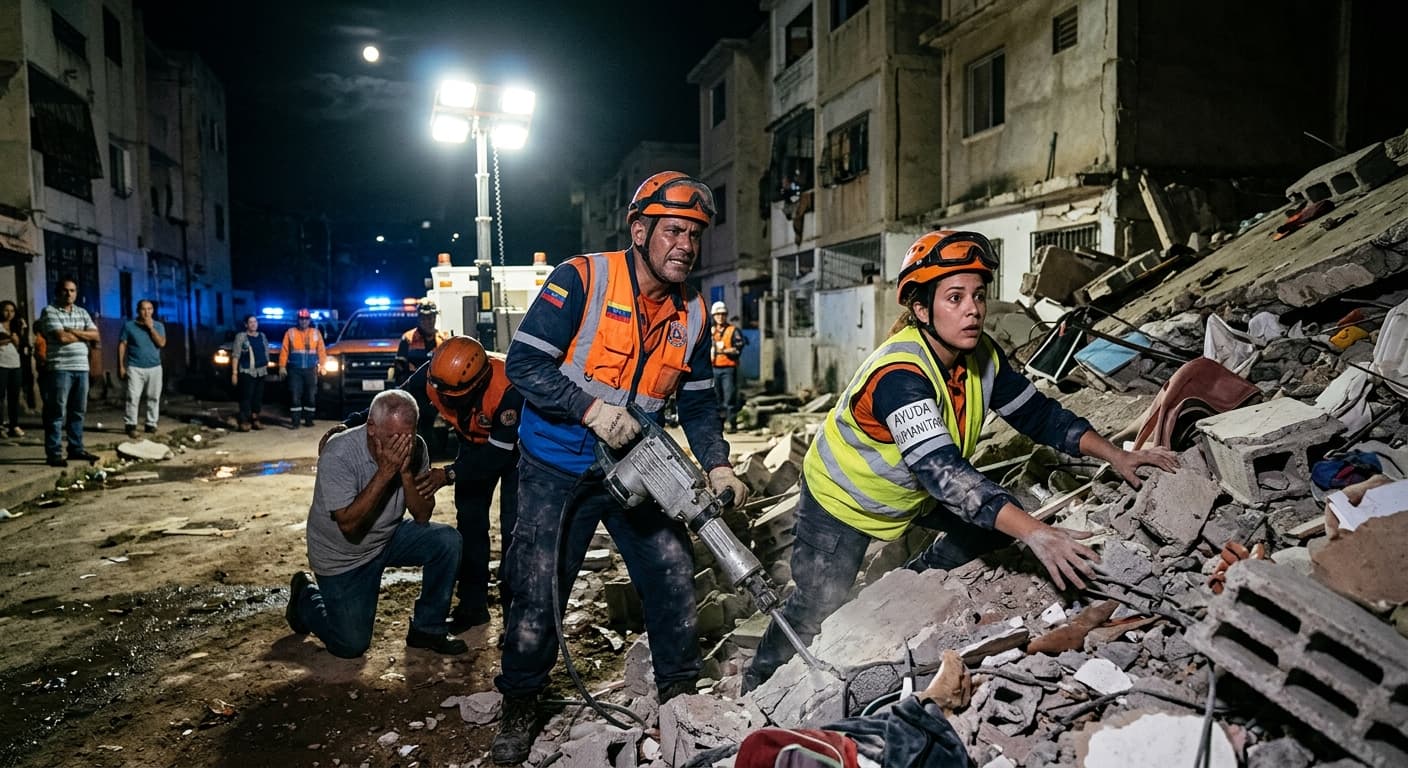
Venezuela quake becomes the Donroe Doctrine's first field test
The US says its Venezuela earthquake response has been "solid" — 2,000 troops, $300M in aid, and an interim government it installed six months ago. Here's what that really means for Latin America.
The largest US military humanitarian deployment in Latin American history is happening in a country whose president Washington physically abducted six months ago — and Caracas is officially thanking it. That inversion, more than any single aid figure, is the story of Venezuela on July 8, 2026. The June 24 earthquakes have handed the Trump administration something rarer than an oil deal: an operational proof-of-concept for the "Donroe Doctrine" — a hemispheric model in which the Pentagon executes and the State Department disburses, on ground held by an interim government the US installed. The winners are US energy majors and a newly consolidated foreign-assistance apparatus inside Foggy Bottom. The losers are the Venezuelan opposition, sidelined by the White House itself, and the Latin American capitals whose sovereignty rhetoric now looks structurally weightless.
What Washington actually says it has done
At a Miami Media Hub briefing on July 1, U.S. Chargé d'Affaires John Barrett and SOUTHCOM commander General Francis Donovan delivered the numbers Washington wanted on the record. According to the State Department transcript, U.S. urban search-and-rescue teams from Miami-Dade, Miami City, Los Angeles and Fairfax County — "more than 310 specialists" — have rescued five survivors including a mother and her toddler. Barrett put U.S. humanitarian assistance at "more than $300 million" and framed the operation as "the largest international earthquake response in Venezuela's modern history."
Donovan was the more revealing witness. He confirmed roughly 2,000 U.S. military personnel on land, air and sea "around Venezuela," a figure that has doubled since SOUTHCOM's initial 900-person disclosure to the Associated Press, as Al Jazeera reported on July 2. Al Jazeera also confirmed that the U.S. military repaired an earthquake-damaged runway at Simón Bolívar International Airport and stationed naval vessels off the coast.
By the July 7 update carried by Infobae, Barrett was calling the effort "solid," citing $310 million spent, 60,000 relief kits distributed and 680 tons of supplies moved. That happened even as Venezuela's death toll climbed to 3,535 with more than 30,000 still missing, according to
Al Jazeera's July 7 count.
Why the aid operation is really a doctrine
The Trump administration dismantled USAID as an independent agency in early 2025 and folded foreign assistance into the State Department. The Venezuela earthquake is the first Category-A disaster testing that architecture. The Council on Foreign Relations noted this bluntly: "The world is watching closely whether the State Department retains operational capability formerly housed at the U.S. Agency for International Development."
That is not an abstract bureaucratic point. It is the mechanism by which Washington now projects influence in Venezuela and, by extension, its "home region" — the phrase Trump used when he rebranded the Monroe Doctrine as the "Donroe Doctrine" in January. As
BBC News reported, Trump declared at Mar-a-Lago that "American dominance in the Western Hemisphere will never be questioned again."
Six months on, the earthquake response operationalizes that phrase. The Pentagon supplies airlift, port capacity and boots. State controls the money. Interim President Delcy Rodríguez controls the permission slip. And the humanitarian catastrophe supplies the political cover to keep U.S. forces inside Venezuela indefinitely — a presence that even the January invasion did not durably establish. As the Center for Strategic and International Studies put it in a June 26 assessment: "Venezuela stands to be the most significant test of the Trump administration's new model for foreign assistance."
The State Department's own primary June 25 release explicitly frames the deployment as a "whole-of-government" effort — the same phrase Trump used for the January raid.
The interim government's dependency
Rodríguez, sworn in on January 6 after U.S. forces flew Nicolás Maduro to a New York courtroom, is the most consequential U.S. client in the hemisphere. She was not Washington's ideological choice. The White House passed over 2024 Nobel Peace laureate María Corina Machado, whom Trump dismissed as "not respected," and installed the Maduro-era vice president instead — a decision BBC News analysis called "Trump's dedazo," borrowing Chávez's own term for anointment by finger-point.
Her leverage is minimal. On January 23, her government advanced a Hydrocarbons Law reform that, according to Al Jazeera, cut oil royalties from 30% to as low as 15%, allowed private companies to market their own crude, and permitted international arbitration for disputes — reversing the 2007 Chávez nationalization. A
Congressional Research Service brief by Brent Yacobucci confirmed the sequencing: Trump announced the sale of 30–50 million barrels of seized Venezuelan oil on January 6; Energy Secretary Chris Wright was working with "the Interim Venezuelan Authorities" the following day.
The earthquake compounded that dependency. Rodríguez publicly thanked Trump for being "in constant contact" — a phrase BBC News noted marked a sharp break from Maduro, who accepted only ideological allies. She has no political room to say no to U.S. troops on the ground when her citizens are still under rubble.

What the ground actually looks like
The gap between Barrett's "solid" and reality on the coast is wide. In Catia la Mar, north of Caracas, residents told Al Jazeera that federal government help arrived only on Sunday — three days after the quake — and in parts of La Guaira has not arrived at all. Carolina Jiménez of the Washington Office on Latin America described the pattern in one line: "In the case of Venezuela, the state has been the last responder."
Angry residents told BBC News that the government's response has been "frustrating and impotent." UNHCR warned that "community tensions are rising as access to assistance remains constrained" as displaced families competed for food in overcrowded shelters. The UN Development Programme's satellite analysis puts material damage at more than $6.7 billion — more than 22 times the announced U.S. aid package.
That distortion — real destruction, thin state, muscular external response — is precisely the environment in which Washington's operational model prospers. When 80 shelters in Caracas and La Guaira depend on foreign logistics, sovereign objections carry no ballast.
The regional reaction has already collapsed
Six months ago, Latin America's reaction to Operation Absolute Resolve was sharp. Colombia's Gustavo Petro called it "aggression against the sovereignty of Venezuela and of Latin America." Brazil's Luiz Inácio Lula da Silva said the raid crossed "an unacceptable line" and set "another extremely dangerous precedent." Mexico's Claudia Sheinbaum invoked Article 2(4) of the UN Charter directly, as Al Jazeera reported.
That coalition has largely dissolved. By late January, Petro was on a phone call with Trump and heading toward a White House meeting after being sanctioned personally and told by Trump to "watch his a**," per the BBC's interview with the Colombian president. Sheinbaum's mantra shifted to "cooperation, not subordination" — the language of a government negotiating tariffs, not defending a neighbor. When the earthquake struck,
Al Jazeera's liveblog showed Argentina's Javier Milei and Panama's José Raúl Mulino among the first to pledge assistance — right-wing governments aligned with the U.S. model. Lula sent a field hospital; the sovereignty argument disappeared into the logistics.
The International Crisis Group captured the strategic outcome in January: "every postponement of efforts to broker a genuine, negotiated transition is likely to hinder the quick reset of the oil industry Trump wants." That postponement is now indefinite. The earthquake has given Rodríguez a legitimate reason to delay elections that Article 233 of Venezuela's constitution nominally required within 30 days of Maduro's "permanent unavailability."
Who wins, who loses
The immediate beneficiary is the White House. Trump has a photogenic humanitarian deployment operating in the same country where six months earlier his forces killed roughly 80 Venezuelans and Cubans, per Crisis Group's count. It reframes the January raid retroactively as prelude to reconstruction.
The second beneficiary is Chevron, still Venezuela's only major U.S. operator, with roughly a fifth of national output. As BBC News reported, Exxon CEO Darren Woods called Venezuela "uninvestable" at a White House meeting where Trump requested $100 billion in oil-sector spending. But Chevron's sunk costs make it the fastest mover, and reconstruction contracts for water and grid infrastructure will disproportionately flow to firms already licensed under Treasury general licenses issued after the earthquake.
The third beneficiary — quieter but structurally significant — is the State Department's new consolidated foreign-assistance directorate. If it proves it can run a 2,000-person deployment and $300 million disbursement without USAID, Congress loses the argument that dismantling the agency degraded U.S. capability.
The losers are more concrete. Machado's opposition movement has been shut out of governance despite winning the 2024 election. Venezuelan civil society — praised across accounts for filling the gap the state cannot — has no political vehicle. And the sovereignty framework that governed inter-American relations since the 1948 OAS Charter has been quietly nullified in practice, without a single member state formally challenging the January raid at the ICJ.
The Foreign Affairs analysis put it plainly: "This would force a recalibration across Latin America and the Caribbean, reminding governments that U.S. disengagement is a choice, not a constraint."
Diplomat View
The earthquake response is not a humanitarian story that happens to occur in Venezuela. It is the Donroe Doctrine's first operational deliverable — and Washington will treat "solid" delivery as licence to keep U.S. forces inside Venezuela through the reconstruction phase, which by every credible estimate runs into 2028. My call: the 2,000-person SOUTHCOM footprint will not fall below 1,000 by year-end, and Rodríguez will use quake reconstruction to justify postponing any Article 233 election window past the U.S. midterms — precisely the timeline former ambassador James Story identified as her bet. What would revise this forecast: a mass-casualty incident involving U.S. personnel, a Chevron pullback signalling that oil economics no longer justify the political cost, or a Brazilian-led OAS resolution putting the January raid on ICJ track. None of those look imminent. The operative question is no longer whether Washington runs Venezuela. It is how long before other Latin American governments treat that as the region's new default.
What to watch
- July 17, 2026: Next scheduled hearing in the Southern District of New York in the Maduro drug-trafficking case — the strongest legal marker of the U.S. political framing of the transition.
- Late July 2026: SOUTHCOM's expected transition announcement from search-and-rescue to reconstruction phase, per Donovan's July 1 briefing — the pivot from "aid" to "presence."
- September 2026: UN General Assembly high-level week. Whether Petro, Lula, or Sheinbaum re-litigates the January raid on that stage — or lets it stand as precedent — will determine whether the Donroe Doctrine faces any multilateral drag before the U.S. midterms.
Discover more

India
Yamini Aiyar on Modi's Federalism Shift
Yamini Aiyar critiques Modi's shift from equity-based to performance-based federalism, highlighting implications for India's political landscape.

US Politics
White House Pressures Congress for Crypto Leg
The Trump administration's push for the CLARITY Act aims to reshape crypto regulation, impacting trillions in market value and the Trump family's wealth.
Global Politics
Trump's Conflicting Messages on Iran War
Trump's mixed messages on Iran reflect a strategy of audience management, benefiting Tehran amid a complex geopolitical landscape.

Conflict & Security
Drone Warfare Killing Aid Workers at Unprec
Over 1,000 humanitarian workers killed in three years as cheap armed drones collapse legal protections. Gaza, Sudan, Ukraine, and DRC see deliberate targeting of aid convoys and hospitals with zero prosecutions.