Venezuela Earthquakes Expose 680,000 Kids
UNICEF warns of trafficking risks for displaced children.
Model Diplomat7 min readLatin America
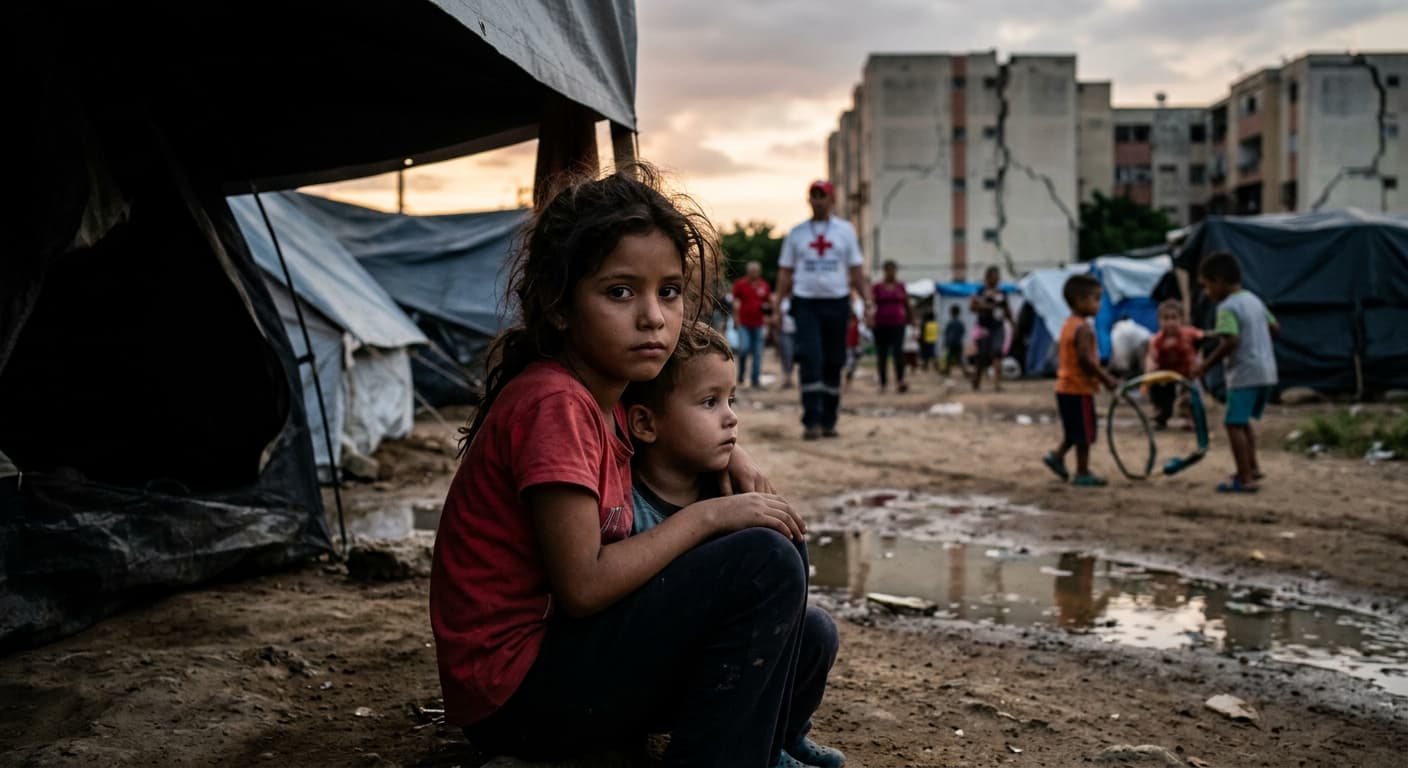
Venezuela quakes leave 680,000 children exposed to a trafficking economy
Two weeks after twin 7.2 and 7.5 quakes struck northern Venezuela, UNICEF warns that displaced children face heightened risks of trafficking and violence — from a state hollowed out long before the ground moved.
Venezuela's June 24 earthquakes have delivered 680,000 children into a protection vacuum that the country's most sophisticated criminal networks have spent a decade learning to exploit. The UN children's agency warned on July 1 that survivors are now at increased risk of trafficking and exploitation, one week into a disaster that has killed at least 3,535 people, injured 16,740 and left 17,854 without housing, according to figures released by Venezuelan lawmaker Jorge Rodríguez and reported by Al Jazeera. The angle that matters is not the death toll — it is that this disaster has coincided with the collapse of the two institutions that ordinarily shield children from that predation: a functioning state and an intact family unit.
The number that reframes everything
UNICEF's headline figure — 680,000 children in need of humanitarian assistance across six states — sits atop a much larger exposed population. The agency estimates that 3.9 million children live inside the disaster zone spanning Caracas, Aragua, Carabobo, Falcón, La Guaira and Miranda, according to a UN media briefing from Copenhagen. Manuel Rodríguez Pumarol, UNICEF's Representative in Venezuela, has framed the emergency as one of infrastructure as much as injury: "Hospitals are operating beyond capacity, thousands of children lack reliable access to clean water, and many schools have been damaged," he told
UN News on 28 June.
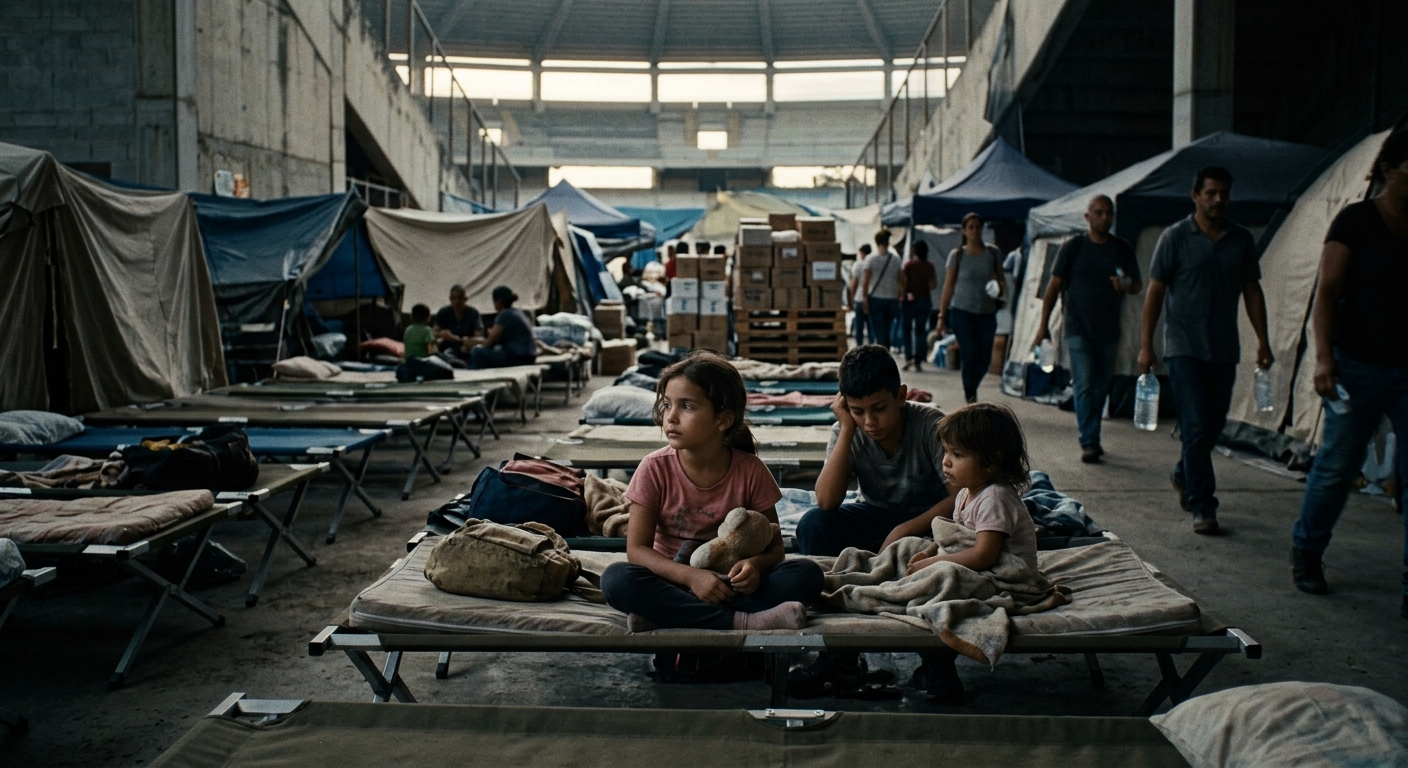
The physical damage compounds the exposure. UN relief agencies report roughly 1,000 buildings damaged or destroyed, including more than 400 schools and water systems, per a UN News update on 1 July. In the Capital District alone, 432 schools have sustained damage — more than a third of the total — and undamaged schools are being repurposed as shelters, erasing the single most reliable daily contact point between children and adults trained to spot abuse.
Why the trafficking warning is not boilerplate
UNICEF's warning of "increased risk of exploitation and trafficking" — carried by the BBC's Global News Podcast — reads like standard humanitarian language. In Venezuela's specific case, it is not.
The Venezuelan state's own anti-trafficking infrastructure was already thin before the quake. UNICEF has spent recent years training officials in the Public Prosecutor's Office and Ombudsman's Office to identify trafficking of women and children, documenting that trafficking networks had been "operating inside and outside the country" and that the affected population of children, adolescents and women had "increased year after year." That capacity now has to absorb an emergency roughly the size of Bolivia's child population landing on top of it, in the same states where it was thinnest.
The empirical evidence on post-disaster child risk is unambiguous. A 2017 paper in Disaster Medicine and Public Health Preparedness on Nepal after the 2015 earthquake described "the increased risk of human trafficking" that follows quakes, and called for anti-trafficking mandates to be embedded in disaster relief coordination, per the Cambridge journal record. A separate cross-country study of 158 states from 2001 to 2011 found a "consistent positive link between natural disasters and the likelihood of internal trafficking," particularly where economic scarcity and weak state protection intersect,
according to the journal International Area Studies Review. And research on internally displaced adolescent girls after the 2010 Haiti earthquake found that the risk of sexual abuse post-disaster rose significantly after controlling for age and education,
in a study published in the Journal of Advanced Nursing.
Venezuela combines three of the aggravating factors those studies identify: pre-existing scarcity, hollow state capacity, and a large mobile displaced population.
Who benefits — and it is a specific "who"
The winner in this equation is not abstract. It is the ecosystem of Venezuelan criminal networks that has spent the last decade turning displaced Venezuelans into revenue.
Tren de Aragua, the transnational syndicate spawned in Aragua state's Tocorón prison, built its business model precisely on the migration wave triggered by Venezuela's post-2014 collapse. Investigative journalist Ronna Rísquez, in an interview archived by BBC Mundo, described how the gang identified "migrants and women" as both victims and revenue streams, expanding into a portfolio of at least 20 crimes that includes sex trafficking, migrant smuggling, extortion and illegal gold mining. Rísquez noted that recruitment of adolescent girls is "constant and via various channels: beauty contests, modelling agencies, school peers or family members who convince them to travel and end up being sexually exploited in other countries."
That is the demand market that a shelter of separated children in La Guaira now feeds into. The state's earlier concession of governance to armed groups has already been documented at the international level: a 2020 report by the UN High Commissioner for Human Rights found children as young as nine working in the Orinoco Mining Arc, with criminal groups controlling operations while the military took bribes, per UN News. Then-High Commissioner Michelle Bachelet called on authorities "to end labour and sexual exploitation, child labour and human trafficking, and…dismantle criminal groups controlling mining activities." That call is six years old and unanswered.
A 2021 US Senate Foreign Relations Committee resolution on Venezuelan women and children captured the pre-quake baseline in blunter terms:
Whereas women and girls fleeing Venezuela face grave threats of sexual violence, exploitation, and trafficking by armed groups operating in border regions, such as the Ejército de Liberación Nacional (ELN).
That is the text of the resolution as filed. Layer 3.9 million children in a disaster zone on top of that baseline, and the trafficking risk warning stops sounding generic.
Family separation is happening in real time
The second-order effect that matters most is family separation, because it is the mechanism through which trafficking risk becomes trafficking. Turkish physicians studying the February 2023 Kahramanmaraş earthquakes coined the term "earthquake orphans" and found that within five days of the disaster, 448 unaccompanied children were being tracked in hospitals or institutional care — 223 of them still unidentified, per a Cambridge-published analysis. The authors warned that such children are "potential victims of violence, organised crime, organ trafficking, drug addiction, sexual exploitation, or human trafficking."
Venezuela's registration failure is structurally worse. PAHO's assessment of Vargas-IVSS hospital in La Guaira — where 96 patients are crammed into a ward designed for eight — found "no working phone or internet connection to track patients," according to UN News. WHO Health Emergencies chief Ian Clark told reporters in Geneva that several health workers remain missing, including the official who coordinated maternal care across La Guaira — a gap already hampering efforts to track pregnant women. If maternal-care coordinators cannot be located, the registration of unaccompanied minors is a distant priority.
The funding gap that decides the outcome
UNICEF says it needs $52 million for the earthquake response — inside a broader 2026 Humanitarian Action for Children appeal for Venezuela of $137.6 million that was, before the quakes, only 35 percent funded, per UN News. WFP has launched a separate $15 million appeal to feed up to 500,000 people over three months,
per its Venezuela director Stephanie Hochstetter. PAHO and WHO have jointly appealed for nearly $24 million. UNHCR is seeking $14.85 million.
The financing picture is worse than the raw numbers suggest. The Center for Strategic and International Studies noted that Venezuela's Bolivarian Armed Forces — the ordinary first responders — have been "hollowed out through purges and politicisation," and that the state directed citizens to use VenApp, the digital-repression tool used after the 2024 election, to report missing relatives. When the state's own registration mechanism is a surveillance app that many citizens will not touch, unaccompanied children default into the informal economy — which in northern Venezuela is not neutral space.
The politics of the aid response add another layer of risk. The US has deployed roughly 900 SOUTHCOM personnel and repaired the Simón Bolívar International Airport runway, per Al Jazeera, and the interim government of Delcy Rodríguez — installed after Nicolás Maduro's capture by US forces on 3 January — is balancing its dependence on that aid against domestic legitimacy pressures. Child protection is not a natural priority in that balancing act.
What to watch
- UNICEF funding trajectory. The $52 million earthquake appeal is the operational floor for child-friendly spaces, psychosocial support and family-tracing services. If it stalls near the pre-quake 35 percent funding level, protection capacity collapses first.
- The next OCHA situation report. OCHA is now coordinating across eight states — including Zulia, Táchira and Anzoátegui — as displaced families move onward. Watch for the first disaggregated figure on unaccompanied and separated children.
- Cross-border movement into Colombia and the Caribbean. CSIS has warned that a botched recovery could trigger "a new wave of Venezuelan outmigration and creating new opportunities for criminal elements who predate on the need of vulnerable populations." Colombian and Trinidadian border data over the next 60 days is the leading indicator.
- Shelter consolidation. With 12,800 people already in 80 shelters across Caracas and La Guaira and the Playa Grande and César Nieves stadiums functioning as service hubs, whether these sites acquire formal child-protection monitors — or remain ad hoc — will determine the on-the-ground risk profile.
The Bottom Line
Venezuela's earthquake has not created a new child-protection crisis; it has detonated an existing one. With 680,000 children exposed inside a state whose registration systems are broken, whose trafficking prosecutors were already understaffed, and whose criminal networks have spent a decade monetising displaced Venezuelans, the trafficking warning from UNICEF is not precautionary — it is a lagging indicator of a market already forming in La Guaira's shelters.
Discover more

US Politics
White House Pressures Congress for Crypto Leg
The Trump administration's push for the CLARITY Act aims to reshape crypto regulation, impacting trillions in market value and the Trump family's wealth.

US Politics
House Ethics Committee Pushes Sexual Miscond.
The House Ethics Committee has shifted responsibility for sexual harassment settlement records to the Office of Congressional Workplace Rights, complicating disclosure efforts.

International Relations
Pakistan's Key Role in US-Israel-Iran Meddle
Pakistan is seeking to mediate the US-Israel-Iran conflict, balancing high-stakes diplomacy against severe economic pressures and steep regional challenges.

Economics
Fed's Amex AML order puts correspondent banking on notice
Federal Reserve's Amex AML order requires board-level controls and a 90-day plan; OCC fined the bank $350 million over enterprise-wide deficiencies.