Venezuela Earthquake Response Challenges
Examining the hurdles in aid delivery post-earthquake
Model Diplomat6 min readLatin America
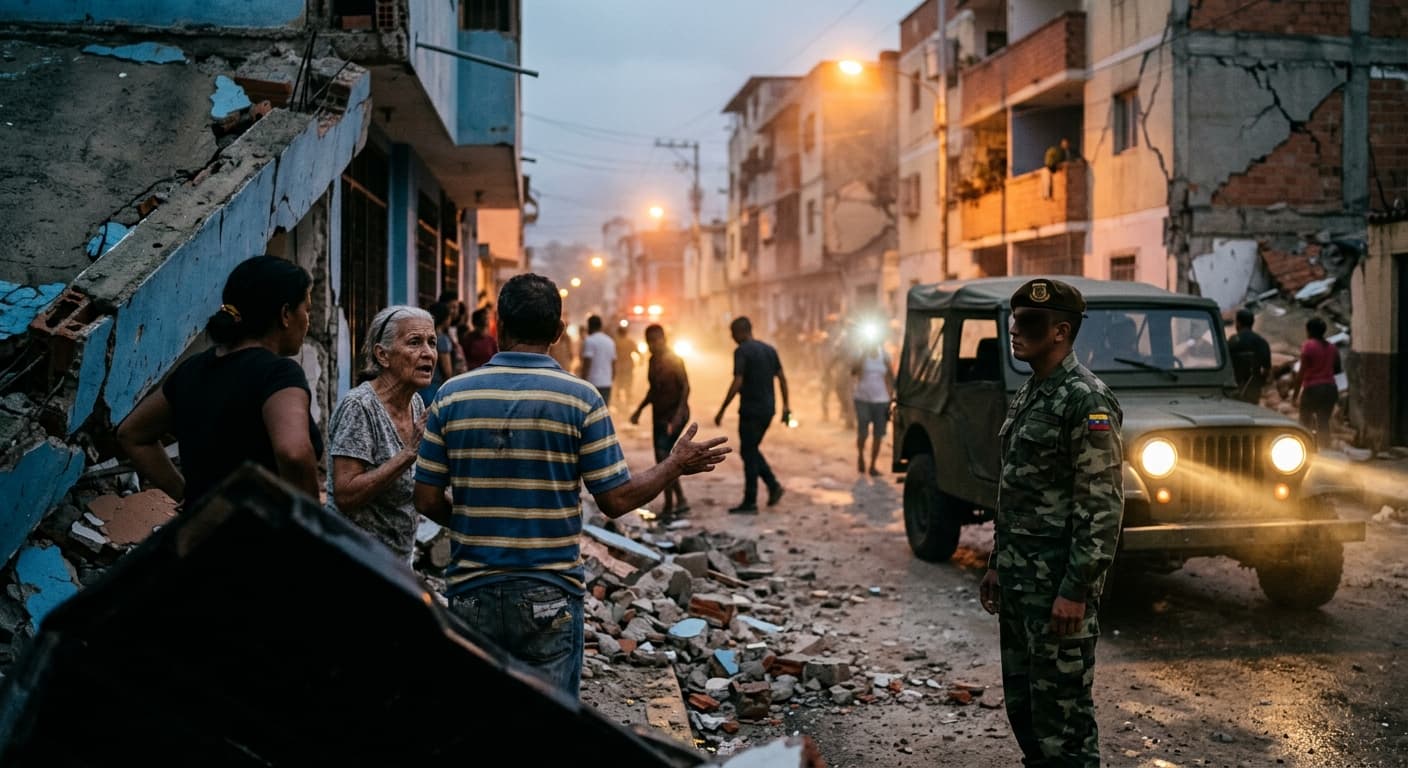
The response is huge. The delivery pipeline is narrow.
By the numbers, the international mobilisation has been exceptional. According to the United Nations, more than 2,000 rescue workers from 27 countries were on the ground by June 27, coordinated through UN OCHA. By July 1 Al Jazeera counted 3,600 rescue and support personnel and 118 search-and-rescue dogs. The United States pledged what the White House called a "whole-of-government response," with 150 million dollars announced in the first 48 hours and the total rising to roughly
$300 million by early July, alongside warships, transport aircraft and helicopters. The European Union added €5 million and a 50-tonne shipment from Copenhagen; the United Kingdom moved from an initial £2 million package on June 26 to an additional
£3.8 million and a UK-Med field hospital treating up to 100 patients a day, announced by the Foreign, Commonwealth and Development Office on July 2. The World Food Programme has appealed for 50 million dollars to feed 500,000 people for three months.
The angle that separates this response from a straightforward humanitarian success story is what happens after the C-17s land. Interim President Delcy Rodríguez handed the response to General Juan Ernesto Sulbarán, commander of the National Guard, according to BBC News. That single decision routed the entire foreign relief pipeline — search teams, tarps, water treatment units, medical brigades — through a military hierarchy built for internal security, not disaster logistics. The result is visible on the ground. Al Jazeera's July 1 field reporting from Catia la Mar found that federal aid did not arrive for three days in parts of La Guaira, that citizens were physically barred by soldiers from entering damaged zones, and that volunteers from the Central University of Venezuela reported
seven trucks of supplies seized by state officials.
The sanctions overhang is real but not the binding constraint
The dominant analytical frame in the first 72 hours — that US and EU sanctions would cripple the response — has aged unevenly. It is true, as the Center for Economic and Policy Research told Al Jazeera on June 25, that financial sanctions have historically slowed NGO payments and import clearances in Venezuela. Sarah Schiffling of the HUMLOG Institute in Helsinki flagged the same secondary-effect problem: administrative friction, self-deterred banks, an already-hollowed domestic supply base. Nearly eight in ten Venezuelans lived in poverty before the quake, per UN figures cited in the same piece.
But the political premise has shifted since January. Following the US military operation that removed Nicolás Maduro and installed Rodríguez, the Trump administration restored roughly $122 million in humanitarian funding, lifted sanctions on Rodríguez personally, and — according to Sam Vigersky at the Council on Foreign Relations — made Washington Venezuela's top humanitarian donor. The Treasury issued new licences in April 2026 to allow transactions with named Venezuelan banks. In practical terms, the money is moving. What is not moving is aid past checkpoints inside La Guaira.
That reframes the effectiveness question. The failure is not at the border. It is at the last mile — and the actor imposing the friction is Caracas, not Washington.
The gap the international system cannot close from outside
Five gaps now dominate the operational picture heading into the next 96 hours, drawn from the July 3 ReliefWeb situation report and IOM's own Situation Report #4.
First, shelter. Roughly 60,000 buildings were damaged or destroyed according to NASA satellite analysis cited by Al Jazeera, and an estimated 13,000 people have been left homeless in the initial count, though displacement is likely higher because thousands are sleeping outside intact homes for safety. IOM is installing tents at the Polideportivo José María Vargas and Estadio César Nieves in La Guaira; UNHCR has requested $15 million to reach 30,000 people over six months, per
BBC News.
Second, health system collapse in the epicentre. The WHO reports that of 21 health centres in the worst-affected areas, three are critically damaged and six partially functional. UNICEF counts 680,000 children among 1.8 million people needing assistance, per the United Nations.
Third, water and disease risk. IOM landed one portable water treatment plant in Maiquetía on July 1; Venezuelan epidemiologists warn of respiratory disease from debris dust and elevated dengue and yellow fever risk in coastal displacement sites.
Fourth, identification of the dead. The BBC's July 3 reporting from a makeshift morgue at La Guaira's port describes families identifying remains without formal forensic support — a system that is not simply overwhelmed but structurally absent.
Fifth, the missing-persons black hole. Against a government figure that stopped short of quantifying the missing, crowd-sourced registries maintained by Venezuelan volunteers list 43,000 to 50,000 unaccounted. The UN is planning against a scenario of up to 10,000 confirmed deaths. Neither number is verifiable, and the discrepancy itself is a political fact — it is what the Rodríguez government cannot afford to acknowledge and what volunteers cannot afford to abandon.
The historical parallel that should worry planners
The comparison being drawn in Washington and Geneva is to the 2023 Türkiye-Syria earthquake, but the more instructive parallel is Haiti in 2010. Both featured massive international mobilisation, a state with limited administrative reach, and a response that pivoted from rescue to recovery within a week. Haiti's downstream lesson was that international generosity peaks at day 10 and collapses by day 90, while the reconstruction bill compounds. UNDP's early estimate of $6.7 billion in physical damage in Venezuela, based on satellite imagery, is on the same order as Haiti's damage assessment. The 2023 Türkiye-Syria disaster, by contrast, produced a state-led response backed by an intact bureaucracy — a model unavailable to Caracas.
The political stakes running underneath the aid
Rodríguez's acceptance of US, Colombian, Spanish and EU teams is a rupture from Maduro-era policy, which restricted aid to ideological allies. President Javier Milei of Argentina offered support "despite any differences"; Ecuador's Daniel Noboa dispatched aid despite frozen diplomatic ties. Iran and China also pledged assistance. This is the first stress test of the post-Maduro settlement, and Washington's Donroe Doctrine — the Trump administration's Western Hemisphere reinterpretation of the Monroe Doctrine, as CFR's Vigersky terms it — is now measured by whether US relief actually reaches La Guaira.
The domestic political cost is already accruing to Rodríguez. NPR and the BBC both documented citizens in Los Corales and Bello Horizonte accusing the government of negligence, with the first official Venezuelan rescue team arriving in some neighbourhoods only on Friday, June 26 — nearly two days after the quakes, per BBC News. Opposition figure María Corina Machado, whom the Trump administration declined to install in January, is a background beneficiary of every day the state performs poorly.
What to watch — next 96 hours
- Formal transition to recovery phase. The July 3 SitRep frames live rescues as "rare exceptions." Watch for UN OCHA's formal declaration of the recovery phase, which will trigger cluster reprioritisation from urban search and rescue toward shelter, WASH and health — and the departure of foreign USAR teams whose mandate ends with the rescue window.
- A flash appeal figure. OCHA has been running a Rapid Needs Assessment with IOM. Expect a consolidated flash appeal in the $200–400 million range, benchmarked against the WFP's standalone $50 million ask and UNHCR's $15 million shelter request. The gap between pledged bilateral money (roughly $300 million from the US alone) and the appeal will indicate whether donors are funding UN channels or bypassing them for bilateral delivery — a choice that materially affects reach.
- The missing-persons reconciliation. The Venezuelan government has not published a missing-persons figure. If official numbers approach the crowd-sourced 43,000–50,000, expect political fallout for Rodríguez; if they remain suppressed, expect the volunteer registries to become the de facto record and a durable source of opposition mobilisation.
- US military footprint. The warships, C-17s and helicopters pledged in the first 48 hours will either be visibly delivering aid on the ground by July 8 or quietly repositioned. The former locks in the Rodríguez–Trump alignment; the latter will be read in Caracas as a signal that Washington's patience is finite.
The Bottom Line
The Venezuela earthquake response is not failing for lack of money, teams, or international will — it is failing at the last mile, where a National Guard-led delivery apparatus is seizing volunteer trucks and blocking citizens from entering their own neighbourhoods. The largest Latin American humanitarian mobilisation in fifteen years is being routed through the weakest state institution it could plausibly use, and the political beneficiary of that mismatch is not the government running the response but the opposition Washington chose not to install in January.
Read today's full |
Discover more

US Politics
White House Pressures Congress for Crypto Leg
The Trump administration's push for the CLARITY Act aims to reshape crypto regulation, impacting trillions in market value and the Trump family's wealth.

International Relations
Pakistan's Key Role in US-Israel-Iran Meddle
Pakistan is seeking to mediate the US-Israel-Iran conflict, balancing high-stakes diplomacy against severe economic pressures and steep regional challenges.
International Relations
Economist Impact Sustainability Week 2026
Economist Impact Sustainability Week 2026 spotlights the energy transition, AI in clean technology, and supply chain resilience as themes for global leaders.

Economics
Fed's Amex AML order puts correspondent banking on notice
Federal Reserve's Amex AML order requires board-level controls and a 90-day plan; OCC fined the bank $350 million over enterprise-wide deficiencies.