Venezuela Earthquake Fuels Rodríguez's Sanção
Delcy Rodríguez leverages disaster for US sanctions relief
Model Diplomat8 min readLatin America
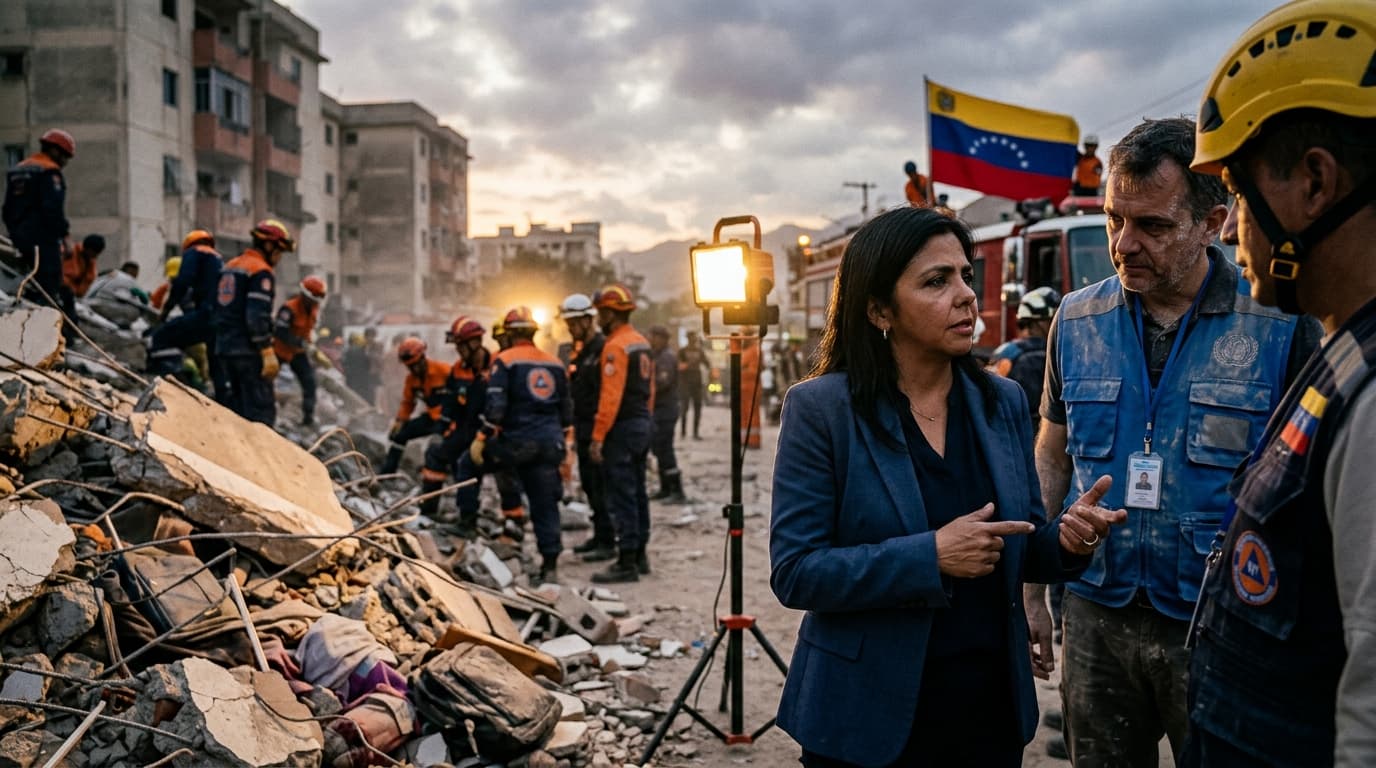
Venezuela earthquake unlocks Rodríguez's bid to end US sanctions
Delcy Rodríguez uses the June 24 quakes — 3,342 dead, $37bn in damage — to press Washington and the IMF for the sanctions relief that could entrench her rule.
Six months after US special forces seized Nicolás Maduro in Caracas, the twin earthquakes of June 24, 2026 have handed his former deputy the political opening she has been unable to manufacture on her own: a humanitarian emergency severe enough to reframe every remaining US sanction as an obstacle to saving Venezuelan lives. Interim President Delcy Rodríguez's July 5 announcement of a new military emergency unit, a housing "Gran Misión" and a demand to "unblock the country" is less a reconstruction plan than a leverage play — one designed to convert disaster relief into the permanent legal certainty her government could not extract in half a year of quiet negotiation with the Trump administration.
The numbers Rodríguez is putting on the table
The scale is the argument. Rodríguez told the country on July 5 that 3,342 people had been confirmed dead, 16,740 injured, 6,462 rescued and 856 buildings affected, according to Noticia Venezuela. The UN Office for the Coordination of Humanitarian Affairs reported an official toll of 1,450 dead only a week earlier, with 38 hospitals and 774 buildings damaged across seven states, per
OCHA Situation Report No. 5. By July 6, the UN Development Programme's satellite-based estimate put direct physical damage at $37 billion — up from an initial $6.7 billion — according to
UN News. That is roughly one-third of Venezuela's $111bn GDP, a figure
Al Jazeera cited from initial assessments in the first 48 hours.
The government's package tracks that scale. Rodríguez has activated a rapid-response military unit named for Antonio José de Sucre, launched the Gran Misión Venezuela Renace under former transport minister Jacqueline Faria, ordered an 80% subsidy on mortgage-linked home purchases and repairs, suspended rental and real-estate taxes and banned the export of construction materials to protect domestic supply. She has also demanded the release of Venezuela's $4.9bn in Special Drawing Rights at the IMF and called for the full lifting of remaining US sanctions to fund reconstruction.
The angle: emergency as sanctions strategy
Rodríguez did not invent this template — she inherited it. What is new is that she now has both a catastrophe severe enough to justify emergency powers and an American administration that has already conceded, in stages, that her government is the one it will deal with. The earthquake collapses those two tracks into one demand.
Since April, Washington has been walking down the sanctions ladder without publicly saying so. OFAC issued General License 48 on February 10, then 48A on March 13, authorising US firms to supply oil, gas and electricity services to Venezuela under Executive Order 14373. On April 15 Treasury eased sanctions on the Central Bank of Venezuela, Banco de Venezuela, Banco del Tesoro and Banco Digital de los Trabajadores, per the
BBC. The next day the IMF's managing director Kristalina Georgieva announced, in
IMF Press Release 26/123, that "the IMF is now dealing with the Government of Venezuela, under the administration of acting President Delcy Rodríguez" — the first formal recognition by a major multilateral since 2019. The World Bank followed within hours.
Then came the quakes. On June 25 — a day after the shocks — OFAC issued Venezuela General License 60, "Authorizing Transactions Related to Earthquake Relief Efforts in Venezuela." The Center for Strategic and International Studies, in an
analysis by its Americas program, called the license a "welcome" step but noted that US Southern Command, not USAID, is now the operational backbone of the response — SOUTHCOM has some 900 personnel on the ground, has repaired the Simón Bolívar airport runway and has stationed naval vessels off the coast,
Al Jazeera reported. The US has pledged $300 million; the EU €5 million.
Rodríguez wants more than a license. In her April meeting with US Chargée Laura Dogu and Assistant Energy Secretary Kyle Haustveit, she said explicitly that "a licence does not provide legal certainty over time because it is temporary," per the BBC. That is the load-bearing sentence of her entire post-quake strategy. A general license can be revoked; a full lift, codified through OFAC delistings and Executive Order rescissions, would let her sign long-tenor reconstruction contracts and re-anchor the Bolívar without Washington holding the kill switch.
Who benefits, who loses
The interim president benefits most if the emergency stretches. Article 233 of the 1999 constitution calls for elections within 30 days of a "permanent" presidential absence — a clock the Supreme Court paused in January by declaring Maduro's detention "temporary." Rodríguez has already told the press, in remarks noted by NPR, that no time limit applies. A national disaster provides the political grammar to extend that ambiguity indefinitely. The Council on Foreign Relations, in its
June 25 briefing, noted that Rodríguez has framed reconstruction as a multi-year project — a framing incompatible with a snap vote.
The Trump administration also benefits, at least in the short term. Secretary of State Marco Rubio's three-stage transition plan — stabilisation, marketing of 30–50 million barrels of US-supervised oil, then "reconciliation" — depends on a compliant Caracas counterparty. The White House told the BBC it saw Rodríguez as a lower-risk manager of that transition than opposition leader María Corina Machado, the 2024 Nobel Peace laureate and de facto election winner. Post-quake, that logic hardens: swapping horses during a rescue operation would jeopardise the SOUTHCOM footprint that is now underwriting the response.
The losers are named. Machado's Vente Venezuela coalition — whose national coordinator Henry Alviarez told Al Jazeera that authorities were "hindering the steps" — sees the disaster response consolidating a government it argues has no democratic mandate. Carolina Jiménez, president of the Washington Office on Latin America, told the same outlet that in Venezuela "the state has been the last responder." Volunteers from the Central University of Venezuela reported that seven trucks of donated supplies were seized by state officials. The optics matter: if reconstruction dollars flow through Rodríguez's ministries, the PSUV's patronage machinery — which the 2024 election was meant to dismantle — gets a new lease.
Bondholders are the second loser. The Financial Times reported that Venezuela is preparing the largest sovereign debt restructuring in history at $240 billion — a figure the
Economist called "hazy" and $40–90bn higher than external analysts had projected. As Francisco Rodríguez wrote in
Foreign Affairs, any deal cut by an unelected interim government risks being repudiated by a future opposition administration — the same manoeuvre Juan Guaidó used to disavow Maduro-era debt after 2019. Creditors are being asked to accept haircuts from a president whose legal legitimacy is itself the collateral.
The historical parallel that reframes it
This is not Venezuela's first quake-driven sanctions play. In December 1999, the Vargas mudslides — which killed tens of thousands in the same coastal state, then called Vargas, now La Guaira — became the pivot on which Hugo Chávez consolidated executive authority under a fresh constitution ratified 10 days before the disaster. Reconstruction never fully arrived; the Misión Vivienda programme Chávez launched in 2011 to close a housing deficit of 2 million units delivered a fraction of what was promised, per contemporaneous BBC Mundo reporting, and the prefabricated blocks it did build are among the structures that failed on June 24, according to volunteers cited by Al Jazeera. Rodríguez's Venezuela Renace is Chavismo's third housing "misión" in fifteen years — launched by the same movement whose earlier missions helped produce the vulnerability the earthquake exposed.
What Washington will actually give
Not a full lift, not yet. The Treasury's post-quake action was General License 60, narrowly scoped to relief. There is no indication in the OFAC recent actions log that a comprehensive rescission of the Venezuela Sanctions Regulations (31 CFR part 591) is being drafted. Rubio's ABC interview in January framed sanctions as "multiple levers of leverage" the US would "retain" — a formulation designed to preserve conditionality, not surrender it. The likelier trajectory is a stepwise expansion of general licenses covering construction, cement imports, port operations and secondary-sanction relief for European and Latin American firms — enough to enable reconstruction, not enough to give Rodríguez the legal certainty she is asking for.
Diplomat View
Rodríguez's post-earthquake package is the moment Chavismo's survival strategy converges with Trump's transactional foreign policy. The interim president is betting that a disaster of this magnitude makes it politically impossible for Washington to withhold the full sanctions lift, and that the reconstruction spending will rebuild the patronage networks the 2024 election tried to break. Trump is betting he can extract Venezuelan oil, counter-narcotics cooperation and a diplomatic distancing from Havana, Moscow and Beijing without paying the cost of a Machado-led transition. Both bets are readable as a joint interest in delay: no election in 2026, no forced reckoning with Article 233, no accountability for the missions that built the buildings that fell. The forecast changes if Rubio's State Department concludes that Rodríguez cannot deliver the oil volumes Trump was promised — 30–50 million barrels under US supervision — or if a credible on-the-ground failure of reconstruction (a cholera outbreak in La Guaira shelters, a second collapse in a Misión Vivienda block) forces the White House to distance itself. Absent one of those shocks, expect the "temporary" interim presidency to reach its first anniversary intact.
What to watch
- July–August 2026: Whether OFAC issues a construction-sector general license or expands GL 48A to cement and steel. That would be the tell on how far Washington will move without a formal delisting.
- Q3 2026: Venezuela's first formal approach to the IMF for a financing arrangement under the resumed relationship — the SDR conversion Bessent floated in January would need Fund staff sign-off.
- January 3, 2027: One-year mark of Rodríguez's interim mandate. Under the constitution, extension beyond that requires a National Assembly vote; the Supreme Court's silence on time limits makes this the next constitutional flashpoint.
The Bottom Line
The June 24 earthquake did not shift Venezuela's power balance so much as accelerate a bargain already underway: Rodríguez trades US oil access and geopolitical realignment for sanctions relief and time, while both governments quietly bury the question of elections. If Washington moves from General License 60 to a full lift, it will be the clearest signal since Maduro's capture that the Trump administration prefers a manageable Chavismo to an uncertain democracy — and that natural disasters, in Caracas as in 1999, still buy governments the years that ballots would deny them.
Discover more
Global Politics
Trump's Conflicting Messages on Iran War
Trump's mixed messages on Iran reflect a strategy of audience management, benefiting Tehran amid a complex geopolitical landscape.
US Politics
House Ethics Committee Pushes Sexual Miscond.
The House Ethics Committee has shifted responsibility for sexual harassment settlement records to the Office of Congressional Workplace Rights, complicating disclosure efforts.

US Politics
White House Pressures Congress for Crypto Leg
The Trump administration's push for the CLARITY Act aims to reshape crypto regulation, impacting trillions in market value and the Trump family's wealth.
Economics
Fed's Amex AML order puts correspondent banking on notice
Federal Reserve's Amex AML order requires board-level controls and a 90-day plan; OCC fined the bank $350 million over enterprise-wide deficiencies.