South Sudan's Famine Risk: A Political Choice
Political decisions drive famine risk in South Sudan, not just weather.
Model Diplomat8 min readAfrica
South Sudan's Famine Risk Is a Political Choice, Not a Weather Event
South Sudan faces IPC Phase 4 Emergency and famine risk through January 2027 as Kiir's Jonglei offensive, a $193m WFP shortfall and erratic rains collide.
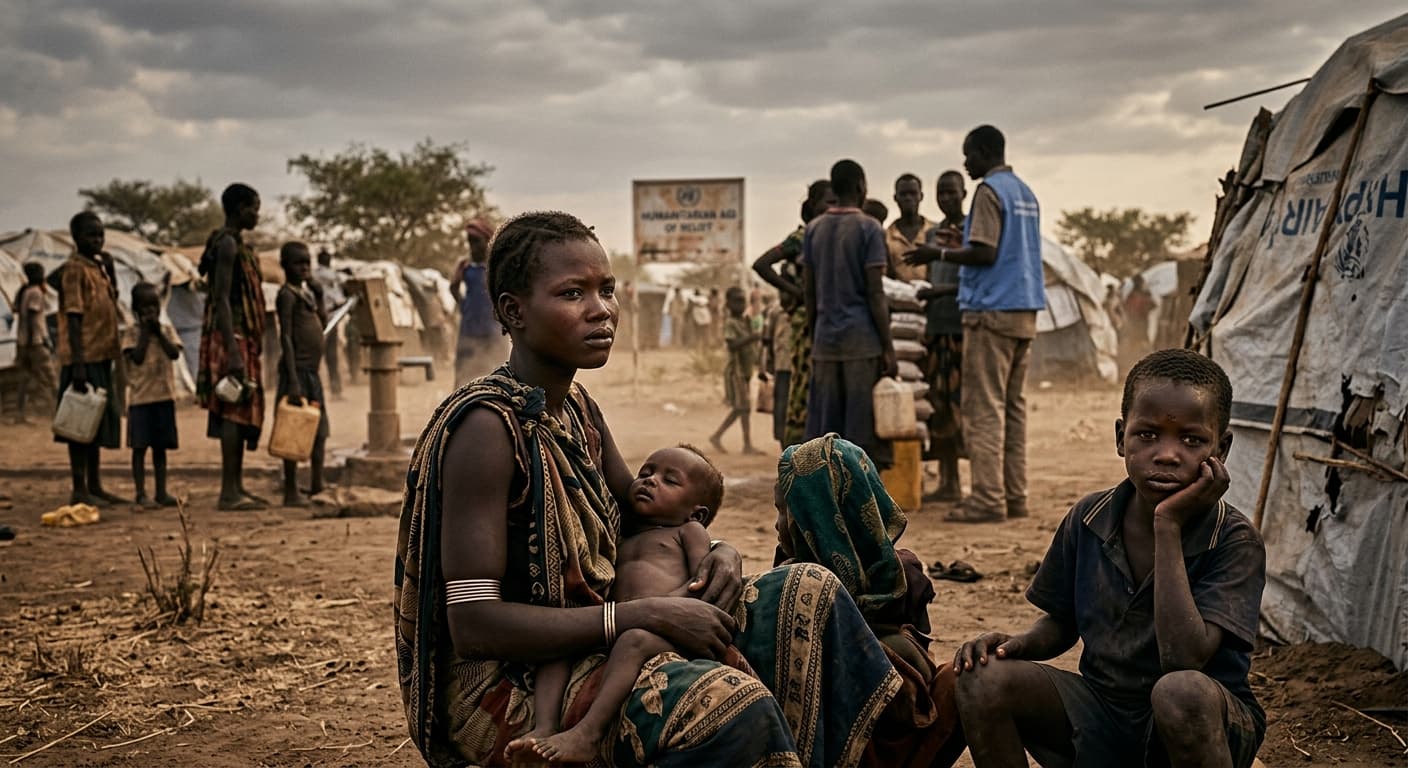
South Sudan will carry an Emergency-level food crisis and a live famine risk through the October-January 2027 harvest, but the decisive variable is not the rain — it is Salva Kiir's decision to prosecute his First Vice President and burn out his stronghold. The Integrated Food Security Phase Classification projects 7.8 million people, 56 percent of the population, in IPC Phase 3 or worse between April and July 2026, roughly 73,000 already in Catastrophe, according to the Food Security Portal. What the Famine Early Warning Systems Network's June 2026–January 2027 outlook adds is the timing: even the main October harvest will not clear the caseload, because two of the ten states most needed to feed the country — Jonglei and Upper Nile — are being emptied, not planted.
The conflict variable has swallowed the climate variable
South Sudan's food-security literature has for a decade treated conflict and climate as parallel drivers. The 2026 data no longer supports that framing. FEWS NET's own back-testing, in a peer-reviewed evaluation published on arXiv, found that South Sudan is one of the two countries where its Food Security Outlooks are least accurate — average accuracy of 60 percent — and the authors attribute the miss almost entirely to violence: "most of the consistently low prediction accuracy can be attributed to the occurrence of conflicts." When Jonglei burns, the models built on rainfall anomalies and NDVI collapse.
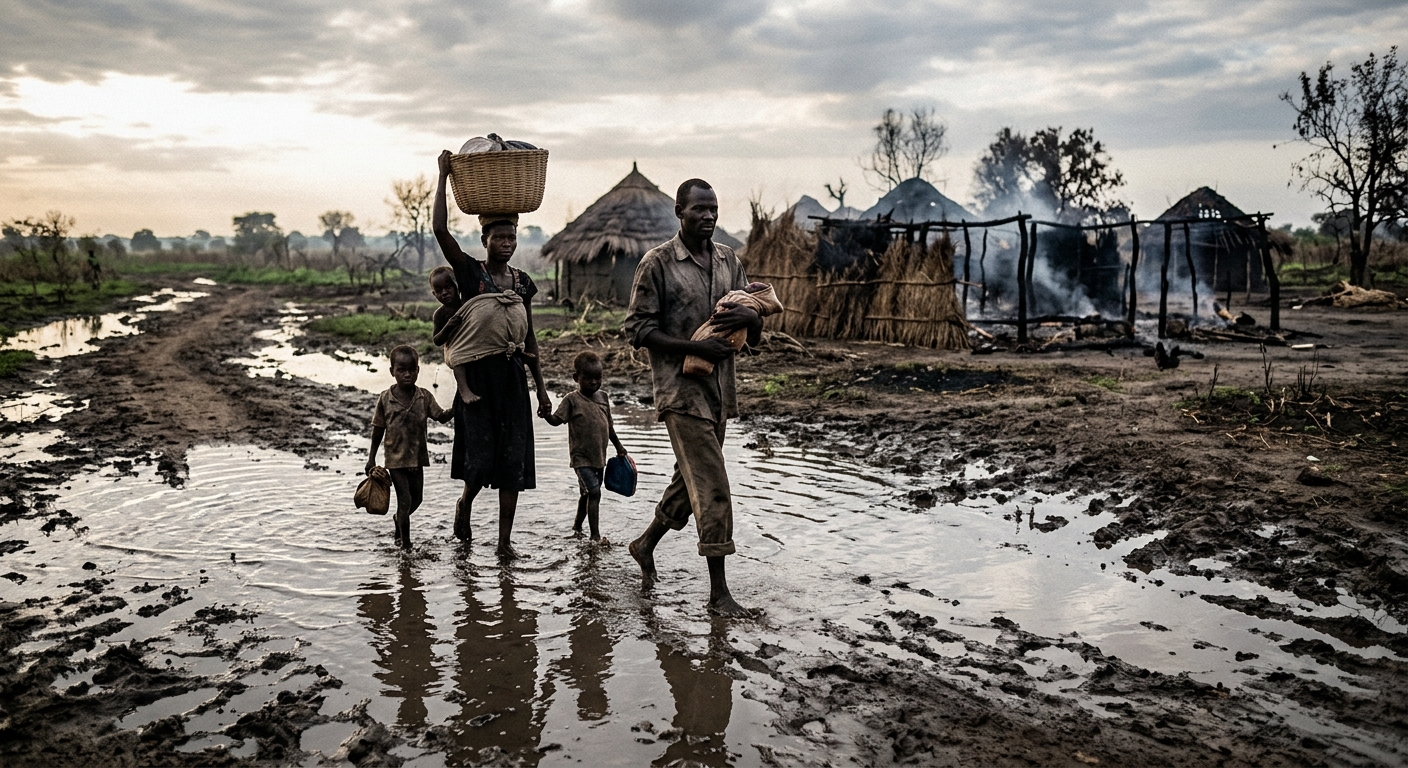
That is exactly the scenario playing out now. A coalition of opposition forces loyal to Riek Machar and the White Army seized government outposts across Jonglei in December 2025, and on January 28, 2026 army spokesman Lul Ruai Koang announced Operation Enduring Peace, ordering civilians out of three counties and aid groups out within 48 hours, according to Al Jazeera. By mid-June, satellite work by the Centre for Information Resilience reviewed by
Al Jazeera had documented 23 incidents of village destruction, and the UN counted 28 damaged or looted health facilities in Jonglei alone, 70 percent of which are no longer functioning.
The climate signal is real but slower. The World Bank's 2026 Country Climate and Development Report calls extreme flooding the "new normal," now covering up to a quarter of the country in severe years and projecting an eight percent decline in sorghum yields by 2050, per the World Bank. Riverine floods in 2025 displaced roughly 335,000 people and damaged 143 health facilities by late October, according to a
WHO public-health situation analysis. The 2026 rainy season is running erratic — below-average early rains in the south, above-average forecasts in flood-prone basins — a pattern flagged by the
FAO/WFP Hunger Hotspots report as "compounded risks" that will disrupt planting rather than destroy standing crops.
The difference matters for programming. A rainfall failure hits yields; a Kiir-Machar war hits the labour force that plants, the roads aid moves on, and the health facilities that treat wasting. FEWS NET's outlook, on the evidence available, is projecting Emergency through the harvest because the second effect has now dwarfed the first.
The donor arithmetic has been rewritten
The clearest change since the last outlook cycle is not on the ground in Bor — it is in Washington. Between 2020 and 2024, U.S. aid to South Sudan regularly exceeded $700 million a year. In fiscal 2026 the State Department has provided only $100 million, and the World Food Programme is carrying a $193 million shortfall in-country, according to the Council on Foreign Relations. The gap is not an accounting anomaly. DG ECHO's 2026 humanitarian implementation plan notes bluntly that the U.S. supplied "54 percent" of foreign aid to South Sudan before the cuts and that "the full impact is expected to be seen in 2026," per the
European Commission.
The mechanics of the retreat are just as important as the topline. USAID was dismantled and Food for Peace was moved to USDA, an agency with limited capacity to run complex-emergency operations, according to CFR. A U.S. State Department spokesperson, quoted by
Al Jazeera, said in April 2025:
"While emergency lifesaving programmes continue, we will not, in good conscience, ask the American taxpayer to provide assistance that effectively subsidises the irresponsible and corrupt behaviour of South Sudan's political leaders."
That framing — corruption-as-justification — moves the cost of a Kiir-Machar war off Washington's balance sheet and onto malnourished children in Akobo. The country-level result: OCHA's 2026 Humanitarian Needs and Response Plan was 22 percent funded as of mid-April, against a $1.46 billion ask, per OCHA's Financial Tracking Service. The pooled fund is being drained faster than replenished; contingency stocks are "rapidly depleted," according to
OCHA's April update.
The second-order effect is a re-ranking of who gets fed. When funding covers a fifth of the plan, cluster leads triage: they cut development-adjacent programmes (livelihood, resilience, cash) and defend life-saving food and nutrition. That is why AVSI's $15 million "graduation" programme for South Sudanese refugees in Uganda was terminated in February 2025, ending coaching and $205 cash grants for 8,100 people meant to be self-supporting by 2028, according to NPR. The resilience layer that would have absorbed the next flood is being liquidated to buy this year's rations.
Who benefits from a starving Jonglei
Every food-security crisis has an incumbent that gains from it. In South Sudan, three actors are extracting rent from the current configuration.
The first is Kiir's inner circle. With roughly 90 percent of government revenue tied to oil exports and pipeline disruption in Sudan cutting exports by two-thirds, the transitional government has run out of patronage cash to keep the coalition intact, according to the Egmont Institute. Prosecuting Machar and destroying Nuer opposition strongholds in Jonglei substitutes military coercion for money. A humanitarian collapse in opposition areas is, in that calculus, a feature — it depopulates Nuer-majority counties before the twice-postponed December 2026 election.
The second is Uganda. Ugandan troops have deployed to Juba and Kaya, "materially strengthening" government forces and raising credible concerns about UN arms-embargo violations, according to the UN Commission on Human Rights in South Sudan report of February 2026. Kampala's leverage over a resource-strapped Juba is at a decade-high.
The third is Sudan's Rapid Support Forces, indirectly. The SAF is reportedly arming Nuer militias in Upper Nile to punish Juba for perceived UAE-RSF logistics through Aweil East, according to Egmont. South Sudan is becoming a subordinate theatre in Sudan's war — with the aid architecture too underfunded to insulate the civilian population from that entanglement.
The losers are the 2.1 million children under five and 1.15 million pregnant and breastfeeding women projected to face acute malnutrition by June 2026, according to the November 2025 IPC assessment reported by Al Jazeera. Also the 1.3 million refugees and returnees who arrived from Sudan since April 2023 into border counties whose services are already running at 300–400 percent of capacity, according to
OCHA.
The historical parallel — and why 2026 is worse
The reference case is 2017, when the UN formally declared famine in Unity state's Leer and Mayendit counties. That famine was lifted within four months because a coalition of donors — chiefly the United States and the UK — surged funding through WFP and NGOs and secured negotiated access from both sides of the conflict. Neither condition is present in 2026. Washington is out. Access is deteriorating: the WFP suspended operations in Baliet county in February after repeated convoy attacks, and MSF has closed two hospitals in Greater Upper Nile after its Pieri facility was looted, according to Al Jazeera.
The FAO's Nicholas Kerandi told Al Jazeera the food-security and public-health shocks in Jonglei "are likely to persist through the remainder of the year and potentially beyond." Read against the FEWS NET methodology, that is a signal that the October harvest — normally the moment food-security phases step down — will not do so in the counties that most need it.
Tom Fletcher, the UN's Emergency Relief Coordinator, briefed the Security Council on April 17, 2026, warning that he feared his next briefing "would speak of famine," according to Al Jazeera. That is not rhetorical. If IPC verifies Phase 5 in additional Jonglei counties in the next analysis, a formal famine declaration becomes plausible in Q3 2026.
Implications for aid strategy
For the donors still writing cheques — the EU, the UK, Germany, the Gulf — three shifts in strategy are already visible and worth watching. First, a pivot from resilience to raw life-saving delivery, hollowing out the multi-year graduation programmes the SDG framework was built around. Second, growing pressure to condition assistance on humanitarian access, following the ICG's argument that the Kiir government has "returned to war" and that unconditional funding subsidises the offensive. Third, an operational bet on cross-border delivery from Ethiopia and Uganda — an approach that only works while both borders remain open, and Ethiopia's Gambella region is itself absorbing Akobo refugees under strain.
The Trump administration's Bureau for Disaster and Humanitarian Response holds roughly $5.4 billion in appropriated but unspent 2026 humanitarian funds, plus $2 billion carried over from 2025, per CFR. Whether any of that gets obligated to South Sudan before the harvest window closes is the single variable that could still change the outlook trajectory.
What to watch
- October 2026 IPC update — the first phase classification that will test whether the June 2026 harvest actually reduces caseloads in Jonglei and Upper Nile, or confirms Phase 4 through the dry season.
- December 22, 2026 elections — the fourth postponement or an insecure vote would remove the last political shock-absorber; Kiir and Machar are both in their 70s and the succession question is unresolved.
- UNMISS mandate renewal and the Security Council's next Sudan-South Sudan session — the peacekeeping mission's protection-of-civilians remit is under pressure from government-imposed no-fly zones.
- WFP's Q3 pipeline — the $193 million shortfall must be closed by August to pre-position food for hard-to-reach counties before roads flood in September.
The Bottom Line
South Sudan's 2026–27 hunger emergency is not a weather story that donor money can smooth out — it is a political story in which Salva Kiir has chosen to prosecute a war in Jonglei while Washington has chosen to walk away. Absent a reversal in U.S. humanitarian posture or an unlikely climb-down by Juba, FEWS NET's Emergency projection through January 2027 is the ceiling, not the base case, and a formal famine declaration in Upper Nile or Jonglei is a live possibility before year-end. *
Discover more

Global Politics
U.S. Naval Blockade Heightens Iran Tensions
The U.S. naval blockade of Iran collapsed oil exports, creating a new maritime regime in Hormuz that favors Tehran.

International Relations
U.S.–Iran Peace Deal
A narrow US-Iran deal on nuclear and regional issues could reshape Middle East diplomacy, offering a pragmatic path forward despite grand bargain obstacles.

India
Yamini Aiyar on Modi's Federalism Shift
Yamini Aiyar critiques Modi's shift from equity-based to performance-based federalism, highlighting implications for India's political landscape.

Conflict & Security
Drone Warfare Killing Aid Workers at Unprec
Over 1,000 humanitarian workers killed in three years as cheap armed drones collapse legal protections. Gaza, Sudan, Ukraine, and DRC see deliberate targeting of aid convoys and hospitals with zero prosecutions.