US–Japan–Korea Pact Redraws Nuclear Map
Trilateral SMR deal aims to reshape Indo-Pacific energy landscape.
Model Diplomat7 min readIndo-Pacific
US–Japan–Korea SMR Pact Redraws Indo-Pacific Nuclear Map
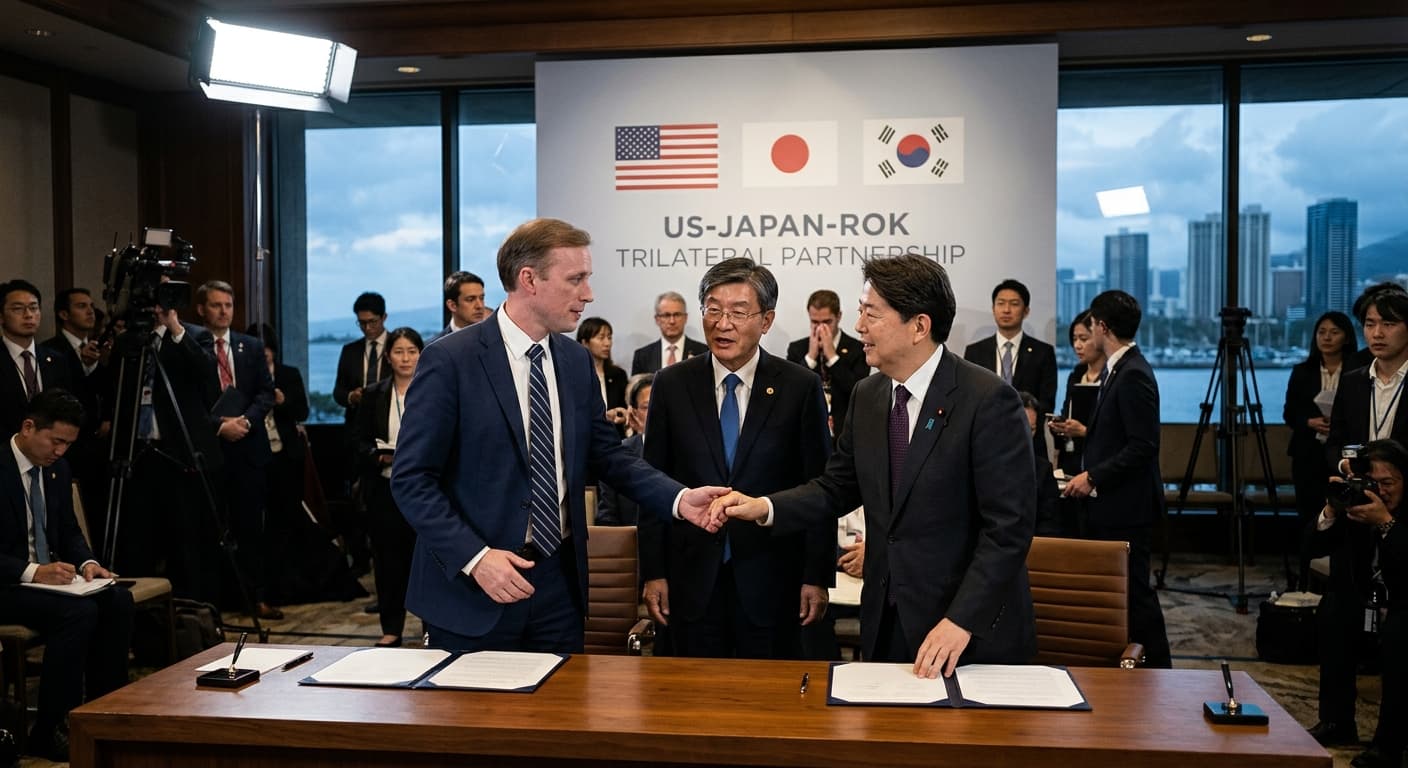
Rubio, Motegi and Cho signed a trilateral SMR memorandum in Ankara on July 7, 2026, tying Korean peninsula denuclearization to reactor exports meant to displace Russia and China.
The trilateral memorandum signed in Ankara on July 7, 2026, is not really about small modular reactors. It is a coordinated bid by Washington, Tokyo and Seoul to lock in the next twenty years of Indo-Pacific energy infrastructure before Rosatom and China National Nuclear Corporation do it for them — and to bind that commercial fight to the same alliance architecture that underwrites deterrence on the Korean peninsula. In doing so, the three governments have quietly answered a question that Camp David left open in 2023: what, exactly, is the trilateral for once the political founders are gone? The answer, from Marco Rubio's State Department, is a nuclear export cartel with a security wrapper.
According to a State Department media note, Secretary Rubio, Japanese Foreign Minister Toshimitsu Motegi and South Korean Foreign Minister Cho Hyun signed a Memorandum of Cooperation on SMR deployments on the sidelines of the NATO summit, with "an initial focus on the Indo-Pacific." The MoC commits the three governments to standardized designs, joint licensing pathways, pooled supply chains and shared financing to "de-risk project development" for third countries. Washington kicked in over $10 million in new funding for the State Department's FIRST program and pledged a regional SMR Training Hub. The Korea Herald and
Yonhap reported that the same meeting reaffirmed "complete denuclearization" of the peninsula and pledged deeper coordination on economic security, AI, quantum and countering DPRK cyber theft.
The Camp David process finally has a product to sell
For three years, the Camp David trilateral has produced communiqués, secretariats and hotlines. It has struggled to produce deliverables that survive an election. What changed on July 7 is that the alliance now has an industrial policy — one keyed to the specific reactor form-factor that most Indo-Pacific buyers are actually shopping for.
Wood Mackenzie's 2025 Southeast Asia nuclear outlook estimates the region needs roughly $208 billion in nuclear investment by 2050 to deliver 25 GW of capacity, with SMRs — despite generation costs of about $220/MWh, more than double large-plant economics — emerging as the preferred technology because of a two-to-three-year deployment timeline versus 10–30 years for large PWRs. Malaysia is targeting 1.2 GW of SMR by 2050. Indonesia's 2025–2034 electricity plan already slots two 250 MW SMR units. The Philippines and Thailand are scoping their own programs. That is the market the trilateral is now organizing to service.
The commercial ambition is unusually specific. The State Department release confirmed a parallel industry pact linking GE Vernova, Hitachi, Samsung C&T and SGE to co-deploy the BWRX-300 SMR across Europe — the same GE Vernova design that
Energy Intelligence reports has now assembled a North American customer fleet.
The KHNP–Westinghouse settlement is the hinge nobody is talking about
To understand why this MoC is more than a photo op, read it against the January 2025 arbitration settlement between Korea Hydro & Nuclear Power and Westinghouse. As E&E News reported, KHNP withdrew from European project bids under terms first surfaced by the Financial Times: KHNP agreed to pay Westinghouse roughly $825 million per exported reactor for 50 years and restrict its sales territory to Southeast Asia, the Middle East, Latin America and Africa.
That settlement resolved a decades-old marketing restriction dating to the 1987 Combustion Engineering technology transfer that produced the APR-1400, a lineage documented in a Congressional Research Service report. It also functionally divided the world. Korea got the Global South. Westinghouse kept Europe. That division held until this week — when the trilateral memorandum, backed by a Samsung C&T co-venture on the BWRX-300, quietly folded the Koreans back into European deployments through a US-led consortium rather than as a standalone bidder. Prague's
KHNP contract award for Dukovany — signed after the settlement — is now the political test case. If it holds, Seoul has traded lone-wolf export rights for a share in a much larger allied fleet.
That is the deal beneath the deal: Washington bought Korean industrial capacity by giving Seoul a legitimate route back into Europe, and got a coordinated response to Rosatom in return.
Why the map matters more than the megawatts
The 2020s nuclear export map is being drawn now, and the trilateral is arriving late.
Rosatom, per Energy Intelligence, remains the world's top reactor exporter despite sanctions. In April 2026 Vietnam signed an intergovernmental agreement with Moscow for two VVER-1200 units at Ninh Thuan 1. Myanmar's junta has an SMR deal with Rosatom. Kazakhstan awarded its first nuclear plant to Rosatom and — as
OilPrice.com documented — subsequently gave the second and third to China's CNNC. China is now building plants at roughly one-seventh the cost of US equivalents according to research cited by E&E News, and has SMR deals or negotiations with Pakistan, Argentina, Brazil and Kazakhstan.
Against that, the trilateral's $10 million in new FIRST-program money, per the State Department, looks modest. The scale-up comes from mobilizing Ex-Im Bank, DFC and Japanese trading-house finance behind a single coordinated pitch — replacing three competing offers with one bundle that a middle-power buyer can actually evaluate against the Rosatom package Moscow finances directly through its state budget.
The denuclearization language is doing quiet work
The MoC's reaffirmation of "complete denuclearization" of the peninsula is not boilerplate this year. According to the SIPRI 2025 Yearbook, North Korea now holds an estimated 50 assembled warheads with fissile material for roughly 40 more, and is preparing to introduce theater nuclear weapons.
USNI News reported that Pyongyang's May 26, 2026 test of the Hwasong-11D — a system capable of a nuclear warhead — was its eighth launch of the year. The trilateral's July 7 statement, per
Yonhap, also flagged shared concern over a Chinese SLBM test toward the Pacific.
The language matters domestically. Seoul under President Lee Jae-myung has been quietly negotiating a revision of the 2015 ROK–US 123 Agreement to secure comprehensive rights to enrich uranium and reprocess spent fuel — a longstanding Korean industrial goal that the Asan Institute argues is now within reach. Every SMR Seoul exports to a third country under a US-led framework strengthens its case that it can be trusted with the full fuel cycle. And every reaffirmation of the "denuclearization" formula pushes back against the domestic Korean debate about pursuing an indigenous bomb — a debate that has grown loud enough that Beijing publicly warned Tokyo against "exploring nuclear possession" after the June 2025 US–Japan Extended Deterrence Dialogue, per
Yonhap.
Beijing has already responded
China's foreign ministry, according to Yonhap's Beijing correspondent, has said Washington's expanding extended-deterrence coordination with Tokyo and Seoul causes "serious concern" and reflects "Cold War thinking." Japan's readout of the July 7 meeting acknowledged that the three ministers discussed a recent PLA Navy SLBM test toward the Pacific and reaffirmed the importance of peace and stability across the Taiwan Strait — language China treats as interference.
Beijing's operational counter is already visible. As Energy Intelligence noted in August 2025, China is engineering its own SMR primarily for export, chasing lower unit costs. If Chinese SMRs can undercut the BWRX-300 fleet in Southeast Asia — where price sensitivity is high and 123-agreement fluency is low — the trilateral's technology edge could evaporate before the first Indo-Pacific unit is grid-connected.
Diplomat View
The July 7 MoC is best understood as an industrial-policy insurance contract for the Camp David architecture. Its logic is that a Biden-era security trilateral cannot survive the political cycles in three democracies unless it produces revenue for domestic constituencies in all three. Reactor exports do that. They also weld Seoul more tightly to a US-led coalition at exactly the moment Lee Jae-myung's government is testing more autonomous nuclear posture ideas.
Forecast: within 12 months, expect at least one non-binding SMR MoU between the trilateral consortium and a Southeast Asian government — Indonesia or the Philippines is likelier than Malaysia — and a revised ROK–US 123 Agreement granting Seoul enrichment consent conditional on multilateral safeguards. The forecast fails if (a) the Dukovany contract collapses in EU state-aid litigation, killing KHNP's European re-entry; (b) a Chinese SMR wins a symbolic first export to a US-aligned ASEAN state; or (c) a Trump-Xi trade détente prices nuclear cooperation into a broader deal that softens the trilateral's coordinated pitch. The likelier failure mode is not Chinese counter-pressure but Korean domestic politics: if Lee concludes the 123 revision is going nowhere, the pull toward a sovereign nuclear posture rises, and the SMR bargain unravels from Seoul's side.
What to watch
- October 2026, APEC (Beijing host year): first trilateral coordination test under Chinese chairmanship — watch for whether Rubio, Motegi and Cho maintain a unified line on Taiwan and Korean peninsula denuclearization on Chinese soil.
- Q4 2026, ROK–US 123 Agreement revision talks: Seoul is pressing for comprehensive enrichment and reprocessing consent; any breakthrough would be the clearest signal the SMR pact is a two-way trade.
- Dukovany final financing close: slippage past year-end 2026 would strand KHNP's European pathway and force the trilateral to find another proving ground.
The Bottom Line
The bottom line: the July 7 memorandum is the moment the US–Japan–Korea trilateral stopped being a security forum and became an industrial cartel — with SMR exports as the deliverable that finally makes the alliance politically self-sustaining across administrations. If it works, the Indo-Pacific's next reactor fleet will be Western-standard rather than Russian- or Chinese-financed; if it stalls, Seoul's temptation to go it alone — commercially and eventually militarily — rises sharply.
Discover more

US Politics
SNAP Food Assistance Faces Legal Challenges
In 2026, SNAP faces stricter eligibility rules and mounting legal challenges, threatening food assistance for the millions of Americans who rely on the program.

India
Delhi CM Rekha Gupta Blasts Opposition's Delm
Delhi CM Rekha Gupta's remarks on women's quota defeat reveal BJP's strategy for the 2029 Lok Sabha elections, focusing on delimitation.
India
Congress Accuses Modi of Stalling Women's Law
Congress accuses Modi of stalling women's reservation law by linking it to delimitation, revealing a deeper electoral strategy.

Conflict & Security
Drone Warfare Killing Aid Workers at Unprec
Over 1,000 humanitarian workers killed in three years as cheap armed drones collapse legal protections. Gaza, Sudan, Ukraine, and DRC see deliberate targeting of aid convoys and hospitals with zero prosecutions.