Democrats' Foreign Policy Group Returns
The 2020 coalition faces new challenges ahead of 2028.
Model Diplomat4 min readamericas
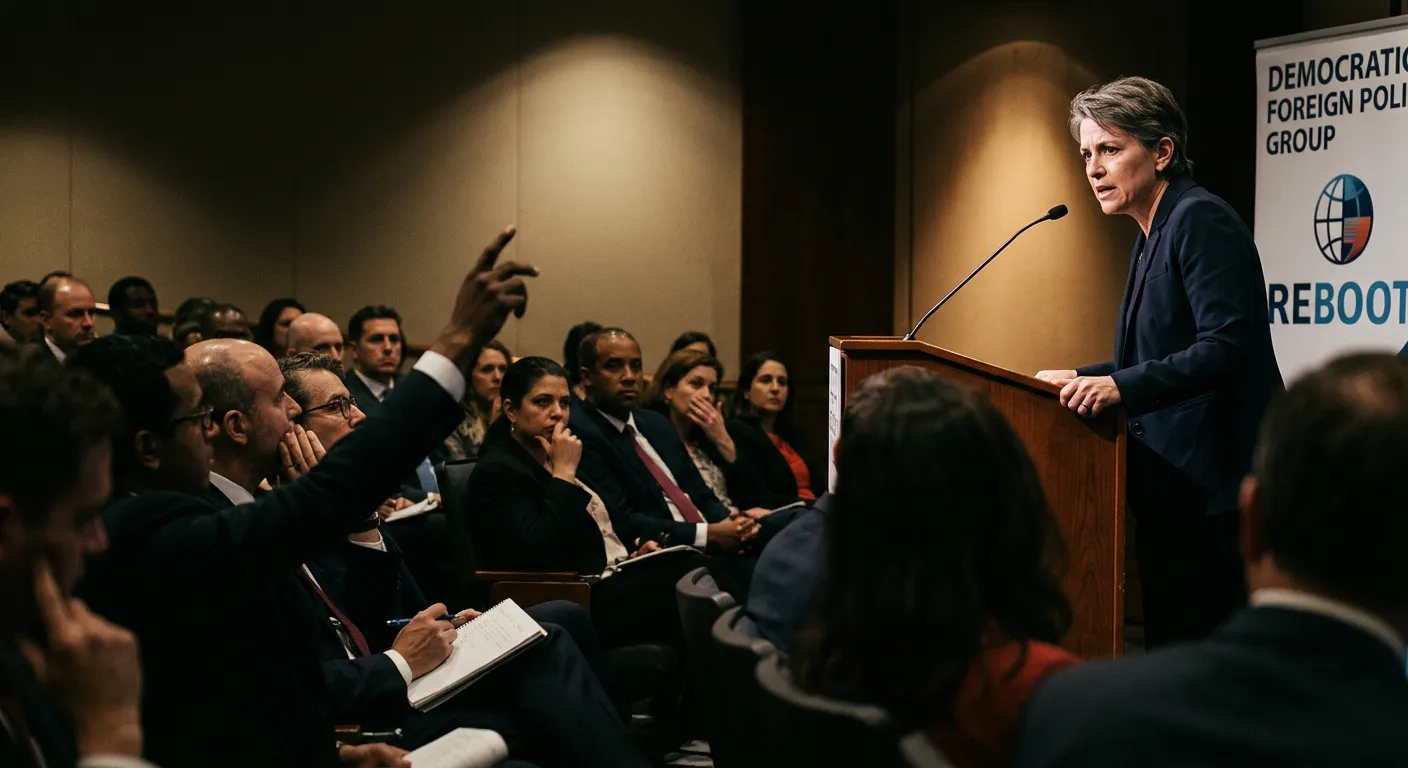
Democrats' Foreign Policy Brain Trust Is Back — And So Is the Israel Fault Line
The party's 2020 kingmaker group returns with Maher Bitar at the helm, but an 80% unfavorable view of Israel among Democratic voters makes coalition management a different game this time.
National Security Action, the Democratic foreign policy group that staffed the Biden national security apparatus and shaped the party's 2020 messaging, is formally rebooting for the 2028 cycle — with a new leader and an open acknowledgment that the coalition it helped assemble last time has fractured beneath it.
NSA has tapped Maher Bitar, national security adviser and chief counsel to Senator Adam Schiff, to steer the organization into the primary season. Bitar, a former NSC coordinator for intelligence and defense policy under Biden, told Axios the group will host retreats, conduct polling, and function as a "hub" to develop Democratic foreign policy "to be ready for 2028 and beyond."
The playbook is familiar. Founded in 2018 by Jake Sullivan and Ben Rhodes — both Obama White House alumni — NSA served as a messaging and staffing engine for Democrats in the 2020 election. Sullivan went on to become Biden's national security adviser; the group helped place dozens of its network into administration posts. The ambition now is to replicate that pipeline.
What has changed is the party itself.
A coalition that no longer agrees
NSA's 2020 formula — hawkish enough to reassure the Blob, progressive enough to keep the left on board — was held together by shared opposition to Trump and a consensus around restoring alliances. That consensus is gone. Axios reports that 80% of Democrats now view Israel unfavorably, up from 53% in 2022, according to Pew.
NPR notes that Gallup recorded its first-ever finding that more Americans sympathize with Palestinians than Israelis — a shift driven almost entirely by Democrats and voters under 35. The
BBC reports the same demographic cleavage, with younger Americans now favoring Palestinians by a 33-to-14 percent margin.
The rupture is not merely rhetorical. Last month, 40 of 47 Senate Democrats voted to block arms sales to Israel — including every senator viewed as a serious 2028 contender: Mark Kelly, Ruben Gallego, Cory Booker, Elissa Slotkin, Jon Ossoff, and Chris Murphy.
The division runs straight through NSA's own boardroom. Sullivan, who has rejoined the board after leaving the Biden administration, acknowledged the shift: "The center of gravity has shifted on the relationship with Israel, and there will be a debate about the nature of the relationship going forward." Rhodes was blunter: "Jake and I obviously moved in different directions" since co-founding the group. "I've moved in a more progressive direction on Israel and other things. I am not shy about making my views known."
Rhodes also signaled that the next Democratic administration "should look quite different" from Biden's — "it's time to pass the baton."
Bitar, for his part, insists NSA will remain a "big-tent" organization. "We are not excluding anyone," he said.
The strategic stakes
NSA's challenge is not merely managing a policy debate. It is navigating a primary electorate whose foreign policy instincts have moved left of the party's traditional national security establishment — and doing so while the group's own co-founders represent opposing poles of that debate.
The organization's two stated projects — "the pipeline of people who might work on campaigns and populate a Democratic administration" and "the ideas that can form a progressive or Democratic foreign policy going forward" — are in tension with each other. The pipeline is stocked with Biden and Obama alumni. The ideas are being demanded by voters who increasingly view those very administrations' foreign policy records as liabilities.
Ben Rhodes, who has positioned himself as the progressive conscience on the board, appears to recognize this. His emphasis on "talent spotting" and "elevating different voices" is a direct challenge to the gravitational pull of the Sullivan-aligned establishment that NSA itself helped install in 2021.
What to watch
The first observable test will be which candidates and which ideas NSA amplifies heading into the 2027 invisible primary. Will the group's retreats and polling reflect the party's leftward drift on Israel, tariffs, and military engagement — or will the institutional weight of its establishment wing pull toward continuity? The answer will signal whether NSA functions as a genuine talent incubator for a changed party, or as a restoration vehicle for the one that just left power. Either way, Bitar's "big tent" is already straining at the seams.
Discover more

Global Politics
US-Iran Tensions Rise
Tensions escalate in the Strait of Hormuz as Iran and the US clash over maritime control, with a ceasefire hinging on a contested MoU paragraph.
Global Politics
U.S. Maritime Pressure on Iran
Washington escalates maritime security operations and sanctions on Iran, disrupting Gulf shipping and reshaping global energy flows in a major strategy shift.

International Relations
U.S.–Iran Peace Deal
A narrow US-Iran deal on nuclear and regional issues could reshape Middle East diplomacy, offering a pragmatic path forward despite grand bargain obstacles.

Conflict & Security
Drone Warfare Killing Aid Workers at Unprec
Over 1,000 humanitarian workers killed in three years as cheap armed drones collapse legal protections. Gaza, Sudan, Ukraine, and DRC see deliberate targeting of aid convoys and hospitals with zero prosecutions.