US Strikes Push Inland to Iran's Missile Fact
US strikes hit Iran's missile factories and disable a tanker running the blockade
Model Diplomat13 min readMiddle East
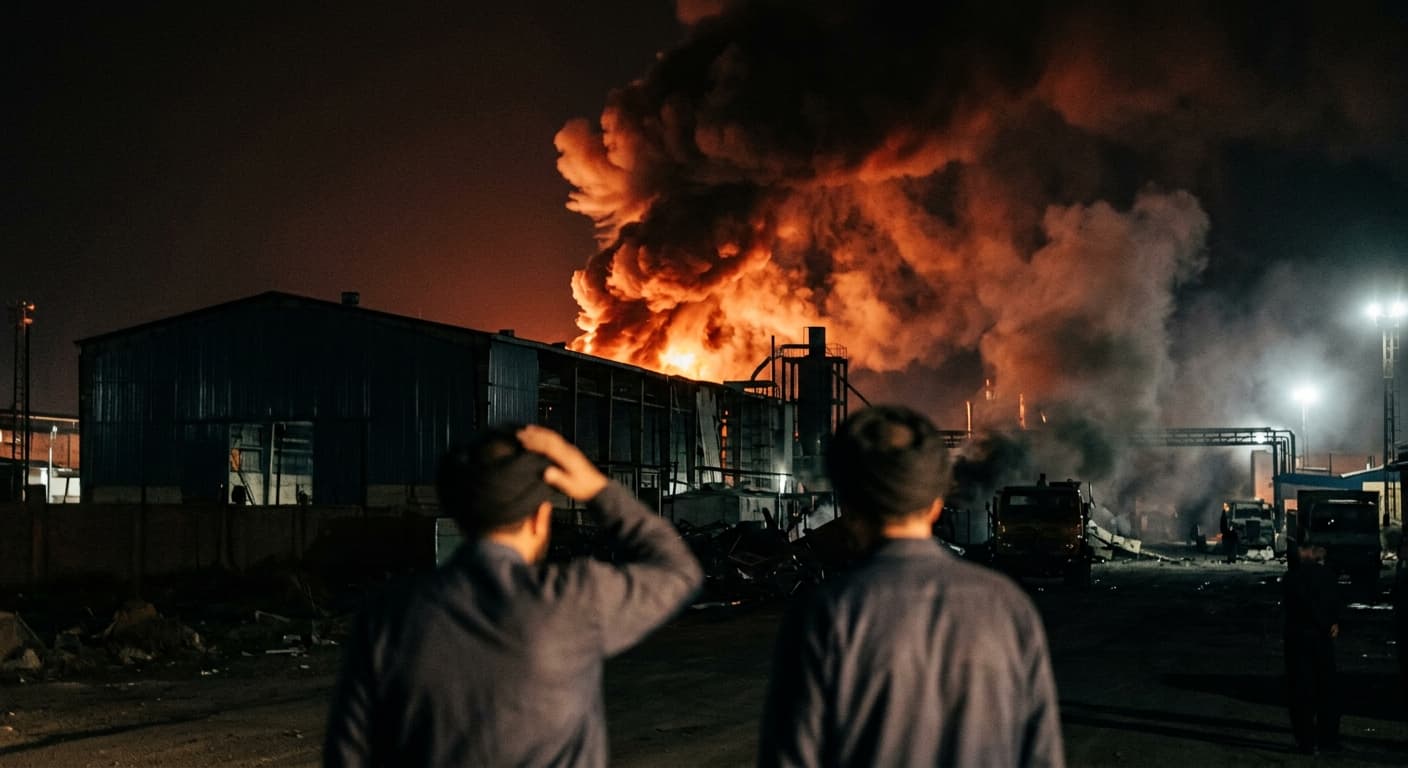
U.S. Strikes Push Inland to Iran's Missile Factories as Hormuz Blockade Goes Kinetic
The collapse of a June 17 ceasefire has sent strikes from Iran's coastline into Semnan's missile-production heartland and turned port enforcement into live fire. Washington is betting it can break the Hormuz chokehold by hitting the arsenal that keeps it closed — not just the launchers on the beach.
Early on July 16, 2026, U.S. Central Command struck bridges in Iran's southern Hormozgan province, killing at least seven people, and hit targets around Tehran and Semnan province — the second reported American attack on northern Iran within a week, according to Al Jazeera. The same night, a U.S. aircraft fired Hellfire missiles into the smokestack of the Curaçao-flagged tanker Belma, disabling the vessel as it attempted to sail toward Iran's Kharg Island oil terminal in defiance of a reimposed naval blockade,
BBC News reported. The northward expansion into Semnan marks a strategic pivot: the factories that build the missiles sustaining Iran's closure of the Strait of Hormuz sit roughly 600 kilometers from the coastline, and Washington has concluded it cannot break the chokepoint without striking the production base, not merely the launchers on the beach.
A coastline campaign moves inland
For five months the air war was largely a coastal affair. Operation Epic Fury, launched February 28 alongside Israeli strikes under the name Operation Roaring Lion, was billed by the White House as a campaign to "dismantle the world's leading state sponsor of terrorism," with four stated objectives: preventing an Iranian nuclear weapon, destroying the missile arsenal, degrading proxy networks, and annihilating the navy, CSIS analysis notes. By March 3, CENTCOM Commander Admiral Brad Cooper reported that "there's not a single Iranian ship underway in the Arabian Gulf, Strait of Hormuz, or Gulf of Oman," according to a
Congressional Research Service report. U.S. officials claimed the campaign had struck over 10,000 targets and established "air superiority over vast swaths of Iran," a separate
CRS assessment documented.
Yet Iran kept the strait effectively shut. Semnan province, east of Tehran, houses the Imam Khomeini Spaceport and the Shahroud complex — sites the International Institute for Strategic Studies identifies as central to long-range missile component production, as BBC Verify reported. U.S. intelligence has long assessed that Iran's space-launch vehicles "shorten the timeline" for intercontinental ballistic missile development because the technology is dual-use,
NPR noted. The Simorgh rocket, tested at Semnan, uses engines derived from the Shahab-3 medium-range ballistic missile, and the CSIS Missile Threat project has flagged that many Simorgh components "could be repurposed to develop long-range ballistic missiles," per
CSIS.
Hitting Semnan's civilian airport and a storage facility, as Al Jazeera's Tehran correspondent Resul Serdar Atas described on July 16, signals that the target set has widened from coastal anti-ship missile batteries to the industrial depth that feeds them. Al Jazeera's Atas reported: "The main building of a civilian airport in Semnan was attacked by the Americans," with damage also to a storage facility in the city, Al Jazeera stated. Iranian state media said U.S. strikes on July 16 also hit around Tehran and Semnan province, home to Iran's ballistic missile production and space program, the
Associated Press reported via BNN Bloomberg.
The implication is operational, not symbolic: degrading missile production inland is slower-acting than destroying a launcher, but it is the only route to a durable reduction in Iran's salvo capacity. Analysts at Sibylline concluded after earlier Israeli strikes on the Khojir and Parchin complexes that damage to rocket-fuel production "will ultimately undermine Iran's ability to fire another salvo of the scale necessary to breach Israeli air defences," BBC reported. The same logic now applies to Hormuz: if Iran cannot replenish anti-ship cruise and ballistic missiles, its ability to threaten commercial vessels degrades over weeks and months, not hours. Fabian Hinz of IISS has identified Khojir as "the area with the highest concentration of ballistic missile-related infrastructure within Iran,"
BBC Verify noted. Semnan is a complementary node in the same production chain.
The blockade turns kinetic
Trump reimposed the naval blockade on Iranian ports at 20:00 GMT on July 14, CENTCOM announced via Al Jazeera, reversing a lifting that had been part of the June 17 memorandum of understanding. The first blockade, running April 13 to June 18, saw U.S. forces redirect more than 140 vessels and disable nine ships, according to
BBC News. The current round is only days old, but enforcement has already turned lethal-by-asset.
The Belma — an unladen tanker previously sanctioned under a former name for Iran links — entered the Gulf on July 14 after passing through Hormuz, according to MarineTraffic data cited by BBC. CENTCOM said the ship "ignored multiple warnings as it attempted to violate the U.S. blockade," and that a U.S. aircraft disabled it by firing Hellfire missiles into the smokestack. By July 16, CENTCOM said it had redirected three commercial vessels trying to run the blockade, disabled one non-compliant ship, and boarded another "to ensure full compliance," the
AP reported via BNN Bloomberg.
The choice of a Hellfire into the smokestack is calibrated: it disables propulsion without rupturing the hull or igniting a cargo fire. This is enforcement designed to be visible and reversible for the ship — but unambiguously kinetic. The message to tanker operators is that the southern Oman-hugging route Trump briefly proposed, then scrapped, carries hardware risk, not just a fee. Trump had floated a 20% cargo charge as the U.S. became "guardian of the strait," then reversed it in favor of Gulf state investment deals, BBC reported. The fee is gone; the missiles are not.
A second sanctioned tanker, the Fuyao, reversed course in the Gulf of Oman on July 17, returning to Iranian waters, BBC reported. Whether that is compliance or rerouting via a non-strait path — perhaps to Pakistani buyers — is a key signal. If Iran can find alternative offtake for its crude, the blockade's economic bite narrows to whatever revenue is lost from the strait's closure, not from a halt in exports.
The MoU that bought Iran $6 billion
The June 17 memorandum of understanding was always a fragile instrument. A 14-point deal, it called for "the immediate and permanent termination of military operations on all fronts, including in Lebanon" and the reopening of Hormuz to all shipping, with an easing of U.S. and UN sanctions, according to UN News. No mutually agreed text was ever released, and the two sides' divergent public statements "presaged subsequent and ongoing points of tension," a
CRS assessment observed.
The window between the blockade's lifting and its reimposition was a revenue bonanza for Tehran. Analysts at UANI and TankerTrackers.com estimate Iran exported at least 74 million barrels of oil worth up to $6 billion before sanctions were reimposed, BBC reported. Iran's chief negotiator Mohammad Bagher Ghalibaf said oil was selling roughly 20% above pre-war prices during the pause. The U.S., meanwhile, got a strait that never fully reopened — traffic remained "well below pre-conflict levels" as Iran sought to formalize de facto control, including a tiered payment system for some vessels, the
CRS report found.
On July 15, Iran's Deputy Foreign Minister Kazem Gharibabadi declared the MoU "no longer valid," and Ghalibaf said the armed forces now have "complete freedom of action" against "the enemy's aggression," Al Jazeera reported. The deal's collapse leaves Qatar's mediation — co-managed with Pakistan — as the last diplomatic thread, and Doha was itself under Iranian missile fire on July 16, with authorities warning the public to shelter as air defenses intercepted incoming warheads, per the
AP/BNN Bloomberg report.
Gulf allies absorb the blowback
Iran's retaliation has spread the conflict across the U.S. partner network. Over July 14–16, the IRGC launched missiles and drones at U.S. military bases in Jordan, Kuwait, and Bahrain, with the Jordanian military saying it downed four Iranian ballistic missiles that breached its airspace, Al Jazeera reported. Kuwait's Ministry of Defence reported that Iranian attacks hit a Kuwaiti Naval Force vessel, wounding four personnel. The IRGC has warned the U.S. to "expect the closure of other oil and gas export routes that serve the interests of the United States and its allies," without specifying which,
BBC reported. The UAE accused Iran of a "brazen" attack on two tankers in the strait that killed one and wounded eight,
BBC noted.
The International Maritime Organization's Council, meeting at its 137th session, condemned the attacks and stressed that "the right of transit passage through straits used for international navigation should not be threatened, impeded, denied, hampered, impaired or suspended," and that passage should "remain free of any tolls and charges," UN News reported. The UK, France, and Germany — the E3 — condemned Iran's "reckless attacks" and called for resumption of the ceasefire and negotiations, in a
Foreign Office statement. A UK-France joint statement with Oman signaled readiness to "deploy the wider Multinational Military Mission to support freedom of navigation,"
gov.uk noted.
The UN Security Council has already weighed in: Secretary-General António Guterres warned that disruptions since early March have "struck at global energy security," and the Council adopted resolution 2817 condemning the use of the strait as a "bargaining chip," according to UN press. Iran's delegate insisted the strait "lies within Iran's territorial waters" and that Tehran is not a party to the 1982 Law of the Sea Convention — a legal posture that keeps the jurisdictional dispute alive even as the shooting intensifies. The U.S. representative countered that "the world's critical maritime waterways are not bargaining chips belonging to any one country" and accused Iran of charging tolls "otherwise known as bribes,"
UN press noted.
The historical parallel: Earnest Will, with higher stakes
The current standoff rhymes with the 1980s Tanker War and Operation Earnest Will, when the U.S. Navy reflagged Kuwaiti tankers and escorted them through the Persian Gulf after Iranian attacks on neutral shipping. The parallel is imperfect but instructive: in the 1980s, the U.S. was escorting a third party's vessels through a contested waterway against a weaker adversary that relied on mines and small-boat attacks. Today, the U.S. is running a unilateral blockade of one littoral state's ports while the other littoral state — Oman — is technically a non-belligerent. The legal architecture is murkier, and the adversary's missile inventory is vastly larger and more precise.
The difference that matters most is throughput. In the 1980s, the strait never fully closed. Iran harassed shipping; it did not shut the waterway. Today, Iran effectively closed Hormuz on February 28 and has kept it largely shut for nearly five months. Roughly 130 vessels transited daily before the war; on July 15, just 11 fuel tankers and cargo vessels crossed, per Kpler data cited by BBC. The IMO has managed to evacuate only 136 ships and 2,900 seafarers since March, with around 6,000 more stranded,
UN News reported. This is not a harassment campaign — it is a closure, enforced by both sides for different reasons.
Markets price a chokepoint that won't quietly reopen
Brent crude rose as much as 3.8% on July 14, reaching $85.92 a barrel — the highest since June 15 — extending a 9.6% gain the prior day, Al Jazeera reported. The benchmark is now about 19% above its pre-war level. Lloyd's List Intelligence reported week-to-week cargo shipments through the strait dropped almost a quarter at the start of July, before the latest surge in tit-for-tat attacks, per the
AP/BNN Bloomberg report. Bart Melek of TD Securities told Al Jazeera that "a move to $100 is quite possible" if physical shortage risks become "real and increasingly likely,"
Al Jazeera noted.
The U.S. Department of Energy has insisted 8.5 million barrels passed through the strait the prior day "with military assistance," calling flow "consistent with the recent average," Al Jazeera reported. That assertion sits awkwardly alongside the IMO's evacuation corridor, which has moved only 136 ships and 2,900 seafarers since March, with around 6,000 more stranded,
UN News reported. The gap between the official U.S. read and the shipping-data read is itself a market risk: traders are pricing the latter. The Economist has assessed that Trump's Hormuz brinkmanship is "worsening a global fuel crunch" and that rising oil prices are "only part of the problem,"
The Economist reported.
Winners and losers, named
The losers are concrete. Gulf state economies — Qatar, Kuwait, Bahrain, the UAE — are absorbing Iranian missile strikes on their territory and military assets while simultaneously losing shipping throughput that their ports depend on. India, which imported roughly 60% of its crude through Hormuz before the war, faces a structural energy-cost shock with no easy alternative supplier. China, Iran's largest oil customer, faces a choice between accepting the U.S.-escorted route or watching its Iranian supply evaporate; the Fuyao's reversal suggests some Chinese-linked tonnage is already standing down. Jones Act shippers in the U.S. have been granted a waiver allowing foreign-flag vessels to carry petroleum and fertilizer between U.S. ports through mid-August, with 23 domestic shipments by foreign-flag vessels reported as of April 30, the CRS report found — a sign the administration is hedging domestic supply risk.
The winners are fewer and mostly indirect. Pipeline operators moving Gulf gas outside the strait are seeing diverted volumes, though Lloyd's List notes this is "not nearly enough to offset the decline in shipping," per the AP/BNN Bloomberg report. Defense contractors supplying Hellfire missiles, precision-strike munitions, and unmanned surface vessels — the U.S. has used three Corsair one-way attack surface drones against Bandar Abbas, CENTCOM imagery showed, per
AP/BNN Bloomberg — face sustained demand. War-risk insurers are repricing Hormuz transits upward, a second-order cost that will hit any operator still willing to run the gauntlet.
Key takeaways
- The strikes have moved from coastline to production base. Semnan province — home to Iran's space launch and long-range missile component facilities — is now a target set, not just the anti-ship batteries on Greater Tunb and Bandar Abbas. The bet: degrade the arsenal at its source, not just at the launch rail.
- The June 17 MoU is dead in all but name. Iran's deputy foreign minister voided it; Qatar, the mediator, is under missile fire. The deal bought Tehran up to $6 billion in oil sales and Washington a strait that never fully reopened — neither side got what it paid for.
- Blockade enforcement is now kinetic. A Hellfire into a tanker's smokestack is designed to be non-lethal to the crew but unambiguous to the market. The 20% fee is gone; the hardware risk is not.
- Gulf allies are bearing the cost of U.S. escalation. Jordan, Kuwait, Bahrain, and the UAE absorbed Iranian missile and drone strikes on July 14–16, even as the E3 and the IMO condemn Tehran's attacks on commercial shipping.
- The market is pricing a chokepoint that won't quietly reopen. Brent near $86, transit at a fraction of pre-war levels, and analysts flagging $100 as plausible if physical shortage risk firms.
What to watch
- Trump's threatened infrastructure escalation. The President said "next week it gets really bad for them… we're going to knock out all their power plants… all their bridges unless they get to the table," per
BBC. The Semnan and Hormozgan bridge strikes suggest this is already beginning. Watch for confirmation of power-plant targeting — that is a categorical shift to civilian-infrastructure pressure.
- The second sanctioned tanker, Fuyao. A crude oil tanker under U.S. sanctions for Iran links reversed course in the Gulf of Oman on July 17,
- The UK-France Multinational Military Mission. The July 3 joint statement with Oman signaled readiness to deploy. If European naval assets move to escort non-Iranian traffic independently of CENTCOM, the architecture of the chokepoint shifts from a unilateral U.S. blockade to a coalition-managed corridor — a meaningfully different legal and political posture.
- Qatar's mediation survival. Doha was under fire July 16. If Qatar withdraws as mediator, the last indirect channel between Washington and Tehran goes with it. Pakistan's parallel mediation is the fallback, but Islamabad's leverage is thinner and its domestic politics more fragile.
- UN Security Council follow-through on resolution 2817. The resolution condemned the use of Hormuz as a "bargaining chip." A further Council meeting on enforcement — or a veto by Russia or China on any binding measure — would clarify how much legal pressure the international system can bring to bear beyond rhetoric.
Diplomat View
The strategic logic of striking Semnan is sound but slow. Degrading missile production inland reduces Iran's ability to sustain the salvo tempo that keeps Hormuz closed — but the effect compounds over months, not days, and it assumes Iran cannot reconstitute via its remaining dual-use industrial base or external supply from North Korea, a relationship CSIS has flagged as historically significant for rocket-engine technology. The faster lever is the blockade itself: if tanker operators price in a real probability of being disabled, insurance war-risk premiums for Hormuz transits will spike, and traffic will fall further regardless of what the U.S. Department of Energy claims about "military assistance" keeping flows "consistent with the recent average."
The decisive variable is whether Gulf and Asian buyers — China above all — accept the U.S.-escorted southern Oman route or withhold cargoes entirely. If Beijing pulls its tonnage, Washington's "guardian" posture collapses into a blockade with no throughput to guard, and Brent tests $100. The Fuyao's reversal is an early signal that at least some Chinese-linked operators are standing down rather than running the cordon. India, which cannot easily reroute 60% of its crude imports, becomes the swing consumer: if New Delhi publicly backs the U.S. escort framework, the coalition holds; if it demurs, the economic case for the blockade weakens.
The forecast holds if three conditions are met: Iran does not successfully close an alternative export route (Bab el-Mandeb remains the watch, given the IRGC's vague threat to target "other oil and gas export routes"); the UK-France mission does not deploy independently; and Trump does not move to power-plant strikes, which would convert a maritime blockade into an infrastructure war and almost certainly trigger IRGC retaliation against Gulf energy sites. Revise upward on escalation if the next CENTCOM statement names power plants; revise downward if Qatar's mediation produces a credible interim recommitment to the MoU terms within two weeks. Neither outcome is the base case.
Discover more

US Politics
White House Pressures Congress for Crypto Leg
The Trump administration's push for the CLARITY Act aims to reshape crypto regulation, impacting trillions in market value and the Trump family's wealth.
US Politics
House Ethics Committee Pushes Sexual Miscond.
The House Ethics Committee has shifted responsibility for sexual harassment settlement records to the Office of Congressional Workplace Rights, complicating disclosure efforts.
US Politics
U.S. House Passes Alert Act for Aviation
The House passed the ALERT Act 396–10, replacing the ROTOR Act after Pentagon intervention, impacting aviation safety regulations.

Conflict & Security
Guatemala: El Niño 2026–27 becomes regional security test
UNICEF: 25.8M children face El Niño risks in Latin America; Guatemala maps 188 municipalities for drought and food insecurity amid regional security test.