US Sanctions Iran's Nobitex — But the Real
Treasury targets Iran's top crypto exchanges; the real pressure is on Tether.
Model Diplomat10 min readMiddle East
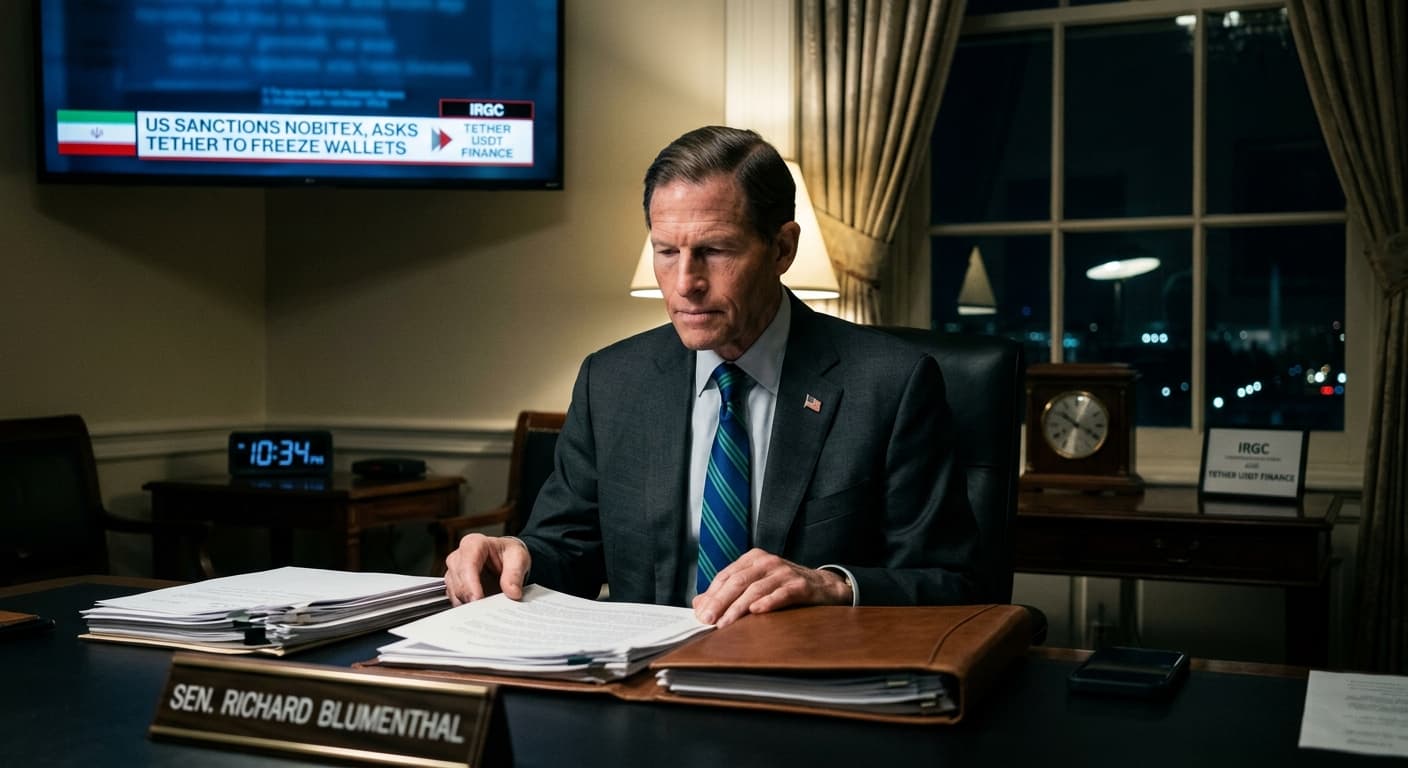
US Sanctions Iran's Nobitex — But the Real Target Is Tether
The Treasury wants you to see four Iranian crypto exchanges. The real target is the dollar-pegged stablecoin plumbing that connects Tehran's shadow banking to the global financial system — and the issuer that calls its compliance with US sanctions "voluntary."
The June 2, 2026 designations by the Treasury's Office of Foreign Assets Control named Nobitex, Iran's largest digital asset exchange, alongside Wallex, Bitpin and Ramzinex, accusing them of financing the Islamic Revolutionary Guard Corps and helping the Central Bank of Iran access hundreds of millions of dollars in stablecoins (US Treasury). This is the crypto leg of "Economic Fury," a sanctions campaign that has hit more than 1,000 Iran-related persons, vessels and aircraft since February 2025. The non-obvious lever is not the four Iranian exchanges, which were already cut off from the dollar system, but the global stablecoin issuer whose rails they depend on: Tether.
What the designations actually hit
Nobitex, founded in 2018, processed more than 50 percent of all Iranian digital asset inflows in 2025, according to Treasury; blockchain analytics firm TRM Labs put its dominance even higher, at 87 percent of all Iranian crypto transactions by volume (JISS). Treasury says the platform helped the Central Bank of Iran obtain stablecoins to defend the plunging rial, moved regime wealth out of the country during wartime internet blackouts, and processed transactions for IRGC-affiliated ransomware actors (
US Treasury). Chairman and co-founder Amir Hossein Rad and chief executive Seyed Ali Khoee were personally designated, along with other Nobitex leaders (
OFAC).
The three smaller exchanges round out the map of Iran's crypto economy. Wallex, the second-largest, received 12 percent of Iranian digital asset inflows in 2025; Bitpin took 10 percent; and Ramzinex, founded in 2018, has processed over $2.45 billion in transactions, including for a government-backed financial institution (US Treasury). All four were designated under Executive Order 13902, which targets persons operating in Iran's financial sector, with Nobitex also hit under the counterterrorism authority of E.O. 13224.
Treasury Secretary Scott Bessent framed the action in maximalist terms: "While Iran's economy is in free fall, the regime has chosen to co-opt digital asset technologies for its own corrupt agenda, including evading sanctions and transferring wealth out of the country" (US Treasury). The State Department's Rewards for Justice program simultaneously offered up to $15 million for information disrupting the IRGC's financial mechanisms.
The designations expose Nobitex's political architecture. The exchange was founded by two brothers from Iran's powerful Kharrazi clan, which is linked to Supreme Leader Mojtaba Khamenei. It has processed transactions ranging from tens to hundreds of millions of dollars tied to sanctioned groups including the central bank and the IRGC (Gulf International Forum). The IRGC's share of on-chain activity exceeded 50 percent in the fourth quarter of 2025, and funds received by IRGC-associated addresses spiked from over $2 billion in 2024 to more than $3 billion in 2025 (
Gulf International Forum). The regime didn't just tolerate crypto; it captured the ecosystem.
The stablecoin dependency
The exchanges are the visible layer. The rails underneath are dollar-pegged stablecoins — overwhelmingly USDT, issued by Tether. Treasury itself has warned that cryptocurrencies have become "one leg of Iran's shadow banking network," naming "large volume stablecoin issuers" as being of particular concern (Sen. Blumenthal press release). The Central Bank of Iran bought more than $500 million in USDT in a single year, a strategy Elliptic described as "a sophisticated strategy to bypass the global banking system" (
Al Jazeera).
Iran's designated wallets are overwhelmingly Tron and Ethereum addresses transacting in USDT. A Senate Homeland Security Subcommittee review of OFAC and Israel's National Bureau for Counter Terror Financing designations found the sanctioned wallets "are predominantly Tron and Ethereum blockchain addresses that have transacted in USDT" (Sen. Blumenthal letter to Tether). Israel's NBCTF in September 2025 identified 187 USDT wallets tied to the IRGC; Elliptic calculated they had received $1.5 billion in USDT (
JISS).
The structural problem is that Tether, though founded in the United States and reliant on US financial infrastructure, has stated its compliance with OFAC sanctions is "voluntary" and that it follows "OFAC guidelines" (Sen. Blumenthal letter to Tether). Its business relationship with Cantor Fitzgerald, tied to Commerce Secretary Howard Lutnick, adds a political dimension. That framing is what makes the June 2 designations more than a symbolic act against Iranian entities already outside the dollar system. It is the setup for a confrontation with the issuer whose product is the de facto settlement layer of Iran's parallel financial system.
The reactive freeze pattern
Two days after the designations, Senator Richard Blumenthal demanded Tether confirm whether it had frozen all USDT in wallets associated with the four sanctioned exchanges, given that Tether possesses a built-in "blacklist" function capable of freezing withdrawals (Sen. Blumenthal press release). The letter cited reporting that hundreds of millions of dollars in USDT were used in Chinese money laundering schemes enabling illicit Iranian oil sales and financing the Houthis — with the funds flowing partly through Nobitex.
Tether has acted against Iran-linked wallets before, but narrowly and only after external exposure. In July 2025, Tether froze 42 USDT wallets — more than half linked to Nobitex and the IRGC, as identified by Israel's NBCTF (JISS). That move followed a devastating June 18, 2025 cyberattack on Nobitex attributed to the Israel-linked group Predatory Sparrow, which stole $90 million and deliberately destroyed the funds by sending them to vanity addresses with no private keys (
Al Jazeera). Within minutes of the first US-Israeli attack in June 2025, outgoing transaction volumes from Nobitex surged by 700 percent, according to Elliptic (
Al Jazeera).
The pattern is reactive, not systematic. The Blumenthal letter notes that even after the June 2 OFAC designations, the four exchanges' websites still advertised USDT-for-rial trading, and Nobitex "advises their customers how to evade sanctions with USDT" (Sen. Blumenthal letter to Tether). The gap between Tether's technical capability to blacklist wallets and its stated "voluntary" compliance posture is the vulnerability the US is now pressing.
Secondary sanctions and the compliance cascade
The secondary-sanctions threat is what makes this more than a US-Iran affair. Treasury issued FAQ 1250 and FAQ 1257 alongside the designations, warning that foreign financial institutions dealing with the designated exchanges risk restrictions on correspondent and payable-through accounts (OFAC). Chainalysis assessed the move as creating "substantial compliance risk for international firms with Iranian counterparties" (
Noah Intelligence). For exchanges, custodians and liquidity providers — especially in jurisdictions with weak anti-money-laundering enforcement — the choice is now starker: delist Iranian counterparties or face US dollar account restrictions.
The December 2025 OFAC settlement with Exodus Movement, a US-based wallet provider, shows how enforcement works at the retail level. Exodus paid $3.1 million for 254 apparent violations after customer service staff recommended Iranian users employ VPNs to obscure their location and bypass exchange partners' sanctions controls — a modest sum, but a signal that even peripheral actors face penalties (OFAC enforcement release). The enforcement landscape now spans from wallet providers to the largest global exchanges.
The Binance parallel and the conflict-of-interest question
The pressure on Tether mirrors a separate congressional probe into Binance. Senator Adam Schiff led a letter to Treasury and the Justice Department reporting that Binance executives allowed sanctioned Iranian operator Babak Zanjani to coordinate $850 million in transactions over two years despite internal warnings. Funds flowed to IRGC-affiliated accounts a month before US military operations against Iran began in January 2026 (Sen. Schiff press release). An internal Binance investigation reportedly found more than $1.7 billion had flowed through Binance to Iran-backed proxy groups since 2023, including the Houthis (
Sen. Schiff letter to Bessent). Between 2024 and 2025, Binance accounts funneled $260 million to accounts with clear ties to Iranian terrorist financing (
Sen. Schiff letter to Bessent).
The Schiff letter raises a sharper political question: Binance is used by President Trump's family and Middle East envoy Steve Witkoff to "prop up their cryptocurrency venture, World Liberty Financial," even as the administration conducts military operations against Iran. The letter argues this "raises grave ethical and national security concerns," including that the president and Witkoff "could be financially enriched through their Binance-linked cryptocurrency venture while the Trump Administration engages in a military operation against Iran" (Sen. Schiff letter to Bessent). A parallel letter from Senator Chris Van Hollen demanded a review of Binance's sanctions compliance, noting the 2023 $4 billion settlement and the firing of compliance staff who uncovered the Iran-linked flows (
Sen. Van Hollen letter).
The Lutnick-Cantor Fitzgerald-Tether nexus adds a second conflict-of-interest thread. The Blumenthal letter highlights Tether's "operational and business relationship to Cantor Fitzgerald and the family of the Secretary of Commerce, Howard Lutnick," while questioning whether Tether's voluntary compliance posture is adequate given its deep reliance on US financial infrastructure (Sen. Blumenthal letter to Tether). Treasury's leverage over Tether is considerable; the political will to use it is the variable.
Winners, losers, and the second-order effects
The immediate losers are the designated exchanges and their leadership. Nobitex's Rad and Khoee face personal sanctions that freeze any US-linked assets and criminalize transactions with US persons. But the second-order loser is ordinary Iranian crypto users — the 11 million Nobitex customers who used the platform to swap rials for cryptocurrencies as an inflation hedge and cross-border payment mechanism (Al Jazeera). Tether's July 2025 wallet freeze reduced the supply of stablecoins accessible to ordinary Iranians, not just the IRGC (
JISS). The June 2 designations will compound that squeeze, pushing retail users toward riskier unregulated platforms or peer-to-peer channels with worse pricing and less security.
The IRGC itself is the hardest target to hit. Iran legalized cryptomining in 2019 and has since built a mining sector estimated at up to 7 percent of global Bitcoin production in 2021, with revenue potentially reaching $1 billion that year — newly minted coins are preferred because they are less traceable, and miners are required to sell crypto to the Central Bank of Iran (Sen. Warren letter to Treasury). Between 2015 and 2021, Bitcoin mining funneled more than $186 million into Iranian crypto platforms (
Sen. Warren letter to Treasury). Sanctioning exchanges does not shut down mining; it forces the regime to adapt, not retreat.
The winners are the compliance and analytics industry. Chainalysis, Elliptic and TRM Labs are the firms whose blockchain forensics underpin these designations — and whose services become more valuable with every new sanctions action. Their consensus is that Iran's crypto ecosystem is now systemically high-risk, a classification that itself drives further delistings and compliance spending. The broader winner is the US sanctions architecture itself: the designations demonstrate that crypto is not beyond the reach of OFAC, provided the political will exists to pressure the intermediaries — especially stablecoin issuers — that sit between sanctioned jurisdictions and the global market.
The historical parallel
Iran's crypto strategy mirrors its oil-smuggling shadow fleet: a parallel logistics system built to evade sanctions, co-opted by the IRGC, and now being systematically targeted by Treasury. The April 24, 2026 designation of China-based Hengli Petrochemical and 19 shadow-fleet vessels followed the same template as the June 2 crypto designations — identify the node, cut it off, warn the enablers (US Treasury). The May 1 designation of three Iranian currency exchange houses and their front companies extended the campaign to the fiat side of the shadow banking network (
US Treasury). The crypto designations close a gap in that architecture — but only if Tether and comparable issuers are forced to enforce them.
The difference is that oil moves on ships that can be tracked and sanctioned; USDT moves on blockchains where the issuer controls a kill switch. The question is whether Washington will compel Tether to use it.
Key Takeaways
- OFAC designated Nobitex, Wallex, Bitpin and Ramzinex on June 2, 2026, targeting Iran's four largest crypto exchanges under E.O. 13902 and, for Nobitex, E.O. 13224.
- Nobitex processed over 50 percent of Iranian crypto inflows in 2025 and helped the Central Bank of Iran access hundreds of millions in stablecoins.
- The decisive pressure falls on Tether, whose USDT is the dominant stablecoin in Iran's shadow banking network; Senator Blumenthal is demanding Tether freeze wallets tied to the sanctioned exchanges.
- Tether has called its OFAC compliance "voluntary," and even after the designations, the exchanges' websites still advertised USDT-for-rial trading.
- Secondary sanctions exposure now extends to any foreign financial institution dealing with the four exchanges, per Treasury FAQs 1250 and 1257.
What to Watch
- Tether's response to Blumenthal's June 4 letter: Whether Tether freezes USDT in wallets associated with Nobitex, Wallex, Bitpin and Ramzinex — or maintains its "voluntary" compliance posture — will determine whether the designations bite or merely signal.
- Schiff and Van Hollen's Binance probes: The Senate inquiry demands answers by June 19, 2026, on Binance's sanctions compliance and the $1.7 billion in Iran-linked flows. The Justice Department's response will signal whether Binance's 2023 settlement monitors are revived or dropped.
- Treasury's next Economic Fury designations: OFAC has signaled more designations could follow if additional wallets, custodians or intermediaries are found to have handled the flows. The campaign has averaged roughly one major action per week since April 2026.
Diplomat View
The June 2 designations will not cripple Iran's crypto economy on their own — the IRGC's mining operations and peer-to-peer channels will adapt, as they have adapted to oil sanctions. The decisive variable is Tether. If Tether systematically blacklists wallets linked to the four exchanges and the Central Bank of Iran, the designations will cut the primary stablecoin rail connecting Tehran to global crypto markets. If Tether maintains its reactive, case-by-case posture, the designations will be another headline in a long sanctions campaign that Iran has learned to absorb.
The forecast turns on three conditions. First, Treasury must escalate from guidance to enforcement action against Tether or its US-based partners — Cantor Fitzgerald's involvement gives OFAC jurisdictional leverage it has not yet used. Second, the Binance probes must produce consequences beyond congressional letters; the Justice Department's willingness to reinstate compliance monitors, dropped or weakened in 2025 negotiations, will indicate whether the administration's crypto industry ties override its sanctions agenda. Third, ordinary Iranian users must find alternatives; if they migrate to decentralized exchanges and non-KYC platforms, the compliance cascade stalls and the IRGC's crypto channels persist under different infrastructure.
The designations are the setup. The next move belongs to Treasury, Tether, and Congress. The answer will determine whether crypto sanctions become enforceable or remain performative.
Discover more
US Politics
House Ethics Committee Pushes Sexual Miscond.
The House Ethics Committee has shifted responsibility for sexual harassment settlement records to the Office of Congressional Workplace Rights, complicating disclosure efforts.

US Politics
SNAP Food Assistance Faces Legal Challenges
In 2026, SNAP faces stricter eligibility rules and mounting legal challenges, threatening food assistance for the millions of Americans who rely on the program.

International Relations
Pakistan's Key Role in US-Israel-Iran Meddle
Pakistan is seeking to mediate the US-Israel-Iran conflict, balancing high-stakes diplomacy against severe economic pressures and steep regional challenges.

Economics
Fed's Amex AML order puts correspondent banking on notice
Federal Reserve's Amex AML order requires board-level controls and a 90-day plan; OCC fined the bank $350 million over enterprise-wide deficiencies.