US Project Freedom
How a 50-hour operation reshaped Hormuz dynamics
Model Diplomat8 min readMiddle East
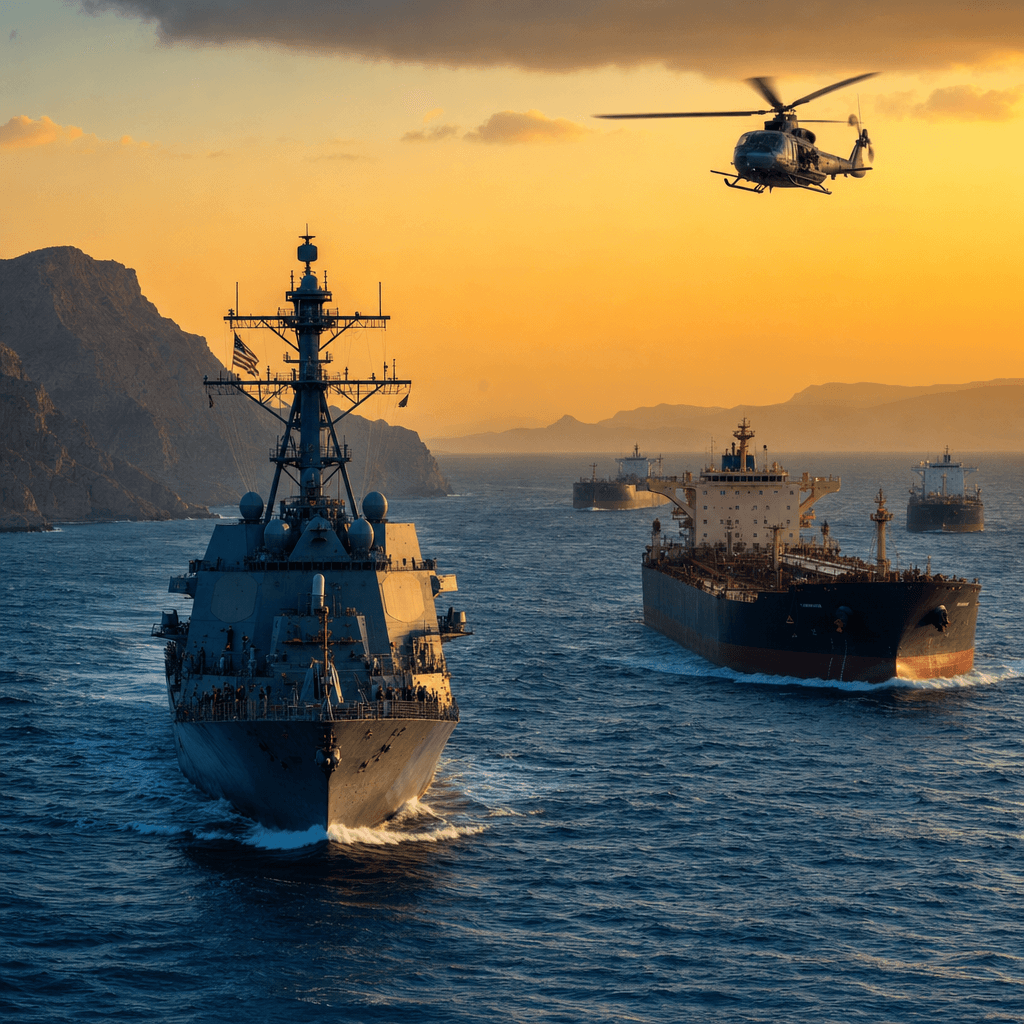
US Project Freedom: How Trump's 50-Hour Hormuz Bluff Handed Iran the Strait
Project Freedom was Trump's May 2026 operation to force open the Strait of Hormuz. It lasted 50 hours — and left Iran with lasting leverage over 20% of global oil.
The United States deployed 15,000 service members, more than 100 aircraft and guided-missile destroyers to the Strait of Hormuz on May 4, 2026. Fifty hours later, President Donald Trump paused the operation. Two US-flagged merchant vessels had transited. A French container ship had been struck. Six Iranian speedboats had been sunk, and Dubai residents had again received incoming-missile alerts on their phones. "Project Freedom" — pitched by Defense Secretary Pete Hegseth as a "gift" to the world — was over before it moved a single foreign tanker. The pause was not a tactical retreat. It was the moment the Trump administration acknowledged that Iran's closure of the strait had already worked, and traded away the principle of free navigation to end the war it started on February 28.
That concession is now visible in the memorandum of understanding Trump signed at the Palace of Versailles on June 17, and in the Persian Gulf Strait Authority (PGSA) Iran stood up during the war — a body Tehran has not dismantled, and which every ship transiting Hormuz must now register with. Project Freedom's collapse turned Iran's blockade into a permanent seat at the table.
What Project Freedom actually was
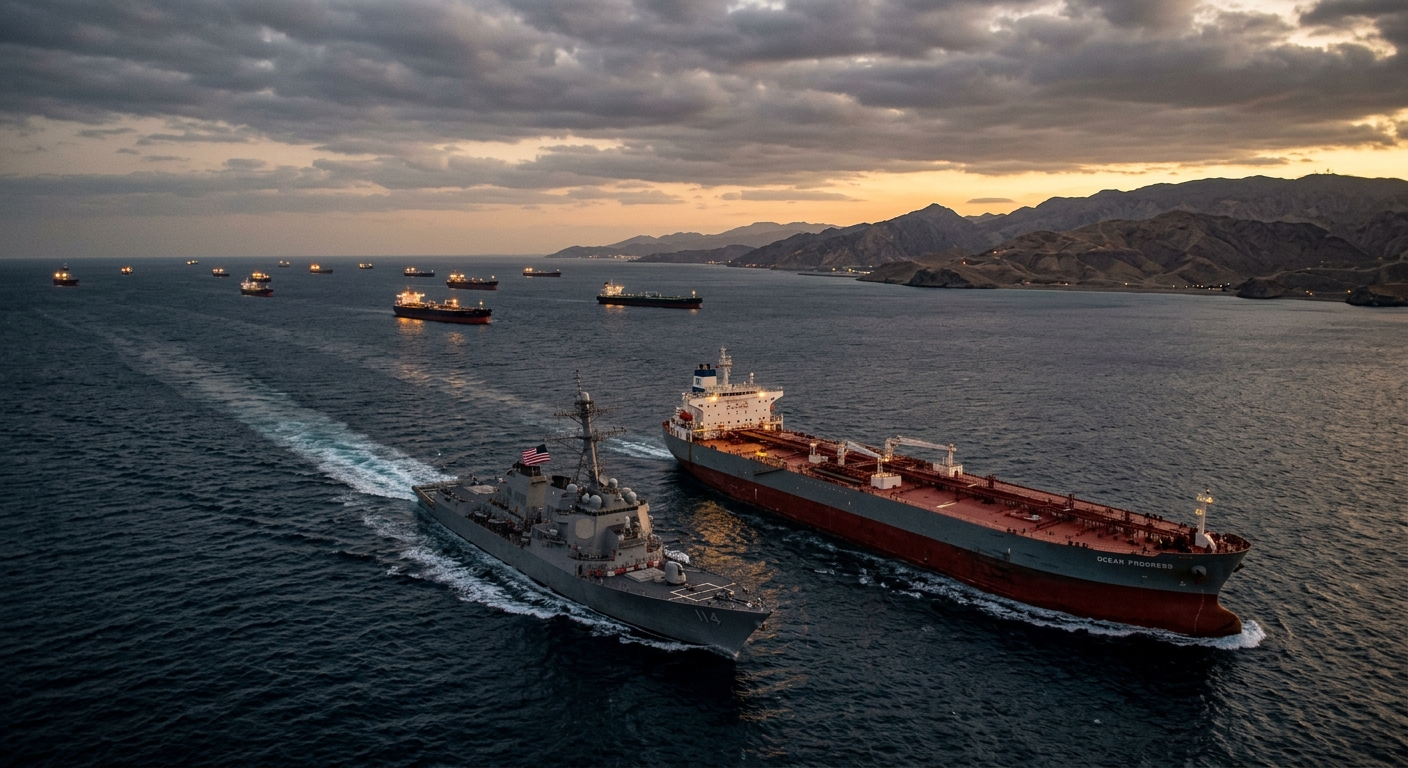
The operation was announced on Trump's Truth Social account on Sunday, May 3, as a "humanitarian gesture" to move ships stranded by Iran's post-war closure of the strait. By 00:35 GMT on May 4, US Central Command had committed to backing it. In an official CENTCOM release, Admiral Brad Cooper described "guided-missile destroyers, over 100 land and sea-based aircraft, multi-domain unmanned platforms, and 15,000 service members" supporting a mission to "restore freedom of navigation for commercial shipping."
The operation was paired with a State Department initiative called the Maritime Freedom Construct, meant to coordinate insurance and diplomatic assistance with allies, according to Al Jazeera. CENTCOM said 87 nations had vessels stranded. Chairman of the Joint Chiefs Gen. Dan Caine put the number of trapped ships at over 1,500, with about 22,500 crew.
The problem was not force posture. It was that shipowners and insurers refused to move. Lloyd's List reported that Project Freedom had failed to give operators "sufficient clarity or credible protection to justify resuming transits," per the BBC. Hapag-Lloyd stated flatly that transits "are for the moment not possible for our ships." Only two US-flagged vessels — including a Maersk-operated carrier called Alliance Fairfax — moved during the entire operation,
NPR reported.
Why Trump pulled the plug
The pause on Tuesday evening, May 5, undercut a day of maximalist messaging from Hegseth, Secretary of State Marco Rubio, and Caine, all of whom had pledged the operation would restore commerce. Four hours before Trump's Truth Social post, a CMA CGM–operated container ship was hit in the strait, injuring crew. NPR, citing a person briefed on the matter, reported that even the Israeli government was blindsided by the halt and had been preparing for escalation.
Pakistan's Prime Minister Shehbaz Sharif — mediating alongside Saudi Crown Prince Mohammed bin Salman — publicly thanked Trump for the pause. According to Reuters and Axios reporting summarised by the BBC, Washington and Tehran were closing on a one-page, 14-point memorandum to end the war. The pause bought that memorandum room to breathe.
But the calculation was harder than that. Iran's parliamentary speaker and lead negotiator, Mohammad Bagher Qalibaf, warned on X that "the continuation of the status quo is intolerable for America; while we have not even begun yet." Iranian air defences and drones were already targeting UAE oil infrastructure; an oil terminal fire had cut Emirati output to about half a million barrels a day, NPR's Aya Batrawy reported from Dubai. The Council on Foreign Relations noted separately that the Gulf states themselves — Riyadh in particular — were urging Trump to fold rather than see Iranian missiles resume flying at their infrastructure.
Mick Mulroy, a former Pentagon Middle East policy official, told the BBC the real question was whether the pause reflected diplomacy or capitulation: "It's unclear if the pause was because of this one-page memorandum or because the 1,500 ships currently stuck behind the [strait] wouldn't transit even with the US security umbrella."
Both were true. Project Freedom had run out of ships to escort before it ran out of political cover.
The MoU: what Trump traded away
The full text of the memorandum, released by the BBC, commits Washington and Tehran to negotiate a final deal within 60 days. Point 4 requires the US to begin lifting its naval blockade "immediately upon signing" and fully within 30 days. Point 5 obliges Iran to use "best efforts for the safe passage of commercial vessels with no charge for 60 days" — and, crucially, states that Iran "will conduct dialog with the Sultanate of Oman to define the future administration and maritime services in the Strait of Hormuz."
Read those clauses cold: they concede that the future administration of Hormuz is a matter for Iran and Oman to negotiate, not a settled question of customary international maritime law. That is the shift. Before the war, transit was free by long-standing practice, even though neither the US nor Iran is party to the UN Convention on the Law of the Sea. The MoU treats a Iranian-Omani co-administration — with the PGSA still in place — as the starting point for talks.
Bruce Jones of Brookings, one of the closer watchers of the strait, put it directly: Iran established the Persian Gulf Strait Authority to collect fees, "and they have not taken that authority down." Iran's national insurance company has already opened policies that transiting ships must apply for. On June 20, the PGSA published its rules: "No vessel is permitted to pass through the Strait of Hormuz without a valid passage permit issued by the PGSA,"
BBC Verify reported. The permits are free for 60 days. After that, they aren't.
The Council on Foreign Relations' Steven Cook and Ray Takeyh went further in a CFR roundtable: "Using the strait to both impose costs on the international community as well as extract revenues in terms of tolls on ships has entered Iran's strategic calculation," Takeyh said. Cook was blunter: "Unlike a nuclear weapon, the strait can be used — again and again."
The winner nobody names: the PGSA
The immediate loser is easy to identify. Trump launched Operation Epic Fury to end Iran's nuclear enrichment, break the missile threat to Gulf states, and reassert freedom of navigation. Under the MoU, as CFR's Richard Fontaine wrote, Iran retains an estimated 11 tons of enriched uranium, most of its drones and missile launchers, and its proxy network. Moody's Analytics estimates US consumers and taxpayers have absorbed roughly $132 billion in war costs; gasoline peaked at $4.56 per gallon. The World Bank downgraded 2026 global growth to its lowest since the Covid contraction.
The clearer winner is bureaucratic: the PGSA. A body invented mid-war to legitimise Iranian control over a strait through which about 20% of the world's oil and LNG flows now has a UN-adjacent, treaty-adjacent existence. Even Rubio's public objections — he told the UAE on June 24 that "no country is allowed to charge tolls or fees on an international waterway" — did not bar the PGSA from operating; they just delayed the fee schedule by 60 days.
Brookings analysts Samantha Gross and Ryan Beane flag the deeper precedent: Iran has demonstrated that access to a critical shipping route can be conditioned on political relationships. Russian, Chinese, Pakistani and Indian vessels reportedly got preferential transits during the war; some paid in yuan,
Al Jazeera reported. This is not a toll booth. It is a discretionary access regime — and the MoU accommodates it.
The historical parallel that reframes the operation
Operation Earnest Will, launched in 1987, reflagged Kuwaiti tankers under US colors to escort them through the same strait during the Iran-Iraq War. It ran for over a year, involved a shadow war of mines and speedboats, and ended with Iran's navy reduced by Operation Praying Mantis in April 1988. It was ugly and expensive, and it worked because Washington was willing to grind.
Project Freedom lasted two days. The distance between those two commitments is the story. Adm. Cooper's forces could execute — helicopters sank speedboats, destroyers escorted, the Alliance Fairfax got out — but the political appetite in Washington evaporated the moment CMA CGM took a hit and Emirati oil terminals started burning. That is the lesson every future coastal state contemplating a chokepoint play will take from May 2026: the US will show up in force, and will leave in two days if the price of gasoline moves.
Diplomat View
Project Freedom was a bluff Iran called inside 50 hours, and the MoU that followed ratified the outcome. The specific, falsifiable claim to watch: when the 60-day free-transit window under the memorandum expires around August 16, 2026, the PGSA will introduce "service fees" of $1–$3 per barrel of oil transiting the strait, and Trump — despite Rubio's public red line — will not restart military operations to stop it. If that happens, the US has effectively accepted a permanent Iranian co-administration of Hormuz, with Oman as a minority partner and a legal precedent that any coastal state with mines, drones and mid-range missiles can monetise a chokepoint.
The forecast would be wrong if two conditions hold: the Doha technical track produces a nuclear verification regime credible enough for Trump to claim a strategic win, and Saudi Arabia and the UAE bankroll a Gulf-led maritime task force to keep the strait open, giving Washington political cover to prosecute the PGSA. Neither is on the table today. The Emiratis are hedging closer to Washington; the Saudis, Qataris, Egyptians, Turks and Pakistanis are discovering a common interest in a post-hegemonic Gulf security order, CFR's Cook has noted. A Trump who abandoned a 15,000-troop operation in 50 hours is not the president who will spend two years enforcing freedom of navigation to nullify the fees.
What to watch next
- August 16, 2026 — expiry of the MoU's 60-day free-passage window. Whether the PGSA publishes a fee schedule that day is the single cleanest indicator of who won.
- Doha technical talks — the
communication channel Iran agreed on July 1 for reporting MoU breaches. If it stalls, tit-for-tat strikes resume.
- European demining mission — announced by Macron at the G7. Timeline of 30 days to 6 months. Until mines are cleared, the "reopening" is theoretical.
- Iran's next Hormuz closure — IRGC briefly closed the strait on June 20 in response to Israeli strikes in Lebanon. The frequency of these micro-closures will telegraph whether Tehran intends to use its new leverage sparingly or often.
The Bottom Line
Project Freedom is not remembered for what it achieved — two ships escorted, six speedboats sunk — but for what it revealed: the US will not sustain the costs of enforcing freedom of navigation in Hormuz once oil prices spike and Gulf partners flinch. The memorandum that ended the war codified that lesson into a co-administered strait, a still-standing Persian Gulf Strait Authority, and a 60-day clock ticking toward the first legally sanctioned toll on 20% of the world's oil. Iran did not win the war. It won the waterway.
Discover more

Global Politics
US Seizes Iranian Ship, Tensions Surge
The US seizure of the Iranian ship Touska highlights a shift in control over the Strait of Hormuz, favoring Iran's strategic position.

Economics
Fed's Amex AML order puts correspondent banking on notice
Federal Reserve's Amex AML order requires board-level controls and a 90-day plan; OCC fined the bank $350 million over enterprise-wide deficiencies.
Conflict & Security
Guatemala: El Niño 2026–27 becomes regional security test
UNICEF: 25.8M children face El Niño risks in Latin America; Guatemala maps 188 municipalities for drought and food insecurity amid regional security test.

Economics
Fed's stress-test overhaul is a capital-smoothing exercise
Federal Reserve finalized stress-test overhaul: two-year averaging for bank capital buffers and public input, expected to halve volatility.