US Job Openings at 6.7M
Job openings rise, but hiring remains stagnant in 2026.
Model Diplomat7 min readNorth America
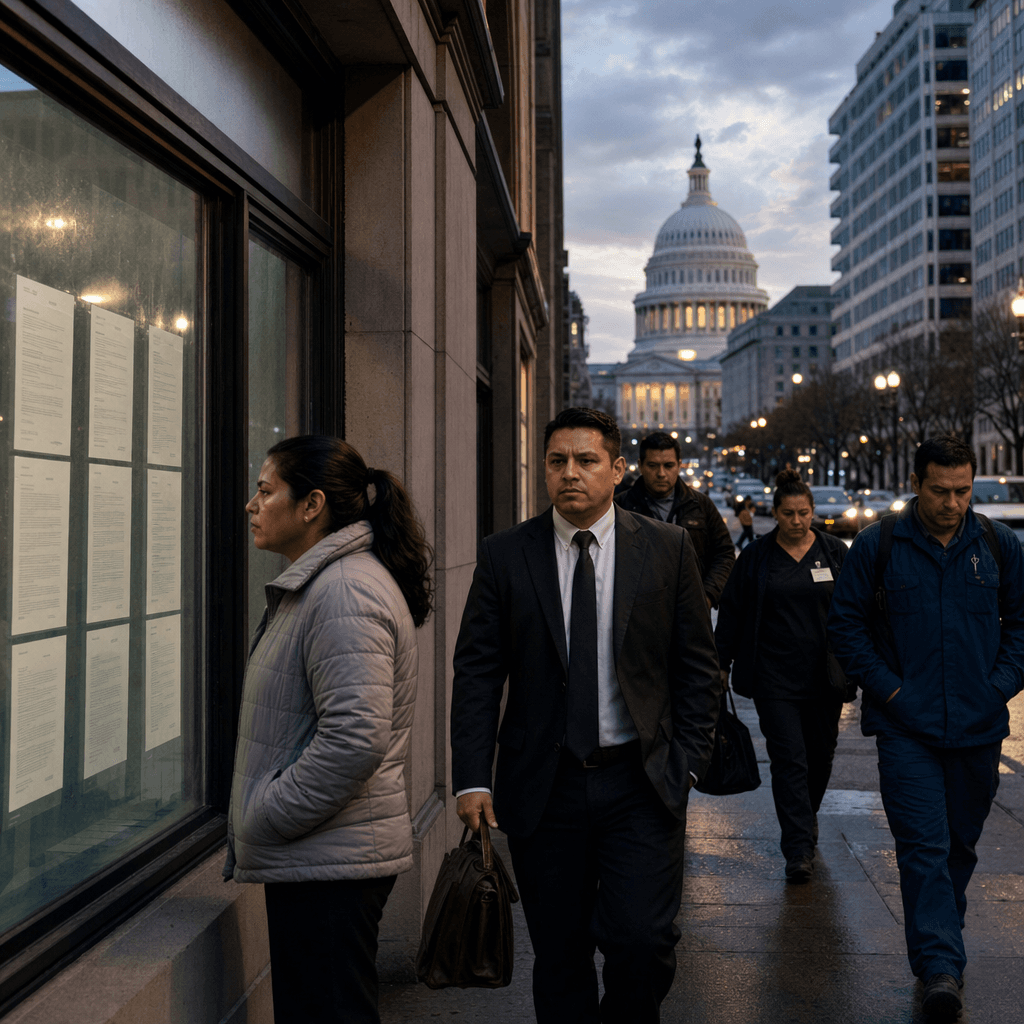
US Job Openings Hit 7.6M — But the Hiring Market Is Frozen
US job openings ran past the 6.7M forecast to 7.6 million in May 2026, the highest in two years — yet hires are stuck at pandemic lows.
The consensus forecast pegged US job openings at roughly 6.7 million heading into spring 2026. The Bureau of Labor Statistics, in its May JOLTS release on June 30, put the actual figure at 7.6 million — the highest reading since May 2024. That gap is the story: openings are climbing, but hires are not. Firms are posting jobs they will not fill, workers are not quitting the jobs they have, and the labor market is delivering the strangest configuration in modern data — a soft top layer over a frozen core. The immediate loser is the Fed under new chair Kevin Warsh, whose inflation problem now runs on top of a paralysed jobs market it cannot ease without picking a fight with the White House.
The number under the number
The headline is deceptively strong. Openings were unchanged at 7.6 million; the openings rate held at 4.6%, according to the BLS. Wholesale trade added 71,000 postings. April had already jumped 731,000 from March, per a separate
BLS Economics Daily note, driven by a 668,000 surge in professional and business services.
Then look one line down. Hires were unchanged at 5.2 million — a rate of 3.3%. Quits held at 3.1 million, a rate of 1.9%. Layoffs, at 1.7 million, did not move either. Haver Analytics, in a research note, described total openings as up just 0.1% month-on-month, "the highest since May 2024." That is a market posting jobs, not filling them.
The Peterson Institute for International Economics has been blunt. In an April analysis, economist Jed Kolko wrote that "the most alarming labor market indicator" is the hires rate, which by late 2025 sat at the 15th percentile of the past 25 years — worse than any period outside the pandemic trough. Openings-to-unemployed is at the 74th percentile. Quits at the 38th. Payroll growth at the 22nd. "Unemployment, payroll growth, and hiring are pointing in different directions to a nearly unprecedented degree," Kolko wrote.
The Beveridge curve has broken
For decades, US labor economists relied on the Beveridge curve: a stable inverse relationship between vacancies and unemployment. High openings meant a tight market and, by extension, wage pressure the Federal Reserve had to lean against. That framework is now unreliable.
Peterson calculated that November 2025's hiring rate of 3.2% would historically have accompanied unemployment near 8%; the actual reading was 4.5%. A Brookings Papers on Economic Activity study presented in March by Federal Reserve economists Scott Brave, Bart Hobijn, Erin Crust, Ayşegül Şahin and Stefano Eusepi described the post-pandemic pattern as "recession-like declines in labor demand without a sharp increase in unemployment rate" — a soft landing sustained by falling short-run labor supply, not by strong demand.
Fed Governor Christopher Waller, quoted in that same paper, put the mechanism in plain English: "firms are holding on to workers but are not backfilling positions or hiring." Labor hoarding, not labor tightness, is what the JOLTS print is measuring.
Immigration is doing the work the Fed cannot
The reason unemployment has not surged despite hiring at pandemic lows is the collapse in labor-force growth. Kolko's Peterson slides put the arithmetic starkly: the "breakeven" payroll gain needed to hold the employment-population ratio steady fell from about 179,000 per month in 2024 to roughly 45,000 in 2026, because net immigration cratered under the Trump administration's enforcement push.
The IMF's 2026 Article IV consultation, published in March, reached the same conclusion. Fund staff wrote that "the reduction in immigration will reduce labor supply which should allow the labor market to remain at, or close to, full employment in 2026–27 (i.e. an unemployment rate close to 4½ percent)," while projecting employment growth "at less than one-half of the pace seen in the five years prior to the pandemic." The Fund also flagged that with policy rates near neutral, "there is little scope to lower the policy rate over the coming year."
That is why a 7.6-million opening print does not deliver the wage acceleration the old model would predict. The pool of new entrants — immigrants, recent graduates, and re-entrants — has thinned. Firms are advertising into a market that no longer supplies the labor at the price they want to pay, and they are refusing to raise wages fast enough to close the gap. So the openings sit.
The June payroll shock
The disconnect got sharper this week. On July 2, the BLS reported that US employers added just 57,000 jobs in June — a print NPR called "June gloom" and the
Financial Times described as an undershoot of consensus. The unemployment rate ticked down, but only because the labor force shrank. The
BBC noted that leisure and hospitality shed roles in a month when the World Cup, hosted across US venues, was supposed to boost the sector.
Set that against the JOLTS: 7.6 million postings on paper, 57,000 net new hires on the ground. Al Jazeera's coverage of the March labor report quoted Stanford Digital Economy Lab research showing a 16% decline in relative employment for early-career workers in AI-exposed roles, even as demand for experienced workers held up. That is where the openings-hires gap lives: the postings exist for senior talent that will not move; the hires that used to absorb graduates have collapsed.
Warsh's box
The political stakes run through the Eccles Building. President Trump replaced Jerome Powell with Kevin Warsh in May, betting that a friendlier chair would deliver the aggressive cuts Trump has demanded since 2025. Instead, Warsh's first meeting on June 17 held rates steady at 3.5%–3.75%.
The June FOMC statement noted that "Job gains have kept pace with the workforce, and the unemployment rate has changed little." The accompanying
Summary of Economic Projections put median 2026 headline PCE inflation at 3.6% and the unemployment rate at 4.3%. Nine of 18 participants penciled in an outright rate hike before year-end, one saw a cut, and eight expected no move.
At the press conference, Warsh was explicit:
"Job gains have kept pace with the workforce, and the unemployment rate has changed little… members of the FOMC are unambiguous and unanimous: This Committee will deliver price stability."
He also stripped forward guidance from the statement, calling it "not well suited to the current policy conjuncture." The Economist framed the bind: Warsh cannot cut into 3.8% inflation driven by a wartime oil spike after the US-Israel strikes on Iran, but he also cannot hike into a hiring rate at multi-decade lows without risking the recession his boss wants him to prevent.
The JOLTS release is the datapoint that most cleanly justifies the hold. Openings at a two-year high give hawks cover to argue labor demand is not collapsing. Doves counter, correctly, that hires and quits tell the opposite story. Warsh has chosen the hawks — for now.
Who wins, who loses
The winner is a narrow slice of incumbent workers in construction, health care and government — the three industries Brookings identified as still doing meaningful net hiring. Their bargaining power is real because their employers cannot easily replace them.
The losers are numerous and specific. The class of 2026, competing for the same shrinking pool of entry-level slots that AI is thinning at the margin. Federal workers, down roughly 348,000 from an October 2024 peak, per Al Jazeera's reporting. Lower-income households absorbing the tariff pass-through the IMF flagged. And President Trump, who inherited a growing labor market in January 2025 and now presides over one that added an average of 68,000 jobs a month across the first half of 2026, versus 186,000 in 2024.
What to watch
- July 29, 2026 — FOMC decision and June JOLTS release land the same week. A hold plus a sub-7.3-million openings print would mark the first clear labor-side pivot.
- August 1, 2026 — July Employment Situation. A second straight sub-100,000 payroll month would break the "solid pace" language Warsh is now defending.
- August 22, 2026 — Warsh's first Jackson Hole speech. His framework-review task forces are due to report; the productivity-and-jobs track is the one that determines whether the Fed formally acknowledges the broken Beveridge curve.
Diplomat View
The 6.7-million forecast that anchored consensus into spring is now the wrong number by nearly a million postings — and the wrong number in the wrong direction. Openings are a lagging indicator of firm optimism; hires are the leading indicator of firm commitment. When they diverge this sharply, the historical pattern is that hiring wins and openings fall to meet it, not the reverse. Expect the July JOLTS print on July 29 to show openings sliding toward 7.2 million as employers pull unfilled requisitions, and expect Warsh to hold rates that same afternoon on the argument that the labor market is "rebalancing." The forecast breaks if core PCE prints below 2.8% before the September meeting — that is the only path to a cut this year. Absent that, the operative political fact is simple: a President who ran on jobs now owns a labor market where the postings look strong and the paychecks do not follow. That is the gap the 2026 midterms will be fought in.
The Bottom Line
US job openings at 7.6 million in May 2026 look like strength and function like paralysis: firms are advertising, not hiring, and workers are staying put because the alternatives have thinned. The Fed under Kevin Warsh is using that ambiguity as cover to hold rates against President Trump's demands, betting that hires will rise to meet openings rather than openings falling to meet hires. If the June JOLTS print on July 29 shows openings retreating below 7.3 million, the bet is lost — and a cut cycle begins with the White House, not the data, in the driver's seat.
Discover more
US Politics
SNAP Food Assistance Faces Legal Challenges
In 2026, SNAP faces stricter eligibility rules and mounting legal challenges, threatening food assistance for the millions of Americans who rely on the program.

Conflict & Security
Drone Warfare Killing Aid Workers at Unprec
Over 1,000 humanitarian workers killed in three years as cheap armed drones collapse legal protections. Gaza, Sudan, Ukraine, and DRC see deliberate targeting of aid convoys and hospitals with zero prosecutions.

Global
World Normalises Taliban as Afghan Women Eras
UN data shows Afghan women erased from public life as Russia recognises the Taliban, EU hosts officials in Brussels, and ICC warrants for gender persecution go unenforced.

Conflict & Security
West Africa Food Crisis: Three Shocks in 2026
Conflict, climate extremes, and the Strait of Hormuz closure drive a severe food crisis in West and Central Africa, with fertilizer prices surging 80% and millions displaced.