US-Japan-South Korea Trilateral Reactor Pact
New nuclear cooperation aims to reshape Indo-Pacific security.
Model Diplomat8 min readAsia
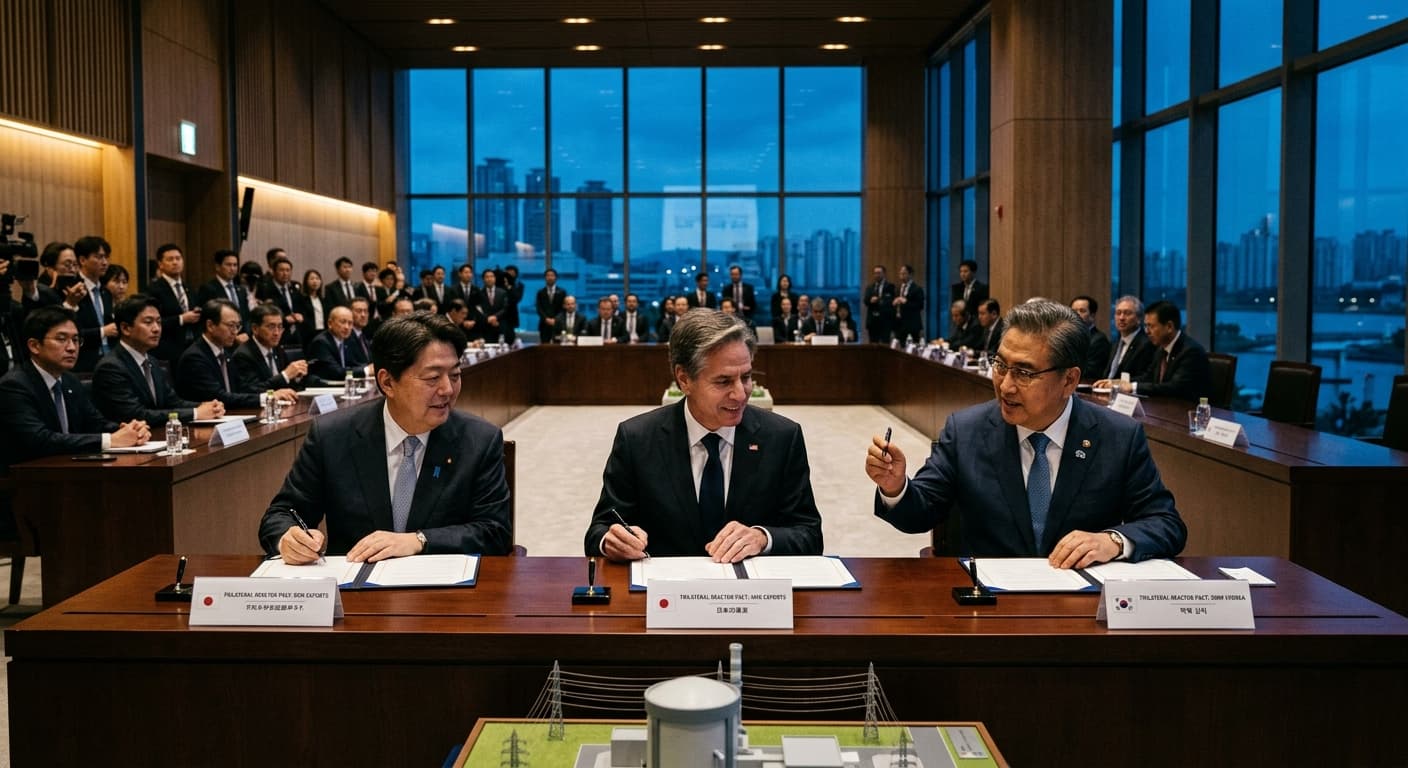
Ankara Trilateral: US-Japan-Korea Bet Indo-Pacific Security on Reactors
The July 7, 2026 US-Japan-South Korea trilateral in Ankara reframes Indo-Pacific security around small modular reactor exports — locking in a 40-year contest with Russia and China.
The load-bearing deliverable from the trilateral foreign ministers' meeting Marco Rubio, Takeshi Iwaya and Cho Hyun signed in Ankara on July 7, 2026 was not the boilerplate on Taiwan or the DPRK — it was a Memorandum of Cooperation on small modular reactor (SMR) exports to third countries, with an initial Indo-Pacific focus. The three allies are converting a security dialogue into a nuclear-vendor bloc, aimed squarely at the Russian and Chinese reactor firms that have quietly captured most of the emerging-market pipeline since 2022. That is the second-order effect the wire coverage missed: infrastructure decisions taken this month will shape which capital any Vietnamese, Filipino or Indonesian government leans toward when the Taiwan Strait heats up in the 2030s.
The document, not the communiqué
The primary source runs three paragraphs. According to the U.S. Department of State, the MOC "establishes a framework for trilateral cooperation on accelerating small modular reactor (SMR) deployments in other countries, with an initial focus on the Indo-Pacific," and the three governments will pursue "fleet deployment models that de-risk project development, achieve economies of scale, catalyze private investment, streamline licensing processes, and optimize supply chains."
Two concrete numbers sit under the language. Washington is putting more than $10 million in new money into the State Department's Foundational Infrastructure for Responsible Use of Small Modular Reactor Technology (FIRST) programme, plus an SMR Regional Training Hub for the Indo-Pacific, per the same State Department release. And a joint industry initiative — GE Vernova, Hitachi, Samsung C&T and SGE — will push the BWRX-300 SMR into European markets, with initial contract targets in Central and Eastern Europe.
Both firms are already anchored in Prime Minister Sanae Takaichi's inbound-investment package. A March 2026 White House fact sheet counted "up to $40 billion from GE Vernova Hitachi in Tennessee and Alabama to build small modular reactor power plants" as part of the second tranche of Japanese investment under the 2025 US-Japan Strategic Trade and Investment Agreement. That inbound capital is now the industrial base underwriting the outbound export push agreed in Ankara — a rare case where domestic-jobs politics and alliance strategy align on the same balance sheet.
The wider Ankara summit context matters. The Ankara Summit Declaration announced "more than $50 billion in new procurements" for NATO members, per the official NATO text, and Secretary-General Mark Rutte flagged a separate €27 billion Alliance fuel-supply investment. The trilateral SMR pact rides that same industrial-policy wave, extending NATO's defence-industrial logic into civilian energy with the Indo-Pacific as its export theatre.
Why reactors are the geopolitics story
Nuclear commerce locks a partner in for 40 to 60 years — plant operating life plus fuel supply plus waste handling. That is why Beijing and Moscow have been racing to sign SMR and Generation-III deals across the Global South. According to a February 2026 CSIS analysis, Rosatom has at least 20 units under active construction in seven countries; the
Carnegie Endowment notes Rosatom has codified nuclear ties with 54 countries and that Rosatom and Chinese counterparts collectively hold over 60 GW of on-order reactors.
Washington has been losing that race in concrete bids, not just rhetoric. A June 2025 tender in Kazakhstan — the world's largest uranium producer — went to Rosatom and CNNC. A CSIS Nuclear Network post-mortem put it starkly: "no American vendor submitted a bid. No U.S. financing package was on the table. The United States simply forfeited." Rosatom's terms are difficult to match — the Egyptian El-Dabaa deal reportedly carried a 3 percent rate over 22 years, and China has extended $6–7 billion in concessional financing for Pakistani reactors at 1–6 percent, according to the same analysis.
The trilateral pact is Washington's answer to that financing gap — through Japanese and Korean balance sheets and industrial capacity. GE Vernova Hitachi carries the reference SMR design; Samsung C&T and Korea Hydro & Nuclear Power add EPC muscle and the willingness to bid at Rosatom-competitive prices. Seoul's 2025 pledge of $350 billion in US investment — with a $7.4 billion critical-minerals slice via Korea Zinc — sits inside the same architecture, per a CSIS trilateral brief. And an
OSW analysis argues Rosatom's own SMR credibility hinges on a single Uzbekistan RITM-200N contract slated for March 2026 — a narrow window that Washington, Tokyo and Seoul now intend to exploit.
The European element is quiet but consequential. The EU's March 2026 SMR strategy explicitly names the United States, Japan and South Korea as cooperation partners, per the Commission communication published on EUR-Lex. Read together with the BWRX-300 industry consortium, Ankara is quietly setting up a transatlantic-to-Indo-Pacific SMR supply chain that would freeze Rosatom out of every OECD-adjacent market simultaneously.
The security architecture underneath
The SMR pact is the visible plank, but Ankara papered over — and quietly stabilised — a fragile political base. Chatham House's December 2025 assessment warned that the Camp David consensus was "already under threat" from leadership changes in all three capitals, Trump's bilateralist preferences and inconsistent burden-sharing demands, and the administration's late-2025 National Security Strategy — which, the Chatham paper notes, "references China largely as an economic competitor" rather than a hard-security adversary.
Ankara is best read as the working-level machinery holding despite the political weather. Rubio met his Japanese and Korean counterparts five times in trilateral format in 2025 alone, per the CSIS trilateral brief cited above. On June 8, 2026, the US House passed H.R. 3429, the US-Japan-ROK Trilateral Cooperation Act, instructing the Secretary of State to negotiate a formal Inter-Parliamentary Dialogue with the Diet and the National Assembly. As Foreign Affairs Chairman Brian Mast argued on the House floor, the bill is designed to "institutionalize trilateral cooperation so that our partnership continues to grow, regardless of political transitions in any of the three countries."
Historical parallel: this is the same insurance logic South Korea's Yoon Suk Yeol used when the defence ministers signed the Trilateral Security Cooperation Framework MOC in Tokyo on July 28, 2024. That document, as the Stimson Center argued at the time, was "an insurance plan" designed to normalise senior-level consultations, information sharing and joint exercises before US and Japanese elections could reset the political weather. Ankara extends that insurance from the security domain into commerce and technology — a harder-to-unwind form of institutionalisation.
The Ankara joint statement's language on North Korea reflects the same pattern. According to UPI, the three ministers "reaffirmed their commitment to the denuclearization of the Korean Peninsula and agreed to strengthen cooperation against North Korea's illicit cyber activities." The financial rationale is stark: US Treasury sanctions in early 2025 documented that DPRK IT-worker networks generate "hundreds of millions of dollars" annually to fund weapons programmes, according to a
Treasury press release, while trilateral assessments have attributed as much as $1.7 billion in stolen cryptocurrency to Pyongyang in a single year, per
Al Jazeera reporting on joint US-Japan-Korea findings. Cyber cooperation, in other words, is now the operational core of what the three countries actually do together against the DPRK, given diminishing UN Security Council prospects after Russian and Chinese vetoes.
The Taiwan line — carefully drawn
On the Taiwan Strait, the ministers held the standard formula: peace and stability, opposition to unilateral changes by force or coercion. That restraint is deliberate. Prime Minister Takaichi's November 2025 Diet remark that a Taiwan contingency could constitute a "survival-threatening situation" for Japan triggered sustained Beijing retaliation — including export controls on dozens of Japanese entities announced on June 29, 2026 and the reinstated ban on Japanese seafood imports.
A Brookings essay by Wu Xinbo captures Beijing's posture: China "must not leave any impression of 'flexibility'" on Taiwan and will "pay any price" to signal that any foreign military role in a contingency is unacceptable. That framing helps explain why the Ankara text was drafted around Seoul's redline rather than Tokyo's: escalation on the summit's own language would have handed Beijing an excuse to open a second economic front against South Korea just as Korean firms are being folded into the SMR export push.
Seoul walked the same line more carefully. Cho Hyun has publicly reaffirmed "One China" while stressing that "peace and stability are important in surrounding issues including Taiwan," per an Asan Institute assessment of Chinese wedge-driving strategy. This is the divergence Beijing is trying to widen: a
Brookings comparison of Japanese and Korean positions on Taiwan documents that Seoul remains "noticeably more cautious than Tokyo about publicly criticizing or upsetting Beijing on extremely sensitive issues" related to the Strait — not least because of Beijing's potential spoiler role vis-à-vis Pyongyang.
Diplomat View
The Ankara trilateral is best read not as another statement on Taiwan or the DPRK, but as the moment the US-Japan-Korea axis stopped being a security-only construct and became a civilian-technology export bloc — with reactors as the vehicle, and the Global South as the battlefield. The falsifiable call: within 24 months, either the trilateral wins at least one SMR export contract in the Indo-Pacific (leading candidates: the Philippines, Indonesia, Vietnam, or a European wildcard like Poland or Romania), or Rosatom and CNNC continue their sweep and the Ankara MOC becomes another document nobody cites. The two indicators to watch: the BWRX-300 consortium's first binding offtake agreement, and whether the Export-Import Bank moves before end-2026 to match Russian financing terms. Two conditions would force a downward revision: a formal Takaichi walk-back on Taiwan under Chinese economic pressure, or a Cho government decision to sign an energy MOU with CNNC before year-end.
Watch next:
- September 2026 UN General Assembly: The three ministers customarily meet on the margins. Any new trilateral SMR contract announcement — or a bilateral Seoul-Beijing energy signal — will telegraph the direction.
- November 2026 APEC in Shenzhen: China's host year. A Takaichi-Xi meeting, or its absence, is the primary indicator of whether Beijing's Japan pressure campaign is easing.
- March 2027 US Trilateral Cooperation Act deadline: State Department must open negotiations on the Inter-Parliamentary Dialogue within 180 days of enactment — the test of whether the executive branch will use the tool Congress just handed it.
The Bottom Line
The Ankara trilateral matters because it moves the US-Japan-Korea partnership from communiqué diplomacy into infrastructure that outlasts any single election cycle in Washington, Tokyo or Seoul. Small modular reactors are the first plank of that infrastructure, and the first serious Western answer to Rosatom's 20-country pipeline and CNNC's 30-reactor 2030 target. If the BWRX-300 consortium wins even one Indo-Pacific contract in the next 24 months, historians will mark July 7, 2026 as the day Washington stopped forfeiting the reactor race.
Discover more

US Politics
SNAP Food Assistance Faces Legal Challenges
In 2026, SNAP faces stricter eligibility rules and mounting legal challenges, threatening food assistance for the millions of Americans who rely on the program.
US Politics
Congress Targets AI Chatbot Access for Terror
The House passed the Generative AI Terrorism Risk Assessment Act, focusing on AI's role in terrorism and potential surveillance implications.

US Politics
Next Generation Republicans
A leaked survey shows 39% of Republicans under 30 do not identify as MAGA, revealing a split in the GOP's future leadership.

Economics
Fed's Amex AML order puts correspondent banking on notice
Federal Reserve's Amex AML order requires board-level controls and a 90-day plan; OCC fined the bank $350 million over enterprise-wide deficiencies.