U.S.-Iran Ceasefire Ends, Tensions Rise
Iran attacks vessels, jeopardizing ceasefire agreement.
Model Diplomat8 min readMiddle East
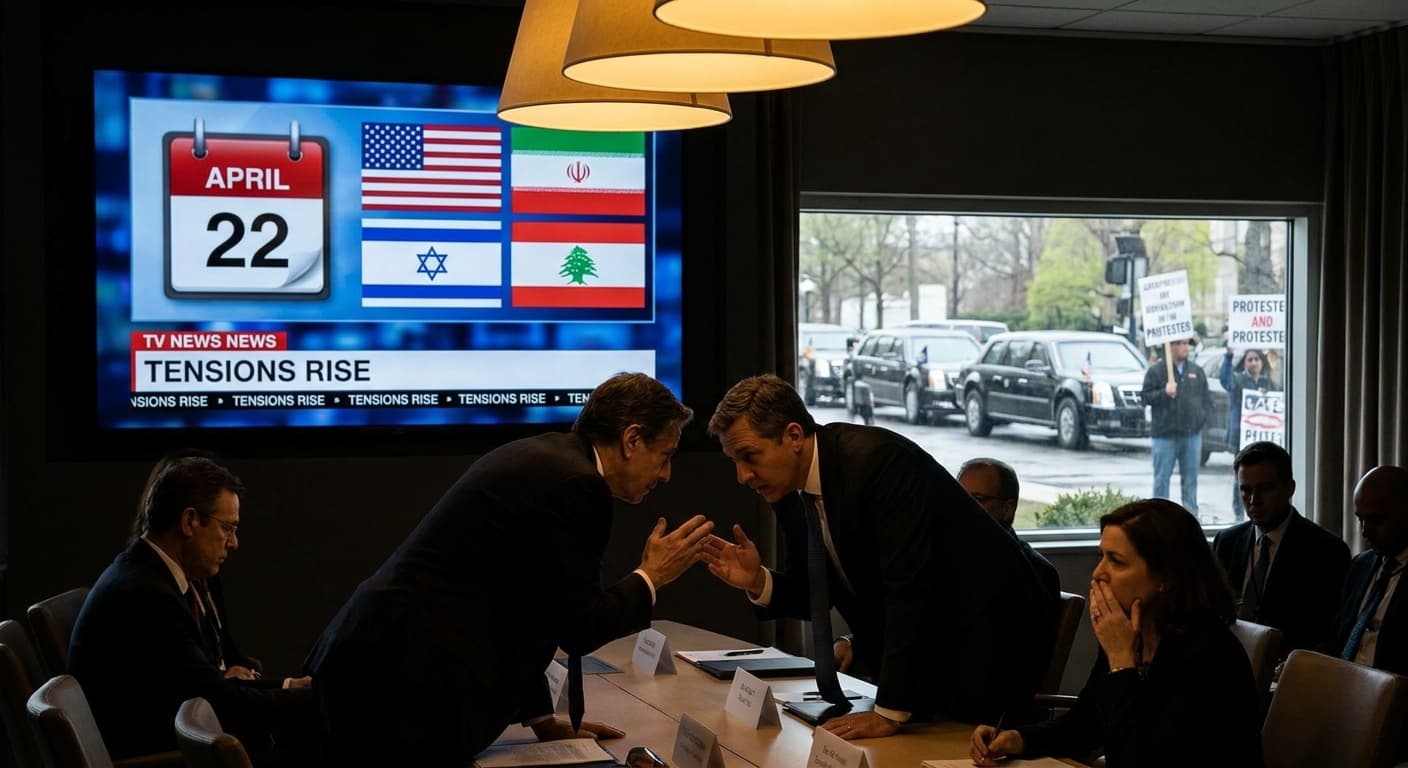
U.S.-Iran Ceasefire Frays as Iran Hits Ships in Strait of Hormuz
Iran struck two commercial vessels near Oman on July 6, 2026, hollowing out the three-week-old US-Iran memorandum and reopening the Hormuz risk premium.
Two Iranian missiles hit commercial ships transiting the Strait of Hormuz on the night of July 6, 2026, according to two US officials cited by Axios, the most serious violation of the 14-point US-Iran memorandum of understanding signed at Versailles just 19 days earlier. The attacks did not end the ceasefire on paper — they ended its usefulness. The MoU was always a bet that Iran would trade attacks on shipping for sanctions relief and $300 billion in reconstruction financing; Tehran is now demonstrating that the leverage over Hormuz is worth more to it than either. That reframes what comes next: less "will the truce hold?" than "how does Washington price a permanent Hormuz risk premium into an agreement Iran no longer needs to keep?"
What actually happened
The United Kingdom Maritime Trade Operations reported that a southbound tanker off the Omani coast was hit by an unknown projectile and set on fire late Monday, per Al Jazeera. A US official told Axios a second vessel was struck by an Iranian missile in the same window. Both suffered significant damage; no casualties were reported. A one-week de-escalation understanding — reached in Doha last week after indirect talks — had just expired.
The strikes followed a fortnight of small, calibrated violations. On June 26, a drone hit the Singapore-flagged Ever Lovely; CENTCOM answered with two nights of strikes on Iranian missile and radar sites, framing them as "a powerful response" to attacks on commercial shipping, according to Al Jazeera's reporting of the CENTCOM statement. Iran retorted that its response struck "targets linked to US forces" and accused Washington of breaching both the UN Charter and the MoU. On July 3, Tehran warned vessels using "unapproved routes" through the strait that they would face a "forceful response," per
Al Jazeera — a de facto assertion of sovereignty over an international waterway.
The Doha round on July 1 produced a hotline, not a settlement. Iranian negotiators refused to meet with Vice President JD Vance and envoy Steve Witkoff, and dealt only with Qatari mediators, The Japan Times reported. The one deliverable — a communications channel to document MoU violations — has now had its first test-case.
What the MoU actually promises — and what it doesn't
The Trump-Pezeshkian memorandum, read verbatim to reporters by US officials on June 17 and reproduced by the BBC, commits both sides to "the immediate and permanent termination of military operations on all fronts, including in Lebanon." Point 4 obliges Washington to end its naval blockade within 30 days. Point 5 obliges Iran to arrange "safe passage of commercial vessels with no charge for 60 days" from the Persian Gulf to the Sea of Oman. Point 8 reaffirms Iran will not "procure or develop nuclear weapons" and provides for down-blending of highly enriched uranium on site under IAEA supervision.
The gaps are the story. The MoU leaves the future governance of the strait to a bilateral dialogue between Iran and Oman — an outcome Tehran has publicly interpreted as endorsing its claim to a permanent role as toll collector. Iran's lead negotiator Mohammad Baqer Qalibaf said within hours of the signing that "the Strait of Hormuz will not return to pre-war conditions" and Iran will "receive a fee for services" to shipping, Al Jazeera reported. That was not a slip. Lloyd's List Intelligence disclosed in May that Iran had incorporated a Persian Gulf Strait Authority to license transits and collect tolls, per
NPR. The authority still exists.
The MoU also defers the nuclear file. Iran's Foreign Ministry spokesman Esmail Baqai said on June 24 that Tehran had made "no new commitments" on inspections, contradicting Vance's claim after Bürgenstock talks that IAEA access would begin "as soon as today," according to the BBC. IAEA Director General Rafael Grossi told reporters in Japan the modalities of inspection remained unset, per the
BBC. The 440 kg of uranium enriched to 60 percent that IAEA reported before the war remains, in Grossi's phrasing, unaccountable — much of it believed to be buried under rubble at Isfahan.
The domestic pressure that broke the truce
Look at who benefits from a controlled ceasefire violation and the picture sharpens. Iran's new supreme leader, Mojtaba Khamenei, inherited a wrecked deterrent and needs a visible one before he inherits anything else. The 56-year-old — installed by the Assembly of Experts on March 8, 2026, after his father was killed in the opening US-Israeli strikes, per the BBC — has never held office, never given a public speech, and reached power over the objection of a US president who publicly called him "unacceptable." His base is the Islamic Revolutionary Guard Corps. His legitimacy rests on being the leader the enemy did not choose.
Iran's post-war military is smaller but not broken. New York Times reporting cited by Al Jazeera found that "almost all missile sites located near the Strait of Hormuz were rendered operational again," with partial or full activity restored at nearly 90 percent of underground facilities. CENTCOM disputed a US media claim that Iran retains 70 percent of its pre-war missile and launcher inventory, but did not put its own number on record. What is uncontested is that fast boats, mine-laying vessels and coastal anti-ship missiles — the tools used on July 6 — survived the war intact.
The internal pressure is documented. Analyst Ali Vaez told Al Jazeera that after two weeks of MoU implementation, factions in Tehran were asking, "Where's the frozen assets that are supposed to be released? Where is Iran's control of the Strait of Hormuz?" President Masoud Pezeshkian has publicly said Iran expects $6 billion in frozen funds as a first tranche. None has moved.
The economic mechanics — why oil is not spiking
The most counterintuitive fact of July 7 is that Brent crude settled near $72 a barrel for September delivery, Al Jazeera reported — below the $72.48 settlement on February 27, the day before the war began. OPEC+ ratified another 188,000 barrel-per-day production increase for August, the fifth consecutive monthly hike.
The market has decoupled the price of oil from the fate of the ceasefire because the alternatives are working. Saudi Arabia's East-West Pipeline and the UAE's Abu Dhabi Crude Oil Pipeline are moving barrels around Hormuz, not through it. Iran itself has shipped almost 50 million barrels since the June 17 blockade lift, per TankerTrackers data cited by Al Jazeera. Sparta oil analyst June Goh told Al Jazeera she expects a sustained push by both producers and buyers to reduce reliance on the waterway.
What is spiking is insurance. War-risk premiums, historically about 0.25 percent of hull value, rose to 5 percent at the war's peak and remain at 1 to 3 percent, insurance broker Oscar Seikaly of NSI told Al Jazeera. That is a structural, not cyclical, repricing: even with a functioning MoU, underwriters are treating Hormuz as a semi-permanent conflict zone. Traffic on July 2 was 38 confirmed transits, against roughly 130 per day before the war — a two-thirds haircut that is not recovering.
The legal weapon Washington has not yet used
Washington's strongest instrument is a UN Security Council resolution most readers have not heard of. Resolution 2817 (2026), passed in March, "condemned in the strongest terms 'egregious attacks' by Iran against seven neighbouring countries," according to a UN readout. A follow-on draft resolution S/2026/273, tabled by Bahrain and Jordan with 136 co-sponsors,
determines that "Iran's actions near and around the Strait of Hormuz … constitute a threat to international peace and security" and demands Iran "immediately cease all attacks against merchant and commercial vessels."
Russia and China vetoed the follow-on in April, per UN News. But the underlying 2817 language — untouched by veto — is a live authorization for coordinated maritime escort operations by "States interested in the use of commercial maritime routes." The Trump administration has not invoked it explicitly since Project Freedom, the short-lived forcible-reopening operation Saudi Arabia refused to back in May, was suspended. Reactivating a multilateral escort mission under 2817 is the cleanest legal off-ramp between diplomacy and another round of unilateral CENTCOM strikes.
Diplomat View
The likeliest scenario over the next 30 days is that the MoU survives on paper while Iran normalizes a two-tier Hormuz regime — free passage for ships that use "approved" (i.e. tolled) routes, and periodic missile signals to those that don't. Washington will retaliate against tactical targets after each incident, as CENTCOM has done in every prior violation cycle, because the alternative — repudiating the MoU — collapses the nuclear leverage that Trump values above shipping. The forecast changes if any of three things happen: an American service member or US-flagged tanker crew is killed; the IAEA is denied a scheduled inspection at Isfahan; or Iran formalizes toll collection through the Persian Gulf Strait Authority beyond the current shadow structure. Any one of those hands Trump's hawks — Waltz at the UN, Hegseth at the Pentagon — the pretext to move from strikes on radar sites to strikes on refineries and power plants, which the president has explicitly threatened. Iran's Mojtaba Khamenei will not fold under that pressure. He was chosen not to.
What to watch
- August 16, 2026 — the MoU's 60-day negotiating window on the "final deal," including sanctions sequencing, expires. Extendable "by mutual consent" per Point 3, but not automatic.
- The next IAEA inspection request — Grossi has said modalities will be set "very soon." The first refused visit to a bombed site is the trigger for European snapback of pre-2015 UN sanctions.
- US retaliation for the July 6 strikes — CENTCOM's pattern is a 24- to 48-hour response cycle. If it is louder than the June 27 package, read that as a signal Trump is preparing to leave the MoU rather than salvage it.
The bottom line: the July 6 attacks are not a ceasefire collapse — they are Iran pricing the ceasefire. Tehran has learned it can violate the MoU at the margin, absorb a proportional CENTCOM strike, and keep the $300 billion reconstruction offer on the table because Washington cannot walk away from the nuclear file the deal contains. Until that asymmetry breaks, every commercial vessel in the Strait of Hormuz is paying an Iranian tax — in insurance, in transit fees, or in fire.
Discover more
Global
Iran Strikes Bahrain and Kuwait Amid US Ties
Iran's IRGC claims missile strikes on 85 US sites in Bahrain and Kuwait after the US revokes its oil sales license, escalating regional tensions.
International Relations
US-Iran Talks: Disputed Agreements Unveiled
US-Iran talks expose deep disagreements over nuclear inspections and sanctions relief, leaving any agreement uncertain as both sides hold firm on core demands.
Global Politics
Iran's De-confliction Cells Face Lebanon Test
The US-Iran ceasefire's de-confliction cells face an early test as Israel presses strikes in Lebanon, straining the fragile deal and wider US-Iran relations.
International Relations
Nabatieh Ceasefire Unravels Amid Attacks
Israeli airstrikes resumed in southern Lebanon, killing 16 near Nabatieh as a fragile ceasefire with Hezbollah collapses and regional tensions escalate.