US Export Rules Keep UAE in AI Slow Lane
UAE's AI ambitions hindered by US export regulations
Model Diplomat8 min readMiddle East

US export rules keep UAE in AI slow lane despite $1.4tn deal
Even with Trump's chip greenlight, Abu Dhabi remains in Country Groups D:3 and D:4 — a case-by-case licensing lane that turns every Nvidia shipment into a diplomatic negotiation.
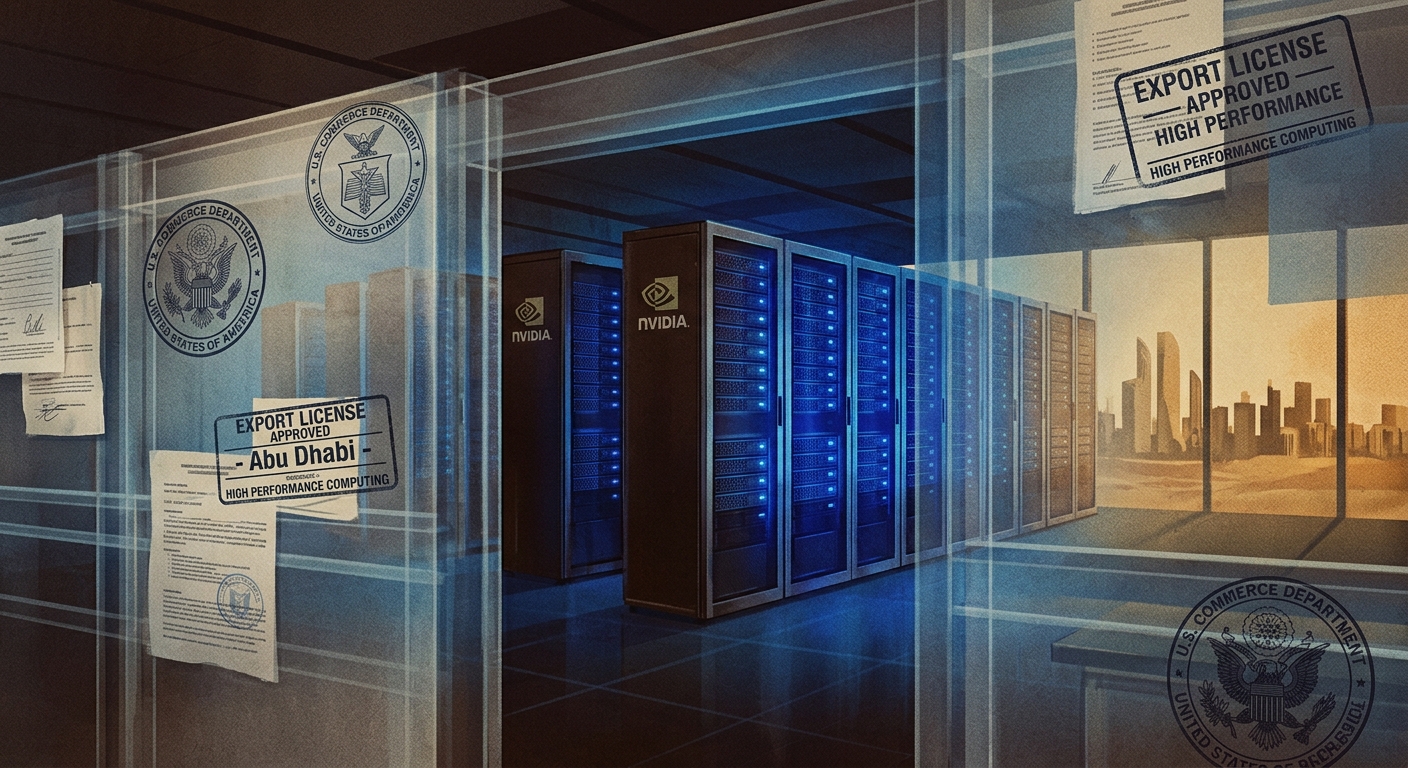
The UAE waited roughly 11 months between the White House greenlight and the first Nvidia H-class chips landing in Abu Dhabi in May 2026 — and it will keep waiting on the next batch because Washington has changed the deals, not the map. Despite a $1.4 trillion investment framework, a 5-gigawatt Abu Dhabi AI campus, and the death of Biden's Diffusion Rule, the Emirates remain classified under Country Groups D:3 and D:4 of the U.S. Export Administration Regulations — the same tier used for chemical, biological and missile-proliferation risk. That country-group status, not the headline politics, is what dictates how fast American compute actually reaches the Gulf. Until it changes, the UAE is a strategic partner in Washington's rhetoric and a case-by-case licensee in its paperwork.
The country-group system is doing the real work
The story broken by AGBI on July 7 is not about a single blocked shipment. It is about the architecture beneath the shipments. The U.S. Bureau of Industry and Security (BIS) sorts destinations for dual-use items into Country Groups A through E; the UAE sits in D:3 (chemical and biological weapons concern) and D:4 (missile-technology concern), while treaty-tier allies like the United Kingdom, Japan and the Netherlands sit in A:5 and A:6 and clear most advanced-chip transactions without a license. That gap was widened, not created, by the AI wave: BIS extended license requirements for ECCN 3A090 advanced computing chips into Country Groups D:1 and D:4 in October 2023, and reaffirmed the structure in a
February 14, 2025 Federal Register rule that tightened performance thresholds and expanded due-diligence attestations.
The practical effect is procedural. Every advanced Nvidia or AMD accelerator destined for the Emirates triggers licensing under §742.6 of the EAR, foreign-direct-product tripwires under §734.9, and, since January 2025, additional attestations from "approved integrated-circuit designers" — a system BIS in April 2026 had to extend by eight months to December 31, 2026 because it could not process the queue. A UAE order is not just a sale; it is a file that has to move through Commerce, State, Defense and Energy, with the White House occasionally on the line.
That's why UAE officials complained privately to visiting American researchers in late 2024 that they were "grouped with our crazy neighbours," as the Center for Strategic and International Studies reported. Reclassifications are rare — Sudan moved from E to D only in 2021 — and, as Thea Kendler of Mayer Brown told AGBI, require agreement among the four dual-use licensing agencies plus, in practice, sign-off from the National Security Council.
The $1.4 trillion deal did not fix the paperwork
Trump's May 2025 Gulf tour was framed in Abu Dhabi as a reset. According to the White House fact sheet, the visit produced $200 billion in fresh deals on top of a 10-year, $1.4 trillion UAE investment framework and a new U.S.-UAE AI Acceleration Partnership. The administration also killed the Biden-era AI Diffusion Rule days before it was to take effect, which the
Council on Foreign Relations called "the most significant proliferation of AI capabilities outside the United States and China to date."
What Trump did not do was move the UAE out of Country Groups D:3 and D:4. That distinction matters. Repealing the Diffusion Rule removed the quantitative caps that would have limited Emirati imports to a set share of global compute; leaving the country-group system in place preserved the qualitative gatekeeping. The Middle East Institute's December 2025 study From Crude to Compute notes that BIS approved only the "first wave" of chip exports under the Acceleration Partnership in October 2025, "the first step of implementation." Nothing about the underlying classification changed.
The result is that the same deal that lets Nvidia ship 35,000 chips to G42 — authorised in November 2025 and delivered in May 2026, according to AGBI — also lets Washington re-tighten the tap without amending any law. Chris McGuire, a former Biden-era State Department official, put it bluntly in a June 2026 Al Jazeera piece: the Commerce Department's clarification that its export controls apply to Chinese-headquartered firms outside China shows BIS is still writing the rules in real time, on top of the existing country-group scaffolding.
G42's compliance dividend — and its limits
The counter-argument in Washington is that the slow lane is working exactly as designed. Under U.S. pressure, G42, chaired by UAE National Security Adviser Sheikh Tahnoun bin Zayed, divested from ByteDance, Huawei and Tencent, stripped an estimated $1.7–$2 billion of Chinese hardware from its data centres, and accepted a first-of-its-kind Intergovernmental Assurance Agreement when Microsoft took a $1.5 billion stake in April 2024. In return, G42 received the November 2025 direct sale of Nvidia chips and became, in the words of one adviser cited by AGBI, the "gold standard" template.
The compliance dividend is real but narrow. As the Atlantic Council documented in May 2026, G42's China divestments were partly absorbed by Lunate, a separate Abu Dhabi holding company under the same chairmanship, which still holds significant Chinese tech exposure. State-owned telecom e& continues to run 5G equipment from Huawei alongside partnerships with Microsoft and AWS. That gives U.S. lawmakers — including the House Select Committee on Strategic Competition with the CCP, which in July 2024 flagged the Microsoft-G42 tie-up as a diversion risk — a permanent reason to keep the UAE in the case-by-case lane.
More importantly, the Stargate UAE campus that anchors the entire deal is not fully cleared. BBC reporting confirms Reuters findings that the multibillion-dollar 5-gigawatt Abu Dhabi cluster "is still awaiting security clearance, as US officials remain concerned about potential Chinese personnel or technology being involved in UAE data centres." That is a D:3/D:4 story dressed up as a Stargate story.
The Anthropic episode showed how thin the guardrails are
The June 2026 order to Anthropic reset expectations about what "export control" now covers. On June 13, the Commerce Department directed Anthropic to disable Claude Fable 5 and Mythos 5 for all foreign nationals worldwide — including its own foreign staff — citing an alleged jailbreak vulnerability. As the BBC reported, the company complied by pulling both models entirely because it could not filter by passport. On July 1, Commerce Secretary Howard Lutnick lifted the order after Anthropic committed to proactive security detection,
Al Jazeera reported.
For UAE customers, the takeaway was not the two-week outage. It was the demonstration that model weights, not just chips, now sit inside the same export-control regime that classifies the Emirates as a proliferation risk. Gulf News picked up the point in a July 6 analysis arguing that UAE companies now need "an AI exit plan before the next model restriction." G42's push into open-weight Arabic models such as Falcon, Jais and K2 Think — described by Carnegie as the UAE's sovereign-AI hedge — starts to look less like national branding and more like insurance.
The non-obvious winner: India
The most interesting second-order effect of keeping the UAE in the slow lane is showing up in New Delhi. In February 2026, on the sidelines of the AI Impact Summit, G42, Cerebras and the Mohamed Bin Zayed University of Artificial Intelligence signed a deal to build an 8-exaflop AI supercomputer in India, formalised during Prime Minister Narendra Modi's May 2026 visit to Abu Dhabi. Carnegie called the arrangement a template for "managed interdependence": Emirati capital, American silicon, Indian data-localisation rules.
The logic is straightforward. If the UAE's own domestic build-out is bottlenecked by BIS licensing timelines and lingering Stargate security clearances, Emirati capital and Emirati compute expertise export more easily than Emirati data centres import. India, which sits in Country Group B and enjoys friendlier terms for many controlled items, becomes a downstream deployment site for the Emirati AI stack — and for U.S. hardware that could not, or would not, be routed directly to Abu Dhabi at scale. The UAE is quietly becoming an AI integrator for the Global South while its own D:3/D:4 status blocks it from being the region's compute capital.
The BBC captured the strategic bargain succinctly: "The US gains allies in its quest to outflank the Chinese… the Gulf nations get a powerful partner in their search for a replacement for oil revenues." What is less discussed is the concentration risk cutting the other way. A June 2026
Foreign Affairs essay by supply-chain analysts argued that the Gulf AI build-out — accelerated after the February 2026 Iran conflict shook regional infrastructure — was designed for peacetime competition with China, not for defending physical data-centre assets from missile and drone strikes. The UAE's slow-lane status may end up being the least of its problems if Iran's proxies continue to treat Emirati compute as a target.
Diplomat View
The UAE's core problem is that Washington's chip diplomacy runs on two clocks. The political clock, set by the White House, is fast: Trump's team wants a compute alliance with Gulf money against a Chinese AI stack, and it wants it before the 2028 election cycle. The regulatory clock, set by BIS and the interagency licensing committee, is deliberately slow — and it is the clock that determines whether GPUs actually land on Emirati concrete. As long as the UAE remains in D:3 and D:4, every meaningful shipment will be a bespoke negotiation, and every bespoke negotiation will be reopened whenever a congressional letter, a Huawei sighting at GITEX, or a rumoured Chinese-linked jailbreak lands on the Commerce Secretary's desk.
The forecast: the UAE will not be reclassified above D:3/D:4 in 2026. The interagency process is too slow, the House Select Committee scrutiny is too active, and G42's Lunate-shaped ambiguity gives skeptics a permanent argument. What Abu Dhabi will get instead is more "gold-standard" bespoke deals — the Microsoft-G42 template extended to Cerebras, Qualcomm and Oracle — layered on top of an unchanged legal map. This forecast changes if two things happen at once: BIS quietly grants G42 a Universal or National Validated End User–style authorisation that de-links its shipments from country-group defaults, and the Stargate UAE campus receives full security clearance. Absent both, the "slow lane" is the destination, not a waypoint.
What to watch next
- Sept. 2026: expected next tranche of Nvidia Blackwell approvals for G42 and Humain, and whether Commerce continues the November 2025 conditions template or tightens them.
- Dec. 31, 2026: extended deadline in BIS's approved-IC-designer regime — the operational choke point for every advanced-chip transaction to Group D destinations.
- Q1 2027: Stargate UAE security-clearance decision on the 5GW Abu Dhabi campus, which will signal whether the U.S.-UAE AI Acceleration Partnership is delivering physical infrastructure or only paperwork.
The Bottom Line
The UAE's problem is not the Trump administration's willingness to sell it chips — that has been settled since May 2025. The problem is that Washington has never redrawn the map that says who counts as a trusted destination, and until D:3 and D:4 come off the Emirates, every Gulf AI deal will move at the speed of an interagency licensing memo. The country that benefits from that slow lane, quietly, is India — where Emirati capital and American compute can meet without an EAR file in the middle.
Discover more
India
Congress Accuses Modi of Stalling Women's Law
Congress accuses Modi of stalling women's reservation law by linking it to delimitation, revealing a deeper electoral strategy.

US Politics
House Ethics Committee Pushes Sexual Miscond.
The House Ethics Committee has shifted responsibility for sexual harassment settlement records to the Office of Congressional Workplace Rights, complicating disclosure efforts.

India
Congress Advocates 33% Women’s Quota
Congress calls for a 33% women's reservation in the existing 543 Lok Sabha seats, countering Modi's plan to expand the house to 850 seats.

Economics
Fed's Amex AML order puts correspondent banking on notice
Federal Reserve's Amex AML order requires board-level controls and a 90-day plan; OCC fined the bank $350 million over enterprise-wide deficiencies.