US DFC Invests in Madagascar Rare Earths
US DFC commits $4.84M to Madagascar rare earths project
Model Diplomat5 min readAfrica
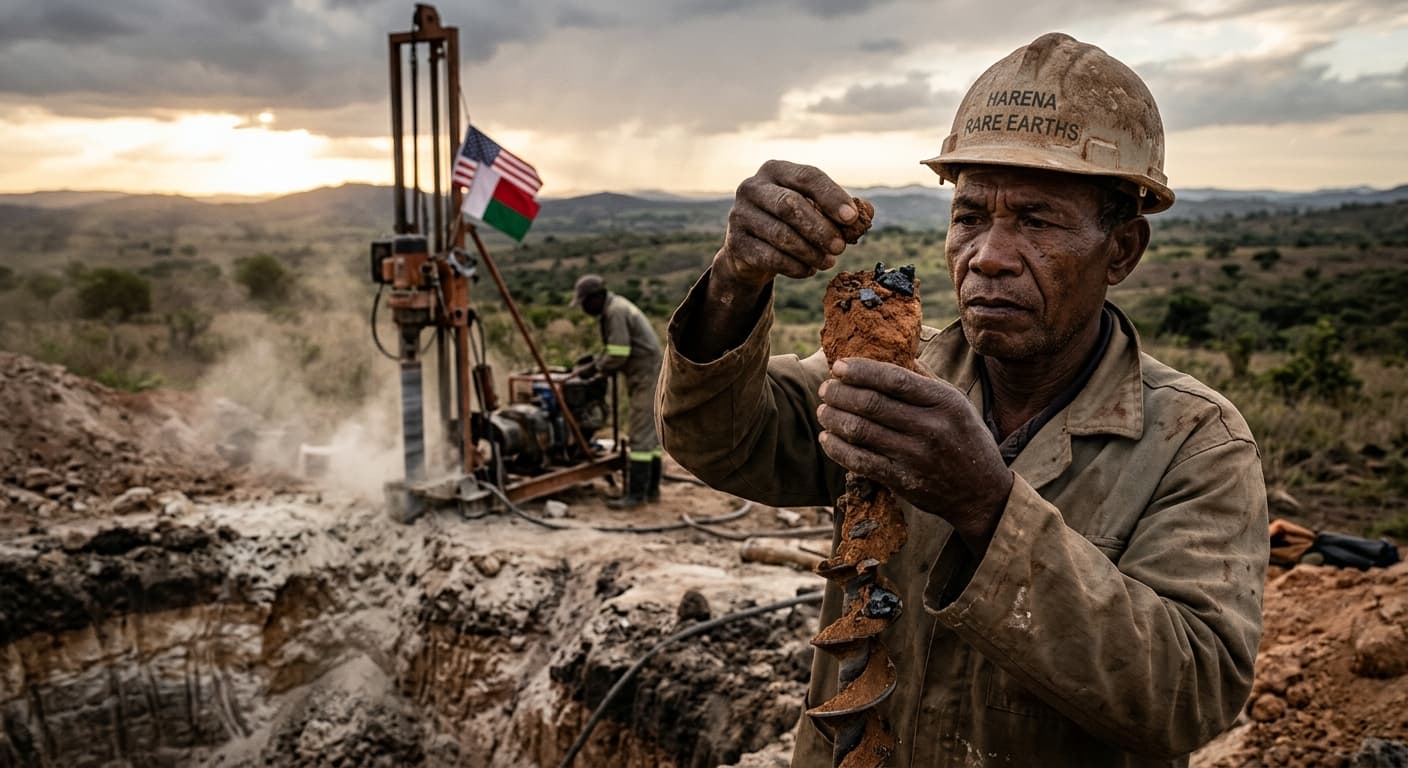
Harena Rare Earths Soars 25% on First US Government Commitment to Madagascar's Strategic Deposit
July 22, 2026 — The DFC's $4.84 million seed investment in Ampasindava is not about the money. It is about Washington placing a flag on one of the largest ionic clay rare earth deposits outside China, at precisely the moment Beijing is weaponizing its near-monopoly on heavy rare earths.
On July 22, 2026, shares of Harena Rare Earths Plc jumped 24.94% to 2.41p after the UK-listed microcap disclosed that the US International Development Finance Corporation had committed up to $4.84 million, according to Proactive Investors, to accelerate its Ampasindava rare earths project in northern Madagascar. The dollar figure is modest by the standards of Washington's critical minerals scramble. The same DFC recently deployed $600 million into the Orion Critical Minerals Consortium and $553 million into the Lobito Atlantic Railway, as documented by
Brookings. But the number is not what makes the transaction worth reading.
The DFC deal marks the first direct US government financial commitment to Ampasindava, and the agency has already indicated it wants a much larger role when the project reaches a construction decision. In one sentence: the United States has just placed its flag on a deposit that holds 606,000 tonnes of total rare earth oxides, including 131,100 tonnes of magnet rare earths — dysprosium, terbium, neodymium, and praseodymium — the elements that make everything from F-35 fighter jets to offshore wind turbines function.
The timing is not coincidental. In January 2026, Beijing restricted heavy rare earth exports to Japan in what the Center for Strategic and International Studies assessed as a coercive signal tied to Taiwan Strait contingency planning. China controls roughly 98% of global heavy rare earth mining, 97% of oxide separation, and 95% of metal refining, according to the
IMF's April 2026 World Economic Outlook commodity special feature. Ampasindava is one of the few deposits outside that monopoly with the mineral profile and scale to matter. The DFC just wrote the down payment on an asset that, if developed, would mark the most significant ex-China source of ionic clay-hosted heavy rare earths on the planet.
The deal: an option on something much larger
The DFC agreement, reported first by Proactive Investors, funds three workstreams: permitting, environmental and social impact studies, and construction of a proof-of-concept pilot plant. Success hinges on the pilot plant, which will validate whether the project's ammonium-sulphate leaching process works under ambient tropical conditions at the mine site in Antsiranana province. Success here de-risks the entire project ahead of a definitive feasibility study and final investment decision, targeted for the fourth quarter of 2027, according to Harena's
pre-feasibility study released in January 2026.
Executive Chairman Ivan Murphy called the DFC agreement "a real turning point" and added a sentence that investors should read twice: the DFC "has also indicated its interest in playing a much larger role in financing the project as it advances towards a construction decision." That is the option embedded within the option. The $4.84 million is seed capital designed to position the agency for a far larger commitment at the construction stage — potentially in the hundreds of millions, consistent with the DFC's pattern of scaling from initial engagement to project finance on strategically aligned mineral assets.
The DFC's capacity to do so has expanded dramatically. Its January 2026 reauthorization under the DFC Modernization and Reauthorization Act raised the agency's maximum contingent liability from $60 billion to $205 billion, according to the Congressional Research Service, and expanded its mandate to allow investments in upper-middle-income countries. The agency was explicitly designed as a counterweight to Chinese development finance. Founded during President Trump's first term in 2019, the DFC states on its website that its mission includes "countering China's presence in strategic regions," as reported by the
BBC. The Ampasindava commitment is that mission operating exactly as designed.
SP Angel, Harena's broker, initiated research coverage with a buy recommendation and a 9.4p target price — nearly four times the current share price. The firm estimated Ampasindava's post-tax net present value at approximately US$200 million under base-case pricing assumptions, rising to US$510 million under spot prices, according to the company's March 2026 announcement. At the current market capitalization, SP Angel calculated that Harena trades at roughly 0.1 times project net asset value.
The geology: what Ampasindava actually holds
The Ampasindava deposit is an ionic adsorption clay — the same type of rare earth deposit that powers China's dominance in heavy rare earths, particularly the southern Chinese deposits across Jiangxi, Guangdong, and Fujian provinces. Ionic clay deposits form when granitic rocks weather under tropical conditions over millions of years, leaving rare earth elements loosely adsorbed onto clay mineral surfaces. This makes them amenable to low-cost, low-energy extraction using simple ammonium-sulphate leaching — a process fundamentally different from the capital-intensive, high-temperature cracking required for hard-rock deposits like MP Materials' Mountain Pass mine in California.
Ampasindava is vast: a JORC 2012-compliant resource of 698.5 million tonnes grading 868 parts per million TREO, stretching across a 20-kilometer peninsula in northern Madagascar. The contained resource breaks down as 606,000 tonnes of total rare earth oxides, of which 131,100 tonnes are magnet rare earth oxides — neodymium, praseodymium, dysprosium, and terbium. The magnet elements represent 22% of the contained TREO, a proportion that compares favorably with the southern Chinese ionic clay deposits that have fed global magnet supply chains for three decades.
The pre-feasibility study models production at 2.5 million tonnes per annum initially, ramping to 5 million tonnes by year five, to produce approximately 4,000 tonnes of TREO annually as a mixed rare earth carbonate concentrate grading 60% TREO. Of that output, roughly 1,700 tonnes per year would be magnet rare earth oxides — the neodymium, praseodymium, dysprosium, and terbium needed for NdFeB permanent magnets. Annual revenue at full production is estimated at approximately US$250 million. Pre-production capital expenditure is estimated at US$142 million — a modest entry fee for a project that, if built, would break Beijing's heavy rare earth monopoly.
| Classification | Tonnage (Mt) | TREO (ppm) | MREO/TREO Ratio | Contained TREO (t) | Contained MREO (t) |
|---|---|---|---|---|---|
| Measured | 42.5 | 958 | 23% | 40,700 | 9,400 |
| Indicated | 184.0 | 842 | 21% | 154,800 | 32,700 |
| Measured + Indicated | 226.5 | 863 | 22% | 195,500 | 42,100 |
| Inferred | 472.0 | 870 | 22% | 410,500 | 89,000 |
| Total | 698.5 | 868 | 22% | 606,000 | 131,100 |
Source: Harena Rare Earths PFS, JORC 2012, January 2026, at 500 ppm TREO cut-off. MREO = Pr₂O₃ + Nd₂O₃ + Tb₂O₃ + Dy₂O₃. *
Discover more

US Politics
Next Generation Republicans
A leaked survey shows 39% of Republicans under 30 do not identify as MAGA, revealing a split in the GOP's future leadership.

India
Women’s Reservation in India
India's 33% women's reservation law is enacted but won't take effect until after 2029 due to political setbacks and census delays.

US Politics
House Ethics Committee Pushes Sexual Miscond.
The House Ethics Committee has shifted responsibility for sexual harassment settlement records to the Office of Congressional Workplace Rights, complicating disclosure efforts.

Conflict & Security
Drone Warfare Killing Aid Workers at Unprec
Over 1,000 humanitarian workers killed in three years as cheap armed drones collapse legal protections. Gaza, Sudan, Ukraine, and DRC see deliberate targeting of aid convoys and hospitals with zero prosecutions.

