US and Zambia
Zambia defies US demands on health funding and minerals access.
Model Diplomat8 min readAfrica
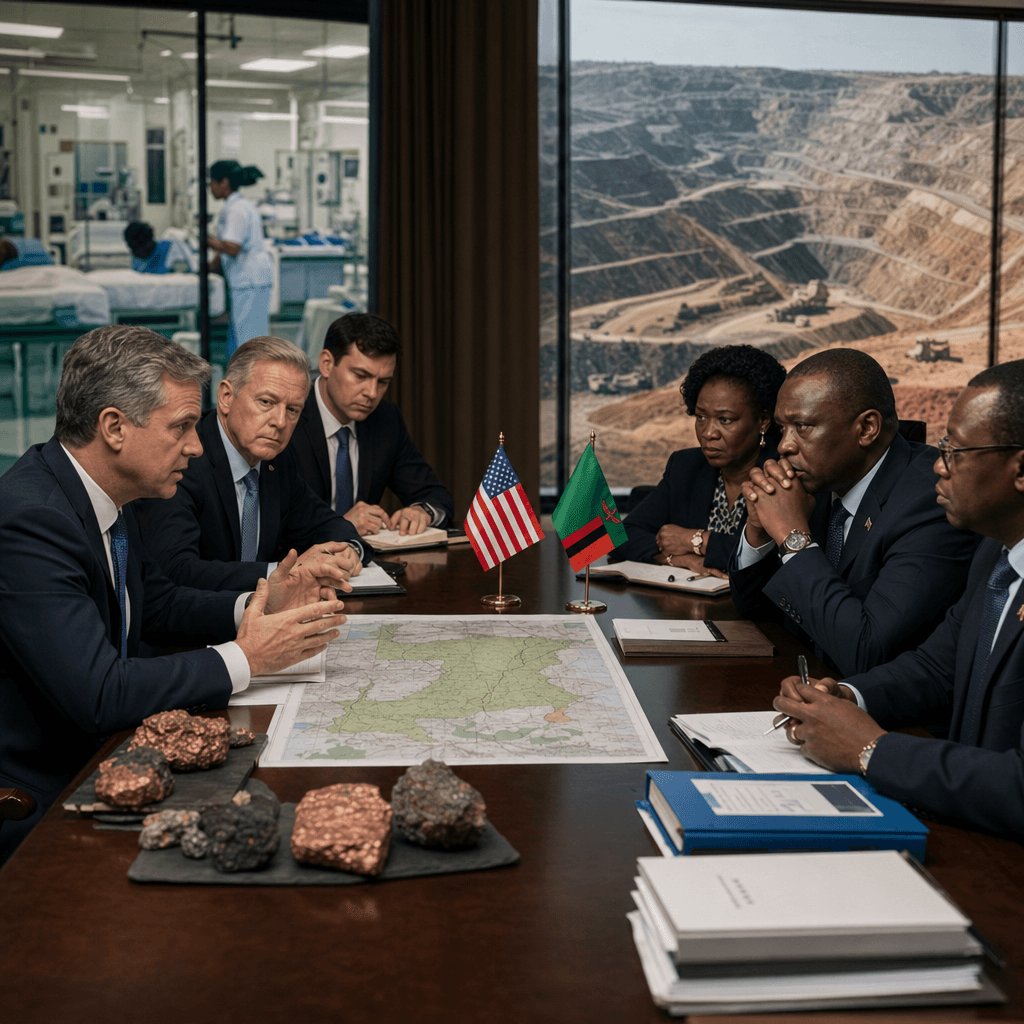
US-Zambia Standoff: Health Aid, Copper, and Trump's Leverage
Zambia publicly rejected US demands to tie $2 billion in health funding to preferential minerals access — the first African "no" to Trump's health-for-minerals playbook.
On May 4, 2026, Zambian Foreign Minister Mulambo Haimbe told parliament that Lusaka would not grant American investors preferential treatment in its mining sector, and named the reason: Washington had insisted that a $2 billion health package be conditional on a minerals deal. The declaration is the first public rejection by an African government of the Trump administration's "health-for-minerals" template — and it lands at the exact moment US private capital, led by KoBold Metals, is quietly breaking ground on Zambia's biggest copper mine anyway. Lusaka is calling the bluff because the leverage has already migrated from the State Department to Silicon Valley.
That is the story worth telling: not that a small African economy defied the world's biggest one, but that it could afford to.
What Zambia actually said
Haimbe's language, delivered in a statement carried by Al Jazeera, was surgical. "Zambians must have a say on how her critical minerals are used," he said, "and no one strategic partner is to be treated preferentially to others." He confirmed that talks had stalled because the United States tied a five-year, $2 billion health support agreement to a separate minerals pact — and to a 10-year, one-way health-data-sharing clause that officials called "unacceptable." The
Globe and Mail first reported the linkage in detail.
The outgoing US ambassador, Michael Gonzales, went the other way. In a valedictory speech he accused Zambia of "unmitigated petty corruption" and said American officials could scarcely get meetings, per the same Globe and Mail account. His public tears a year earlier, when he announced $50 million in medical-aid cuts over the "systematic" theft of donated drugs found in more than 2,000 pharmacies across Zambia, had made him a folk hero to some Zambians. That year-long US embassy investigation — cited by the
BBC — found that 95% of the pharmacies visited stocked stolen goods, and nearly half were selling drugs the US itself had donated. The second act — blaming Lusaka for a stalled minerals deal — turned the same script into a diplomatic incident. According to the
BBC, Haimbe formally warned envoys against "interfering" through the press.
Why Lusaka can say no
Two years ago, this refusal would have been unthinkable. The United States accounted for about one-third of Zambia's public-health spending, according to a US embassy statement cited by the BBC, and PEPFAR alone underwrote antiretroviral therapy for roughly 1.2 million Zambians, the Stiftung Wissenschaft und Politik notes in a
March 2025 briefing. Cutting that off is not an idle threat; the same analysis found that some 23,000 Zambians lost aid-sector jobs within weeks of Trump's January 2025 aid pause, and reported the suicide of a 31-year-old PEPFAR facilitator in Katete after his project was terminated.
But the leverage cuts both ways — and Trump has already spent his. The health cuts arrived before any deal was signed, which turned the "aid" side of the transaction into a sunk cost. What is left on offer, at $2 billion over five years, represents roughly a 40% cut on the historical baseline, ISS Africa calculates across the roughly 24 similar MOUs Washington has signed under the America First Global Health Strategy. Zambia's economy, meanwhile, grew 4% in 2024 despite a historic drought and is forecast to reach over 6% in 2026 on the back of a copper rebound, per the
World Bank. President Hakainde Hichilema summed up the mood in March 2025 when he said Trump had "slapped us on both cheeks" and that it was time for
Zambia to fund its own medicines, per the
BBC.
The primary document that anchors the Zambian side of this is Haimbe's own June 27, 2025 ministerial statement to parliament, in which he laid out how Lusaka would engage Washington through "diplomatic channels" rather than press conferences — including on a proposed US travel-ban listing tied to passport-security concerns, per the National Assembly of Zambia. That document also confirms that Haimbe personally met the US ambassador on June 24, 2025 and agreed to a "regular consultative mechanism" and enhanced data-sharing on immigration overstayers — but only within a defined 60-day diplomatic window. Read alongside his May 2026 rebuke, the pattern is deliberate: engage quietly, refuse publicly only when Washington escalates first.
The Silicon Valley bypass
Here is the twist Washington's diplomats keep missing. On the same week Haimbe was rejecting preferential access, KoBold Metals — a US firm backed by Jeff Bezos and Bill Gates and valued at roughly $2.96 billion, according to the Financial Times — broke ground on the $3 billion Mingomba project outside Chililabombwe, per the
Globe and Mail. Mingomba is slated to become Zambia's biggest copper mine. It got there with no MOU, no data-sharing rider, and no PEPFAR quid pro quo. It got there because Zambia rewrote its mining tax code in 2022 — ending double taxation and restoring VAT refunds,
Brookings has documented — and because KoBold's AI-driven geology, first funded with a $150 million commitment at the December 2022 US-Africa Leaders Summit, found the deposit ahead of state-owned Chinese rivals.
That undercuts the entire premise of the State Department's coercion strategy. A leaked internal memo prepared for Secretary of State Marco Rubio, reported by The New York Times and summarised by Al Jazeera, argued Washington could "secure our priorities by demonstrating willingness to publicly take support away from Zambia on a massive scale." But US private capital was already inside the fence line. The Observer Research Foundation's
analysis notes that the draft Zambia MOU also sought to repurpose an existing Millennium Challenge Corporation agricultural grant to force mining-sector regulatory reforms — a triple-conditional structure that produced short-term concessions on mining data early in 2025, then hardened into political refusal once Zambian officials saw the shape of the whole package.
The historical parallel matters here. In 2019, Zambia's previous administration expelled the openly pro-gay-rights US ambassador Daniel Foote and endured years of frosty relations, per the BBC. Under Hichilema, ties warmed to almost $600 million a year in bilateral assistance, the
SWP briefing shows. Trump has now spent that goodwill in eighteen months — and Zambia's response is more coordinated than it was against Foote, because the counterweights have grown.
Who benefits from the "no"
Not China, at least not directly. Beijing already dominates: Chinese Premier Li Qiang signed a $1.4 billion TAZARA rail refurbishment in late 2025, and Chinese and Middle Eastern firms remain "major players" in Zambian mining, per the Globe and Mail. Canadian companies benefit most concretely.
First Quantum Minerals and Barrick Mining together produce more than half of Zambia's copper, and both have expansion projects — Kansanshi, the Enterprise nickel mine, and a nearly $2 billion Lumwana brownfield expansion that lifts output to about 240,000 tonnes a year and extends the mine's life to 2060, per
CSIS. All of that presupposes non-preferential access. The EU, mobilising $2.3 billion via the Global Gateway for the Lobito Corridor, is the second-order winner: its "governance-first" pitch,
ISS Africa argues, looks measurably more credible when Washington tries and fails to strong-arm the same government.
The losers are more specific than the "African patient." The Chatham House analysis identifies them as the roughly 1.3 million Zambians on US-funded HIV treatment whom Ambassador Gonzales acknowledged in an
April 2026 Al Jazeera briefing were being used as the bargaining unit. NPR's on-the-ground reporting from Zambia's Copperbelt found dozens of US-funded HIV clinics shuttered by January 2025 stop-work orders, with patients like 42-year-old Mary Mayongana rationing pills two-and-a-half months after their clinics closed, per
NPR. Zimbabwe already walked away from a similar MOU after Harare's information secretary Nick Mangwana called it exploitative,
ISS Africa reports. Kenya's High Court froze another over pathogen-data clauses. If Lusaka joins that list, roughly a quarter of the AFGHS's 20 African MOUs are effectively in dispute, and the strategy stops resembling a template.
The second-order signal
For Diplomat readers watching Global Politics, the deeper story is what happens to US influence when the private sector out-runs the State Department. KoBold is not an outlier. BHP has partnered with the firm to prospect globally; Equinor has taken a stake; the
Financial Times chronicles its expansion into the DRC on Zambia's northern border. The
Economist has profiled the American mining rush into Congo that Zambia sits astride. In every case, US commercial interests are secured by tax stability, geology, and AI — not by health-aid coercion. The State Department's transactional model, in other words, is trying to charge for access that the market is already delivering.
The Observer Research Foundation's broader review puts the aggregate AFGHS package at $20.4 billion in new funding, with $7.7 billion in co-investment demanded from recipient countries — a $340 million ask in Zambia's case,
Al Jazeera reports. That co-financing requirement is the ceiling on how far poor states can be pushed: at some point the arithmetic of accepting the deal looks worse than the arithmetic of walking away. Zambia has done the math.
What to watch next
- Ambassador succession. Gonzales is departing; his replacement's opening posture will signal whether Washington doubles down on Rubio's leaked "take support away" doctrine or pivots to KoBold-style commercial engagement.
- January 2026 aid cliff. The $50 million medical-aid cut takes effect at year-end 2025, per the
BBC; Zambia's ability to backfill malaria, TB and HIV supply chains will determine whether public opinion turns against Hichilema's defiance.
- Mingomba milestones. KoBold's next permitting decisions and any US Development Finance Corporation co-financing will show whether the private-capital bypass hardens into a formal alternative track.
- The Lobito–TAZARA arithmetic. Zambian copper output is projected to rise to about 1 million tonnes in 2026,
CSIS estimates. Which corridor moves the marginal tonne — EU-backed Lobito west, Chinese-refurbished TAZARA east — is the concrete measure of whose influence is compounding.
Diplomat View
The evidence points to a specific call: Trump's health-for-minerals doctrine is already a spent force in Zambia, and the market has moved faster than State could re-arm. Expect the next US administration — Republican or Democratic — to quietly delink health assistance from mineral clauses and route commercial leverage through the DFC and firms like KoBold, because the current design has cost Washington a friendly government's trust without extracting a signed MOU. The forecast changes if two things happen: if a successor US ambassador secures a face-saving revised MOU by Q4 2026 that separates the two tracks, or if Zambian copper output stalls below 900,000 tonnes and forces Lusaka back to the table for bridge financing. Absent those, the "no" of May 4, 2026 will be remembered as the moment Africa's mineral-rich middle powers learned they could refuse Washington's price and keep the American investors anyway.
The Bottom Line
Zambia's public rejection of the US health-for-minerals package is not a diplomatic tantrum — it is a rational read of a leverage map that has shifted decisively. With US private capital already committed to Mingomba, Canadian majors producing most of the country's copper, and the EU and China courting Lusaka on parallel corridors, Washington's stick has lost its bite before its carrot could be delivered. If the Trump administration wants African critical minerals, it will have to buy them on commercial terms — which is what its own investors are already doing.
Discover more

International Relations
Pakistan's Key Role in US-Israel-Iran Meddle
Pakistan is seeking to mediate the US-Israel-Iran conflict, balancing high-stakes diplomacy against severe economic pressures and steep regional challenges.

Global Politics
US Seizes Iranian Ship, Tensions Surge
The US seizure of the Iranian ship Touska highlights a shift in control over the Strait of Hormuz, favoring Iran's strategic position.

Economics
Fed's Amex AML order puts correspondent banking on notice
Federal Reserve's Amex AML order requires board-level controls and a 90-day plan; OCC fined the bank $350 million over enterprise-wide deficiencies.
Conflict & Security
Guatemala: El Niño 2026–27 becomes regional security test
UNICEF: 25.8M children face El Niño risks in Latin America; Guatemala maps 188 municipalities for drought and food insecurity amid regional security test.