UN Warns of Genocide in El Obeid, Sudan
Urgent call to prevent atrocities in Sudan's El Obeid
Model Diplomat7 min readAfrica
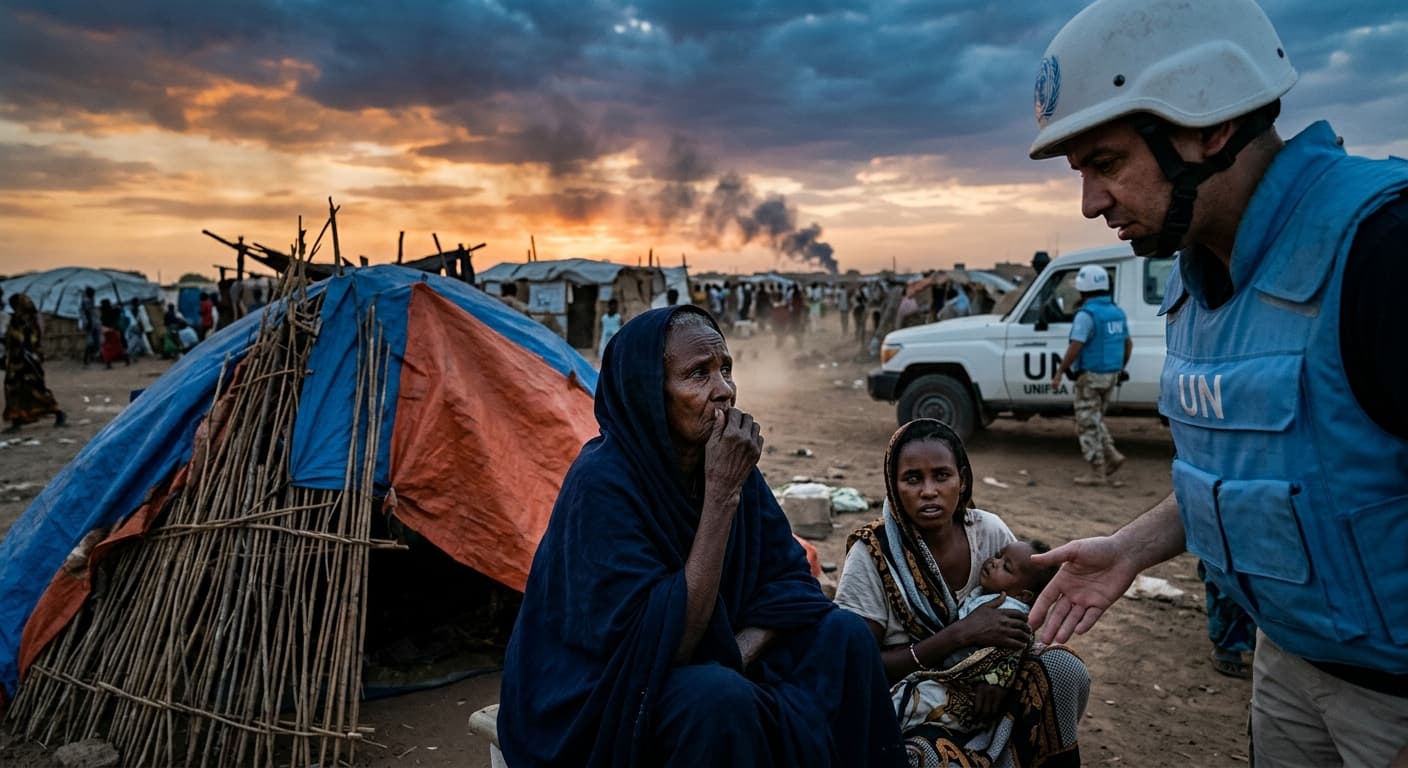
El Obeid on the brink: UN issues a genocide warning Sudan cannot afford to ignore
UN Fact-Finding Mission warns El Obeid faces the same encirclement playbook the RSF used in El Fasher, where 6,000 died in three days.
The Rapid Support Forces are running the El Fasher siege playbook again — this time around El Obeid, a city of half a million people plus roughly 100,000 displaced — and the UN's Independent International Fact-Finding Mission said so plainly on July 8, 2026. The Mission's message is not that atrocities may happen; it is that the operational pattern that produced a genocidal massacre eight months ago is already visible on the ground, and the international community has a closing window to act on evidence it did not have last time. That reframes the story: this is no longer about early warning — it is about whether Abu Dhabi, Washington, Cairo, and Ankara choose to use their leverage before the assault, or perform outrage after.
"El Obeid must not become the next crime scene," mission expert Mona Rishmawi said in a statement carried by UN News, announcing that the Human Rights Council had, two days earlier, adopted by consensus a resolution directing her mission to open an urgent inquiry into violations in and around the city.
What the Council actually did — and why "consensus" matters
The Human Rights Council's July 6 resolution, adopted without a vote, tasks the Fact-Finding Mission with investigating alleged violations of international human rights and humanitarian law "in and around" El Obeid, and with reporting to both the Council and the UN General Assembly in the coming months. The UN Spokesperson's office confirmed the resolution in its July 6 press briefing, which also disclosed that Under-Secretary-General for Humanitarian Affairs Tom Fletcher had spoken by phone the same day with RSF commander Mohamed Hamdan Dagalo, known as Hemedti, about the "escalating hostilities."
Consensus is the operative word. On El Fasher in November 2025, the equivalent resolution S-38/1 passed with a divided Council; on El Obeid, not one state — including RSF backers — was willing to be seen blocking a preventive inquiry. That is diplomatic movement, but it is also cheap. The Council has no enforcement power. Its leverage is documentary: producing an evidentiary record admissible to the International Criminal Court, whose Darfur mandate under UN Security Council Resolution 1593 (2005) does not automatically extend to Kordofan.
What the Mission actually found — the El Fasher template
The Fact-Finding Mission's February 19, 2026 report, A/HRC/61/77 — "Hallmarks of Genocide in El-Fasher" — is the document that makes this week's warning specific rather than rhetorical. The Mission assessed that RSF forces in El Fasher had, in October 2025, carried out door-to-door executions, identity-based targeting of non-Arab communities, and systematic sexual violence, with more than 6,000 killed in three days.
Chair Mohamed Chande Othman was blunt on July 8: "The patterns we documented in El Fasher — including encirclement, attacks on civilian infrastructure, restrictions on humanitarian access, and widespread abuses against civilians — serve as a stark warning," according to UN News. All four of those indicators are already documented around El Obeid.
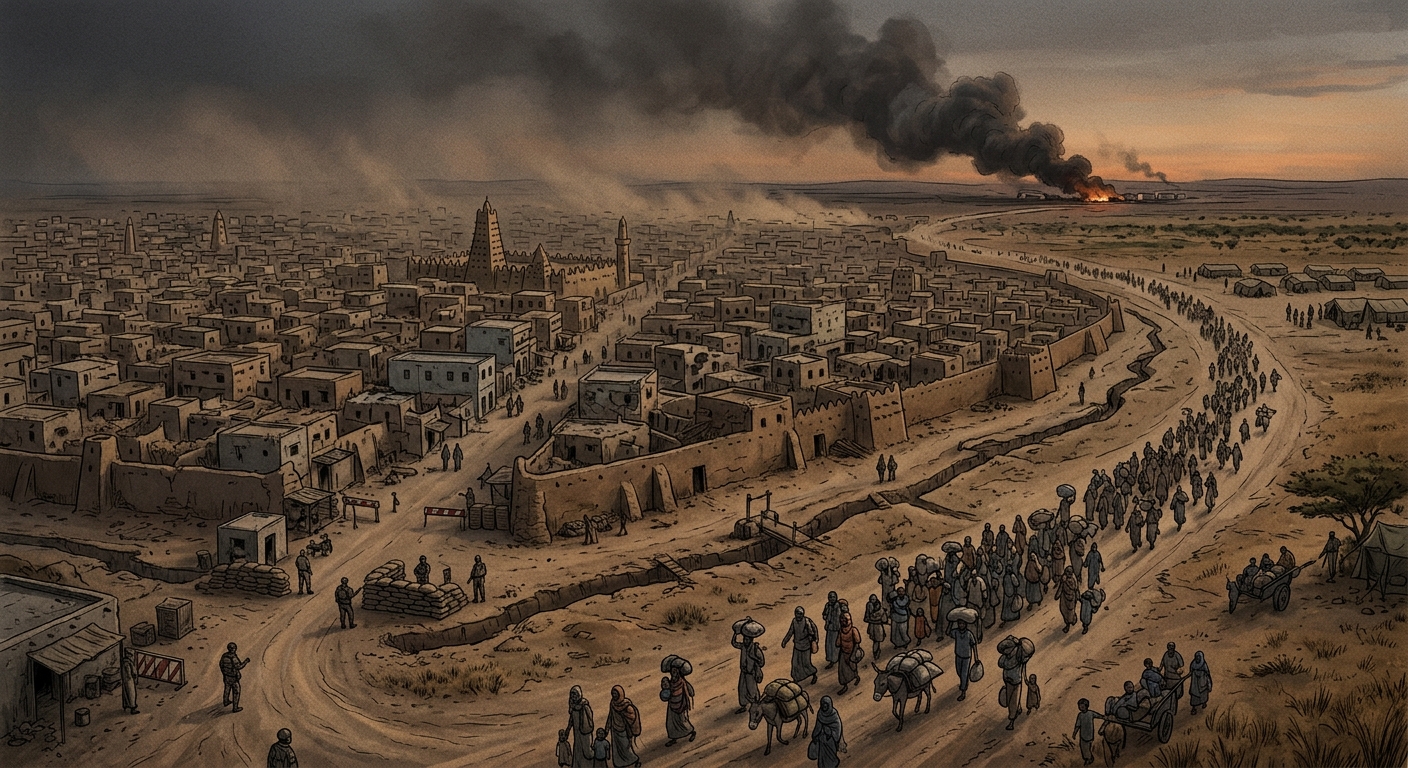
Encirclement: the Armed Conflict Location & Event Data Project (Acled) told the BBC that 27 drone strikes hit El Obeid in June — the highest monthly total of the war — and that the RSF has encircled the city from the north, west and south, leaving only a single army-held supply corridor east. Infrastructure attacks: UN human rights chief Volker Türk told the Council on July 3 that 15 verified drone strikes killed at least 45 civilians and injured 41 between June 6 and 28, hitting the main electrical substation, fuel depots and residential neighbourhoods, according to
Al Jazeera. Humanitarian access restrictions: Save the Children reported that 5,500 children were among more than 11,000 people newly displaced in the two weeks to July 6, with a confirmed cholera outbreak now running through the camps,
per Al Jazeera.
Why El Obeid — and why now
El Obeid is not simply the next city in line; it is the hinge of the Kordofan front. The city sits 550 km southwest of Khartoum on the primary tarmac road linking the capital to RSF-held Darfur. It hosts the Sudanese Armed Forces' 5th Infantry Division, one of the largest bases in central Sudan, and controls the water and fuel logistics for the wider region. Whoever holds it dictates whether the RSF can consolidate a de facto western state — the "parallel governing authority" the UN Security Council explicitly rejected in its June 20 statement — or whether the SAF can push back into Darfur.
That is why the RSF is willing to accept the diplomatic cost of another siege. Yale's Humanitarian Research Lab director Nathaniel Raymond told the BBC that around 700 temporary structures had gone up in El Obeid's displacement camps in a single month. "Civilians, including internally displaced people, will start drinking water that could be contaminated," he warned, if the power station and fuel depots go dark. Acled analyst Nohad Eltayeb assessed on June 30 that while an RSF assault is "very likely," the army's eastern supply corridor and militia reinforcements make a full takeover "improbable" — pointing toward a prolonged siege rather than a rapid fall, and a slower-motion atrocity than El Fasher.
That is the scenario UN investigators are trying to interdict.
The leverage question — where the pressure has to land
The Fact-Finding Mission's inquiry is a documentation instrument, not a deterrent. Deterrence in Sudan runs through the RSF's backers, and the evidence base on that has hardened considerably in the past 18 months.
The UN Panel of Experts on Sudan and successive Amnesty International investigations have documented weapons transfers to the RSF via the United Arab Emirates in violation of the Darfur arms embargo. In May 2025, Amnesty identified newly manufactured Chinese Norinco GB50A guided bombs and AH-4 howitzers in RSF use, concluding they had "almost certainly" been re-exported by the UAE. Germany's SWP institute, in
its 2026 assessment, tallied 458 heavy-transport flights from Emirati military airports or the Bosaso hub to eastern Libya between October 2024 and end-2025, of which 239 went to Kufra — a documented staging point for RSF resupply. Abu Dhabi denies the transfers and has publicly called for the Darfur embargo to be extended to the whole of Sudan.
Washington's own tools are already on the table. On January 7, 2025, the US Treasury designated Hemedti personally under Executive Order 14098, and on
December 9, 2025, OFAC sanctioned a transnational network recruiting Colombian mercenaries to fight for the RSF via UAE-based entities. On
February 19, 2026 — the same day the "Hallmarks of Genocide" report was released — Treasury added two more RSF field commanders to the SDN list, including Elfateh Abdullah Idris, known as "Abu Lulu." Those are documentary constraints, not operational ones. The RSF has kept fighting.
The obvious escalation instrument, extending the UN arms embargo from Darfur to all of Sudan, has been blocked in the Security Council. Human Rights Watch has urged the Council to do so since 2024; the UAE's public position is that it agrees, but Russia and China have not moved. Absent that, the Fact-Finding Mission's inquiry is the highest-order accountability lever the multilateral system has left before the ICC picks up cases years from now.
Diplomat View
The forecast: El Obeid does not fall this month, but it deteriorates into a chronic siege — a slow El Fasher rather than a fast one — and the international response repeats. The Coalition for Atrocity Prevention and Justice for Sudan, assembled by Norway and joined by 28 other states on June 18, has produced the diplomatic scaffolding — a Council resolution, a red alert from Türk, a Secretary-General statement warning "we must not allow the horrors of El Fasher to be repeated in El Obeid." What it has not produced is a coercive instrument that changes the RSF's cost calculation before the ground offensive. The one variable that would revise this forecast is an explicit public break by the UAE from the RSF supply chain, a step Abu Dhabi has verbally offered but never operationally taken. If that happens — the September HRC session and any US–UAE readout after Trump administration envoy contacts are the next tripwires — the RSF's drone campaign against El Obeid's infrastructure loses its Chinese munitions pipeline within weeks, and a negotiated pause becomes plausible. If it does not, the Fact-Finding Mission will be writing another "Hallmarks" report by early 2027 — this time on Kordofan. The falsifiable call: absent UAE action, El Obeid's power and water systems collapse within 90 days.
What to watch
- September–October 2026: The Fact-Finding Mission's comprehensive report to the HRC's 63rd session and its presentation to the UN General Assembly's 81st session. These are the first opportunities to name individuals against whom there are "reasonable grounds" to believe responsibility exists — the trigger for ICC referral packages.
- UN Security Council: Any move to extend or renew the Darfur arms embargo. The current 1591 sanctions regime is up for annual renewal; a push to expand it Sudan-wide is the single most consequential vote on this file.
- US Treasury: Further OFAC designations targeting UAE-based intermediaries. The
December 9, 2025 network sanctions established the template; secondary sanctions on Emirati logistics entities would be the escalation.
- On the ground: The status of the El Obeid–Rabak highway, the army's remaining eastern supply corridor. If the RSF cuts it with drone strikes, the siege becomes total and the atrocity clock accelerates.
The bottom line: El Obeid is the first city where the international community has both the evidentiary template — an official UN finding of genocidal indicators in El Fasher — and the warning time to act before mass killing begins. Whether it does will be measured not in resolutions but in whether the RSF's external supply chain, principally through the UAE, is meaningfully interrupted in the next 60 days. If it is not, the next UN inquiry will be a post-mortem.
Discover more

US Politics
House Ethics Committee Pushes Sexual Miscond.
The House Ethics Committee has shifted responsibility for sexual harassment settlement records to the Office of Congressional Workplace Rights, complicating disclosure efforts.

India
Congress Accuses Modi of Stalling Women's Law
Congress accuses Modi of stalling women's reservation law by linking it to delimitation, revealing a deeper electoral strategy.

India
Rajnath Singh's Durga Squad for 2026 Polls
Rajnath Singh's Durga Squad promised women's safety in Bengal but has since disappeared from the agenda, revealing BJP's true priorities.

Economics
Fed's Amex AML order puts correspondent banking on notice
Federal Reserve's Amex AML order requires board-level controls and a 90-day plan; OCC fined the bank $350 million over enterprise-wide deficiencies.