UN Security Council Faces 9,788 CRSV Cases
Debate reveals new challenges in addressing sexual violence in conflict.
Model Diplomat8 min readGlobal
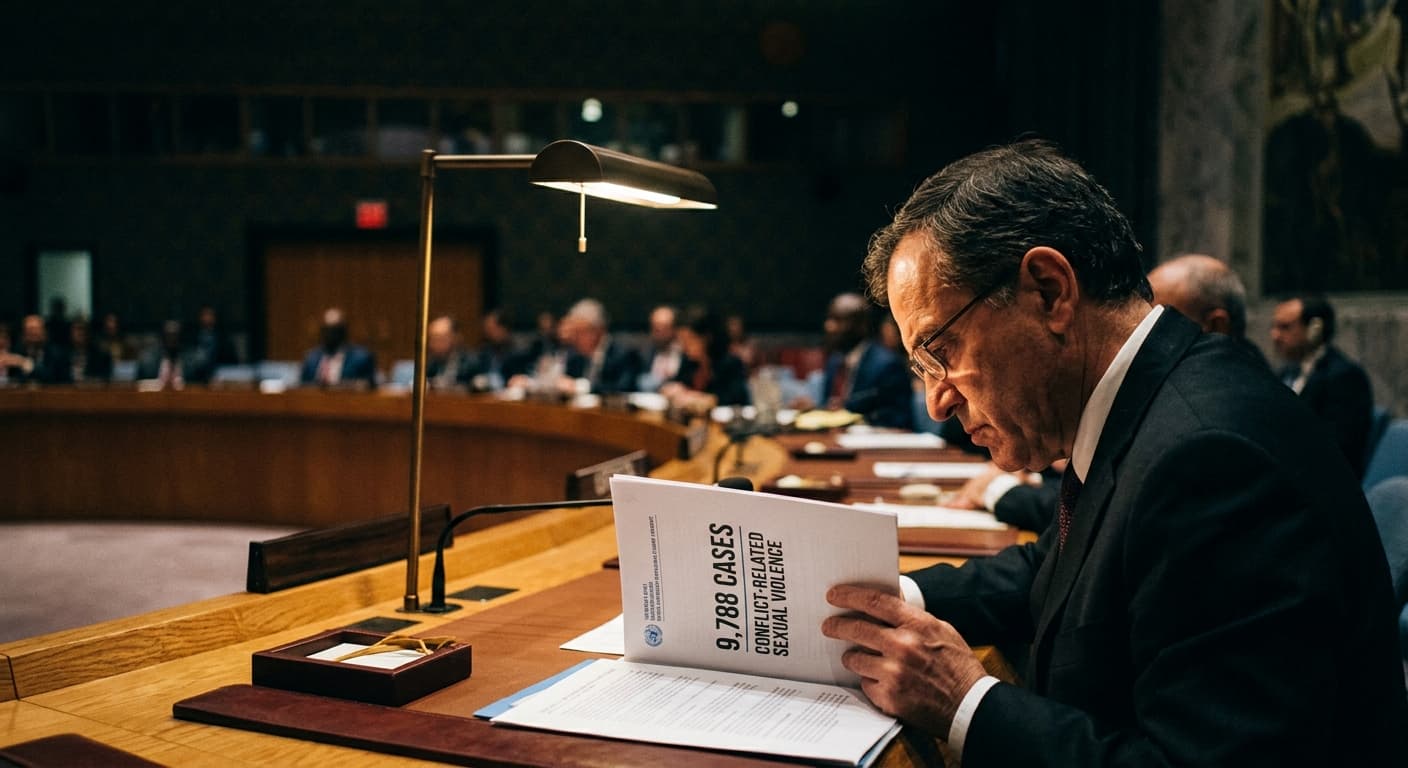
UN Security Council debate confronts record 9,788 CRSV cases
The Secretary-General's 2026 report doubles verified conflict-related sexual violence cases and — for the first time — lists Russian and Israeli forces. What the July 8 debate reveals about the fraying framework.
The UN Security Council opened its annual debate on conflict-related sexual violence on July 8, 2026 with a number that reframes the entire agenda: 9,788 UN-verified cases in 2025, more than double the 4,617 recorded a year earlier, according to the Secretary-General's report S/2026/321. The debate is being chaired by Democratic Republic of the Congo Prime Minister Judith Suminwa Tuluka — the same country whose eastern provinces account for the largest single share of that spike — and it lands at the moment the normative architecture built since 2008 is quietly being hollowed out from two directions: a US-led financial retreat from the UN's gender infrastructure, and a diplomatic revolt by two of the parties newly named on the perpetrators' annex. The story of this debate is not the numbers. It is that the Council is choosing to name Russia and Israel in the same year Washington is defunding the mechanism that does the naming.
The listing that changed the game
The annex to the 2026 report — the "blacklist" — now runs to 77 parties credibly suspected of patterns of sexual violence, 62 of them non-State actors, according to Al Jazeera's reporting on the report's release. For the first time, the list names Russian armed and security forces, including the Federal Penitentiary Service and FSB, and Israeli armed and security forces, including the IDF, Israel Prison Service and the border police Counter-Terrorism Unit. Three new non-State armed groups operating in the DRC were also added.
The evidentiary basis matters. The UN human rights monitoring mission in Ukraine has verified 310 cases of conflict-related sexual violence committed by Russian forces, affecting 280 men, 26 women and four girls — with rape, castration threats, genital mutilation and electric shocks documented in 50 official and 22 unofficial detention facilities, as SRSG Pramila Patten laid out in her Ottawa remarks in October 2025. For Israel, the
BBC noted that the office verified 31 cases against Palestinians from Gaza and the West Bank — 13 in 2025, 18 in the two prior years — and that Guterres had already placed Israel "on notice" the previous year.
Israel's response was to sever official contact. In a statement carried on the UN's own Question of Palestine portal, Israel's Ministry of Foreign Affairs called the listing "shameful and absurd" and announced Israel would cut all ties with the Secretary-General's Office until Guterres leaves. Russia has not publicly commented. Ukraine's foreign minister Andrii Sybiha welcomed the report as "a crucial step on the painful road to truth and accountability."
Why the annex matters more than sanctions
The reflexive critique — that the list carries no punitive teeth — misreads what the mechanism actually does. Being listed does not trigger automatic sanctions. But under Council resolution 2242 (2015), repeatedly-listed State forces are barred from participating in UN peacekeeping operations, and the annex is designed to feed the Council's sanctions committees as a listing criterion. Over 70% of parties named are "persistent perpetrators" appearing for five years or more, and Patten has explicitly called for "coherence between the list of implicated parties and the measures imposed by UN sanctions regimes."
The listing also functions as a docket for international justice. As Cambridge's Review of International Studies has documented, the annex feeds a network of Joint Communiqués — bilateral agreements between listed states and the SRSG on specific reforms — that has produced convictions in the DRC and Côte d'Ivoire. It underpins ICC charging strategies: in 2019 the ICC recognised that sexual violence can constitute a war crime, crime against humanity or an act of genocide depending on the elements. And it is the primary trigger for the deployment of the UN Team of Experts on the Rule of Law, which supports domestic prosecutions.
That is the machinery Russia and Israel have now been formally inserted into — a record that will outlast any government's tenure.
The DRC gavel: symbolism and inversion
DRC's July presidency of the Security Council is the pivot of the debate's optics. Suminwa is chairing a session on a crime her own country's territory produces at unmatched scale. The Council's UN Web TV feed titled the meeting "Honouring the promise of international law to survivors" — a phrase pulled directly from the concept note.
The numbers behind that promise are grim. Between January and September 2025, service providers in eastern DRC recorded over 90,000 CRSV cases, with UN-verified data showing an 86% increase over 2024, driven primarily by non-State armed groups including the Rwandan-backed M23, according to Patten's March 2026 remarks in New York. Nearly three million newly displaced civilians face forced prostitution as a survival strategy. In the Goma area alone, around 500 sexual violence cases were reported in the first week after M23 seized the city, more than 100 of them involving children, per a June 2025
UN inquiry document.
Kinshasa is using the gavel to press one point: the naming of M23 and its state backers, and the leveraging of sanctions coherence against them. That aligns Suminwa's presidency with Patten's institutional agenda — but exposes the underlying contradiction. The Congolese national army and police remain in previous annexes as persistent perpetrators. The state chairing the debate is itself a listed party. Whether that undercuts or strengthens the moral weight of the July 8 session is the diplomatic subtext running through every P5 intervention.
The financial hollowing
While the annex expands, the response architecture is contracting. The Secretary-General's report itself is unusually blunt: "acute funding cuts to United Nations entities hollowed out assistance to survivors, shuttering women and girls' safe spaces and reducing services." The UN Action network's 2025 annual report describes 2025 as "the sharpest contraction in humanitarian funding in a decade," with the closure of hundreds of safe spaces and more than 1,000 UN-supported health facilities and mobile teams shut down or at risk.
The proximate cause is a policy decision, not a market shock. On January 20, 2025 the Trump administration issued executive orders dismantling the US gender portfolio; on March 7, 2025 the Council on Foreign Relations reported that Washington cancelled 48 grants worth $377 million to UNFPA, halting rape treatment and clinical management-of-rape programmes in Afghanistan, Chad, the DRC, Haiti, Gaza, Mali, Sudan, Syria and Ukraine. The August 28, 2025
White House rescission memo proposed rescinding $520.5 million from US assessed UN contributions and $392.5 million from UN peacekeeping. CSIS
documented the full withdrawal from UN Women — $10 million in voluntary contributions and roughly $15 million in project funding gone.
The knock-on impact is quantifiable. NPR, citing a UN Women global survey published in October 2025, reported that more than 40% of organisations working to end violence against women and girls had scaled back services or shut down in the past year. The Women's Refugee Commission found over $400 million in US aid cut from grants explicitly citing gender-based violence.
What the P5 lineup tells you
The debate exposes a Council split that is now structural rather than tactical. The UK — represented by Ambassador James Kariuki — has anchored the pro-mandate coalition, calling in an August 2025 statement for "adequate and sustained resourcing" and appointing a new Prime Minister's Special Representative for Preventing Sexual Violence in Conflict. France, the E10 states led by Sierra Leone and Slovenia, and the EU (through Special Representative Kajsa Ollongren's joint statement with Patten) form the political core defending resolution 2467's survivor-centred approach.
Against them: Russia and China have consistently opposed expanding the Women, Peace and Security agenda's ambit, and Russia now sits as a listed party voting on its own accountability regime. The US position under the second Trump administration is the wild card — technically committed to prosecuting sexual violence, structurally opposed to the "gender ideology" framework that carries the agenda's language. Vice-President Vance's January 23, 2026 expansion of the Mexico City Policy to all non-military foreign aid, as Cambridge's Politics & Gender documented, has cut off funding to any programme touching "gender ideology" or DEI — categories broad enough to sweep in most CRSV service delivery.
Israel's decision to cut ties with the Secretary-General over the listing forecloses the Joint Communiqué route entirely. Patten confirmed at a May 2026 press briefing that she "never received an iota of information on measures taken by the government of Israel on implementation of the preventive measures" the annex had been designed to trigger.
Diplomat View
The July 8 debate is being staged as a moral moment. It is really a stress test of whether a framework designed for the post-Rwanda, post-Bosnia consensus can survive when two of the world's most consequential militaries — one a permanent Council member, the other its closest ally — are inside the annex and the largest historical funder is dismantling the response side. The specific bet: the listing mechanism will hold as a legal-historical record even as sanctions coherence stalls, because the record itself feeds ICC dockets, national universal-jurisdiction cases and the survivor-reparations claims that will outlive current governments. That was the Bosnian pattern; it was the Sierra Leonean pattern; it is now becoming the Ukraine pattern with the March 2025 Sde Teiman indictment against IDF Unit 100 reservists — notable for what it omits (no sexual violence charge despite documented rectal injury), which the Secretary-General's report explicitly flagged as evidence of impunity.
What would revise the forecast: a US veto or hold on the DRC or Sudan sanctions renewals directly linked to the CRSV annex (that would signal the listing mechanism itself is being kneecapped, not just underfunded); a Russian counter-mobilisation to challenge the Ottawa Convention-style consensus that has kept the annex procedurally non-negotiable; or a decisive prosecutorial breakthrough — an ICC arrest warrant citing sexual violence against a listed Russian or Israeli commander — that would convert reputational damage into legal exposure. Absent those, the debate today is theatre with a paper trail. The paper trail is the point.
What to watch next
- August 2026: Renewal cycle for the DRC (1533) and Sudan (1591) sanctions regimes — the first test of "coherence" between the CRSV annex and targeted measures.
- October 2026: 26th anniversary open debate on Women, Peace and Security (Resolution 1325), the moment the E10 typically pushes new implementation language.
- December 2026: End of Guterres's term as Secretary-General — Israel has staked its re-engagement on the successor. The identity of that successor will determine whether the annex mechanism gains a defender or a liquidator.
The Bottom Line
The July 8, 2026 Security Council debate is the moment the conflict-related sexual violence framework is being asked to do the heaviest lifting of its 18-year existence — name a P5 military and a close US ally as perpetrators — while the funder that built it walks away. If the listing mechanism survives this year with its evidentiary weight intact, the annex will become the most consequential accountability instrument in international humanitarian law outside the ICC itself. If Washington's disengagement pulls sanctions coherence and prosecutorial resources down with it, the Council will have kept the record and lost the remedy.
Discover more

US Politics
White House Pressures Congress for Crypto Leg
The Trump administration's push for the CLARITY Act aims to reshape crypto regulation, impacting trillions in market value and the Trump family's wealth.
US Politics
SNAP Food Assistance Faces Legal Challenges
In 2026, SNAP faces stricter eligibility rules and mounting legal challenges, threatening food assistance for the millions of Americans who rely on the program.

US Politics
House Ethics Committee Pushes Sexual Miscond.
The House Ethics Committee has shifted responsibility for sexual harassment settlement records to the Office of Congressional Workplace Rights, complicating disclosure efforts.

Economics
Fed's Amex AML order puts correspondent banking on notice
Federal Reserve's Amex AML order requires board-level controls and a 90-day plan; OCC fined the bank $350 million over enterprise-wide deficiencies.