UN SDG Report 2026: A Blueprint for Peace
UN report highlights progress and challenges in SDG implementation.
Model Diplomat8 min readGlobal
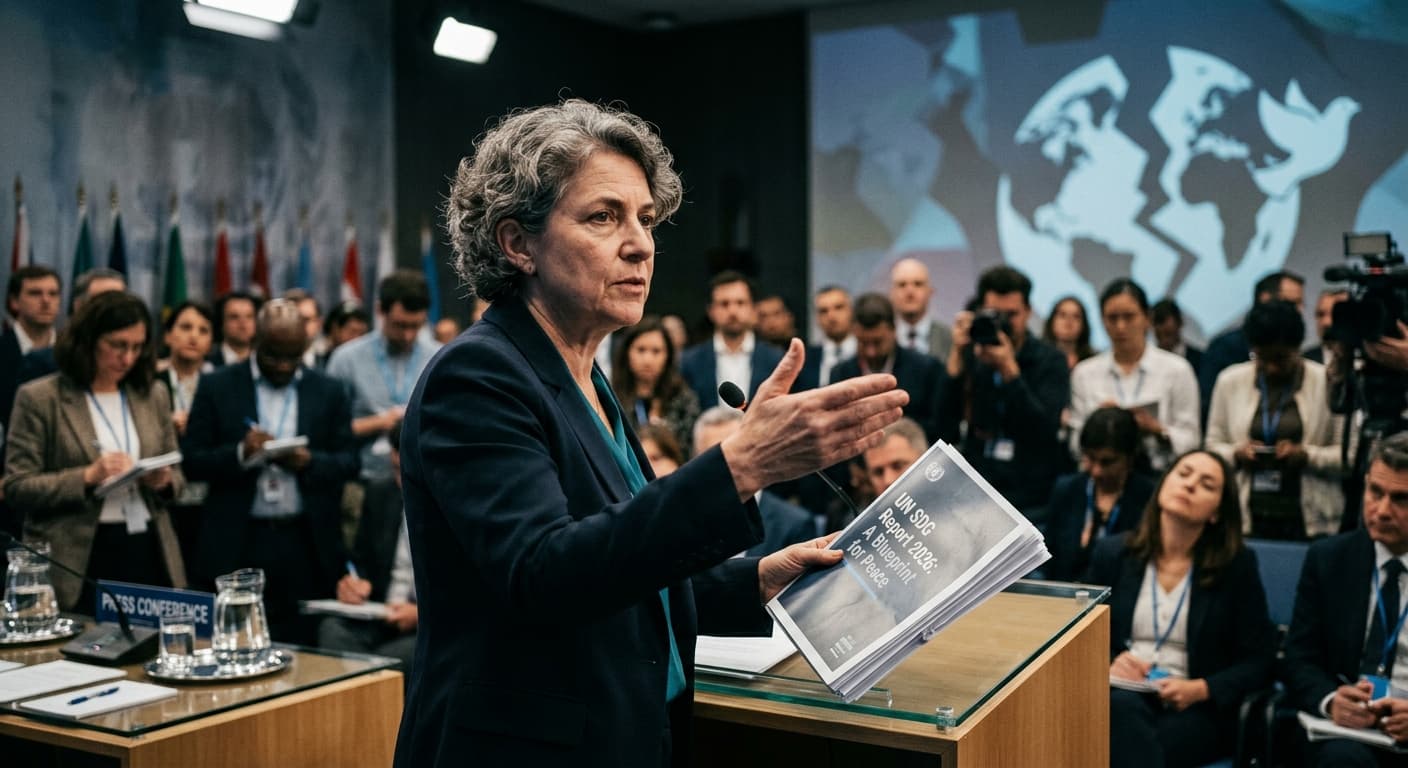
‘Shared Blueprint for Peace’: SDG Report Delivers for Billions
The UN's 2026 SDG Report finds a third of targets on track, billions helped since 2015 — but frames the goals as a diplomatic weapon as US withdrawal reshapes multilateralism.
The United Nations released The Sustainable Development Goals Report 2026 on July 7 with a diplomatic message buried in the executive summary: the 17 goals remain "the world's shared blueprint for peace, prosperity and sustainability." That phrasing — delivered as UN Secretary-General António Guterres opened the High-Level Political Forum in New York — is not decorative. It is a flag planted against the Trump administration's active rejection of the framework, and it reframes what began in 2015 as a technocratic checklist into a contested claim about who owns the post-2030 multilateral order. The report says billions of lives have improved; the fight now is whether the paradigm survives its most powerful defector.
What the numbers actually show
Of 139 SDG targets with trend data, 36 percent are on track or making moderate progress, 49 percent are advancing too slowly, and 15 percent have regressed below their 2015 baselines, according to the UN Department of Economic and Social Affairs' press release accompanying the report. That is an incremental improvement on the 2025 edition, which found only 35 percent on track or moderately advancing and 18 percent in reverse, per the
UN's 2025 progress note.
The gains are real and specific. Since 2015, nearly one billion people have gained access to safely managed drinking water and 1.2 billion to safely managed sanitation. New HIV infections fell 30 percent between 2015 and 2024, AIDS-related deaths by 35 percent, and internet use climbed from 40 to 74 percent of the global population, UN DESA reported. Social protection now covers more than half of humanity for the first time in recorded history. Between 2012 and 2024, the world had 30.2 million fewer stunted children under five. Renewable electricity capacity per capita is now 2.2 times its 2015 level.
The regression side of the ledger is where the "blueprint for peace" rhetoric strains. One in ten people still live in extreme poverty. Roughly 2.3 billion face moderate or severe food insecurity. More than 150 million children remain stunted. Maternal mortality sits at nearly three times the SDG target. And, as UN DESA notes, none of the gender equality targets are on track — a stark data point given that women's share of parliamentary seats has only crept from 22.3 to 27.4 percent since 2015. The number of people affected by climate-related disasters has more than doubled over the same period.
The diplomatic subtext: SDGs as multilateral loyalty test
The 2026 report is the first released after Washington's decisive break with the framework. On January 7, 2026, President Donald Trump signed a memorandum withdrawing the United States from 66 international bodies, including 31 UN entities, the UN Framework Convention on Climate Change, the Intergovernmental Panel on Climate Change and the International Renewable Energy Agency, the BBC reported. The White House called them a "waste of taxpayer dollars" advancing "globalist agendas." In July 2025, the State Department explicitly denounced UNESCO's commitment to the SDGs as evidence of "a globalist, ideological agenda,"
Al Jazeera reported.
This is not rhetorical. The independent Sustainable Development Report 2026, published on June 23 by the UN Sustainable Development Solutions Network, found that in 2025 more than 170 of 193 UN member states backed every General Assembly resolution referencing sustainable development. Only two — Argentina and the United States — consistently voted no. SDSN president Jeffrey Sachs and vice-president Guillaume Lafortune describe the American position as "active opposition to the paradigm of sustainable development and the multilateral institutions that underpin it."
The geopolitical arithmetic runs against Washington's assumption that its exit hollows the framework. The Council on Foreign Relations' backgrounder notes that on the SDG Index, Finland, Sweden and Denmark lead while the United States ranks 44th and China 49th. The 2026 SDSN edition places India and China as the biggest rank climbers among major economies since 2015, with India up 18 places and China up 14. The Center for Strategic and International Studies argues bluntly in its January 2026 analysis that Washington is
ceding sustainable development to Beijing, which "shows up at these forums and dominates the agenda with its economic initiatives" — from Belt and Road follow-ons to the Regional Economic Commissions the US just abandoned.
That is the load-bearing implication of today's report: the SDGs are becoming a de facto membership card for the non-American multilateral order. Guterres's insistence that the goals are a "shared blueprint for peace" — not just a development checklist — is a bid to lock the framework into the language of international security, where opting out carries a heavier cost than opting out of a development compact.
The $4 trillion gap and the Sevilla wager
The report's central bet on delivery is financial. It calls the Sevilla Commitment, adopted at the Fourth International Conference on Financing for Development on July 3, 2025, "essential" to closing the roughly $4 trillion annual SDG financing gap. UN DESA's closing statement lists 130 initiatives under the Sevilla Platform for Action, including a debt-pause alliance, a currency-risk tool for multilateral development banks, and the world's first solidarity levy on premium-class flights and private jets.
The Compromiso de Sevilla was negotiated by consensus, but only after Washington walked out of the preparatory committee in mid-June 2025 and stayed out of the conference itself, per the UN's own confirmation. The Carnegie Endowment's post-conference
analysis argued the US departure was, ironically, enabling: it "cleared the path for an agreement that might otherwise have been impossible or watered down."
The numbers underneath the gap remain grim. Official development assistance fell 7.1 percent in 2024 after five years of growth, per the UN's 2025 report summary, and the OECD projects a further decline of 9–17 percent in 2025 as donor budgets contract. Three billion people live in countries spending more on interest payments than on health or education. The
World Bank's June 2026 SDG 7 tracker shows 655 million people still lack electricity, with Sub-Saharan Africa's rural deficit growing from 376 million in 2010 to 447 million in 2024.
"The 2030 Agenda represents our collective recognition that our destinies are intertwined and that sustainable development is not a zero-sum game but a shared endeavour that benefits us all." — Li Junhua, UN Under-Secretary-General for Economic and Social Affairs, opening the HLPF
Where the framework is fraying — and where it is not
The peer-reviewed literature has been skeptical of the SDGs' governance model for years. Utrecht University's Frank Biermann, quoted by Al Jazeera in 2023, argued that "this voluntary approach is maybe not the right one" — that non-binding goals with no compliance mechanism translate poorly into national policy. Brookings' 2024
working paper by John McArthur and colleagues reached a subtler verdict: on most indicators, the human condition improved after 2015, but on nine of 24 measures the rate of progress slowed compared with the pre-2015 decade. Improvement, in other words, without acceleration.
The 2026 SDSN findings echo this. Goal 11 (Sustainable Cities), Goal 14 (Life Below Water), Goal 15 (Life on Land) and Goal 16 (Peace, Justice and Strong Institutions) are the furthest off track. Indicators on press freedom, judicial timeliness and corruption perceptions are all deteriorating. SDG 16 — the "peace" goal — is failing at the same moment the UN is calling the whole package a blueprint for peace. That contradiction is doing diplomatic work. Guterres has repeatedly framed conflict as the primary blocker: in 2024, one person died in armed conflict every 12 minutes, per the UN Sustainable Development Group's 2025 briefing. "Sustainable development cannot be achieved amid ongoing conflict, making peace the top priority of our time," Sachs said on release of the SDSN report.
For India, China and the ASEAN core, the framework's survival matters because it is the tool through which they extract concessions from creditor economies — on debt restructuring, on multilateral development bank governance, on climate finance. For Europe, the SDGs are the only remaining instrument for coordinating with the Global South on migration, health security and supply chains without the United States. For the African Union and CARICOM, the Sevilla Commitment's debt-pause alliance is the first serious sovereign-debt architecture in a generation. None of these actors gains by letting the framework collapse, which is why the 2026 report is quietly optimistic even as the underlying data grows more polarized.
Diplomat View
The 2026 SDG Report is being read in capitals not as a scorecard but as a diplomatic dividing line. The framework is delivering — 30 percent HIV reductions, 30 million fewer stunted children, near-universal internet — and the countries that most benefit (India, China, sub-Saharan Africa, Latin America) are the ones now shaping the post-2030 agenda while Washington absents itself. The specific call: expect the September 2026 UN General Assembly to elevate SDG 16 (peace and institutions) as the political pivot, with Guterres pushing to link development, security and financial architecture reform into a single "shared blueprint" package the US cannot easily veto because it is no longer in the room. The forecast changes if two things happen: an American recommitment (unlikely before 2029) or a major emerging-economy defection — an Argentina-style vote flip from Brazil, South Africa or Indonesia. Neither looks probable in the 90 days ahead. Absent that, the framework survives its worst crisis by becoming narrower and more Southern: fewer donors, more implementers, and a coalition that treats multilateralism itself as the deliverable.
What to watch
- July 7–16, 2026: HLPF ministerial segment reviews SDGs 3, 5, 8, 14 and 17; watch for VNR presentations from Argentina and any G7 dilution language.
- July 8, 2026: World Bank–IEA–IRENA joint SDG 7 launch event in New York — first read on whether the US IRENA withdrawal has slowed the tracker.
- September 22–26, 2026: UNGA high-level week; Guterres expected to press "peace-development" linkage and post-2030 framework consultations.
- November 2026: COP31 host confirmation and first post-UNFCCC-withdrawal negotiation round; a test of whether Sevilla's climate finance provisions hold without US participation.
The Bottom Line
The 2026 SDG Report shows the framework has materially improved billions of lives over a decade, but its diplomatic value now exceeds its statistical one: with only 36 percent of targets on pace and Washington in open opposition, the "shared blueprint for peace" language is Guterres's attempt to convert a development compact into a multilateral loyalty test. The story of the next four years is not whether the world hits the 2030 targets — it will not — but whether the coalition defending the goals emerges strong enough to write the post-2030 rules without the United States in the room.
Discover more

US Politics
SNAP Food Assistance Faces Legal Challenges
In 2026, SNAP faces stricter eligibility rules and mounting legal challenges, threatening food assistance for the millions of Americans who rely on the program.
India
Congress Accuses Modi of Stalling Women's Law
Congress accuses Modi of stalling women's reservation law by linking it to delimitation, revealing a deeper electoral strategy.

India
Delhi CM Rekha Gupta Blasts Opposition's Delm
Delhi CM Rekha Gupta's remarks on women's quota defeat reveal BJP's strategy for the 2029 Lok Sabha elections, focusing on delimitation.

Economics
Fed's Amex AML order puts correspondent banking on notice
Federal Reserve's Amex AML order requires board-level controls and a 90-day plan; OCC fined the bank $350 million over enterprise-wide deficiencies.