UN Occupation Resolution Turns Two
Indonesia shifts from supporting UN resolution to leading US-led force.
Model Diplomat7 min readMiddle East
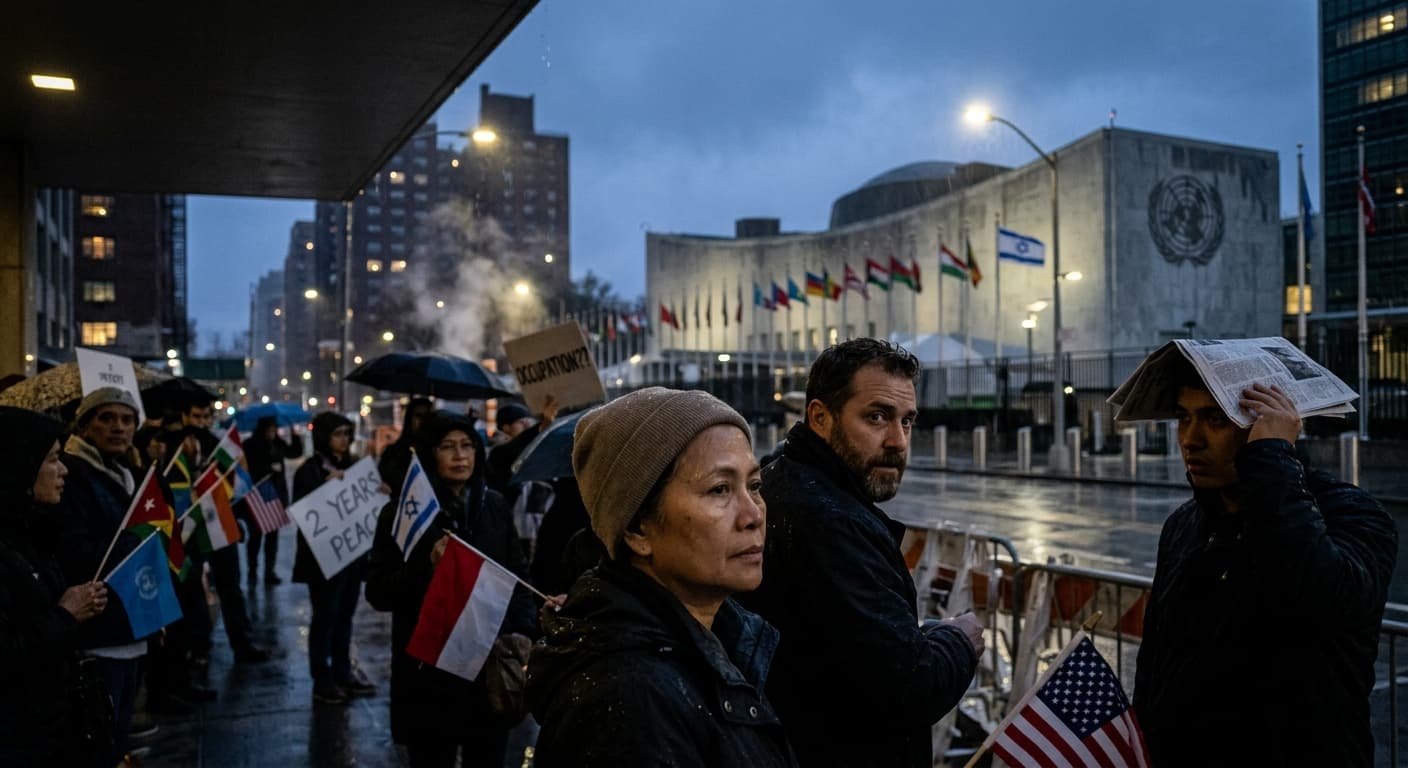
The UN's Occupation Resolution Turns Two — And Loses the Argument
Two years after the ICJ called Israel's occupation unlawful and 124 states demanded it end within 12 months, the resolution's loudest backer, Indonesia, is now anchoring the US-led force replacing it.
Resolution ES-10/24 passed the United Nations General Assembly on September 18, 2024, by 124 votes to 14, demanding that Israel end its "unlawful presence" in the Occupied Palestinian Territory within 12 months. Indonesia's Foreign Ministry welcomed the vote as "broad international recognition" of Palestinian self-determination. The deadline lapsed on September 18, 2025 without compliance; by July 2026, Israel has approved its largest settlement expansion in three decades, the ICJ has issued a second advisory opinion, and the Security Council has quietly folded the whole legal edifice into a Trump-authored governance plan for Gaza. The resolution Jakarta hailed as historic is now the losing side of a two-track argument about who defines the law of occupation — and Indonesia is sending 20,000 troops to serve the winning track.
What the resolution actually did
ES-10/24 was not a routine condemnation. It operationalised the ICJ's July 19, 2024 advisory opinion, which held that Israel's continued presence in the West Bank, East Jerusalem and Gaza was unlawful and that third states had an obligation not to "render aid or assistance" in maintaining it.
The General Assembly's operative paragraph, in the adopted text, was categorical:
"Demands that Israel brings to an end without delay its unlawful presence in the Occupied Palestinian Territory, which constitutes a wrongful act of a continuing character entailing its international responsibility, and do so no later than 12 months from the adoption of the present resolution."
It also demanded that Israel cease new settlement activity, evacuate settlers, dismantle sections of the separation wall inside the West Bank, return seized property, and pay reparations. According to the UN press release GA/12626, the Assembly further decided to convene an international conference on implementing UN resolutions on Palestine and the two-state solution.
Legally, the text set out obligations on states and international organisations — including "the obligation not to recognize as legal the situation arising from the unlawful presence of Israel." No previous General Assembly resolution had built so directly on a Court of Justice opinion to construct third-state duties.
The compliance record: zero
The 12-month clock ran out on September 18, 2025. There was no withdrawal. There was the opposite.
According to the BBC, citing Finance Minister Bezalel Smotrich, Israel's security cabinet has approved 69 new settlements in the occupied West Bank since 2022 — 22 in May 2025, described by Peace Now as "the most extensive move of its kind" in over 30 years, and another 19 in December 2025. The Brookings Institution
reported that Israel advanced 28,872 settlement housing units in 2024 alone, a 250 percent jump since 2018.
A UN Human Rights Council commission, reported by Al Jazeera, concluded in September 2025 that "Israeli policies and actions implemented since October 2023 in the West Bank demonstrate clear intent to forcibly transfer Palestinians, expand Israeli civilian presence and annex the entirety of the West Bank."
By February 2026, more than 80 UN member states had jointly condemned what Al Jazeera described as Israel's de facto annexation, after the security cabinet cancelled the Jordanian-era prohibition on land sales to non-Arabs and authorised Israeli demolitions in Oslo-designated Areas A and B. Chatham House's April 2026
assessment framed annexation as accelerating rather than merely continuing.
The ICJ tried again. On October 22, 2025, it delivered a second advisory opinion, this time on Israel's duties toward UN agencies. The court held, according to the Financial Times, that "as an occupying power, Israel is obliged to ensure the basic needs of the local population, including the supplies essential for their survival," and that it could not invoke security concerns to justify suspending humanitarian aid. Israel's Foreign Ministry,
NPR reported, rejected the decision as "a political attempt to harm Israel under the guise of international law."
The pivot: from legal track to security track
While the ICJ-UNGA architecture accumulated findings without enforcement, a parallel track appeared. On November 17, 2025, the Security Council adopted Resolution 2803 by 13-0, with Russia and China abstaining. The resolution endorsed President Trump's 20-point Gaza plan, authorised an International Stabilization Force through December 2027, and created a Board of Peace chaired by Trump himself.
Crucially, 2803 replaced the ES-10/24 vocabulary of "unlawful presence" with the language of "demilitarisation" and conditional statehood. As NPR reported, the resolution says only that after Palestinian Authority reforms and Gaza reconstruction, "the conditions may finally be in place for a credible pathway to Palestinian self-determination and statehood." Israeli withdrawal is tied to milestones "agreed to by the stabilization force, Israeli forces, the U.S." — not to the 12-month ICJ-based demand of the year before.
Russia's ambassador Vassily Nebenzia abstained, warning the text must not become "the death knell of a two-state solution." The Palestinian question moved from The Hague and Turtle Bay to a board Trump would personally chair.

Indonesia: from loudest welcomer to load-bearing pillar
The pivot has an unlikely architect on the ground. Indonesia — the world's largest Muslim-majority state, a founding voice of the Non-Aligned Movement, and the most vocal welcomer of ES-10/24 — is now the largest troop contributor to the very framework that has supplanted the resolution it applauded.
At the September 2025 General Assembly, President Prabowo Subianto told delegates Indonesia was ready to deploy 20,000 peacekeepers to Gaza, according to Al Jazeera's coverage. By November, Defence Minister Sjafrie Sjamsoeddin confirmed to reporters, cited by
Al Jazeera, that Jakarta was preparing up to 20,000 troops. In February 2026, Prabowo attended the Board of Peace's inaugural Washington meeting and formally committed 8,000 personnel; Indonesia's contingent,
Al Jazeera reported, accepted the deputy commander position under US Army General Jasper Jeffers.
The BBC reported that Indonesia is the first country to formally deploy under phase two of the Trump ceasefire. Prabowo has framed the mission, according to CSIS's
analysis, as consistent with "support for Palestinian self-determination."
Not everyone in Jakarta agrees. Amnesty International Indonesia head Usman Hamid, quoted by Al Jazeera, warned that deployment "means putting Indonesia at risk of participating in a mechanism that will strengthen violations of International Humanitarian Law." An Al Jazeera
opinion analysis argued the Board of Peace "sits outside established multilateral systems," risking Indonesia's neutrality.
The contradiction is legally sharp. The 2024 ICJ opinion held that all states must refrain from rendering aid or assistance in maintaining an unlawful occupation — and UN experts, in an October 2024 position paper, warned that third-country cooperation could trigger complicity liability. Indonesia insists its Gaza mandate is humanitarian and non-combat. But the ISF will "work with Israel and Egypt," per
Resolution 2803, coordinate withdrawal timelines with the Israeli military, and operate inside a framework that Palestinian factions — and Russia and China — have flagged as sidelining Palestinian sovereignty.
Who benefits from the pivot
Follow the leverage. Three actors gain from replacing ES-10/24's 12-month deadline with 2803's open-ended stabilisation timeline:
Israel. The Netanyahu government avoided any binding withdrawal date. Prime Minister Netanyahu told the Knesset, as Al Jazeera noted, that opposition to a Palestinian state "is existing, valid, and has not changed one bit." Settlement expansion has continued unabated since 2803's adoption, with the December 2025 approval of 19 additional settlements.
The United States. Washington voted against ES-10/24 even though its own ICJ judge, Sarah Cleveland, voted in favour of the July 2024 advisory opinion. Resolution 2803 restored American primacy over the Palestinian file, placing President Trump personally at the head of the transitional authority.
Arab and Muslim states willing to shoulder security costs. Indonesia, Egypt, the UAE, Qatar, Saudi Arabia, Pakistan, Jordan and Turkey issued a joint statement calling for "swift adoption" of the US proposal. In exchange, they gained inclusion in the post-war governance architecture — though not, as of July 2026, a binding commitment to Palestinian statehood.
The clearest losers are the Palestinian Authority, which retains no formal role in Gaza governance under 2803, and the legal doctrine constructed at The Hague — which, absent enforcement, is being catalogued rather than applied. The 17 percent contraction in the West Bank economy in 2024, per the World Bank, and 34 percent unemployment underline the ground-level cost.
Yet the Western recognition wave of September 2025 — the UK, Canada, Australia, Portugal, France, Belgium, Luxembourg and Malta all recognising Palestinian statehood within days of the ES-10/24 deadline lapsing — signals the resolution did political work even as it failed on its own timeline. Roughly three-quarters of the UN's 193 members now recognise a State of Palestine.
What to watch
- Board of Peace review, September 2026. Prabowo has publicly signalled he may "evaluate" Indonesia's role in the Gaza plan following domestic backlash over US-Iran tensions, according to
Al Jazeera. Any Indonesian withdrawal would gut the ISF's Muslim-majority legitimacy.
- ISF mandate expiry, December 2027. Resolution 2803's authorisation runs out at year-end 2027. Renewal — or non-renewal — will force the Security Council to reopen the question of Palestinian statehood on binding terms.
- UN Secretary-General's follow-up report on ES-10/24. The
December 2024 report laid out obligations; a two-year assessment is expected in the 81st session. The gap between the resolution's demands and Israel's settlement figures will be measurable.
- Knesset election, expected late 2026. Israeli analysts
The Bottom Line
The 2024 UN resolution and the ICJ opinion it enforced remain the most complete legal case ever built against Israel's occupation — and by July 2026, the least enforced. What replaced them is not repudiation but substitution: a US-authored Security Council framework that traded a 12-month withdrawal deadline for an open-ended stabilisation mandate Trump personally chairs. Indonesia's journey from the resolution's loudest welcomer to the Board of Peace's largest troop provider is the clearest single measure of how far the Palestine file has shifted from The Hague to Washington in twenty-two months.
Discover more
US Politics
Virginia's Redistricting Referendum
Virginia's redistricting referendum is drawing a flood of dark money, shaping future elections and the fight for congressional control amid party stakes.

US Politics
US Military Funding Request for Iran Looms
The White House Budget Director signals a formal funding request for military operations against Iran, foreshadowing rising tensions and congressional clashes.
US Politics
Washington's Scrutiny of Iran War Prediction
The Iran war prediction market scandal exposes political ties and regulatory challenges in Washington, as insider trading concerns rise.

Economics
Fed's Amex AML order puts correspondent banking on notice
Federal Reserve's Amex AML order requires board-level controls and a 90-day plan; OCC fined the bank $350 million over enterprise-wide deficiencies.