UK–Türkiye Defence Pact Rewires NATO's Flank
New partnership reshapes NATO's southern strategy
Model Diplomat7 min readEurope
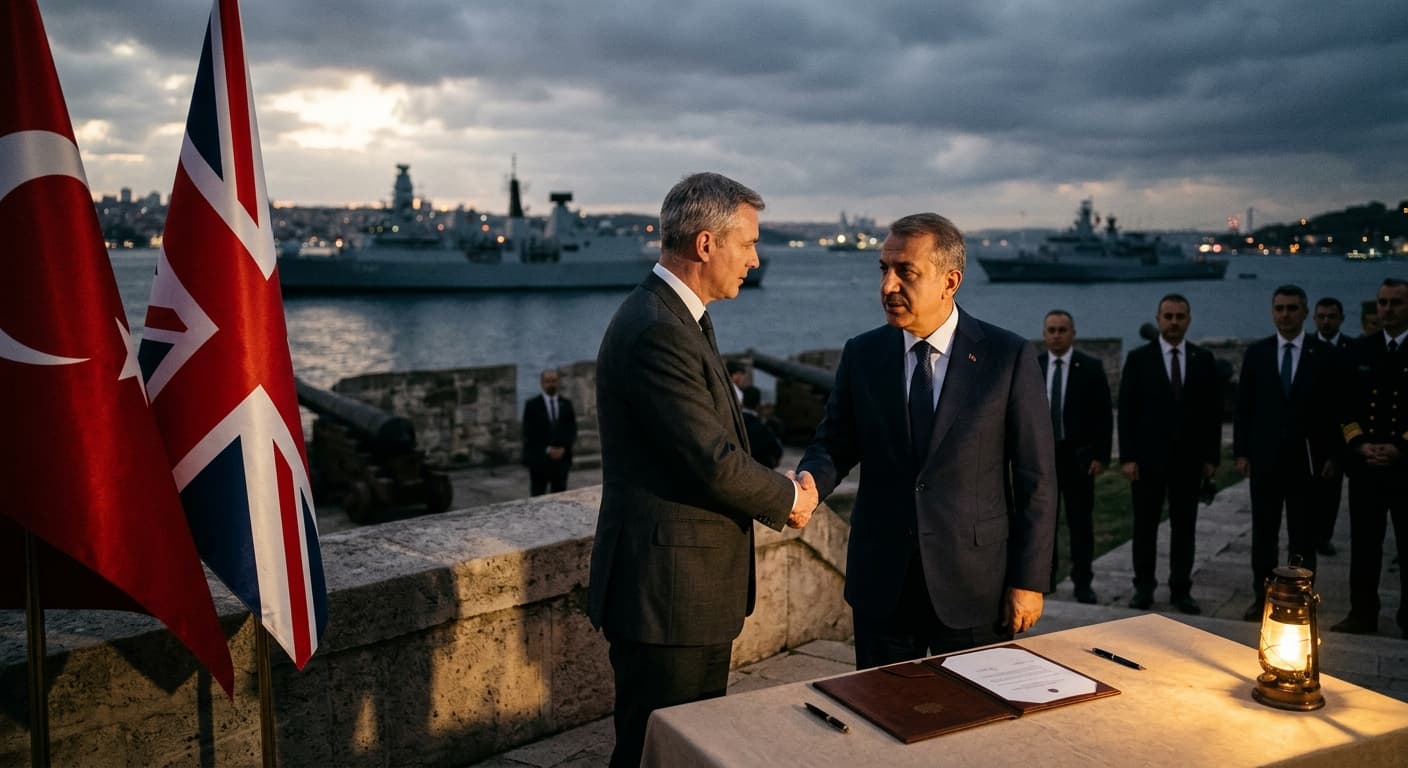
UK–Türkiye Defence Pact Rewires NATO's Southern Flank
The Starmer–Erdoğan Security and Defence Partnership signed in Ankara on July 8, 2026 formalises an intra-NATO bloc that hedges against a receding United States and against Greek-French power in the Mediterranean.
Britain and Türkiye signed a Security and Defence Partnership at the NATO summit in Ankara on July 8, 2026 that quietly builds a second intra-alliance security bloc — the mirror image of the 2021 Franco-Greek pact — and gives Keir Starmer and Recep Tayyip Erdoğan a joint answer to the same problem: an American security guarantee that is being priced, conditioned and drawn down by the hour. The two-page joint statement is deliberately thin; the operative text is being withheld. What is public is enough to see the shape of the deal: London locks in the buyer of its biggest fighter-jet export in twenty years, Ankara locks in a European guarantor with a UN Security Council seat and a nuclear deterrent, and NATO acquires a second bilateral spine running north-west to south-east across the alliance.
What was signed, and what wasn't
The GOV.UK joint statement commits the two governments to institutionalise cooperation across "politico-military aspects of security and defence policy, including deterrence and defence, military co-operation, defence industry and technology, cyber security and hybrid threats, counter-terrorism, resilience and civil preparedness and space." It reaffirms both states' "deep commitment to each other's defence and to the North Atlantic Treaty" and pledges rising defence expenditure in support of NATO capability targets.
The document is short by design. Turkish and British officials told Middle East Eye the full text will not be released, "underscoring the sensitivity of its provisions"; one source described the deal as being "in the same spirit" as the 2021 France–Greece Strategic Partnership on Defence and Security — while pointedly declining to say whether it contains a mutual-defence clause. Turkish state agency
Anadolu confirmed the signing on the summit's second day;
Defence Turkey described it as "a new chapter in their bilateral strategic relationship."
The France–Greece comparison is the tell. As Al Jazeera reported at the time, the Franco-Greek pact was the first agreement binding two NATO members to defend one another against an attack originating inside the alliance — a category NATO's Article 5 explicitly does not cover. It was aimed, transparently, at Türkiye. That an equivalent Turkish–British instrument is now being framed the same way, with an ambiguous clause and a classified annex, is not accidental. It is a strategic reply.
Why now: three converging pressures
The pact is the endpoint of a sequence, not a surprise. A Statement of Intent signed on November 23, 2023 opened the door; a Strategic Partnership Framework followed on April 23, 2026, per the
Foreign, Commonwealth and Development Office; and on October 27, 2025 Starmer flew to Ankara to sign an £8 billion contract for 20 Eurofighter Typhoons — the biggest UK fighter export in almost two decades,
BBC News reported. The Ankara pact is the political super-structure over that industrial base.
Three pressures converged to force the move now.
The first is the United States. Defence Secretary Pete Hegseth announced a six-month review of US force posture in Europe in June 2026, and Washington has begun a phased withdrawal of warplanes, destroyers and submarines from NATO countries — a shift Al Jazeera reported has "a more tangible impact" than any troop drawdown. The Trump administration is openly selling what US officials call "NATO 3.0" — Europeans doing more, Americans doing less, per the
Center for Strategic and International Studies. Bilateral scaffolding between capable European allies is how the alliance is being retro-fitted for that world.
The second is Türkiye's own realignment. Aaron Stein, writing for Foreign Affairs, documents Ankara's "quiet return" to NATO: Erdoğan asked Vladimir Putin in December 2025 to take back the second S-400 battery; NATO Patriots were deployed to defend Turkish airspace during the US–Israel war on Iran; and Germany added a Patriot battery and 150 troops at the end of June. Türkiye now needs Western technology, financing and market access to sustain its defence industry — and Britain is offering all three outside the EU's SAFE regulation, which Ankara remains locked out of, per
ELIAMEP.
The third is the eastern Mediterranean. Greece and Israel, per Al Jazeera, signed a military cooperation work plan in December 2025 and are negotiating up to €3.1 billion in Israeli missile defence purchases; Athens has referred to the Greek–Israeli–Cypriot triangle as an "anti-Turkish alliance." The Ankara pact re-balances that triangle by giving Türkiye a heavyweight European partner that is not France.
The industrial logic that binds
The partnership rests on a defence-industrial base that has changed beyond recognition in five years. Between 2020 and 2025, Turkish arms export volumes rose roughly fivefold, per the Fondation pour la Recherche Stratégique; Europe overtook the United States in 2024 as the top destination, absorbing 27% of Turkish defence exports. Türkiye's total defence and aerospace exports reached $6.3 billion in 2024, ELIAMEP records, and by SETA's
SAHA Expo 2026 tally are running at roughly $10 billion on an annualised basis. Baykar's TB2 became the world's most exported drone in 2024; its TB3 flew its first NATO live-fire mission from TCG Anadolu in the Baltic in early 2026,
Hudson Institute's Can Kasapoğlu noted.
Britain brings the other half. The UK's Strategic Defence Review, published on June 2, 2025, formalised a "NATO first" posture, seven thousand new long-range and cruise missiles, six new munitions factories and a £15 billion sovereign warhead programme, per the
Atlantic Council. The Defence Investment Plan published last week is,
BBC reports, "billions of pounds short" of the SDR's own requirements — a gap Ankara helps close. Every Typhoon sold to Türkiye supports thousands of UK supply-chain jobs at BAE Systems' Warton site and validates the industrial base underpinning the Global Combat Air Programme with Italy and Japan.
The reciprocity is the point. Türkiye buys British platforms; Britain buys into a Turkish defence sector whose drone, electronic warfare and munitions output is now among the fastest-growing in the alliance. Luke Coffey of the Hudson Institute argues both governments now share an interest in preventing the EU's SAFE regulation from freezing them out of European defence procurement — a shared exclusion that is itself a strategic bond.
The southern-flank problem the pact is really solving
NATO's southern flank has become the alliance's neglected front. Four Iranian ballistic missiles were intercepted by NATO air defences over Turkish territory during the US–Israel strikes on Iran, per a June 2026 Atlantic Council brief; Turkey is pressing for a multinational corps in Adana under Turkish command and for revived engagement with Istanbul Cooperation Initiative partners in the Gulf. NATO Mission Iraq temporarily withdrew during the Iranian strikes. The Ankara pact wraps British political weight around Türkiye's push to make the southern flank a strategic priority, not — as the brief puts it — "an afterthought."
That has second-order effects the summit did not want to advertise. Greek Prime Minister Kyriakos Mitsotakis has publicly opposed any US F-35 sale to Türkiye; Israeli Prime Minister Benjamin Netanyahu said such a sale would "destroy" Israel's regional edge. Trump, per Al Jazeera, told reporters in Ankara that Greek and Israeli objections "have no place in my world" and that his inclination was to approve the sale. A British security guarantee gives Ankara additional political cover if that sale — or the corresponding CAATSA sanctions relief — moves forward.
For Athens, the mirror-imaging is uncomfortable. Chatham House flagged that even the 2023 UK–Türkiye Statement of Intent had "caused consternation" in Athens. The 2026 pact is qualitatively larger, and Greek officials are already telegraphing accelerated co-production talks with Israel to compensate.
What the pact does not do
It does not, on the public text, create an Article 5-plus obligation. It does not name Russia. It does not mention Cyprus, the Aegean or the Eastern Mediterranean maritime boundaries at the heart of Greek–Turkish tension. It does not include an F-35 clause. The classified annex almost certainly handles what the joint statement omits: basing rights, technology transfer, intelligence-sharing floors, and possibly the mutual-assistance language Ankara wants but London will not publish.
The absence of a released text is itself the message. As the International Crisis Group has documented in the drone context, Ankara increasingly uses defence agreements as instruments of political leverage — the ambiguity is the deterrent.
Diplomat View
The Ankara pact is best read as the second pillar of a two-pillar bilateral architecture inside NATO — Paris–Athens on the alliance's south-west, London–Ankara on its south-east — designed to hold the southern flank together while Washington rebalances. The forecast: within eighteen months, the pact will be followed by a Turkish participation vehicle in GCAP-adjacent technology programmes, a UK basing-and-access arrangement in southern Türkiye tied to the Adana multinational corps, and joint UK–Turkish drone production lines aimed at the Ukrainian and Gulf markets. What would falsify this call: (1) an F-35 sale to Türkiye on terms that pull Ankara decisively back into a US-anchored bilateral track, making the British scaffolding redundant; (2) a Greek veto inside the EU that forces London to choose between Athens and Ankara on procurement; or (3) a Turkish domestic political shift after the 2028 election that re-opens the S-400 file. Absent those, this is the most consequential intra-NATO bilateral since 2021 — and its central beneficiary is neither London nor Ankara but the idea of a NATO that can function with less America in it.
What to watch next
- Late July 2026: publication (or non-publication) of any implementing annex; the first Commons parliamentary questions on whether the pact contains a mutual-defence clause will be the earliest signal of classified content.
- Autumn 2026: Trump's decision on F-35 sales to Türkiye and CAATSA sanctions relief; a positive decision reshapes the pact's leverage.
- First Typhoon delivery, 2030: the industrial milestone against which the political relationship will be measured; slippage there would signal the deal is thinner than advertised.
- NATO Defence Ministerial, October 2026: first test of whether the UK–Türkiye axis pushes a formal southern-flank command structure onto the alliance agenda.
Discover more
US Politics
Congress Targets AI Chatbot Access for Terror
The House passed the Generative AI Terrorism Risk Assessment Act, focusing on AI's role in terrorism and potential surveillance implications.

US Politics
SNAP Food Assistance Faces Legal Challenges
In 2026, SNAP faces stricter eligibility rules and mounting legal challenges, threatening food assistance for the millions of Americans who rely on the program.
US Politics
House Ethics Committee Pushes Sexual Miscond.
The House Ethics Committee has shifted responsibility for sexual harassment settlement records to the Office of Congressional Workplace Rights, complicating disclosure efforts.

Economics
Fed's Amex AML order puts correspondent banking on notice
Federal Reserve's Amex AML order requires board-level controls and a 90-day plan; OCC fined the bank $350 million over enterprise-wide deficiencies.