Ukraine's 430-Drone Salvo on Moscow
A tactical strike turns into political leverage for Ukraine.
Model Diplomat10 min readEurope
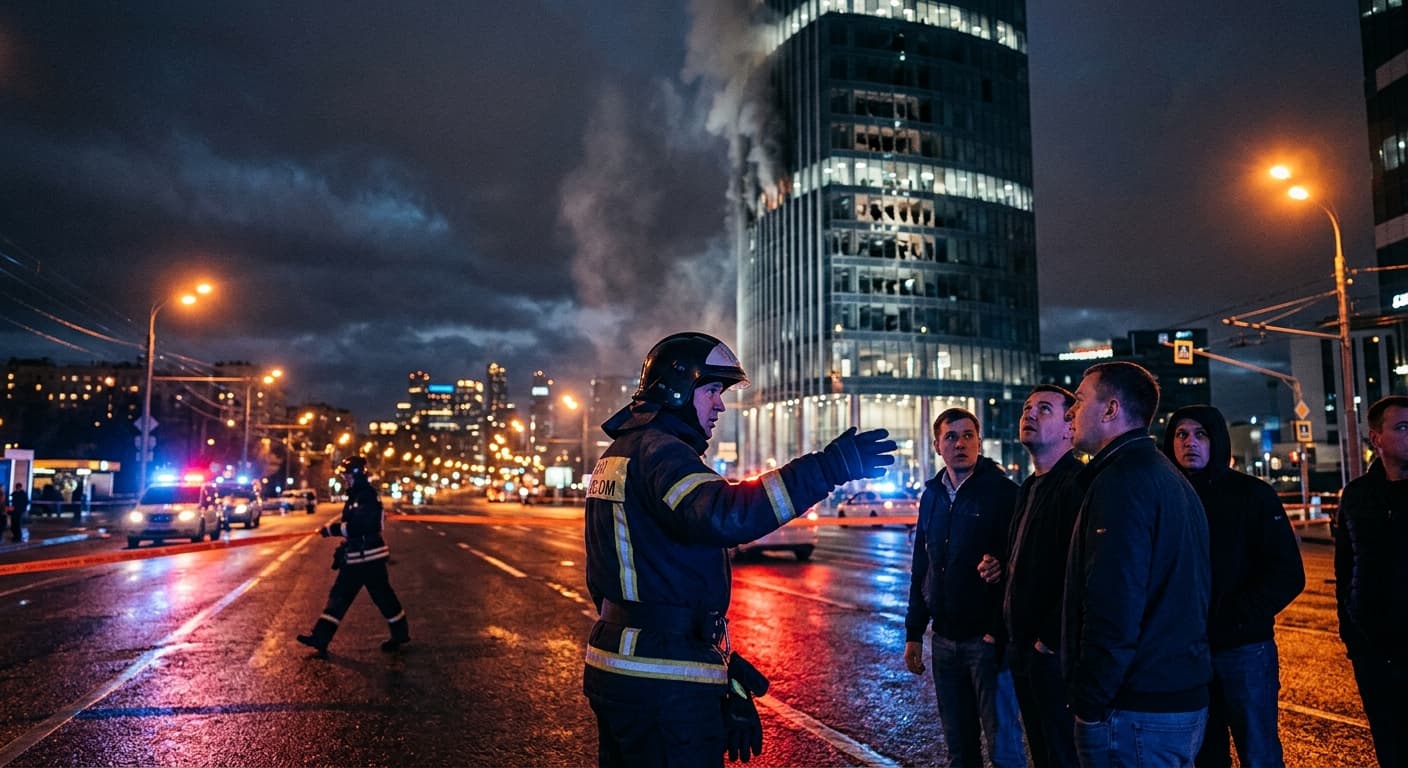
Ukraine's 430-drone salvo on Moscow reframes the air war
Ukraine fired more than 430 drones at the Moscow region on July 7, 2026 — the largest strike on the capital of the war, timed to the opening of the NATO summit in Ankara.
Ukraine timed its largest-ever drone salvo against the Moscow region — more than 430 aircraft in a single night — to coincide with the opening morning of the NATO summit in Ankara, converting a tactical strike into political theatre. The point of the July 7 attack was not damage; it was leverage. Volodymyr Zelenskyy needed Western capitals to see Ukraine as a supplier of coercive power, not just a recipient of Patriot missiles, before he sat down with Donald Trump on July 8. The wider implication is harder to walk back: a mid-sized power with a domestic drone industry has demonstrated it can hold a nuclear superpower's capital at sustained operational risk, without Western permission or Western weapons.
What actually happened overnight
Moscow Mayor Sergei Sobyanin said on Telegram that air defences engaged "more than 430" unmanned aerial vehicles heading toward the capital region between the evening of July 6 and 6 a.m. local time, with roughly 43 aimed at Moscow itself, according to the BBC. Russia's federal aviation regulator imposed restrictions at all four Moscow airports — Sheremetyevo, Domodedovo, Vnukovo and Zhukovsky — and at hubs in Yaroslavl and Nizhny Novgorod,
per RBC-Ukraine. The barrage capped a weekend in which Russian carriers cancelled 485 flights, diverted 88 aircraft and delayed roughly 1,900 more, at an airline-industry cost of at least 40 billion rubles,
BBC Russian reported. Some 43,000 forced ticket refunds were processed in the same 55-hour window.
The strike also extended a chain of records. On July 6, Ukraine's General Staff confirmed a hit on Russia's largest refinery, in Omsk — roughly 2,700 kilometres from Ukrainian-held territory, Al Jazeera reported. Two days earlier, drones struck an oil terminal in St Petersburg and the Kronstadt naval base at ranges near 900 kilometres. On July 1, the SBU hit the Kupol plant in Izhevsk — an air-defence and drone manufacturer more than 800 miles from Ukraine's border and already under international sanctions,
according to a Hudson Institute military situation report. Zelenskyy publicly committed to a 40-day mid- and long-range campaign "aimed at compelling [Russia] to end the war," announced on June 25.
The Ankara calculation
The choreography was deliberate. NATO leaders convened in Ankara on July 7–8 for a summit whose agenda, as set out by NATO's official overview, placed "continued support for Ukraine" alongside a defence-industrial push tied to the 5%-of-GDP spending commitment adopted at The Hague in 2025. A Congressional Research Service briefing prepared for U.S. lawmakers ahead of the summit noted that NATO Secretary General Mark Rutte has called for "a 400% increase in allied air defence capabilities" to counter Russian strikes, and that allied contributions to Ukraine's defence industry now count toward the 5% target,
according to the CRS report. The same briefing described the Ankara agenda as an attempt to "breathe life into the concept of NATO 3.0" — an alliance less dependent on Washington but still anchored to it.
Zelenskyy walked into that room with an argument the drones over Moscow made for him. In a video address on July 7, he told allies:
"We are capable of doing everything else ourselves, but when it comes to air defence, we need our partners' determination."
That is a bargain, not a plea. Ukraine is offering — in effect — to absorb the offensive burden of pressuring Russia, provided NATO members transfer or license the interceptors needed to keep Ukrainian cities standing. The Council on Foreign Relations argued on July 6 that Ukraine's central ask at Ankara is a U.S. licence for Patriot missile production inside Ukraine, in an analysis by CFR. That is a very different transaction from the 2022–2024 model of donated systems drawn from shrinking Western stockpiles.
The urgency has a shape. On the same day Ukraine fired 430 drones at Moscow, Kyiv's air force reported that not a single Russian ballistic missile had been intercepted in the previous night's attack. "It is simply absurd that production has still not been scaled up to the level actually required to protect people from ballistic terror," Zelenskyy said in a video address, as quoted by the BBC. Russian missile strikes on Kyiv on July 2 and again on July 6 killed more than 50 civilians combined, per the same BBC report — a toll that gives Ukraine's counter-strike campaign its domestic political oxygen.
Why the strategic reading has shifted
The military assessment beneath the political theatre has moved. Russia seized 622 square kilometres of Ukrainian territory in the first half of 2026, down from 2,190 square kilometres in the equivalent period of 2025, according to Institute for the Study of War data reported by Al Jazeera. Net of Ukrainian counter-advances and Russian infiltrations that never firmed into control, the ISW figure drops to just 97 square kilometres for the half-year — a rounding error against the front-line lengths involved. Mid-range Ukrainian strikes on Russian logistics rose from 210 in May to 303 in June, the same source noted; Robert "Magyar" Brovdi, commander of Ukraine's Unmanned Systems Forces, told Al Jazeera his units struck a Russian target every 52 seconds in June.
At the strategic level, Ukraine's General Staff claimed on July 4 that Ukrainian strikes had disabled 42.74% of Russian oil-refining capacity, with eight refineries hit in a month and more than 60 storage tanks destroyed or damaged, per Al Jazeera. Independent analysts are more cautious: the Carnegie Endowment's Sergey Vakulenko, in
a June 2026 assessment, puts the more defensible figure at roughly 28% below prior-year capacity, with daily refined-oil output down as much as 700,000 barrels in April and May. His conclusion is the analytically important line: not even the heavy air defences around Moscow can stop drones getting through. The Kapotnya refinery inside Moscow city limits — struck June 12 and again June 18 — sits inside the densest surface-to-air missile ring in the Russian Federation. Its penetration was the moment the deterrence assumption around the capital broke. Everything since, including the Omsk strike at 2,700 kilometres, has been exploitation of that break.
The geographical distribution of the damage matters as much as the aggregate percentage. Vakulenko notes that every refinery supplying Moscow via pipeline — Yaroslavl, Ryazan, and Kstovo — has been hit, and that about 14% of Russia's 53 million passenger cars are registered in Moscow and the surrounding region, which also handles 40% of national air traffic. The capital is now the pinch point of Russia's own fuel logistics. Videos of Russians queuing for hours at petrol stations, and fighting over rationed litres, are circulating on Telegram and were confirmed by Norway's Indra Overland to Al Jazeera on June 30.
Who benefits — and who loses
Three actors are visibly gaining leverage from this campaign, and each is worth naming.
The first is Ukraine's domestic defence industry. Zelenskyy has said Ukraine now produces 56 types of indigenous weapons, including 31 drone models, and that industry capacity has grown "more than 50 times" since February 2022, per Al Jazeera reporting on his April 2026 speech. The Firepoint FP-1 — the drone used against Moscow — is manufactured at roughly 100 units per day, with about 10% reaching their targets, per
the Carnegie analysis. That is a hit ratio Kyiv can multiply by simply building more airframes. European capital is flowing in: Germany committed €300 million to Ukrainian long-range strike production this spring, Norway another €560 million, the Netherlands €248 million and Belgium €85 million, according to the same Al Jazeera report. Russia's defence ministry has already labelled these European sponsors "a list of potential targets," in a statement quoted by former president Dmitry Medvedev — a threat that has failed to slow the contracts.
The second beneficiary is NATO's European wing, which now has an operational proof-of-concept for asymmetric deterrence against Russia that does not depend on U.S. force posture. That matters because the Trump administration has announced phased withdrawals of U.S. warplanes, destroyers and submarines from NATO, and about 5,000 troops from Germany, per the CFR analysis. Berlin will reach 3.5% of GDP on defence by 2029, Poland is heading toward 5%, and the Baltic states are already at or above 3.5%. If Kyiv can pin Russian air defences and refineries with drones costing a small fraction of an Iskander missile, European defence planners have a template — and a supplier they already fund.
The clear loser is Russia's rear-area air-defence model. Nikolay Mitrokhin at Bremen University estimates Russia would need roughly 6,000 Pantsir systems with crews and missiles to build three layers of protection across its border and Black Sea coast — and none are coming, he told Al Jazeera. Russia's legacy systems, Mitrokhin argues, were designed to intercept Cold War missiles, not "swarms of much slower, low-flying drones." Russian pro-war Telegram channels, including Prizrak Novorossii, have begun openly calling for mass mobilisation to compensate for what they describe as "unfavourable dynamics." Putin acknowledged on June 29 that Ukrainian strikes on infrastructure "create problems," while denying the shortage was "critical" — a rare concession from a leader who has spent four years dismissing Western sanctions and Ukrainian counter-strikes as marginal. That admission, buried in a Kremlin-published interview with Vesti reporter Pavel Zarubin, is a stronger tell than any Ukrainian claim; link the Kremlin transcript here when available.
A quieter loser is the Russian civil aviation sector, whose weekend collapse cost carriers 40 billion rubles and generated video footage — passengers sleeping on airport floors, brawling over refunds — that Russian censors banned but could not contain. The Ryazan refinery has now been attacked 15 times, per Carnegie, and each cycle of damage and hasty repair degrades the plant's structural integrity further. There is a point past which a refining unit cannot be economically restored; several Russian units are already close to it.
The historical parallel and its limits
Ukraine's campaign invites comparison to Allied strategic bombing of Germany in 1943–45 and the U.S. Rolling Thunder campaign over North Vietnam — and the comparison is instructive precisely where it breaks down. Peter Dickinson of the Atlantic Council explicitly frames it that way, calling it "a strategic bombing campaign of deep strikes across the Russian Federation" in a May 2026 analysis. The analogy captures the intent — coerce a larger adversary by making its rear areas expensive — but misses the economics. A B-17 cost roughly $238,000 in 1944 dollars and required a ten-man crew. An FP-1 costs a fraction of a Kalibr cruise missile and flies uncrewed from a launch trailer. This is the first strategic bombing campaign in history where the attacker's per-sortie cost is meaningfully lower than the defender's per-intercept cost — and where the attacker's supply chain is being financed, indirectly, by the defender's neighbours.
The Royal United Services Institute's Jack Watling framed the Ankara-summit stakes in operational terms: Ukraine's task is to signal to Moscow "that there will be no diminution in its defensive capacity over the next 12–24 months," he told Al Jazeera. Today's 430 drones were the offensive half of that signal — and, crucially, the half that costs nothing in Western political capital, because none of the drones were Western-supplied.
There is a further wrinkle in the parallel worth naming. Strategic bombing in 1943–45 was a war of nation-states with roughly comparable industrial bases. Ukraine's campaign against a state with more than three times its population and a nuclear arsenal only makes sense if the goal is coercion of Moscow's decision-making, not destruction of Moscow's economy. That is Zelenskyy's stated logic — force Putin into talks on terms Kyiv can accept, which he has said do not include surrendering the entire Donbas. Whether the Kremlin's pain threshold is reachable by drones alone is the empirical question this summer is already beginning to answer.
What to watch
- July 8, 2026, Ankara: The Trump–Zelenskyy bilateral. The specific ask is Patriot production licensing in Ukraine plus European stockpile transfers; watch the White House readout for either concrete commitment or open-ended language.
- NATO-Ukraine Council communiqué, July 8: Whether allied contributions to Ukraine's drone and long-range strike industry are explicitly named as counting toward the 5%-of-GDP defence investment target — the mechanism that quietly finances Ukraine's campaign.
- Russian domestic fuel indicators through August: Carnegie's Vakulenko warned that peak summer demand and repeated strikes on the Ryazan refinery — hit 15 times to date — could push regional shortages past the 2025 benchmark. Kommersant's weekly refinery-throughput data is the tell.
- August 4, 2026: The nominal end of Zelenskyy's declared 40-day campaign. Whether Kyiv announces an extension, or shifts targeting priorities to pipelines (which NUPI's Indra Overland notes remain conspicuously under-attacked because they are cheap to repair), will indicate whether this is a fixed operation or the new baseline of the war.
The Bottom Line
The 430-drone strike on Moscow on July 7, 2026 was less an attack than a demonstration: Ukraine has industrialised long-range drone warfare to the point where it can impose real cost on a nuclear superpower's capital on the schedule of a NATO summit. The strategic implication runs past this war — a mid-sized state with a domestic drone base can now do what only air forces the size of NATO's used to do. For Kyiv, the immediate prize is Patriot production rights and European stockpiles. For everyone else watching, from Warsaw to Taipei, the lesson is that the economics of deep strike have inverted — and the deterrence maps drawn before 2022 are now cartography of a country that no longer exists.
Discover more

US Politics
SNAP Food Assistance Faces Legal Challenges
In 2026, SNAP faces stricter eligibility rules and mounting legal challenges, threatening food assistance for the millions of Americans who rely on the program.

India
BJP's Misunderstanding of Women's Quota Needs
The BJP's linking of the Women Reservation Bill to delimitation risks delaying women's empowerment in India, misreading the aspirations of female voters.
India
Congress Accuses Modi of Stalling Women's Law
Congress accuses Modi of stalling women's reservation law by linking it to delimitation, revealing a deeper electoral strategy.

Conflict & Security
Drone Warfare Killing Aid Workers at Unprec
Over 1,000 humanitarian workers killed in three years as cheap armed drones collapse legal protections. Gaza, Sudan, Ukraine, and DRC see deliberate targeting of aid convoys and hospitals with zero prosecutions.