Ukraine's $295M Privatization Strategy
Kyiv targets Russian-linked assets for auction
Model Diplomat8 min readEurope

Ukraine's $295M Privatization Push Targets Russian-Linked Assets
Kyiv aims to raise UAH 13 billion ($295M) in 2026 by auctioning Odesa Portside Plant, Ocean Plaza and other assets seized from sanctioned Russian oligarchs.
Ukraine's government intends to raise approximately UAH 13 billion — about $295 million — in 2026 from privatizing state and confiscated assets, headlined by the Odesa Portside Plant, the Ocean Plaza shopping mall in Kyiv, and the Mykolaiv Alumina Plant. Prime Minister Yulia Svyrydenko told the Cabinet of Ministers that UAH 10 billion is expected from large-scale sales and UAH 3 billion from smaller lots, according to the Cabinet of Ministers of Ukraine. The revenue number is small — the fiscal deficit for the first nine months of 2025 alone ran UAH 926.5 billion, per the
Ukrainian Institute for the Future. The real prize is not the cash. It is the political laundering of assets taken from Vladimir Putin's inner circle into the hands of Western investors before any ceasefire freezes their status.
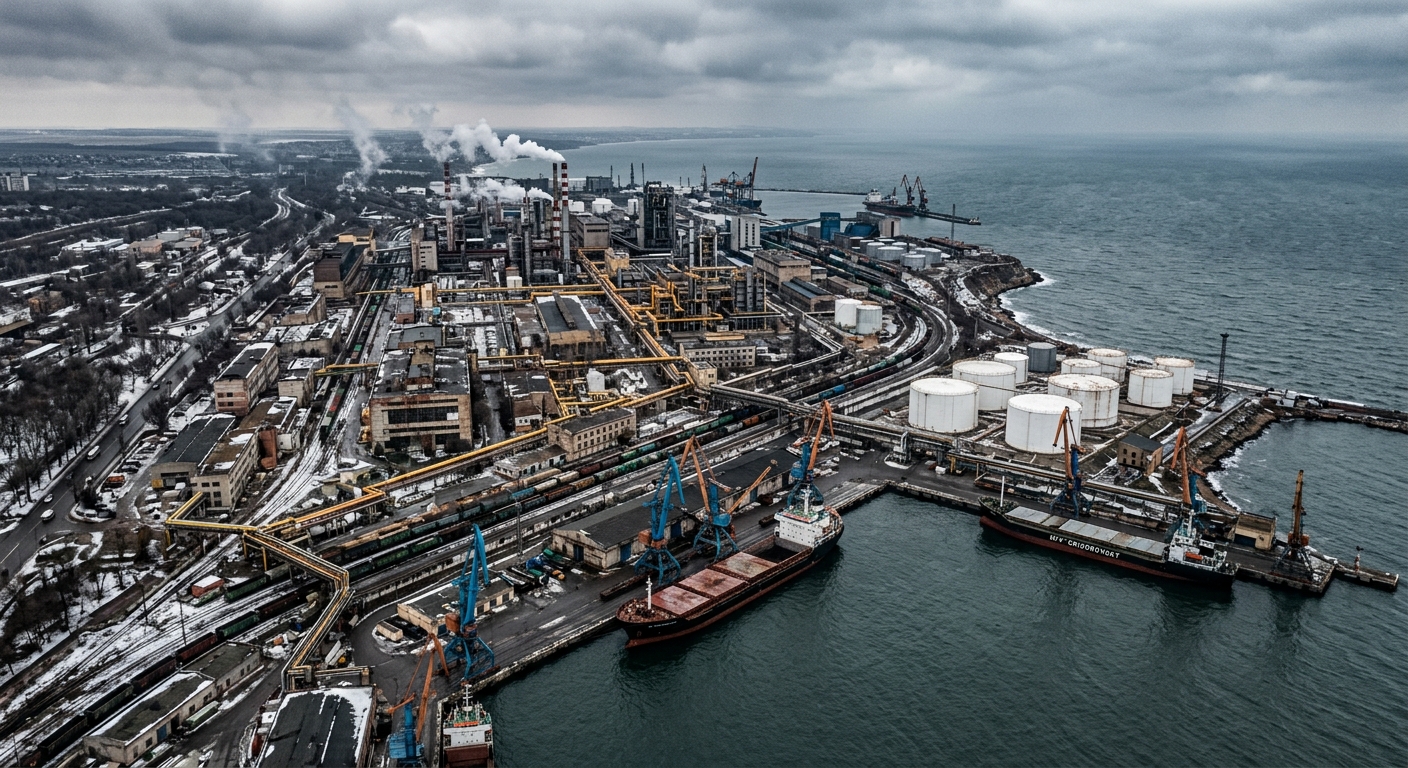
The lots — and who used to own them
State Property Fund (SPFU) Chairman Dmytro Natalukha laid out the 2026 auction slate at the Ukraine Recovery Conference in Gdańsk on June 25–26, telling reporters the fund would put the Odesa Portside Plant (OPZ), the Mykolaiv Alumina Plant, the Ocean Plaza mall, Sumykhimprom and the Demurinsky Mining and Processing Plant on the block by year-end, according to Interfax-Ukraine. Three of those five carry provenance that matters more than the reserve price.
Ocean Plaza, one of Kyiv's flagship shopping centers, was until 2023 controlled by the family of Arkady Rotenberg, Putin's boyhood judo partner. Ukraine's Security Service alleged that revenues from the mall had funded ammunition factories in Russia, and the High Anti-Corruption Court transferred its corporate rights to the state — a case documented by the Royal United Services Institute. The Mykolaiv Alumina Refinery — one of Europe's largest — was nationalized in June 2023 from Oleg Deripaska, the Russian aluminium magnate. Sense Bank, formerly Alfa-Bank Ukraine, was pulled from Mikhail Fridman, Petr Aven and Andrei Kosogov under a bespoke martial-law statute passed on May 29, 2023, as documented by Poland's
OSW Centre for Eastern Studies. The Ukrainian state now owns them. It wants out.
The $295M number is a floor, not a ceiling
Read narrowly, the target looks unambitious. UAH 13 billion is roughly 0.3% of Ukraine's projected 2026 revenues and less than 3% of a single month's wartime deficit. The IMF's June 12, 2026 staff-level statement projects GDP growth of just 1.0–1.6% this year and warns that "expenditures will remain elevated over the medium term" for defense and reconstruction. Privatization proceeds do not close that gap.
They are not meant to. What the number signals is a credibility test. Ukraine has tried to sell the Odesa Portside Plant twice — in July 2016 at UAH 13.175 billion, and again in December 2016 at a cut-rate UAH 5.16 billion. Both attempts collapsed. As the BBC Ukrainian service reported at the time, unresolved debts to Dmytro Firtash's Group DF — later confirmed by a Stockholm arbitration ruling — deterred every serious bidder. The Atlantic Council's
Melinda Haring warned in 2018 that without a policy on the Firtash debt, "the third attempt to privatize the Odesa Portside Plant will likely fail." That policy still does not fully exist.
The State Property Fund itself has a long history of missing revenue targets. The National Bureau of Economic Research paper by Guriev and colleagues, drawing on SPFU records, notes that the number of state-owned enterprises fell only from 4,604 in 2008 to 3,260 in 2023 — a 29% cut over 15 years despite four privatization "waves" — and finds that SOEs "crowd out private businesses and are overrepresented among laggard firms" in Ukrainian manufacturing, per the NBER working paper.
The Western pipeline behind the auction
The angle the wire copy misses: this auction is not a Ukrainian solo. It is being underwritten and choreographed by the same three institutions writing Kyiv's balance-of-payments checks.
The World Bank's Board approved a $3.39 billion Ukraine Jobs and Private Sector Growth Development Policy Operation on June 22, 2026, explicitly conditioned on "efforts to advance the privatization agenda," according to the World Bank press release. The European Commission's June 2026 proposal to disburse EU Ukraine Facility tranches — a document published on EUR-Lex — names as a structural condition "C5.R2 Reducing state ownership in the banking sector" and requires "entry into force of the legislation on the principles for the sale of state-owned banks," per the
EUR-Lex text.
The European Bank for Reconstruction and Development has separately signaled it will finance strategic investors into the very banks Ukraine is preparing to sell — Sense Bank and Ukrgasbank — with EBRD President Odile Renaud-Basso saying the bank could "provide financing for those efforts," as reported by Reuters via Global Banking & Finance. The UK Foreign Secretary Yvette Cooper's £290 million recovery package announced in Gdańsk includes a Bank of Lviv credit line and up to £65 million from British International Investment for co-financing with the EBRD, according to
GOV.UK.
Read together, these documents describe a single machine: multilateral lenders are guaranteeing the buyers, IFIs are conditioning grants on the sales going through, and Ukraine is producing the merchandise. The $295 million line item is the exit ramp for confiscated Russian capital into a Western-supervised owner class.
The IMF's fingerprints
The IMF's four-year, $8.1 billion Extended Fund Facility approved on February 26, 2026, makes this explicit. The staff-level agreement on the First Review, published June 12, 2026, states that "efficient management of state assets, well-functioning supervisory boards and professional management will be key pre-requisites to preserve the value of national assets, contain fiscal risks," per the IMF press release. The
IMF Country Report 25/156 from June 2025 shows Ukraine has already agreed to structural benchmarks on the Single Project Pipeline, financial-market infrastructure and international valuation standards — the plumbing that makes cross-border privatization deals close.
Critically, the June 12 statement flags that "progress on structural reforms has slowed" and that two Q1 structural benchmarks slipped. That is the pressure point. The 2026 auction calendar is not just a fiscal exercise; it is the corrective action the Fund extracted to keep disbursements flowing.
"As the [war continues], efficient management of state assets, well-functioning supervisory boards and professional management will be key pre-requisites to preserve the value of national assets, contain fiscal risks and mitigate governance vulnerabilities." — IMF staff, June 12, 2026
Who benefits, who loses
The clearest winners are Western strategic investors positioned to buy assets stripped of Russian ownership with multilateral risk cover behind them. The EBRD has signalled willingness to co-invest in Sense Bank and Ukrgasbank; BII is capitalising the Bank of Lviv; and the World Bank's ADVANCE Ukraine Trust Fund, backed by $540 million from Japan and $500 million in UK guarantees, exists precisely to de-risk private capital flows into Ukraine.
The clearest losers are the sanctioned prior owners. A completed, arm's-length sale to a Western strategic investor with EBRD equity is far harder to unwind in any future settlement than an asset the Ukrainian state simply holds. Rotenberg cannot credibly sue a Polish or German buyer of Ocean Plaza in a Kyiv court. Deripaska cannot easily reclaim an alumina plant sold to a Norwegian or Turkish smelter. Every closed deal is a permanent title change.
The ambiguous loser is Ukraine's domestic oligarchic class. Rinat Akhmetov bought a minority stake in regional power distributors during the last privatization wave, as the Atlantic Council documented in 2018. The SPFU under Natalukha — a former MP with a Foreign Affairs byline arguing against premature negotiations with Moscow, per his
Foreign Affairs contributor page — is under IMF-mandated pressure to run open, English-law-governed tenders that keep local incumbents from repeating that playbook. Whether that discipline holds under wartime opacity is the open question.
The historical parallel that reframes it
Poland privatized roughly 8,000 SOEs down to fewer than 100 across its post-Cold-War transition, a benchmark the Atlantic Council's Peter Dickinson invoked when Ukraine's parliament unblocked large-scale sales in March 2021. Ukraine still sits above 3,000 state entities. What is different in 2026 is that the assets on offer are not battered Soviet inheritances alone — they include prime commercial real estate in Kyiv, a Black Sea ammonia complex, and Europe's largest alumina refinery, all stripped from sanctioned Russians. That is a portfolio no post-communist state has ever brought to market.
Diplomat View
The forecast: Ukraine will miss the UAH 13 billion nominal target in 2026 — probably by 20–40% — but the auction of Ocean Plaza and at least one of the two industrial trophies (Mykolaiv Alumina is likelier than OPZ, which is still poisoned by Firtash debt) will close before year-end. That partial success is enough to keep the IMF's Second Review on track in late October 2026 and to justify the next World Bank DPO tranche.
The strategic point: Kyiv is racing the diplomatic clock. Every asset sold to a Western investor with EBRD equity becomes a fait accompli that no future US-brokered settlement can easily reverse. If a ceasefire framework emerges before these sales close, expect the Kremlin to press hard for the freezing — or reversal — of confiscations of Russian property. Selling the assets first eliminates the leverage.
What would revise the call: (1) a Rada vote diluting the state-owned-bank sale framework demanded by the EU Ukraine Facility, (2) an SPFU corruption scandal touching Natalukha's team, or (3) a US-brokered ceasefire term that explicitly addresses confiscated Russian assets. Absent those, the machine grinds forward.
What to watch next
- July 15, 2026 — SPFU publication of the updated auction calendar with reserve prices for OPZ and Ocean Plaza.
- September 15, 2026 — Ukraine's draft 2027 budget tabled; the privatization revenue line is the credibility signal.
- Late October 2026 — IMF Executive Board decision on the First EFF Review disbursement (~$690 million) and the setting of Second Review benchmarks.
The Bottom Line
Ukraine's $295 million privatization target is not a fiscal story; it is a title-transfer race. Kyiv is converting Russian-oligarch assets seized in wartime into permanent Western ownership before any diplomatic settlement can contest the confiscations — and the IMF, World Bank and EBRD are underwriting the entire pipeline. If enough deals close before a ceasefire, the de-Russianization of Ukraine's commanding heights becomes irreversible; if they don't, these assets become bargaining chips on someone else's table.
Discover more
India
Romanian Coalition Party Demands PM Resign
Romania's Social Democrats withdrew from coalition, joining far-right AUR to topple PM Bolojan, risking €10 billion in EU funds by August 2026.
India
Modi's Women’s Convention in Varanasi
Modi's Varanasi rally frames women's reservation as a national mission, targeting the 2027 Uttar Pradesh elections with a strategic narrative.

Conflict & Security
Drone Warfare Killing Aid Workers at Unprec
Over 1,000 humanitarian workers killed in three years as cheap armed drones collapse legal protections. Gaza, Sudan, Ukraine, and DRC see deliberate targeting of aid convoys and hospitals with zero prosecutions.

Global
World Normalises Taliban as Afghan Women Eras
UN data shows Afghan women erased from public life as Russia recognises the Taliban, EU hosts officials in Brussels, and ICC warrants for gender persecution go unenforced.