Ukraine Strikes Russian Tankers in Azov
Ukraine targets sanctioned vessels in bold overnight raid.
Model Diplomat7 min readEurope
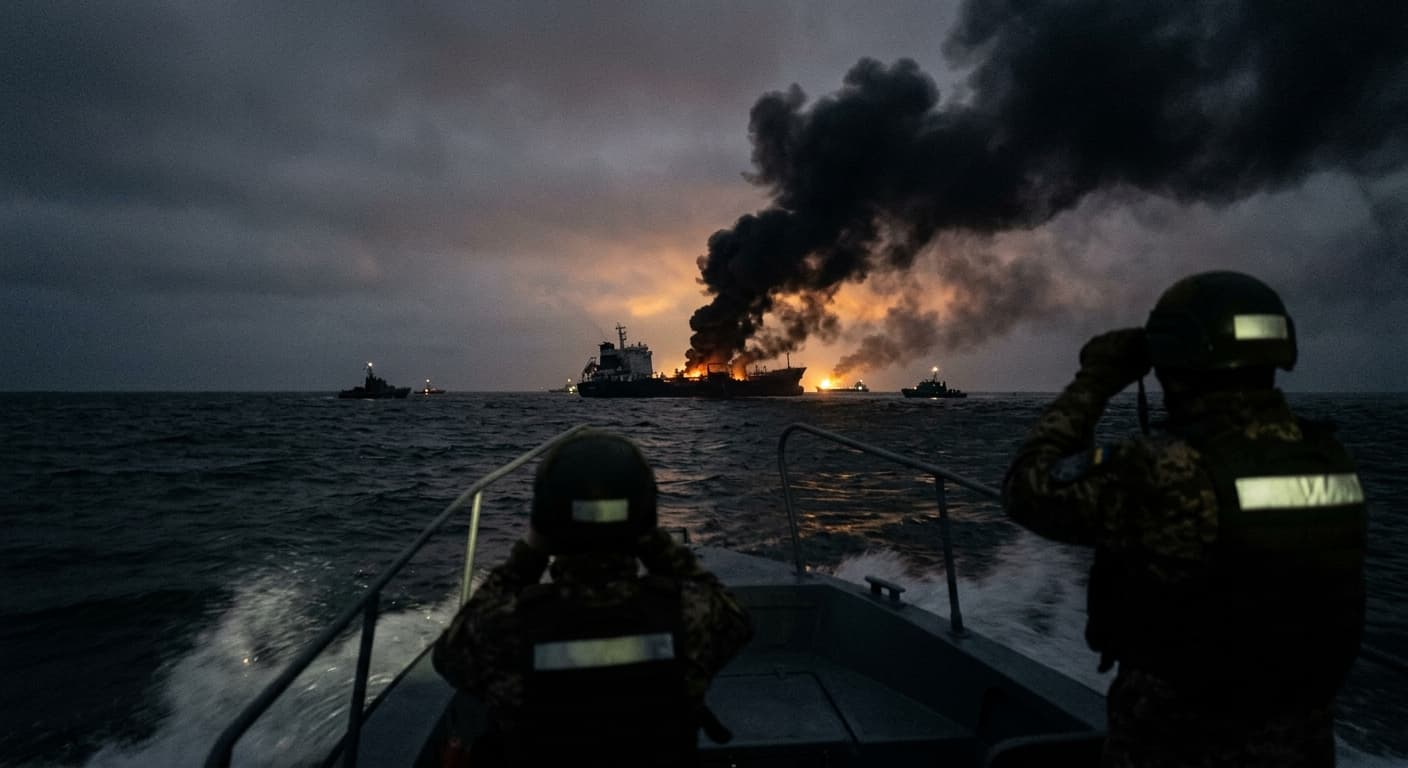
Ukraine Hits Eight Shadow-Fleet Tankers in Sea of Azov Strike
Ukraine's Unmanned Systems Forces struck eight sanctioned Russian tankers, a cargo ship and a ferry in a single overnight raid on July 7, 2026 — closing Moscow's last sea route to Crimea.
Ukraine's Unmanned Systems Forces (USF) reported on July 7, 2026 that overnight drone strikes hit 10 vessels in the Sea of Azov, including eight tankers already on Western sanctions lists as part of Russia's shadow fleet. The operation matters less for the tonnage sunk than for the geography: Moscow had treated the Azov as an internal Russian lake, the one basin where its sanctions-evading fleet could still move freely. That assumption ended overnight — and it ended at the exact moment Ukraine's six-week "logistics lockdown" has already severed the Kerch ferry crossing, disabled key rail bridges into Crimea, and forced Sevastopol to declare a state of emergency.
What actually happened
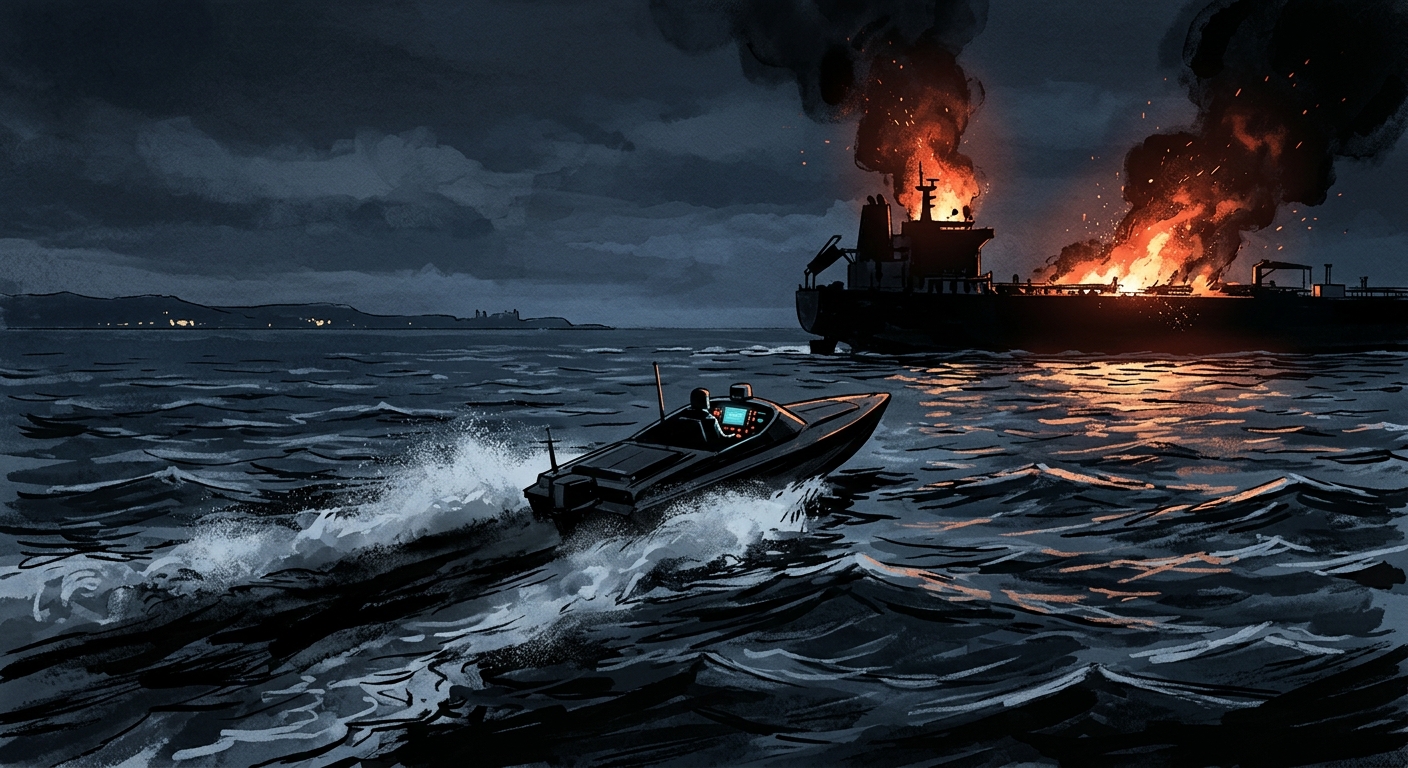
USF commander Robert "Madyar" Brovdi announced the raid on Telegram, claiming pilots from the Kairos unit of the 414th "Birds of Magyar" Brigade struck eight tankers plus a dry cargo ship and a ferry inside Russian-occupied waters. Seven of the eight tankers were already sanctioned by the EU, the UK, the US or a combination of them, according to United24 Media, which relayed Brovdi's designations. Each vessel is roughly 140 metres long and 7,000 deadweight tonnes, built between 2006 and 2012 — the ageing, thinly-insured hulls that make up the bulk of Russia's fuel-carrying dark fleet.
The BBC, which covered the same raid, reported that Brovdi described the vessels as "illegally loitering" in the ports of Mariupol, Berdyansk and adjacent coastal waters, and accused them of moving grain looted from occupied territories alongside military cargo and fuel. Azerbaijan's foreign ministry confirmed five Azerbaijani citizens were killed on two of the ships, naming the Nastra and the Circon — the first known third-country casualties on the shadow-fleet side of this campaign, and a diplomatic complication Kyiv will now have to manage.
Brovdi's summary was blunter than his casualty figures. "The shadow fleet exits the chat," he wrote, per The Deep Dive, which called it the largest single-night strike on Russia's maritime logistics of the war. In parallel, Ukraine's General Staff reported hits on two railway bridges in occupied Crimea and infrastructure in Russia's Bryansk region overnight, part of a wider 58-target sweep across the occupied operational zone.
Why the Azov strike is different
The dark-fleet story has, until now, been a Baltic and Mediterranean story. Ukrainian naval drones struck the Kairos and Virat off the Turkish coast in November 2025; a Russian LNG tanker, the Arctic Metagaz, was hit in the Mediterranean north of Libya in early 2026, according to the BBC. Those strikes rattled global shipping, but Russia could still route its export volumes and, critically, its Crimea-bound supplies through the semi-enclosed Sea of Azov — a body of water Moscow controls on three sides and where Ukrainian surface drones must transit hostile coast to reach targets.
That sanctuary is now gone. The July 7 operation shows Ukraine can prosecute targets inside the Azov at scale, at night, and against ten hulls simultaneously. The Royal United Services Institute, in a July 6 assessment of Kyiv's logistics campaign, judged that Ukraine's evolving unmanned systems have exposed "serious weaknesses in Russia's rear defences" and pushed Russian supply chains into "long vulnerable convoys" wherever pontoon and secondary routes remain, according to RUSI.
The strategic significance is that Moscow was running out of workarounds. Warsaw's Centre for Eastern Studies documented in late June that all three Kerch Strait rail ferries had been knocked out, and that bridges over the Syvash and North Crimean Canal were repeatedly struck between June 17–23, 2026, per OSW. With the ferry link down and the Crimean Bridge banning trucks above 1.5 tonnes, one of the fallback plans openly discussed by Russian officials was to move fuel to Crimea by tanker across the Azov. The Atlantic Council flagged this "import fuel via sea" option in a June
Ukraine Alert analysis. Kyiv has now made that option prohibitively risky.
The sanctions dimension: kinetic where paper failed
The Azov strike lands on top of a sanctions architecture that has grown teeth but not enough of them. On April 23, 2026, the EU adopted its 20th sanctions package, bringing the total number of Russian shadow-fleet vessels on its port-access-and-services blacklist to 632, according to the European Commission. The underlying regulation,
Council Regulation (EU) 2026/506, introduced mandatory "no-Russia" clauses on EU tanker sales and a scrapping derogation to accelerate the decommissioning of ageing hulls.
The strategic problem, as Brookings scholars Robin Brooks and Ben Harris documented, is that the fleet has kept growing even as the sanctioned share of it climbed to roughly 77% by March 2025 — meaning listings alone are not decisive when third-country flag registries and insurers keep underwriting the trade, per Brookings. A separate Atlantic Council
report noted 292 sanctioned-vessel transits through Danish waters in 2025 alone — traffic that European navies have been reluctant to interdict under UNCLOS.
Ukraine has now done what NATO capitals have not been willing to do. Where Copenhagen, Berlin and Paris cite the freedom-of-navigation regime, Kyiv is treating any vessel in occupied waters supplying the occupation force as a legitimate military target. That reframing — from sanctions enforcement to lawful wartime targeting — is the through-line connecting the November Black Sea strikes, the March Mediterranean incident, and today's Azov raid. It also puts every insurer, flag registry and shipowner on notice that the risk premium for shadow-fleet tonnage is now a kinetic one.
Who benefits, who loses
The immediate loser is the Russian occupation administration in Crimea. Sevastopol governor Mikhail Razvozhayev declared a regional state of emergency on June 26, 2026, and Sergei Aksyonov's Crimea government suspended petrol sales to the public earlier in the month, according to the BBC. Al Jazeera reported that motorists were queuing up to 10 hours at the pump and that tourists were abandoning bookings as the peninsula's summer season collapsed, per its June 15
feature from Crimea. Ukraine's General Staff, cited by
Al Jazeera, claims 42.74% of Russia's oil refining capacity is now disabled — a figure that, even discounted for wartime inflation, tracks Moscow's petrol export ban and rationing across 40+ regions.
The unexpected loser is the third-country crewing and ownership ecosystem that keeps the shadow fleet moving. The five Azerbaijani deaths reported on July 7 will now feed into an existing quiet lobbying campaign — inside Turkey, Azerbaijan, the UAE and India — to make Russian charter contracts less attractive. Insurers and P&I clubs already flinched at the Kairos and Virat strikes in November 2025. The Azov operation says the risk is not confined to open water.
The winner Kyiv did not have to fight for is a shift in the political economy of European enforcement. The German Institute for International and Security Affairs argued in a June SWP analysis that European states have hidden behind UNCLOS while Russia's shadow fleet doubles as a hybrid-warfare vector for cable-cutting and sabotage. Ukrainian action lowers the political cost for a Baltic or Nordic government contemplating a boarding: Kyiv is already destroying these hulls, so a detention looks moderate by comparison.
Russia's response signals the strain. RUSI documented that since late 2025 part of the dark fleet has moved directly onto the Russian flag — a costly reversal of the deniability Moscow spent $14 billion to construct — with roughly 80 tankers earmarked for re-flagging by the Russian Maritime Register of Shipping, according to a March 2026 RUSI commentary. Absorbing that liability onto the sovereign ledger means every future incident becomes a state-to-state matter.
The commander behind the campaign
Brovdi is not a peripheral figure. The BBC profiled him earlier this year as the commander of a force that is 2% of Ukraine's military but accounts for roughly a third of destroyed targets, on his own count. The Economist
described his subterranean command point and the pace of his kill chain in March 2026. He has publicly set a target of exceeding Russia's monthly recruitment rate in casualties inflicted, and reports one strike behind or on the frontline every 52 seconds in June.
That operational tempo is the doctrine behind the Azov strike. Where Western sanctions policy is legalistic and reactive — the phrase used by the Atlantic Council in its January dispatch on Baltic enforcement — Brovdi's playbook is industrial: cheap platforms, mass application, no legal ambiguity because it is prosecuted as war.
What to watch
- Kerch Bridge traffic: The bridge is now the sole meaningful road route into Crimea for anything under 1.5 tonnes. If the July 7 strike prompts Russia to allow heavy trucks back onto the bridge, expect Ukraine to hit it again — OSW's assessment is that a complete blockade still requires taking the Kerch out. Watch for repeat strikes in the week of July 14, 2026.
- Azerbaijani diplomatic response: Baku confirmed five citizen deaths. President Ilham Aliyev's next public statement, and any change in Azerbaijan's tacit tolerance of shadow-fleet crewing, will be a leading indicator of third-country risk repricing.
- EU 21st sanctions package: Council conclusions in late July or September 2026 are the next scheduled opportunity to add tankers, insurers and third-country refiners. Watch whether member states move to endorse boarding authority, not just listing.
- Russian re-flagging pace: RUSI's tracker of Russian-registered shadow tankers is the cleanest signal of how far Moscow is being forced to bring the fleet onto its own books. A sharp uptick in July would confirm the July 7 raid has changed the risk calculus.
The Bottom Line
Ukraine's July 7 strike on eight sanctioned tankers in the Sea of Azov is not another headline in the drone war — it is the moment Kyiv converted a European sanctions problem into a kinetic one and closed Moscow's last viable resupply route to occupied Crimea. If the tempo holds, the shadow fleet's economics will no longer be governed by listings in Brussels or Washington, but by the risk premium Robert Brovdi's brigade imposes at sea. That is a shift in maritime enforcement Western capitals spent three years avoiding.
Discover more
US Politics
House Ethics Committee Pushes Sexual Miscond.
The House Ethics Committee has shifted responsibility for sexual harassment settlement records to the Office of Congressional Workplace Rights, complicating disclosure efforts.

India
BJP's Misunderstanding of Women's Quota Needs
The BJP's linking of the Women Reservation Bill to delimitation risks delaying women's empowerment in India, misreading the aspirations of female voters.

US Politics
SNAP Food Assistance Faces Legal Challenges
In 2026, SNAP faces stricter eligibility rules and mounting legal challenges, threatening food assistance for the millions of Americans who rely on the program.

Conflict & Security
Drone Warfare Killing Aid Workers at Unprec
Over 1,000 humanitarian workers killed in three years as cheap armed drones collapse legal protections. Gaza, Sudan, Ukraine, and DRC see deliberate targeting of aid convoys and hospitals with zero prosecutions.