Ukraine Strikes 12 Russian Tankers Off Crimea
Major drone attacks disrupt Russian fuel supply lines.
Model Diplomat7 min readEurope
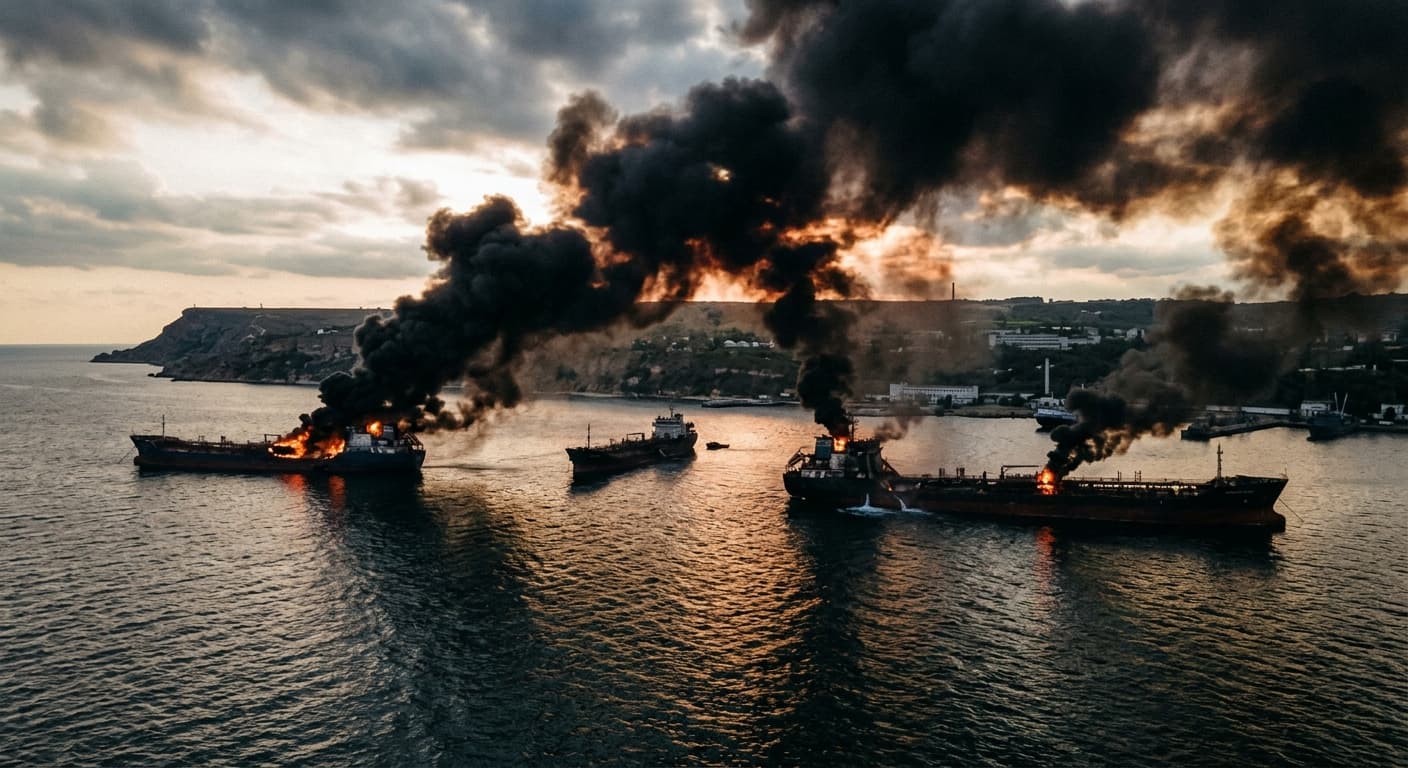
Ukraine Sinks 12 Russian Fuel Tankers in 48 Hours Off Crimea
Ukraine's drone forces struck 12 Russian fuel tankers, a cargo ship and a ferry in the Sea of Azov on July 6–7, 2026, choking Crimea's last supply line.
Ukraine's Unmanned Systems Forces (SBS) hit 12 Russian fuel tankers, a cargo ship and a ferry over two nights on July 6–7, 2026, in the largest claimed strike on Russian maritime fuel logistics since the full-scale war began. The strategic implication is narrower than the wire copy suggests: Kyiv has just closed the improvised sea corridor Russia built to replace the Kerch Bridge and southern rail lines it can no longer defend — turning occupied Crimea from a launch pad into a stranded garrison whose civilian rationing regime is now the norm, not the exception.
What actually hit the water
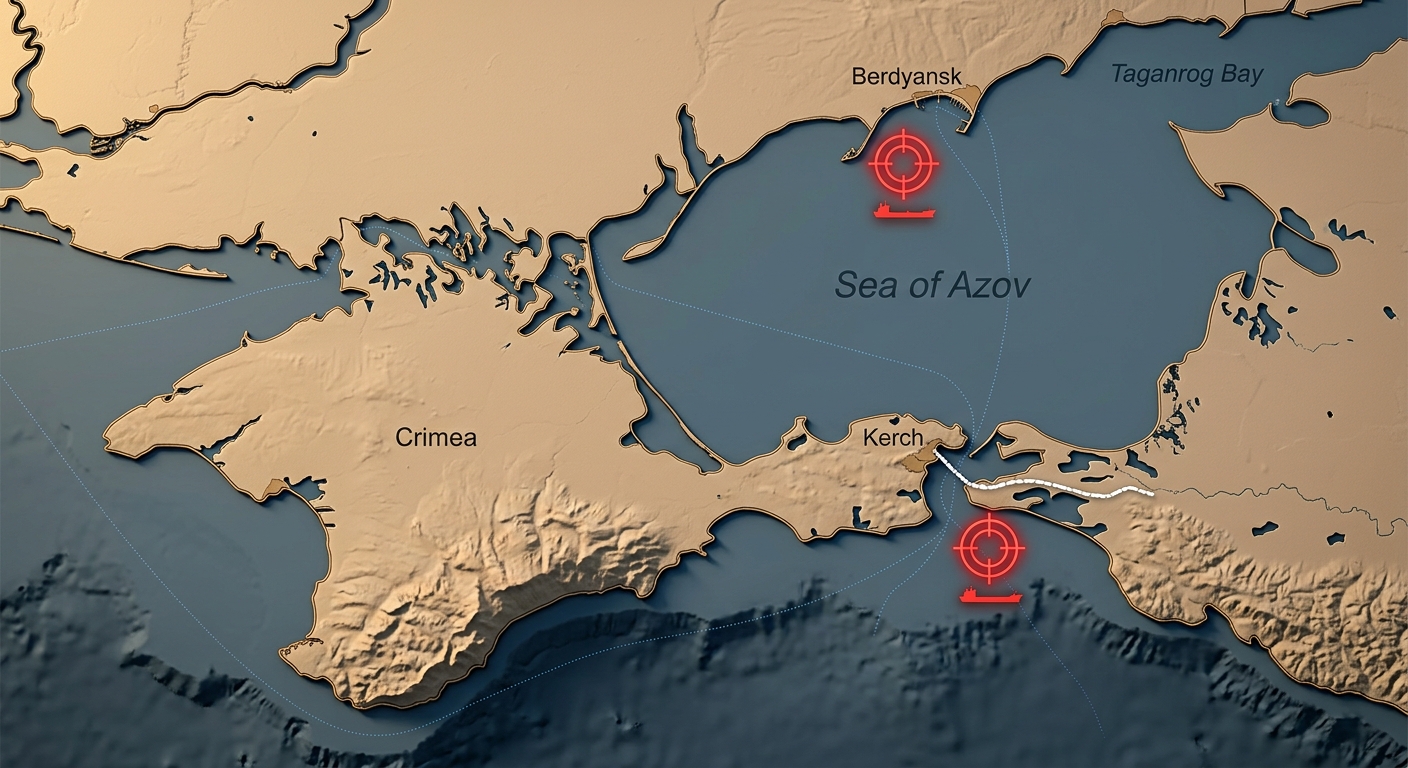
According to SBS commander Robert "Madyar" Brovdi, cited by Euromaidan Press, operators from the Kairos unit of the 414th "Birds of Madyar" brigade first struck two "shadow fleet" tankers each carrying roughly 7,000 tonnes of gasoline in a joint operation with the Ukrainian Navy on the night of July 6. The next night, drones damaged eight more sanctioned tankers plus a dry cargo vessel and a ferry running the Taganrog-to-Crimea route across the Sea of Azov, with two further tankers reported hit in a later update.
Brovdi framed the operation as the "battle for gasoline for Crimea." The BBC's Sarah Rainsford profile in April recorded him warning that "1,500 to 2,000 km inside Russian territory is no longer the 'peaceful rear'"; the Azov strikes extend that logic to Russia's own coastal waters.
UNITED24 Media reported his terser summary: "The shadow fleet exits the chat."
Alongside the maritime attacks, Brovdi said SBS crews struck 47 targets on July 6 and 58 on July 7, including two S-400 Triumf launchers, a Nebo-U surveillance radar near Kerch, five electrical substations and a gas compressor station. Ukraine's General Staff separately confirmed the S-400 destroyed in Bryansk Oblast had been used to launch ballistic missiles toward Kyiv.
Why the sea corridor existed at all
To understand why the tankers matter, follow the map. The Kerch Bridge — the "strategic object" that Ukraine's Defence Intelligence chief Vadym Skibitskyi told the HUR press service "supplies the entire southern group of troops" — has been degraded to the point where, as Harvard's Craig Kennedy told the
BBC, "I wouldn't want to put a truck full of diesel on the Kerch Bridge right now — that's just asking for trouble." Ukrainian strikes on the Chonhar bridges and the Rostov-to-Mariupol motorway have made the land routes almost as dangerous.
That left Moscow with the sea. In late June, Al Jazeera documented how Russia was pushing fuel across the Kerch Strait via the ferry port at Kavkaz and importing more gasoline through Taganrog — the very route SBS hit this week. The
Atlantic Council's Peter Dickinson noted on June 23 that Russia was "improvising solutions such as pontoon bridges" and planning to import fuel by sea. Ukraine's July 6–7 attacks answered that improvisation directly.
Civilian rationing as the new baseline
The Kremlin-appointed head of Crimea, Sergey Aksyonov, suspended retail fuel sales to civilians and businesses on June 21, 2026, reserving gasoline for "government agencies ensuring Crimea's functioning and security." That order predated the tanker strikes; it was already the response to strikes on the Kerch oil depot that killed four people. On June 8, Russia's energy ministry publicly acknowledged "temporary difficulties" in the "southern regions" and stood up a permanent headquarters to manage the shortages — Moscow's first formal admission that the fuel crisis had escaped local control.
Ukraine's Defence Minister Mykhailo Fedorov had earlier promised to turn the peninsula into "an island." The July operation is the naval half of that logistics lockdown. According to Brovdi, SBS has hit 44 energy facilities in occupied Crimea and southern occupied Ukraine since July 1 alone.
The shadow fleet as a strategic target
The tankers hit off Crimea sit at the intersection of two Ukrainian campaigns: kinetic disruption of Crimean logistics, and what RUSI has called Kyiv's "kinetic sanctions" on Russia's global oil trade. On May 7, 2026, Ukraine's military intelligence directorate (HUR) added 12 shadow-fleet tankers and more than 200 captains to its
War & Sanctions portal, naming Rosneft, Surgutneftegaz, Novatek and Lukoil as end-users of the trade. Two months later, ships of that class are being sunk in the Azov.
President Volodymyr Zelenskyy's office says Ukraine has now formally sanctioned 91 shadow-fleet vessels flying flags from Panama to Palau — of which only 27 were already sanctioned by G7 partners, per the presidential decree issued this spring. The Kyiv logic is simple: if Western sanctions enforcement is slow, drones are not.
"Each such vessel should be regarded as an element of financing Russia's war machine," Ukraine's sanctions commissioner Vladyslav Vlasiuk said in
the presidential statement.
The pressure is measurable. A New Strategy Center analysis drawing on Kyiv School of Economics data found the shadow fleet's effective operational capacity had contracted by 34% in deadweight tonnage against theoretical capacity by early 2026 — a function of Western sanctions on specific hulls, KSE estimates that Russia has lost about $166 billion in oil revenue since March 2022, and now the added risk premium of physical attack.
Brookings' database puts 264 of 343 identified shadow tankers under sanction by at least one Western jurisdiction.
The second-order effect Moscow cannot easily fix
The Carnegie Endowment's Sergey Vakulenko argues that Russia's crude export revenues have proven resilient because Ukrainian attacks on refineries have coincided with global price spikes: refined-oil output fell about 13% in April–May 2026 against pre-strike levels, but higher Urals prices offset the volume loss. That is the case for Moscow's macroeconomic durability.
It is not the case for Crimea. The peninsula's problem is not export revenue; it is retail gasoline. Refineries under repair cannot dispatch product; damaged terminals cannot load ferries; ferries and tankers that do sail are being hit. The Al Jazeera video desk confirmed that on the same day the tankers burned, Ukrainian drones also struck a fuel terminal in occupied Crimea itself. Every link in the chain is under simultaneous fire.
The Carnegie Endowment's Ukraine-focused Black Sea study reported that Russia's Black Sea Fleet has lost 25% of its long-range missile-strike capacity and nearly 40% of its anti-ship missile capability since 2022, with seven of twelve landing ships destroyed or disabled. Novorossiysk remains its only fully functional naval base. That is why Moscow cannot simply escort tankers through the Azov: it lacks the surface combatants and small-boat air defense to police a 380-kilometer sea route against saturation drone attacks originating from Ukrainian-held coast.
Who benefits, who loses
The immediate beneficiary is Ukraine's ground command. Occupation of Crimea forces Russia to run supplies south — every tonne of gasoline burned in the Azov is a tonne not reaching artillery batteries in Kherson and Zaporizhzhia. The secondary beneficiary is the G7 sanctions regime, which for three years has struggled to enforce the $60 price cap against shadow-fleet workarounds. Ukraine is doing physically what Brussels and Washington have declined to do politically: making the marginal shadow-tanker voyage uninsurable at any price.
The loser is not primarily Vladimir Putin's federal budget, which continues to draw revenue from Asia-bound crude flows. It is the political economy of the occupation itself. Crimea was meant to be Moscow's demonstration project — annexed, absorbed, normalized. A peninsula where residents queue 10 hours for 20 litres of fuel, where Russian tourists cannot find gasoline to drive home, and where the Russia-appointed governor admits "it does not appear possible to fully satisfy the demand," is the opposite of the propaganda offer.
What to watch
- Russian escort response. Whether the Black Sea Fleet redeploys surviving small combatants and Pantsir systems from mainland air defense to escort Azov tanker traffic — and at what cost to coverage of Kerch and Novorossiysk.
- Insurance withdrawal. Whether reinsurers still touching sanctioned tanker voyages to Russian Azov ports pull cover in the next 30 days, following the RUSI-flagged pattern after the November–December 2025 strikes.
- Next Ukrainian target set. Brovdi has publicly telegraphed that the campaign will extend to Novorossiysk-linked logistics; the Fire Point FP-1 production ramp cited by
Aviation Week suggests capacity is not the constraint.
- Aksyonov's next fuel decree. Whether the June 21 rationing order is extended or tightened in the two weeks after the tanker strikes — the clearest public metric of whether the sea corridor can be reconstituted.
The Bottom Line
Ukraine has not won the war with 12 tankers, but it has closed the last low-risk logistics channel into occupied Crimea and turned Russia's shadow fleet — the same vessels the G7 has spent four years failing to sanction into irrelevance — into legitimate military targets in the Sea of Azov. The strategic significance is not the count of hulls burning; it is that Moscow now has no cheap way to keep the peninsula functioning as a launch pad, and every fix — pontoon bridges, ferries, tankers — is inside the drone envelope. Crimea is becoming a liability, not a fortress.
Discover more
Global Politics
Xi Jinping Calls China-Russia Ties 'Precious'
Xi Jinping's description of China-Russia ties as 'precious' reflects a strategic imbalance, with Beijing dictating terms in the partnership.

US Politics
House Ethics Committee Pushes Sexual Miscond.
The House Ethics Committee has shifted responsibility for sexual harassment settlement records to the Office of Congressional Workplace Rights, complicating disclosure efforts.

US Politics
Virginia's Redistricting Referendum
Virginia's redistricting referendum is drawing a flood of dark money, shaping future elections and the fight for congressional control amid party stakes.

Conflict & Security
Drone Warfare Killing Aid Workers at Unprec
Over 1,000 humanitarian workers killed in three years as cheap armed drones collapse legal protections. Gaza, Sudan, Ukraine, and DRC see deliberate targeting of aid convoys and hospitals with zero prosecutions.