Ukraine Signs Drone Deals with NATO Allies
New agreements enhance Ukraine's defense exports.
Model Diplomat8 min readEurope
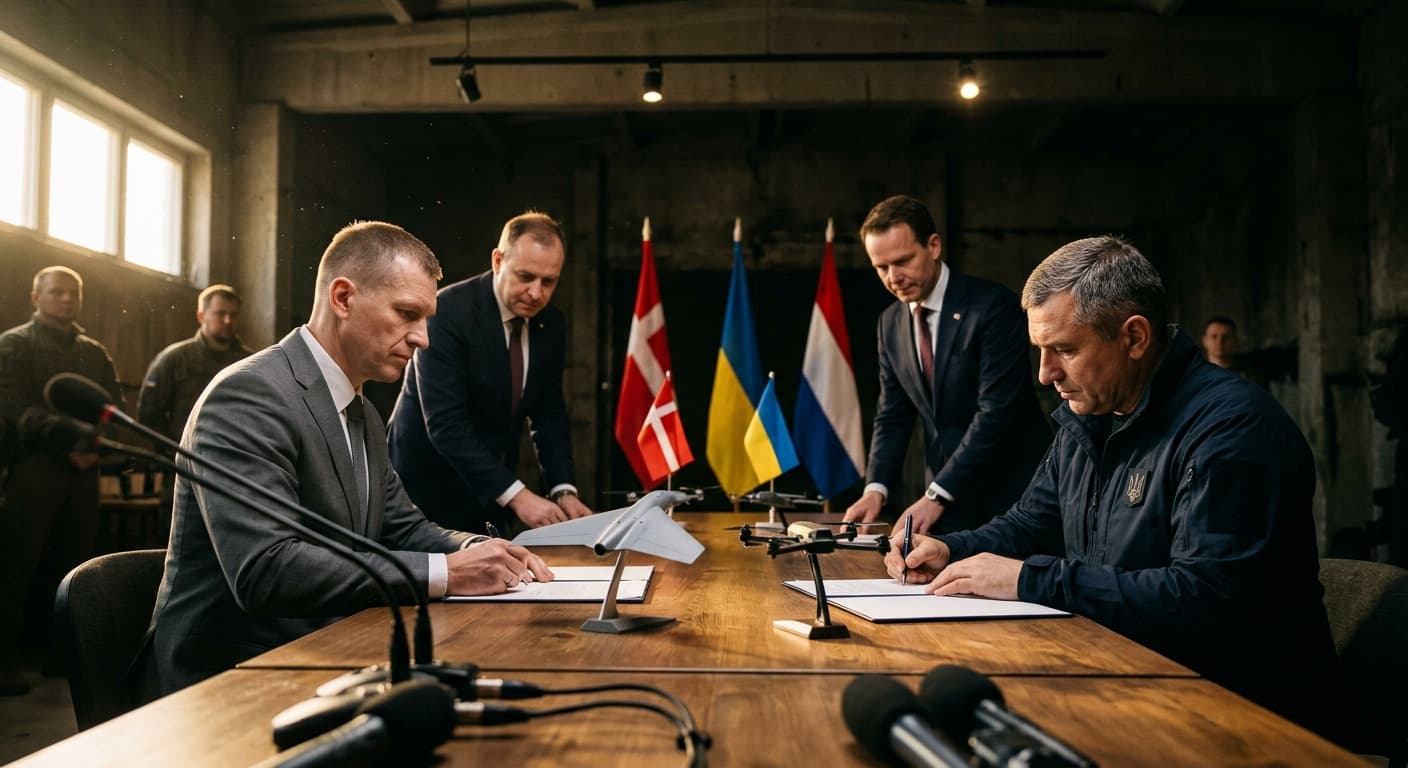
Ukraine's Ankara Drone Pact: Estonia, Netherlands, Denmark Sign
Ukraine signed three new Drone Deal agreements at the Ankara NATO summit on July 7, 2026, with Estonia, the Netherlands and Denmark, deepening a Russia-facing defence-industrial bloc.
Ukraine used the sidelines of the Ankara NATO summit on July 7, 2026, to sign three new "Drone Deal" agreements — with Estonia, the Netherlands and Denmark — that convert Kyiv's battlefield expertise into a formal export franchise across NATO's most exposed northern flank. The Denmark pact, Ukraine's ninth in the format, completes a defence-industrial belt running from the Baltic to the North Sea in which Ukraine is no longer the aid recipient but the supplier of the drone doctrine Europe does not yet possess. For the Baltic and Nordic states, the bet is that Ukrainian know-how buys them the one capability NATO planners privately concede they lack — mass, cheap, attritable air power at scale.
What was signed in Ankara
President Volodymyr Zelensky and Estonian Prime Minister Kristen Michal signed the Estonia–Ukraine drone cooperation agreement on the summit margins, covering joint military production on both sides of the border and air-defence capabilities, according to NV and
Yevropeiska Pravda. Michal called it "a big step forward in defence cooperation." Hours later, Zelensky met Dutch Prime Minister Rob Jetten, signing a second pact covering drones, joint production, cybersecurity, R&D and — critically — potential Ukrainian arms exports, per a readout carried by
Rubryka.
The Denmark agreement, announced later the same day, was framed by Kyiv as the ninth Drone Deal Ukraine has concluded since the format was rolled out in early 2026. It builds directly on the so-called "Danish model" of allied-funded procurement from Ukrainian factories and, according to Antikor, gives Copenhagen guaranteed access to Ukrainian defence exports once Kyiv's licensing regime opens fully. The Rutte–Zelensky bilateral in Ankara on July 7, 2026 — where the President previewed the industrial track and pushed for Patriot deliveries — is logged on the
NATO media portal.
The context matters. In a speech at the summit reported by the BBC, Zelensky argued that "Russia is placing its bets on ballistic weapons, and those who want peace must place their bets on protection against ballistic attacks." The three Drone Deals are the industrial correlate of that message: partners help finance Ukrainian scale, Ukraine reciprocates with combat-tested interceptors, and both sides bank the surplus.
Ukraine's Drone Deal partners, 2026
| Country | Signed | Core content | Distinguishing feature |
|---|---|---|---|
| Germany | Apr 14, 2026 (Berlin) | €4bn air-defence package; drone co-production | Largest bilateral partner; Quantum-Frontline JV |
| Norway | Apr 2026 | Licensed production of Ukrainian UAS | Licence-manufacture model |
| Italy | Apr 2026 | Exchange on unmanned systems doctrine | Doctrine/experience focus |
| United Kingdom | Mar 2026 (updated) | Co-production; Ukrspecsystems factory in Suffolk | Confidential 2024 framework upgraded |
| Estonia (LoI) | Apr 25, 2026 | €15m for joint production projects | Baltic entry point |
| Estonia — Drone Deal | Jul 7, 2026 (Ankara) | Joint production; air defence | Formalises April LoI |
| Netherlands — Drone Deal | Jul 7, 2026 (Ankara) | Drones, cyber, R&D, exports | Adds to $1bn Dutch procurement line |
| Denmark — Drone Deal (9th) | Jul 7, 2026 (Ankara) | Joint production; export access | Extends "Danish model" — ~€597m delivered to date |
The mechanism: from aid recipient to arms exporter
The three Ankara agreements are not stand-alone press events; they are the operational layer on top of an export architecture Kyiv finalised in late spring. On May 28, 2026, an OSW analysis set out that Ukraine has ended its de facto arms-export ban only for products routed through two frameworks: the "Build with Ukraine" programme and the "Drone Deals" initiative. In practice, no European partner can lawfully buy a Ukrainian FPV, interceptor UAS or long-range strike drone off the shelf unless its government has signed an intergovernmental drone-deal umbrella. That agreement is now the price of admission — and the reason three prime ministers cleared their schedules on July 7.
The Cabinet of Ministers in Kyiv approved the enabling decree days before the summit — a threshold-based permit regime that clears export contracts above 15 million hryvnia within 30 days, according to Ukrainian Wall. National Security and Defence Council Secretary Rustem Umerov has told OSW analysts that the first contracts will be executed in the second half of 2026, with projected annual revenues in the "several billion dollars." Zelensky argued in February that Ukrainian defence exports could eventually rival agriculture as a pillar of the economy.
The scale story sits underneath. Ukraine manufactured between 2.5 million and 4 million drones in 2025 and targets roughly 7 million in 2026, according to a Council on Foreign Relations brief. By contrast, the entire U.S. small-drone manufacturing base produces fewer than 100,000 units a year, per
Foreign Affairs. Europe's output, the same essay notes, is "not meaningfully better." That gap — a factor of roughly 70 between what Ukraine can build and what a major NATO ally can — is what the three Ankara signatures are pricing in.
Why these three, why now
Estonia matters less for volume than for doctrine. Tallinn's April 25, 2026 letter of intent — €15 million earmarked for joint production, described in an OSW commentary — was a placeholder for something bigger. The Foreign Affairs essay records how Ukrainian drone pilots "effectively wiped out two NATO battalions in a single day" during exercises in Estonia last May — before NATO could deploy its own drones. Estonia has since spent 18 months trying to build a domestic drone start-up ecosystem, and it needs Ukrainian airframes, ground-station software, and pilots with combat hours. The
BBC reported the September 2025 airspace incident in which stray Ukrainian drones crossed from Russia into Estonian and Latvian territory — a moment Michal used to argue that walls do not work, but interceptors might.
The Netherlands brings money and mass. The Hague is already the second-largest bilateral funder of Ukrainian-produced drones, having allocated roughly $1 billion under a direct-contracting variant of the Danish model, according to CSIS testimony by Kate Bondar. What the July 7 agreement adds is a bilateral framework covering joint IP, cyber and R&D — the pieces a pure procurement contract could not carry. Dutch Defence Minister Dilan Yeşilgöz told
Al Jazeera that the Netherlands would announce more than €3 billion in defence deals in Ankara. The Drone Deal sits inside that package alongside a €2.4 billion UK–Netherlands amphibious-ship partnership signed the same day by Keir Starmer and Rob Jetten, confirmed by
10 Downing Street, whose flight decks are specifically designed to launch "current and future long-range drones and autonomous systems."
Denmark is the pioneer that lets Kyiv franchise the model. Copenhagen invented the "Danish model" of direct, allied-funded procurement in 2024; CSIS calculates that the mechanism has now generated nearly €597 million in delivered weaponry, of which Denmark itself supplied €175 million. Denmark's initial €50 million tranche funded 18 Bohdana howitzers delivered to the front two months after signature — a benchmark for speed. A Danish "fast-track" law, described in an LSE paper by Tamar Jacoby, was passed expressly to let Ukraine's Fire Point build a solid-rocket-fuel plant near Skrydstrup airbase, bypassing standard environmental review. The July 7 pact widens that model. Danish officials have flagged SkyFall — maker of the Vampire and P1-Sun interceptor — as the next Ukrainian entrant.
The Screenshot Number
7 million drones: Ukraine's 2026 production target, versus fewer than 100,000 built annually by the entire U.S. small-drone industry. Source: CFR;
Foreign Affairs.
Winners, losers, and the historical parallel
The clear beneficiaries are the mid-sized European industrial states that never had a chance of matching French, German or American primes on their own — Estonia, Denmark, the Netherlands, Norway, the Baltic three — and Ukrainian firms that gain durable, non-Kyiv-financed production lines. Fire Point, Ukrspecsystems, SkyFall, Frontline Robotics, TAF Industries and Airlogix each now have named foreign anchor sites; the Atlantic Council has begun calling this "drone diplomacy."
The losers are subtler. Legacy European primes lose their monopoly on serial production for their own governments — the Netherlands is signing directly with Ukrainian manufacturers, and Copenhagen's fast-track law bypasses domestic incumbents. Poland loses relative status: the OSW notes that "bilateral intergovernmental agreements between Poland and Ukraine have yet to be implemented" under Build with Ukraine, despite years of company-level ties. And the United States loses a form of leverage. Zelensky offered Washington a drone deal a year ago, per the BBC; the Trump administration declined. Kyiv is now diversifying without it, even as
Al Jazeera reports that Washington has begun a phased withdrawal of warplanes, destroyers and submarines from NATO countries.
The historical parallel is not the Lend-Lease Act — Ukraine is neither creditor nor arsenal in that classical sense. It is closer to the postwar Marshall Plan's counterpart-fund logic inverted: European capital finances Ukrainian production for shared use, with contract terms structured so that surplus flows back into partner inventories. The CSIS testimony cited above projects that up to $10 billion may flow through these mechanisms in 2026 alone.
What to watch next
- Canada's Drone Deal: Ukrainian and Canadian officials are preparing a fourth Ankara-vintage agreement, per
Moy By; the next Zelensky–Carney bilateral is the trigger.
- The FirePoint plant in Skrydstrup: initial production line was expected to open later in 2026, but corruption investigations touching individuals linked to the firm — flagged in the
OSW commentary — could delay commissioning. This is the single most reputationally exposed pilot.
- First licensed exports under the 30-day permit regime: Umerov targets the second half of 2026. The first contract publicly executed will set the pricing benchmark.
- The Trump–Zelensky bilateral in Ankara on July 8, 2026: whether Washington re-engages the drone track — or continues to cede the file to European capitals — will determine whether the Drone Deal architecture becomes a NATO-wide framework or a European workaround.
Diplomat View
The Ankara three should be read not as gestures of solidarity but as commercial term-sheets negotiated under wartime discount. Kyiv now controls the licensing gate on the most in-demand class of weapon in the alliance, and it is charging admission in the currency of long-term production commitments, air-defence transfers and export-market access. Our forecast: by end-2027, at least twelve NATO members will have signed Drone Deals, and Ukrainian-designed platforms will account for a majority of new small-UAS procurement across the Nordic-Baltic corridor. This forecast is falsifiable in three ways — a peace settlement that includes Russian veto rights over Ukrainian defence exports; a Trump administration decision to sanction third-country transfers of Ukrainian technology; or a corruption scandal at Fire Point or a peer firm that spooks Copenhagen and The Hague. Absent those triggers, the drone franchise is now Ukraine's most durable claim on European security — more portable than NATO membership, harder to unwind than a security guarantee, and cheaper for partners than building it themselves.
The Bottom Line
Ukraine's three Drone Deal signatures in Ankara — Estonia, the Netherlands, Denmark — are the moment Kyiv stopped being the object of European defence policy and became its supplier. The Danish model financed Ukrainian howitzers; the Drone Deal franchise now sells Ukrainian doctrine, workforce and airframes back into NATO inventories. The company that benefits most is not European.
Discover more

US Politics
SNAP Food Assistance Faces Legal Challenges
In 2026, SNAP faces stricter eligibility rules and mounting legal challenges, threatening food assistance for the millions of Americans who rely on the program.

US Politics
House Ethics Committee Pushes Sexual Miscond.
The House Ethics Committee has shifted responsibility for sexual harassment settlement records to the Office of Congressional Workplace Rights, complicating disclosure efforts.
US Politics
Congress Targets AI Chatbot Access for Terror
The House passed the Generative AI Terrorism Risk Assessment Act, focusing on AI's role in terrorism and potential surveillance implications.

Conflict & Security
Drone Warfare Killing Aid Workers at Unprec
Over 1,000 humanitarian workers killed in three years as cheap armed drones collapse legal protections. Gaza, Sudan, Ukraine, and DRC see deliberate targeting of aid convoys and hospitals with zero prosecutions.