UK-Türkiye Defence Pact Strengthens NATO
New partnership solidifies Türkiye's role in European security.
Model Diplomat8 min readEurope
UK-Türkiye Defence Pact Locks Ankara Into NATO's European Pillar
The 8 July 2026 UK-Türkiye Security and Defence Partnership, signed in Ankara alongside a $50.66bn NATO strike initiative, quietly anchors Erdoğan's rearmed Türkiye inside Europe's post-American security architecture.
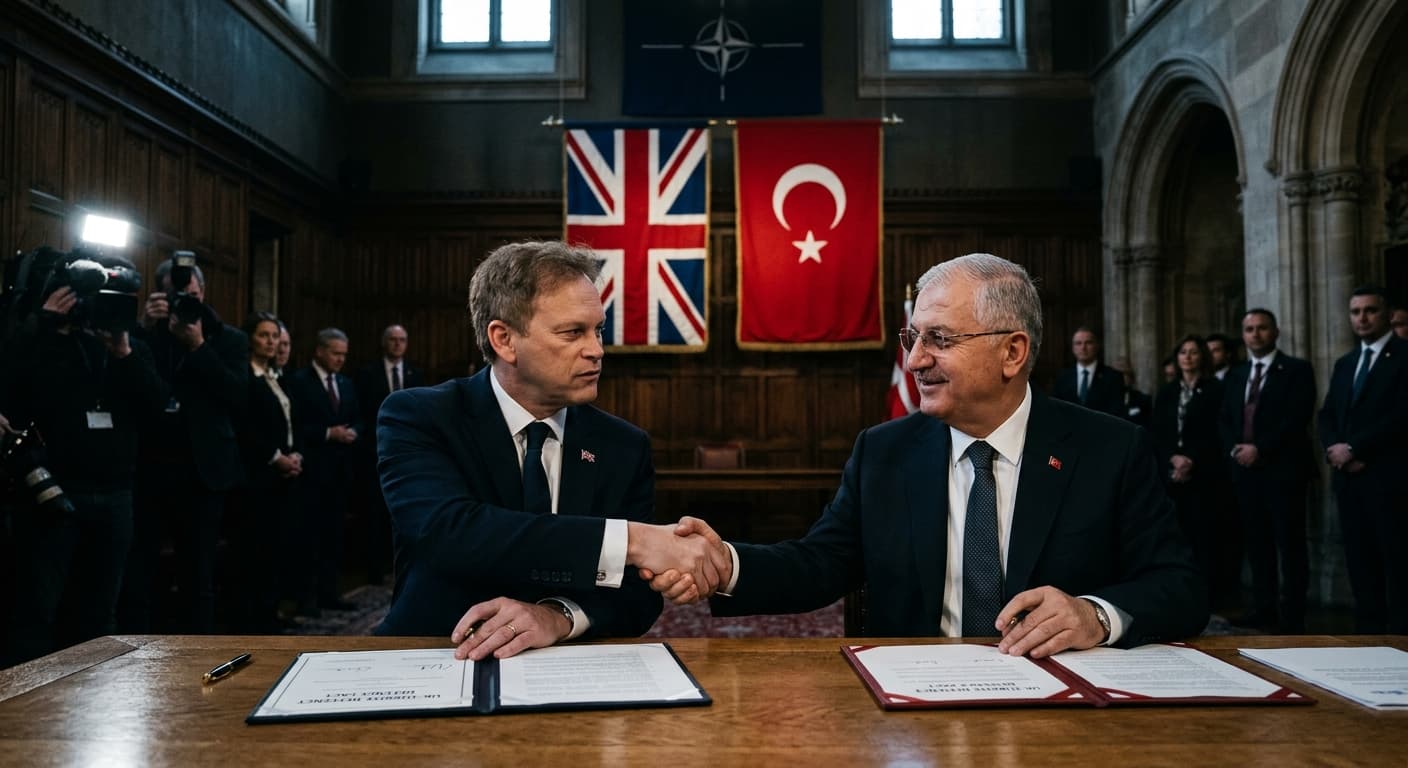
The UK and Türkiye signed a Security and Defence Partnership in Ankara on 8 July 2026, in a text kept confidential but built explicitly on the model of the 2021 France-Greece pact — and its immediate effect is to lock NATO's second-largest army into the emerging European defence pillar at the exact moment the Trump administration is pulling US forces off the continent. That is the story. The Typhoon jets are the trigger; the wider prize for London is a strategic bet that a rearmed, Western-supplied Türkiye is a safer neighbour to Greece, a harder problem for Moscow, and an indispensable industrial partner as Britain tries to build a defence economy without EU membership.
The pact was signed on the sidelines of the 36th NATO Summit by Prime Minister Keir Starmer and President Recep Tayyip Erdoğan. The joint statement published by 10 Downing Street commits both governments to "deepening consultations through new mechanisms on the politico-military aspects of security and defence policy," running across deterrence, defence industry, cyber, hybrid threats, counter-terrorism, resilience and space. The operative text is not being released. According to
Middle East Eye, Ankara-based sources say the document mandates the two states to "support each on every matter on defence" and describe it as "in the same spirit" as the 2021 Franco-Greek Strategic Partnership — which contains a mutual defence clause echoing NATO Article 5. Whether the UK-Türkiye text carries the same clause, officials on both sides refuse to say.
Why the France-Greece precedent matters
The 2021 pact between Paris and Athens broke a taboo. As the Atlantic Council noted at the time, its Article 2 obliged the two NATO members to assist each other "with all the means at their disposal, in the event that armed force is needed" against an attack on either's territory — the first intra-alliance defence guarantee designed to cover threats originating inside NATO. In practice, that meant French protection for Greek claims against Türkiye.
Al Jazeera confirmed at ratification that it went "beyond" NATO obligations.
Reading the UK-Türkiye deal through that lens explains why the operative text is being suppressed. If it contains a comparable clause, London has just underwritten Ankara politically against Greek and Cypriot maritime claims — a diplomatic earthquake even in a summer of upheavals. If it does not, the deliberate ambiguity still gives Erdoğan most of the deterrent value of one. Either way, the ELIAMEP policy paper published in Athens last October captures the Greek anxiety: closer Western defence-industrial ties with Erdoğan's Türkiye are seen as "corrosive to the norms and interests binding collective security arrangements among EU member-states." Athens will not protest publicly this week — Greece is a NATO host — but the Foreign Ministry's file on this is already thick.
The industrial spine: Typhoons, not paperwork
Every strategic partnership needs a cash-flow. This one has $10.5 billion of it. The pact codifies the political relationship first sketched when Starmer and Erdoğan signed the 20-aircraft Eurofighter Typhoon contract in Ankara on 27 October 2025, worth around £8 billion and supporting some 20,000 UK jobs, according to the BBC. A follow-on training and support contract was signed in London on 25 March 2026. Britain's
Ministry of Defence has confirmed a 37% UK workshare, with radars from Edinburgh and Rolls-Royce engines from Bristol — the first Typhoon export order won since 2017.
The wider industrial logic is set out by the Hudson Institute's Luke Coffey, who calls the sale a "win-win" that fills the fifth-generation gap left by Türkiye's expulsion from the F-35 programme after its 2019 purchase of the Russian S-400. Türkiye's own defence and aviation exports surpassed $10 billion in 2025, up 48% year-on-year — a figure cited by Brookings scholar Aslı Aydıntaşbaş in
her analysis of Turkey's strategic repositioning. Ankara now supplies more 155mm artillery ammunition inside NATO than most European members produce — a fact Kyiv understands better than Brussels does.
The Trump variable — and why London moved first
The pact must be read against the acute crisis in transatlantic relations. On the summit's opening day, President Donald Trump lashed out at NATO members, singling out Spain as a "terrible partner," according to Al Jazeera's live coverage. Only five allies are projected to hit the 3.5% core defence spending target the alliance set at The Hague last year. NATO Secretary General Mark Rutte's
pre-summit briefing framed Ankara explicitly as a "delivery summit" for the 5%-of-GDP-by-2035 commitment agreed at The Hague — 3.5% on core defence, 1.5% on resilience.
The bigger deliverable of the summit — beyond the €70 billion Ukraine assistance pledge reported at closing — is a 12-nation Deep Precision Strike Capability Investment Initiative. The
joint statement issued by Downing Street commits Denmark, Estonia, Finland, France, Germany, the Netherlands, Norway, Romania, Spain, Sweden, Türkiye and the UK to "collectively determined to invest $50.66 billion in DPS over the next 10 years," explicitly framed as a response to "recent US force adjustments." Türkiye's presence in that list is the tell. This is the first time Ankara has been slotted into a European long-range fires consortium — the sort of programme that, five years ago, would have been an EU-only conversation from which Türkiye and post-Brexit Britain were both excluded.
That exclusion problem is what the UK-Türkiye pact solves, at least bilaterally. The Hudson Institute analysis notes that "some [EU] members have been hesitant to include non-EU partners" in SAFE and other Brussels-led rearmament vehicles. London and Ankara have now built a workaround: a bilateral chassis that will inevitably plug into whatever multilateral scaffolding emerges. The next test is whether Türkiye is offered an associate role in the
Global Combat Air Programme — the £4.6bn UK-Italy-Japan sixth-generation fighter due to enter service in 2035. Turkish participation in GCAP was discussed on the summit sidelines, according to Brookings analyst Serhat Güvenç in
his essay on Turkey's defence-industrial future.
The Russia angle everyone under-reads
Foreign Affairs' recent piece on "Turkey's Quiet Realignment" reports that in December 2025, Erdoğan asked Putin to take the S-400 system back — the same purchase that got Türkiye kicked out of the F-35 line in 2019. Assad's fall in late 2024 and the emergence of a Damascus government aligned with Ankara stripped Russia of much of its Syrian leverage, removing Erdoğan's principal reason to court Putin. Turkish officials have simultaneously revealed a NATO multinational corps in Türkiye targeted for 2028 and a Black Sea demining initiative with Bulgaria and Romania launched in January 2026.
The UK deal is the visible peak of that iceberg. What the OSW Centre for Eastern Studies calls the "bedrock" of Turkish security policy — NATO membership — is being reinforced with fresh concrete. Turkish defence spending has climbed from roughly 1.4% of GDP in 2014 to around 2.33% ($27.3 billion) by 2025, per figures in
NATO's official 2014–2025 spending report. That is now expected to accelerate toward the 5% target.
What Starmer gets, what Erdoğan gets
For Starmer — attending his final NATO summit per BBC reporting, whose Defence Investment Plan has been "derided for being billions of pounds short" of the Strategic Defence Review's requirements — the pact delivers three things a domestically embattled Labour government cannot easily generate elsewhere: 20,000 defence-supply-chain jobs, a foreign-policy win outside the Brussels track, and a strategic story about Britain shaping the European pillar without rejoining it. The
modernised UK-Türkiye Free Trade Agreement, now through five negotiating rounds with 11 chapters closed, is the commercial spine underneath.
For Erdoğan, it is protection against three risks in one document: continued US export restrictions, EU exclusion from SAFE-style defence funds, and the political stigma of the S-400 episode. It also carries a domestic dividend — the arrival of a Western defence hardware pipeline at a moment when the ELIAMEP Athens paper argues, from the opposite viewpoint, that Turkish democratic backsliding should have disqualified Ankara. That argument lost in Ankara this week. Realpolitik ran ahead of the values conversation.
Who loses
Greece and Cyprus are the immediate losers, even if neither will say so on the summit record. A pact confidential in text but Franco-Greek in "spirit" is designed to be read across the Aegean — and it will be. Athens's calculation is that its own 2021 pact with France still outweighs anything London signs with Erdoğan, and that the US remains the ultimate broker in the Eastern Mediterranean. Both propositions are less certain than they were 18 months ago.
Moscow loses in a subtler way. Every layer of Western industrial integration that Ankara accepts makes future Turkish arbitrage between NATO and Russia costlier. The S-400 walk-back is the leading indicator; the Typhoon and the DPS initiative are the follow-through.
Diplomat View
Our call: the confidential text almost certainly does not contain a Franco-Greek-style hard mutual defence clause covering intra-NATO conflict — that would be politically indefensible in London — but it does contain enhanced consultation obligations that give Ankara most of the deterrent value of one, without the diplomatic cost to Britain of siding against Athens. This is a Middle Way pact designed to be read maximally in Ankara and minimally in Athens. The forecast would change if either (a) Greek diplomats extract a confirmation from the FCDO that no mutual-defence clause exists, forcing Ankara to acknowledge the same, or (b) the text leaks and shows a specific defence-assistance obligation. Either would blow the ambiguity apart. What matters strategically is that London has just bought a decade of Turkish alignment with the European defence pillar at a moment when the US commitment is visibly thinning. That is a real bet. On the evidence available today, London got the better of it.
What to watch next
- Autumn 2026: Sixth round of UK-Türkiye FTA talks; a defence-industry annex would signal the pact has commercial teeth beyond Typhoon.
- Before year-end: Any Turkish invitation to associate with GCAP/Edgewing; the Reading HQ decision on third-nation access is the pressure point.
- Q1 2027: First Deep Precision Strike programme contracts — the test of whether Türkiye is inside the industrial workshare or window-dressing.
- 2028: Target date for the NATO multinational corps in Türkiye reported by Foreign Affairs — the ultimate metric of Ankara's realignment.
Discover more

India
BJP's Misunderstanding of Women's Quota Needs
The BJP's linking of the Women Reservation Bill to delimitation risks delaying women's empowerment in India, misreading the aspirations of female voters.
India
Rajnath Singh's Durga Squad for 2026 Polls
Rajnath Singh's Durga Squad promised women's safety in Bengal but has since disappeared from the agenda, revealing BJP's true priorities.

US Politics
House Ethics Committee Pushes Sexual Miscond.
The House Ethics Committee has shifted responsibility for sexual harassment settlement records to the Office of Congressional Workplace Rights, complicating disclosure efforts.

Economics
Fed's Amex AML order puts correspondent banking on notice
Federal Reserve's Amex AML order requires board-level controls and a 90-day plan; OCC fined the bank $350 million over enterprise-wide deficiencies.