Uganda's Sovereignty Bill: A New Doctrine
Kampala codifies security-first foreign policy into law.
Model Diplomat4 min readafrica
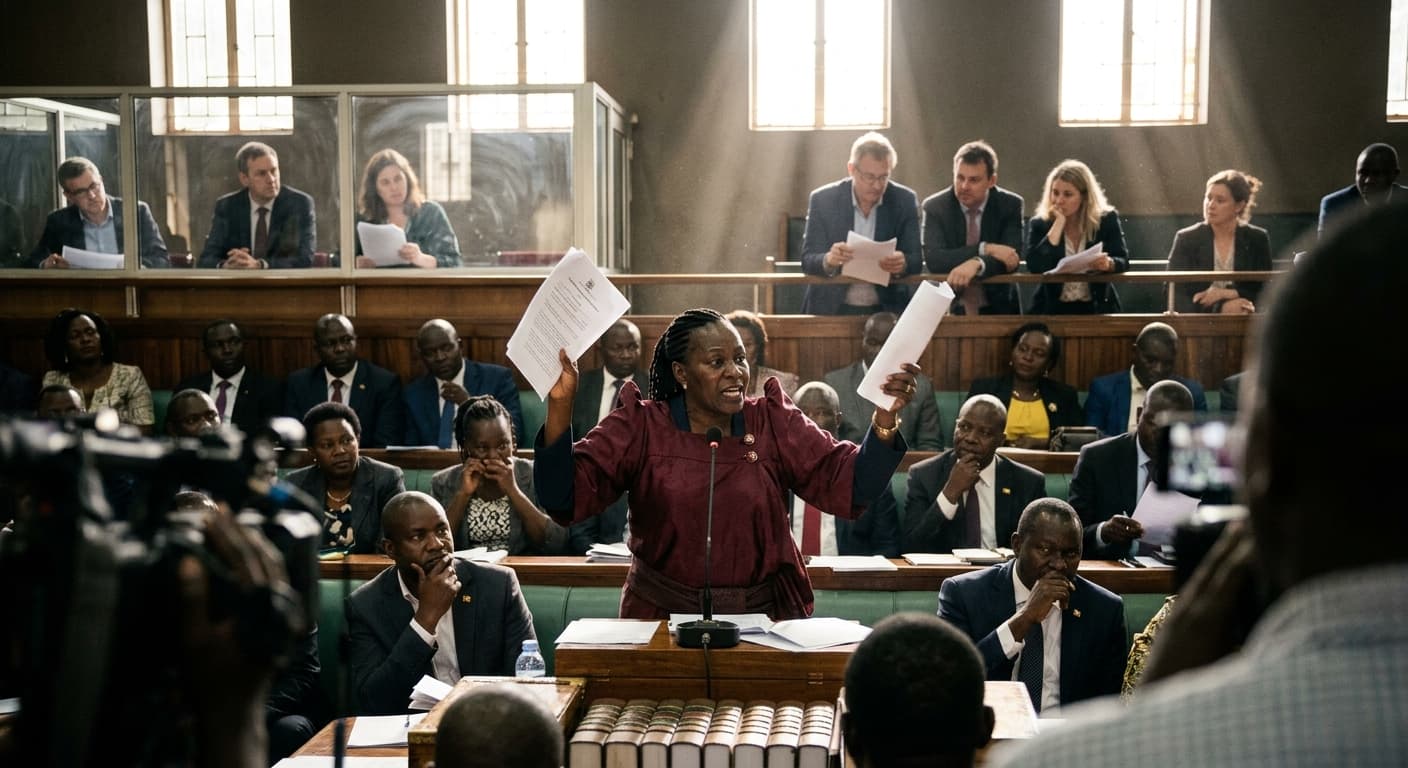
Uganda's Sovereignty Bill Is Kampala's New Foreign Policy Doctrine — In Law
A sovereignty bill, a seventh term, and a flurry of bilateral deals reveal how Museveni is codifying his security-first foreign policy into domestic law — and what that means for donors, neighbors, and the UN.
On April 15, Uganda's Parliament formally introduced the Protection of Sovereignty Bill, 2026 — legislation that would require any individual or entity "acting on behalf of foreign interests" to register with the government, disclose funding sources, and submit to oversight by the security apparatus. Violators face criminal penalties yet to be determined in committee Ghana News Agency. The bill's broad definition of "agent of a foreigner" — anyone under the "direction, control, or funding" of a foreign entity, directly or indirectly — gives State House a legal instrument to regulate virtually any foreign-linked activity in Uganda.
This is not a standalone development. It is the domestic legal expression of a foreign policy that the Model Diplomat dossier on Uganda describes as "presidential, security-led, and region-focused," with a priority hierarchy that places regime security and border survival above all else. The bill lands at a moment when President Yoweri Museveni — sworn in on May 12 for a record seventh term after a disputed January election
Ghana News Agency — is reshaping Kampala's external relationships along three axes: tightening control over foreign influence, deepening economic integration with neighbors, and maintaining a studiously non-aligned UN voting posture.
The Doctrine Becomes Law
Uganda's foreign policy has always been made in State House, not in the Foreign Ministry. The Model Diplomat dossier makes this explicit: "President Yoweri Museveni remains the primary driver, with the government and foreign decisions heavily centered in State House; recent cabinet reshuffles reinforce limited autonomy for a formal foreign ministry." The Sovereignty Bill extends this centralization into the legal code. Minister of State for Internal Affairs Gen. David Muhoozi, who introduced the bill, framed it as a response to "illegal or undisclosed foreign funding" that "could undermine national sovereignty, security, and governance processes" Ghana News Agency.
The bill's real function is dual-purpose. On one level, it's regime maintenance: after a disputed election in which the opposition alleged "ballot-stuffing" and main rival Bobi Wine fled the country citing assassination fears Ghana News Agency, a law requiring registration of foreign-funded entities gives Kampala a tool to scrutinize — and deter — civil society and opposition groups that rely on Western donor funding. On another level, it signals to development partners that Uganda's room for external conditionality is narrowing. With aid inflows exceeding $2 billion annually, the leverage is real on both sides, but the bill tilts the asymmetry.
Who Benefits: Neighbors, Not Donors
While Kampala tightens the domestic spigot on foreign influence, it is simultaneously accelerating regional economic and security integration. On May 10–12, DRC President Félix Tshisekedi traveled to Kampala for the 9th session of the Uganda-DRC Joint Standing Committee and to attend Museveni's inauguration. The two sides signed six memoranda covering tourism, ICT, trade, one-stop border posts, culture, youth affairs, and civil aviation search-and-rescue ACP.
The defense relationship is even more consequential. Uganda's Operation Shujaa — a joint military campaign with the Congolese army against the Allied Democratic Forces (ADF) in eastern DRC since November 2021 — continues to deepen. In June 2025, Ugandan Chief of Staff Gen. Muhoozi Kainerugaba and his Congolese counterpart signed an updated memorandum on joint operations, intelligence sharing, and training ACP. This is the security-first logic of the dossier in action: eastern DRC is Uganda's core security concern, and the military-diplomatic channel around it operates largely outside the formal foreign ministry structure.
Trade tells the same story. In February 2026, Kenya and Uganda resolved to eliminate non-tariff barriers at Malaba, Busia, Suam, and Lwakhakha border crossings, following a direct directive from Presidents Ruto and Museveni Kenya News Agency. Uganda also held Joint Ministerial Commission meetings with Ethiopia in April and August 2025, signing agreements on trade, infrastructure, and transboundary water cooperation
ENA. The pattern is consistent: bilateralism, presidential summitry, and an explicit focus on market access for a landlocked economy.
The UN Voting Record: Non-Aligned, in Practice
Uganda's UN voting pattern confirms the dossier's characterization of a "Pan-African, non-aligned, and integrationist" stance. On the February 2025 General Assembly resolution condemning Russia's invasion of Ukraine, Uganda abstained — alongside 64 other states — rather than voting with either the Western bloc or Russia's 18 supporters Al Jazeera. On Gaza, Uganda voted with the overwhelming majority: for the December 2024 permanent ceasefire resolution (158-9), for the September 2024 resolution demanding an end to Israeli occupation (124-14), and for the December 2025 resolution demanding humanitarian access to Gaza (139-12)
Al Jazeera
Al Jazeera
Al Jazeera. Uganda also voted yes on the March 2026 slavery reparations resolution
NPR and the May 2026 resolution endorsing the ICJ's climate obligations ruling
Al Jazeera.
The through-line: Kampala aligns with the African and Global South consensus, stays conspicuously neutral where great-power competition is at stake, and never isolates itself from the majority. This is pragmatic — Uganda needs both Western aid and Chinese investment, and its BRICS partner status (effective January 2025) adds another layer of hedging.
What to Watch Next
The Sovereignty Bill now sits with the Committee on Defence and Internal Affairs for scrutiny and possible amendments. The speed at which it moves — and how broad the final definition of "agent of a foreigner" remains — will determine whether Western donors treat it as a manageable irritant or a relationship-altering event. Simultaneously, Uganda's deepening security partnership with the DRC faces a stress test: the 10th Joint Standing Committee is scheduled for Kinshasa in May 2028, but the operational tempo of Operation Shujaa will set the tone long before then. And Museveni, now 81 and constitutionally locked in until 2031, has signaled that the succession question — always the third rail of Ugandan politics — will be managed through the same centralized, security-first apparatus that governs everything else.
Discover more

US Politics
SNAP Food Assistance Faces Legal Challenges
In 2026, SNAP faces stricter eligibility rules and mounting legal challenges, threatening food assistance for the millions of Americans who rely on the program.
India
Rajnath Singh's Durga Squad for 2026 Polls
Rajnath Singh's Durga Squad promised women's safety in Bengal but has since disappeared from the agenda, revealing BJP's true priorities.
India
700 Activists Accuse PM Modi of MCC Breach
Over 700 activists allege PM Modi breached election code with a televised address attacking opposition parties just before state elections.

Conflict & Security
Drone Warfare Killing Aid Workers at Unprec
Over 1,000 humanitarian workers killed in three years as cheap armed drones collapse legal protections. Gaza, Sudan, Ukraine, and DRC see deliberate targeting of aid convoys and hospitals with zero prosecutions.