UAE Fujairah Strike
The May 4 attack accelerates UAE's oil export plans.
Model Diplomat7 min readMiddle East

UAE Fujairah Strike: Why Iran's May 4 Attack Reshaped Gulf Oil
The May 4, 2026 Iranian drone strike on Fujairah wounded three Indians, ignited an ADNOC-linked terminal, and accelerated the UAE's plan to route oil around the Strait of Hormuz — permanently.
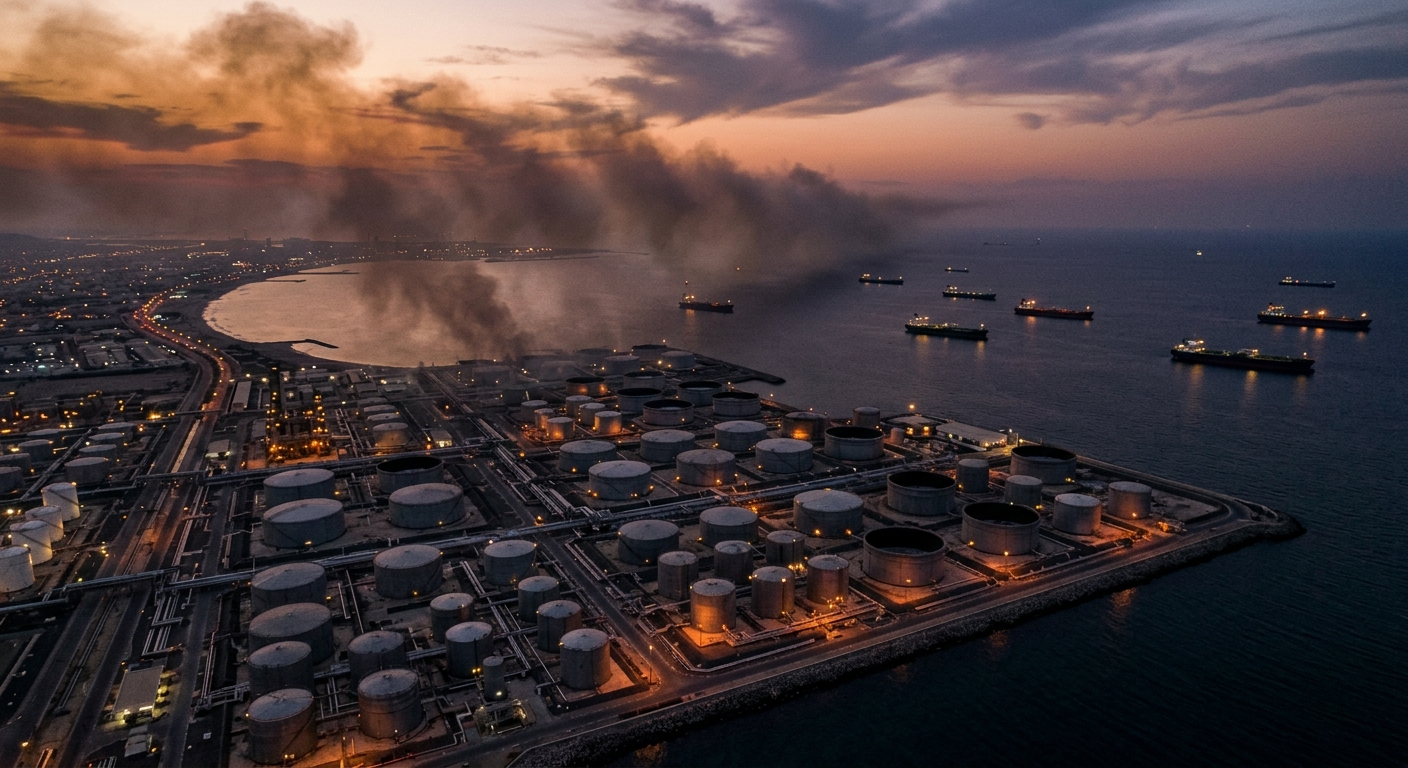
At 05:00 GMT on May 4, 2026, a drone launched from Iran punched into the Fujairah Petroleum Industries Zone on the UAE's eastern coast, setting a fuel terminal ablaze and wounding three Indian workers. The strike, part of a barrage the UAE said involved 12 ballistic missiles, three cruise missiles and four drones, was the first hit on Emirati soil since the April 8 ceasefire in the US-Israel war on Iran. The lasting consequence is not the fire — it is that Abu Dhabi is now hard-wiring an oil export architecture designed to make the Strait of Hormuz optional, and Iran itself supplied the political cover to build it. That shift will outlive the war, outlive OPEC+ discipline, and outlive Iran's leverage over global crude.
What actually hit, and who owns it
The target was the VTTI terminal inside the Fujairah Oil Industry Zone, co-owned by IFM Global Infrastructure Fund, Vitol Group and the Abu Dhabi National Oil Company (ADNOC), according to Offshore Technology. The Fujairah Government Media Office confirmed the same day that civil defence teams had contained the blaze, per
Sharjah 24. India's Ministry of External Affairs called the wounding of its nationals "unacceptable," a rare public rebuke of Tehran from New Delhi and one
NDTV reported was delivered through both public and private channels.
The UAE Ministry of Foreign Affairs condemned what it called "renewed terrorist, unprovoked Iranian attacks targeting civilian sites and facilities," per Al Jazeera, and reserved the right to respond. Iran's IRGC, in a statement carried by Fars News, denied responsibility outright. An unnamed Iranian military commander on state broadcaster IRIB blamed "US military adventurism" tied to Trump's Project Freedom, a one-day operation to escort stranded tankers out of the strait that Washington abandoned within 24 hours. Emirati officials rejected that framing;
BBC News reported Brent crude jumped past $115 a barrel within hours of the fire.
Why Fujairah, and why now
Fujairah is not just another oil port. It sits on the Gulf of Oman, outside the Strait of Hormuz, and is the sea terminus of the Abu Dhabi Crude Oil Pipeline (ADCOP), also known as the Habshan-Fujairah line. The 380-kilometre pipeline has a nameplate capacity of 1.5 million barrels per day, but was carrying 1.7–1.8 million bpd during the war, above nameplate, according to Argus Media. Kpler data reported by
Al Jazeera showed Fujairah exports averaged 1.62 million bpd in March 2026, up from 1.17 million bpd in February — a 38 percent jump in a single month as the strait closed.
That is the leverage Iran was aiming to break. With Hormuz effectively blockaded since February 28, when US-Israeli strikes on Iran began, Fujairah became the UAE's dominant crude export valve and its principal source of foreign-exchange inflows. The Center for Strategic and International Studies estimates the port normally handles roughly one-third of the UAE's 3 million bpd export volume; CSIS analysis notes that in a full Hormuz closure, Fujairah is one of the few pipes globally capable of moving Gulf barrels to Asian buyers without transiting Iranian-controlled waters. Fujairah is also the world's second-largest bunkering hub after Singapore, per the
UK government — a chokepoint of its own.
Hit Fujairah, and you close the last exit door. That was the logic. It failed.
The primary document: UNSCR 2817 and the diplomatic pincer
The most consequential outcome of the May 4 strike was not military but institutional. The UAE, working with GCC partners, drove the adoption of United Nations Security Council Resolution 2817 (2026), which the UN press office describes as condemning Iran's "egregious attacks" against its neighbours. The resolution was co-sponsored by 136 countries — extraordinary in a fractured Security Council — and its text is
available at the UN document portal.
An earlier Bahrain-US draft on Hormuz specifically had been blocked on April 7 by Russian and Chinese vetoes, with 11 in favour, per UN News. Russia's Ambassador Vassily Nebenzia argued the draft presented Iran as "the sole source of regional tensions." Resolution 2817 rerouted around that veto by framing the issue as a threat to civilian infrastructure and global food and energy supply chains — a framing the UAE then leveraged at the FAO Council, where an Emirati-led initiative secured a formal condemnation, per the
UAE Ministry of Foreign Affairs. Assistant Minister Abdulla Balalaa argued that "the safety of global food and energy supply chains cannot be separated from the security of vital maritime routes."
The MFA statement quantifies why Fujairah's protection is not just an Emirati concern: roughly one-fifth of the world's energy, 25 percent of global gas flows, "nearly 70 per cent of petrochemical needs, and approximately 30 per cent of the fertilizers essential for global food production" transit the strait daily. Reframing Iran's campaign as a food-security violation isolated Tehran from developing-country partners who had otherwise been sympathetic on sanctions.
The unexpected beneficiary: ADNOC's balance sheet
Within 11 days of the Fujairah strike, Abu Dhabi Crown Prince Sheikh Khaled bin Mohamed bin Zayed ordered ADNOC to accelerate the West-East 1 Pipeline, a new line designed to double the UAE's Hormuz-bypass export capacity, according to Al Jazeera.
Energy Intelligence had earlier reported the new pipeline would carry 1.5 million bpd of additional crude, targeting operations by 2027.
OilPrice.com notes the timing lines up with the UAE's exit from OPEC after nearly 60 years and its target of 5 million bpd of production capacity by 2027.
Read that in reverse. The Fujairah strike accelerated a project Abu Dhabi had wanted anyway. Iran, in trying to punish the UAE for hosting American military infrastructure, has permanently reduced the strategic value of its own chokepoint. Every additional barrel the West-East 1 pipeline moves after 2027 is a barrel over which the IRGC has no veto. The CSIS baseline — that Gulf pipelines can only reroute a fraction of Hormuz volumes — will need revising downward as Saudi Aramco's East-West line, ADNOC's ADCOP and now West-East 1 collectively raise the non-Hormuz export ceiling.
The losers, in order: Iran, which loses its structural leverage over Asian buyers; OPEC+ discipline, which the UAE has already exited; and the shipping insurance premium at Bandar Abbas.
What the market has already priced in
By July 2, 2026 — six weeks after the strike and two weeks after the US-Iran memorandum of understanding signed on June 17 — Brent futures for September delivery closed at $72, below the $72.48 settlement on February 27, the day before the war began, per Al Jazeera's markets desk. Brent had briefly topped $126 in April. Traffic through Hormuz, though, remains structurally impaired: MarineTraffic data cited by Al Jazeera recorded 38 transits on July 2 versus a pre-war baseline of about 130.
BBC Verify counted 172 vessels crossing the strait between June 18 and late June, with 42 on a single day, still 70 percent below the pre-war average of 138 daily transits. Iran's Persian Gulf Strait Authority requires transit permits; the IRGC has already re-closed the waterway twice since the ceasefire. The Joint Maritime Information Center has warned of at least two mines in central shipping lanes and is directing traffic to a narrower southern corridor along Oman's coast.
Ali Vaez, Iran Project director at the International Crisis Group, told Al Jazeera that "the US is trying to loosen Iran's chokehold upon the Strait of Hormuz while Iran remains determined to push back." Trita Parsi at the Quincy Institute framed it more starkly: Tehran sees Washington's approach as an attempt to impose "what Israel has created in Gaza" — a unilateral ceasefire it does not really control.
That is the tension June's MoU papered over. It has not resolved it.
Diplomat View
Iran's May 4 strike on Fujairah was tactically successful and strategically self-defeating. It wounded three Indians, ignited a Vitol-ADNOC-IFM terminal, and briefly shocked Brent above $115. It also produced Security Council Resolution 2817, a 136-country diplomatic coalition against Iran's Gulf posture, and an accelerated ADNOC pipeline that will strip Tehran of roughly 1.5 million bpd of Hormuz leverage by 2027. The forecast: the UAE's Fujairah-centred export architecture is now a permanent feature of Gulf oil, not a wartime workaround. What would change that call is a Chinese or Russian move to block ADNOC's Hormuz-bypass financing at the Security Council under the guise of "regional balance," or a decisive Iranian concession on strait transit tolls that restores pre-war insurance premiums. Absent either, the strategic value of Iranian coastline just fell — and the value of Emirati coastline just doubled. The 60-day MoU window closes on August 16, 2026. That is the date that matters.
What to watch next
- August 16, 2026 — The 60-day US-Iran MoU expires; failure to convert it into a permanent deal reopens the Hormuz closure risk and re-prices Fujairah upward.
- August 2, 2026 — Next OPEC+ ministerial meeting reviews the fifth consecutive production increase; UAE quota flexibility is the tell.
- 2027 commissioning of ADNOC's West-East 1 pipeline — the moment Fujairah's Hormuz-bypass capacity structurally exceeds Iran's blocking power.
Related coverage: Global Politics.
Discover more

Global Politics
US Seizes Iranian Ship, Tensions Surge
The US seizure of the Iranian ship Touska highlights a shift in control over the Strait of Hormuz, favoring Iran's strategic position.

Conflict & Security
Drone Warfare Killing Aid Workers at Unprec
Over 1,000 humanitarian workers killed in three years as cheap armed drones collapse legal protections. Gaza, Sudan, Ukraine, and DRC see deliberate targeting of aid convoys and hospitals with zero prosecutions.

Global
World Normalises Taliban as Afghan Women Eras
UN data shows Afghan women erased from public life as Russia recognises the Taliban, EU hosts officials in Brussels, and ICC warrants for gender persecution go unenforced.
Conflict & Security
West Africa Food Crisis: Three Shocks in 2026
Conflict, climate extremes, and the Strait of Hormuz closure drive a severe food crisis in West and Central Africa, with fertilizer prices surging 80% and millions displaced.