Governor's Power Play in Tamil Nadu Politics
A power struggle unfolds in Tamil Nadu's political landscape.
Model Diplomat3 min readAsia
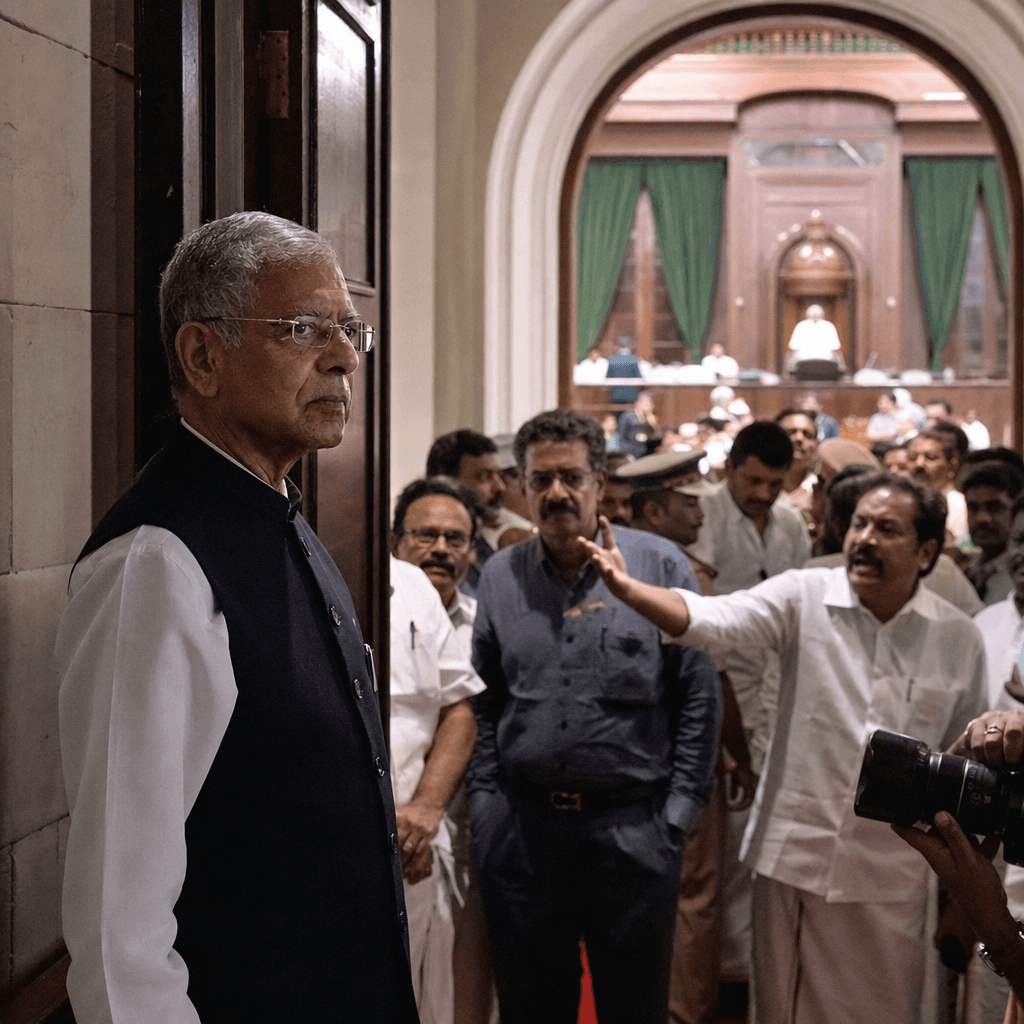
TVK’s claim exposes Governor’s leverage in Tamil Nadu
Vijay has the numbers advantage of a single largest party, but Raj Bhavan controls the sequence — and that gives Governor Arlekar time to force a floor-test path or edge toward President’s Rule.
Tamil Nadu’s new power struggle is now about who gets to define majority support first. Governor Rajendra Vishwanath Arlekar has asked Tamilaga Vettri Kazhagam president C. Joseph Vijay to produce letters of support from 118 MLAs before being invited to form the government, even though TVK has emerged as the single largest party with 108 seats in the 234-member Assembly, according to The Hindu. Vijay met the Governor after staking his claim on Wednesday, while the Assembly was dissolved with effect from May 5, 2026,
The Hindu reported.
The Governor is using procedure as power
The immediate fight is not over ideology; it is over the order of operations. The constitutional convention, as laid out in the Sarkaria and Punchhi reports and reiterated by the Supreme Court, puts the largest party first when no pre-poll alliance has a majority, but it also lets a Governor satisfy himself that a claimant can actually command the House, The Federal said. That is why Arlekar’s insistence on proof of 118 matters: it delays an invitation and keeps the burden on Vijay to assemble a working majority before he is sworn in,
The Hindu said.
The political arithmetic is still loose. The Hindu reported that the Congress, which won five seats as part of the DMK alliance, has backed TVK; AIADMK has denied support; CPI(M), CPI and VCK are still holding internal consultations; and IUML has already said no, The Hindu.
The HinduBusinessLine added that the TVK-Congress alignment is still short of the majority mark and that VCK and CPI leaders are publicly urging the Governor to let Vijay prove his strength on the Assembly floor.
Why President’s Rule is the real shadow
This is where the leverage sits. The Governor’s demand is not just bureaucratic caution; it is a signal that if no claimant can prove a majority, the next stop is constitutional failure, and eventually President’s Rule under Article 356, The Hindu said. But the Supreme Court’s Bommai line is clear: majority is to be tested on the floor of the House, not in Raj Bhavan, and the Governor cannot use Article 356 as a partisan tool,
The Federal noted.
That cuts both ways. If Arlekar overplays his hand, he invites litigation and a charge that Raj Bhavan is trying to manage the outcome rather than the process. If he moves too slowly, he risks appearing to sit on a hung House until defections, bargaining, or a destabilising interim arrangement produce a more favourable result. Either way, the Governor, not the parties, now controls the tempo. For the old DMK-AIADMK duopoly, that is a loss of narrative control; for TVK, it is a chance to turn a fragmented verdict into a governing coalition. For readers tracking this across India, the deeper point is that hung-assembly politics in a big state immediately becomes a contest over constitutional timing, not just seat counts.
What to watch next
The next decision point is whether Arlekar invites Vijay to form the government and sets an early floor test, or keeps demanding proof before swearing-in. The crucial date is the moment the Governor has to decide whether he has enough political and legal cover to move forward without triggering a challenge. If TVK cannot close the gap quickly, the shadow of President’s Rule will stop being rhetorical and become the governing threat.
Discover more
India
CPI MP Accuses PM Modi of MCC Violations
CPI MP P Sandosh Kumar alleges PM Modi violated MCC during Tamil Nadu visit, raising serious election integrity issues ahead of 2026 Assembly elections.
India
BJP Congress Clash Over MP Bill Defeat
The defeat of a Constitution Amendment Bill in Madhya Pradesh sparks a fierce clash between BJP and Congress, highlighting political tensions ahead of 2027 elections.
India
Women’s Reservation Bill 2026
The Women’s Reservation Bill's defeat reveals a deeper battle over delimitation, impacting India's electoral landscape and gender representation.
India
India Rejects Zardari's Mosque Comments
India's MEA rebukes Zardari's mosque comments, citing Pakistan's human rights record.